DR CHITTIBABU KT
R0R1 R2 D1 D2 D3D4
ROUX ENYBILROTH 1
BILROTH 2
 Resection Classification
 The R classification system indicates the amount
of residual disease left after tumor resection.
 R0 indicates no gross or microscopic residual
disease;
 R1 indicates microscopic residual disease, and
 R2 signifies gross residual disease.
 Surgeons should wait for the final pathology
results before completing their operative
summaries so that patient records include the R
classification for the gastrectomy.
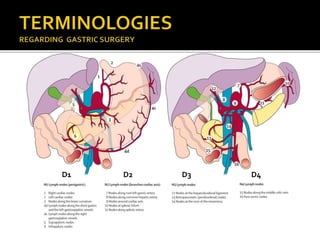
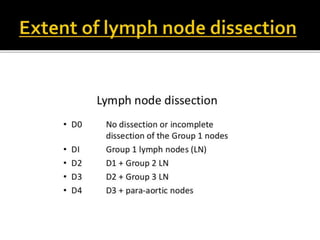
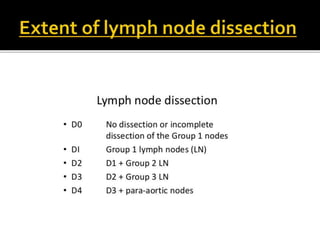
 Dissection classification: D1 D2 D3 D4
 Lymph node stations :
 The Japanese Research Society for Gastric Cancer
has numbered the lymph node stations that
potentially drain the stomach
D1 D4D3D2
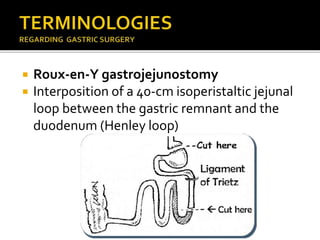
 Roux-en-Y gastrojejunostomy
 Interposition of a 40-cm isoperistaltic jejunal
loop between the gastric remnant and the
duodenum (Henley loop)
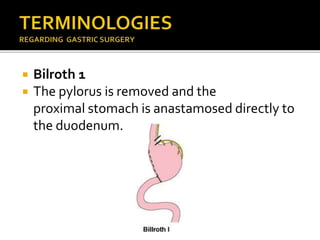
 Bilroth 1
 The pylorus is removed and the
proximal stomach is anastamosed directly to
the duodenum.
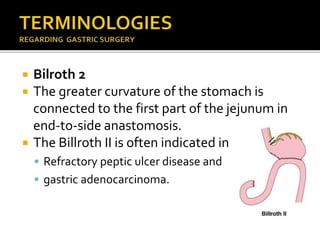
 Bilroth 2
 The greater curvature of the stomach is
connected to the first part of the jejunum in
end-to-side anastomosis.
 The Billroth II is often indicated in
 Refractory peptic ulcer disease and
 gastric adenocarcinoma.
 OG JUNCTION & PROXIMAL
 MIDDLE
 DISTAL
 EXTENT OF LYMPHADENECTOMY
 RECONSTRUCTION
 PALLIATION
 For the best chance at curing a patient from
gastric cancer, surgical resection remains the
first-line therapy.
 The goal of curative surgical treatment is
resection of all tumor (i.e., R0 resection).
 Thus, all margins (proximal, distal, and radial)
should be negative and an adequate
lymphadenectomy performed.
 Generally, the surgeon strives for a grossly
negative margin of at least 5 cm.
 Some gastric tumors, particularly the diffuse
variety, are quite infiltrative and tumor cells
can extend well beyond the tumor mass;
thus, gross margins beyond 5 cm may be
desirable.
 Classification of Esophagogastric Junction
Cancers
 Siewert and Stein classification system for
adenocarcinoma of the esophagogastric
junction
 Type 1: Adenocarcinoma of the distal esophagus,
which usually arises from an area with specialized
intestinal metaplasia of the esophagus (i.e., Barrett's
esophagus) and may infiltrate the esophagogastric
junction from above;
 Type II: Adenocarcinoma of the cardia, which arises
from the epithelium of the cardia or from short
segments with intestinal metaplasia at the
esophagogastric junction;
 Type III: Adenocarcinoma of the subcardial stomach,
which may infiltrate the esophagogastric junction or
distal esophagus from below.
 These are most often treated with an
 Ivor-Lewis esophagogastrectomy or
 esophagectomy with gastric pull-up procedure
via the transhiatal approach.
 Surgeons trained in thoracic surgery have
frequently advocated
 a combined abdominal and thoracic procedure (often
termed esophagogastrectomy) with an intrathoracic
or cervical anastomosis between the proximal
esophagus and the distal stomach or
 a procedure termed transhiatal (or blunt)
esophagectomy (THE), which involves resection of
the esophagus and esophagogastric junction with
mediastinal dissection performed in a blunt fashion
through the esophageal hiatus of the diaphragm.
 These two types of gastric carcinomas most
often result in resection via a
 total gastrectomy.
 Most tumors occurring in the midbody of the
stomach require a total gastrectomy for
curative resection owing to the need for
negative margins.
 Although proximal tumors may require a
total gastrectomy for adequate negative
margins, distal tumors often only need a
subtotal gastrectomy for surgical resection
to be successful
 Endoscopic Mucosal Resection
 Limited Surgical Resection
 Gastrectomy
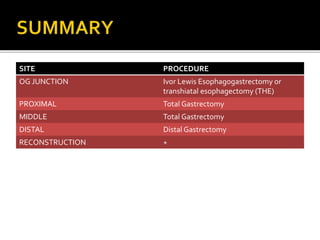
SITE PROCEDURE
OG JUNCTION Ivor Lewis Esophagogastrectomy or
transhiatal esophagectomy (THE)
PROXIMAL Total Gastrectomy
MIDDLE Total Gastrectomy
DISTAL Distal Gastrectomy
RECONSTRUCTION +
 The extent of lymph node involvement is related
to the stage of the primary tumor, with tumor
located in the
 mucosa having only a 5% chance of lymphatic
spread.
 If the tumor has reached the submucosa, the
 involvement of lymph nodes can be as high as 25%.
 Higher percentages of nodal involvement,
 greater than 90%, are associated with stage III and
IV tumors.
 The standard operation is the D2
gastrectomy, which involves a more
extensive lymphadenectomy (removal of the
D1 and D2 nodes).

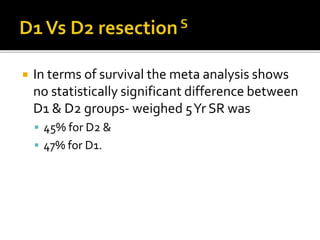
 In terms of survival the meta analysis shows
no statistically significant difference between
D1 & D2 groups- weighed 5Yr SR was
 45% for D2 &
 47% for D1.
 Overall, the D2 resections not involving
pancreaticosplenectomy were found to be
the most advantageous.
 Surgeon preference is perhaps the most
important factor in determining the
procedure for reconstruction after distal
gastrectomy.
 After Subtotal Gastrectomy
 Billroth I gastroduodenostomy,
 Billroth II gastrojejunostomy, and
 Roux-en-Y gastrojejunostomy.
 AfterTotal Gastrectomy
 Roux-en-Y esophagojejunostomy,
 Jejunal interposition
 Pouch reconstruction.
 Billroth I gastroduodenostomy,
 We do not generally recommend a Billroth I
gastroduodenostomy for malignant disease
resections.
 Billroth II gastrojejunostomy
 Billroth II can be employed if the resection of the
distal stomach leaves a large enough gastric
remnant.
 Roux-en-Y gastrojejunostomy.
 Roux-en-Y gastrojejunostomy has become a
popular choice owing to the ability to use a
smaller gastric remnant with
▪ better bile reflux control and
▪ less postoperative dumping syndrome observed.
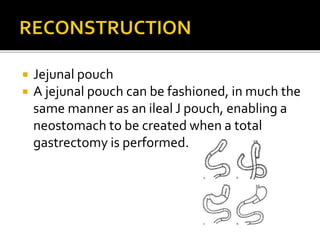
 Jejunal pouch
 A jejunal pouch can be fashioned, in much the
same manner as an ileal J pouch, enabling a
neostomach to be created when a total
gastrectomy is performed.
 A variety of disorders may occur after gastric
resection that are greatly influenced by the
type of reconstruction performed to
reestablishGI continuity.
 By far, the majority of problems develop in
patients who have previously undergone a
Billroth II gastrectomy.
 BILE REFLUX GASTRITIS
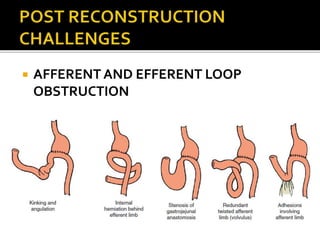
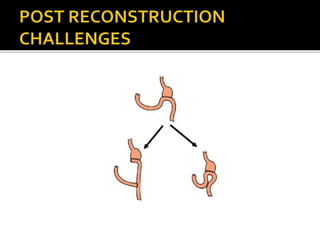
 AFFERENT AND EFFERENT LOOP
OBSTRUCTION
 JEJUNOGASTRIC INTUSSUSCEPTION
 THE ROUX SYNDROME
 BILE REFLUX GASTRITIS
 Bile reflux commonly occurs after gastric surgery
regardless of the procedure performed.
 Bile in the stomach on endoscopic examination is
often seen when the pyloric sphincter has been
ablated or resected;
 it is even more commonly encountered if a
portion of the distal part of the stomach has been
resected, regardless of whether a Billroth I or
Billroth II reconstruction has been fashioned.
 BILE REFLUX GASTRITIS
 In a small subset of patients such reflux is
associated with
▪ marked, unrelenting epigastric pain,
▪ nausea,
▪ bilious vomiting, and
▪ quantitative evidence of excessive enterogastric reflux.
 BILE REFLUX GASTRITIS
 Medical treatment, including
 acid secretory inhibitors,
 anticholinergic drugs, and
 cholestyramine
 Patients with unrelenting or intractable
symptoms can be managed with surgery.
 BILE REFLUX GASTRITIS
 These procedures include conversion to a
 Roux-en-Y gastrojejunostomy
 BILE REFLUX GASTRITIS
 AFFERENT AND EFFERENT LOOP
OBSTRUCTION
 JEJUNOGASTRIC INTUSSUSCEPTION
 THE ROUX SYNDROME
 BILE REFLUX GASTRITIS
 AFFERENT AND EFFERENT LOOP
OBSTRUCTION
 JEJUNOGASTRIC INTUSSUSCEPTION
 THE ROUX SYNDROME
 AFFERENT AND EFFERENT LOOP
OBSTRUCTION
 Afferent loop obstruction, known as the
afferent loop syndrome, is a mechanical
problem resulting from the inability of this
loop to empty its contents.
 AFFERENT AND EFFERENT LOOP
OBSTRUCTION
 THE ROUX SYNDROME
 Occasionally, a patient who has undergone
distal gastrectomy with a Roux-en-Y
reconstruction will have difficulty with gastric
emptying along with the symptoms of
 gastric vomiting,
 epigastric pain, and
 weight loss.
 THE ROUX SYNDROME
 Endoscopically, the gastric remnant may be
dilated, as well as the Roux limb, but no
evidence of mechanical obstruction can be
identified on CT or upper GI series.
 The only significant finding with this latter study
is a delay in gastric emptying.
 This constellation of clinical findings has been
called the Roux syndrome or the Roux stasis
 syndrome.
 THE ROUX SYNDROME
 The cause of this syndrome appears to be an
abnormality in motility.
 This disordered motility appears to occur in
all patients after this procedure, but why the
Roux syndrome develops in only a small
subset remains unknown.
 THE ROUX SYNDROME
 Endoscopically, the gastric remnant may be
dilated, as well as the Roux limb, but no
evidence of mechanical obstruction can be
identified on CT or upper GI series.
 The only significant finding with this latter study
is a delay in gastric emptying.
 This constellation of clinical findings has been
called the Roux syndrome or the Roux stasis
 syndrome.
 PalliativeChemotherapy
 Palliative Surgery
 Palliative Radiotherapy
 Half of patients diagnosed with gastric
adenocarcinoma are in need of palliation
rather than curative resection at the time of
presentation.
 For patients with advanced cancer, the two most
commonly used surgical techniques for
palliation are
 Resection and
 Bypass
 Although resection may offer a greater chance
at disease-free survival, the specific
circumstances of each patient may dictate the
need for bypass.
 However, some patients may be unable to
tolerate, both anatomically and physically, a
resection and the need for a gastrojejunal
bypass procedure could be required.
 If performance status is acceptable, palliative
chemotherapy can be used to help patients
with advanced disease.
 Multiagent regimens, much the same as
those used for nonpalliative patients, can be
used.
 Survival can be improved by up to 6 months
with the use of chemotherapy when
compared to supportive measures.
 Unfortunately, because of the presence of
node-positive disease, radiotherapy has a
limited role in the palliative setting..
 Current trials are under way to evaluate the
long-term outcomes of using neoadjuvant
chemoradiation in the setting of gastric
adenocarcinoma.
Carcinoma Stomach

Carcinoma Stomach

  • 1.
  • 2.
    R0R1 R2 D1D2 D3D4 ROUX ENYBILROTH 1 BILROTH 2
  • 3.
     Resection Classification The R classification system indicates the amount of residual disease left after tumor resection.  R0 indicates no gross or microscopic residual disease;  R1 indicates microscopic residual disease, and  R2 signifies gross residual disease.  Surgeons should wait for the final pathology results before completing their operative summaries so that patient records include the R classification for the gastrectomy.
  • 4.
     Dissection classification:D1 D2 D3 D4  Lymph node stations :  The Japanese Research Society for Gastric Cancer has numbered the lymph node stations that potentially drain the stomach
  • 5.
  • 7.
     Roux-en-Y gastrojejunostomy Interposition of a 40-cm isoperistaltic jejunal loop between the gastric remnant and the duodenum (Henley loop)
  • 8.
     Bilroth 1 The pylorus is removed and the proximal stomach is anastamosed directly to the duodenum.
  • 9.
     Bilroth 2 The greater curvature of the stomach is connected to the first part of the jejunum in end-to-side anastomosis.  The Billroth II is often indicated in  Refractory peptic ulcer disease and  gastric adenocarcinoma.
  • 11.
     OG JUNCTION& PROXIMAL  MIDDLE  DISTAL  EXTENT OF LYMPHADENECTOMY  RECONSTRUCTION  PALLIATION
  • 12.
     For thebest chance at curing a patient from gastric cancer, surgical resection remains the first-line therapy.
  • 13.
     The goalof curative surgical treatment is resection of all tumor (i.e., R0 resection).  Thus, all margins (proximal, distal, and radial) should be negative and an adequate lymphadenectomy performed.
  • 14.
     Generally, thesurgeon strives for a grossly negative margin of at least 5 cm.  Some gastric tumors, particularly the diffuse variety, are quite infiltrative and tumor cells can extend well beyond the tumor mass; thus, gross margins beyond 5 cm may be desirable.
  • 15.
     Classification ofEsophagogastric Junction Cancers  Siewert and Stein classification system for adenocarcinoma of the esophagogastric junction
  • 16.
     Type 1:Adenocarcinoma of the distal esophagus, which usually arises from an area with specialized intestinal metaplasia of the esophagus (i.e., Barrett's esophagus) and may infiltrate the esophagogastric junction from above;  Type II: Adenocarcinoma of the cardia, which arises from the epithelium of the cardia or from short segments with intestinal metaplasia at the esophagogastric junction;  Type III: Adenocarcinoma of the subcardial stomach, which may infiltrate the esophagogastric junction or distal esophagus from below.
  • 17.
     These aremost often treated with an  Ivor-Lewis esophagogastrectomy or  esophagectomy with gastric pull-up procedure via the transhiatal approach.
  • 18.
     Surgeons trainedin thoracic surgery have frequently advocated  a combined abdominal and thoracic procedure (often termed esophagogastrectomy) with an intrathoracic or cervical anastomosis between the proximal esophagus and the distal stomach or  a procedure termed transhiatal (or blunt) esophagectomy (THE), which involves resection of the esophagus and esophagogastric junction with mediastinal dissection performed in a blunt fashion through the esophageal hiatus of the diaphragm.
  • 19.
     These twotypes of gastric carcinomas most often result in resection via a  total gastrectomy.
  • 20.
     Most tumorsoccurring in the midbody of the stomach require a total gastrectomy for curative resection owing to the need for negative margins.
  • 21.
     Although proximaltumors may require a total gastrectomy for adequate negative margins, distal tumors often only need a subtotal gastrectomy for surgical resection to be successful
  • 22.
     Endoscopic MucosalResection  Limited Surgical Resection  Gastrectomy
  • 23.
    SITE PROCEDURE OG JUNCTIONIvor Lewis Esophagogastrectomy or transhiatal esophagectomy (THE) PROXIMAL Total Gastrectomy MIDDLE Total Gastrectomy DISTAL Distal Gastrectomy RECONSTRUCTION +
  • 24.
     The extentof lymph node involvement is related to the stage of the primary tumor, with tumor located in the  mucosa having only a 5% chance of lymphatic spread.  If the tumor has reached the submucosa, the  involvement of lymph nodes can be as high as 25%.  Higher percentages of nodal involvement,  greater than 90%, are associated with stage III and IV tumors.
  • 25.
     The standardoperation is the D2 gastrectomy, which involves a more extensive lymphadenectomy (removal of the D1 and D2 nodes). 
  • 26.
     In termsof survival the meta analysis shows no statistically significant difference between D1 & D2 groups- weighed 5Yr SR was  45% for D2 &  47% for D1.
  • 27.
     Overall, theD2 resections not involving pancreaticosplenectomy were found to be the most advantageous.
  • 28.
     Surgeon preferenceis perhaps the most important factor in determining the procedure for reconstruction after distal gastrectomy.
  • 29.
     After SubtotalGastrectomy  Billroth I gastroduodenostomy,  Billroth II gastrojejunostomy, and  Roux-en-Y gastrojejunostomy.  AfterTotal Gastrectomy  Roux-en-Y esophagojejunostomy,  Jejunal interposition  Pouch reconstruction.
  • 30.
     Billroth Igastroduodenostomy,  We do not generally recommend a Billroth I gastroduodenostomy for malignant disease resections.
  • 31.
     Billroth IIgastrojejunostomy  Billroth II can be employed if the resection of the distal stomach leaves a large enough gastric remnant.
  • 32.
     Roux-en-Y gastrojejunostomy. Roux-en-Y gastrojejunostomy has become a popular choice owing to the ability to use a smaller gastric remnant with ▪ better bile reflux control and ▪ less postoperative dumping syndrome observed.
  • 33.
     Jejunal pouch A jejunal pouch can be fashioned, in much the same manner as an ileal J pouch, enabling a neostomach to be created when a total gastrectomy is performed.
  • 34.
     A varietyof disorders may occur after gastric resection that are greatly influenced by the type of reconstruction performed to reestablishGI continuity.  By far, the majority of problems develop in patients who have previously undergone a Billroth II gastrectomy.
  • 35.
     BILE REFLUXGASTRITIS  AFFERENT AND EFFERENT LOOP OBSTRUCTION  JEJUNOGASTRIC INTUSSUSCEPTION  THE ROUX SYNDROME
  • 36.
     BILE REFLUXGASTRITIS  Bile reflux commonly occurs after gastric surgery regardless of the procedure performed.  Bile in the stomach on endoscopic examination is often seen when the pyloric sphincter has been ablated or resected;  it is even more commonly encountered if a portion of the distal part of the stomach has been resected, regardless of whether a Billroth I or Billroth II reconstruction has been fashioned.
  • 37.
     BILE REFLUXGASTRITIS  In a small subset of patients such reflux is associated with ▪ marked, unrelenting epigastric pain, ▪ nausea, ▪ bilious vomiting, and ▪ quantitative evidence of excessive enterogastric reflux.
  • 38.
     BILE REFLUXGASTRITIS  Medical treatment, including  acid secretory inhibitors,  anticholinergic drugs, and  cholestyramine  Patients with unrelenting or intractable symptoms can be managed with surgery.
  • 39.
     BILE REFLUXGASTRITIS  These procedures include conversion to a  Roux-en-Y gastrojejunostomy
  • 40.
     BILE REFLUXGASTRITIS  AFFERENT AND EFFERENT LOOP OBSTRUCTION  JEJUNOGASTRIC INTUSSUSCEPTION  THE ROUX SYNDROME
  • 41.
     BILE REFLUXGASTRITIS  AFFERENT AND EFFERENT LOOP OBSTRUCTION  JEJUNOGASTRIC INTUSSUSCEPTION  THE ROUX SYNDROME
  • 42.
     AFFERENT ANDEFFERENT LOOP OBSTRUCTION  Afferent loop obstruction, known as the afferent loop syndrome, is a mechanical problem resulting from the inability of this loop to empty its contents.
  • 43.
     AFFERENT ANDEFFERENT LOOP OBSTRUCTION
  • 45.
     THE ROUXSYNDROME  Occasionally, a patient who has undergone distal gastrectomy with a Roux-en-Y reconstruction will have difficulty with gastric emptying along with the symptoms of  gastric vomiting,  epigastric pain, and  weight loss.
  • 46.
     THE ROUXSYNDROME  Endoscopically, the gastric remnant may be dilated, as well as the Roux limb, but no evidence of mechanical obstruction can be identified on CT or upper GI series.  The only significant finding with this latter study is a delay in gastric emptying.  This constellation of clinical findings has been called the Roux syndrome or the Roux stasis  syndrome.
  • 47.
     THE ROUXSYNDROME  The cause of this syndrome appears to be an abnormality in motility.  This disordered motility appears to occur in all patients after this procedure, but why the Roux syndrome develops in only a small subset remains unknown.
  • 48.
     THE ROUXSYNDROME  Endoscopically, the gastric remnant may be dilated, as well as the Roux limb, but no evidence of mechanical obstruction can be identified on CT or upper GI series.  The only significant finding with this latter study is a delay in gastric emptying.  This constellation of clinical findings has been called the Roux syndrome or the Roux stasis  syndrome.
  • 49.
     PalliativeChemotherapy  PalliativeSurgery  Palliative Radiotherapy  Half of patients diagnosed with gastric adenocarcinoma are in need of palliation rather than curative resection at the time of presentation.
  • 50.
     For patientswith advanced cancer, the two most commonly used surgical techniques for palliation are  Resection and  Bypass  Although resection may offer a greater chance at disease-free survival, the specific circumstances of each patient may dictate the need for bypass.
  • 51.
     However, somepatients may be unable to tolerate, both anatomically and physically, a resection and the need for a gastrojejunal bypass procedure could be required.
  • 52.
     If performancestatus is acceptable, palliative chemotherapy can be used to help patients with advanced disease.  Multiagent regimens, much the same as those used for nonpalliative patients, can be used.  Survival can be improved by up to 6 months with the use of chemotherapy when compared to supportive measures.
  • 53.
     Unfortunately, becauseof the presence of node-positive disease, radiotherapy has a limited role in the palliative setting..
  • 54.
     Current trialsare under way to evaluate the long-term outcomes of using neoadjuvant chemoradiation in the setting of gastric adenocarcinoma.