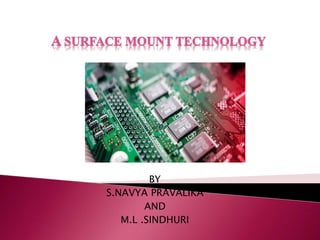
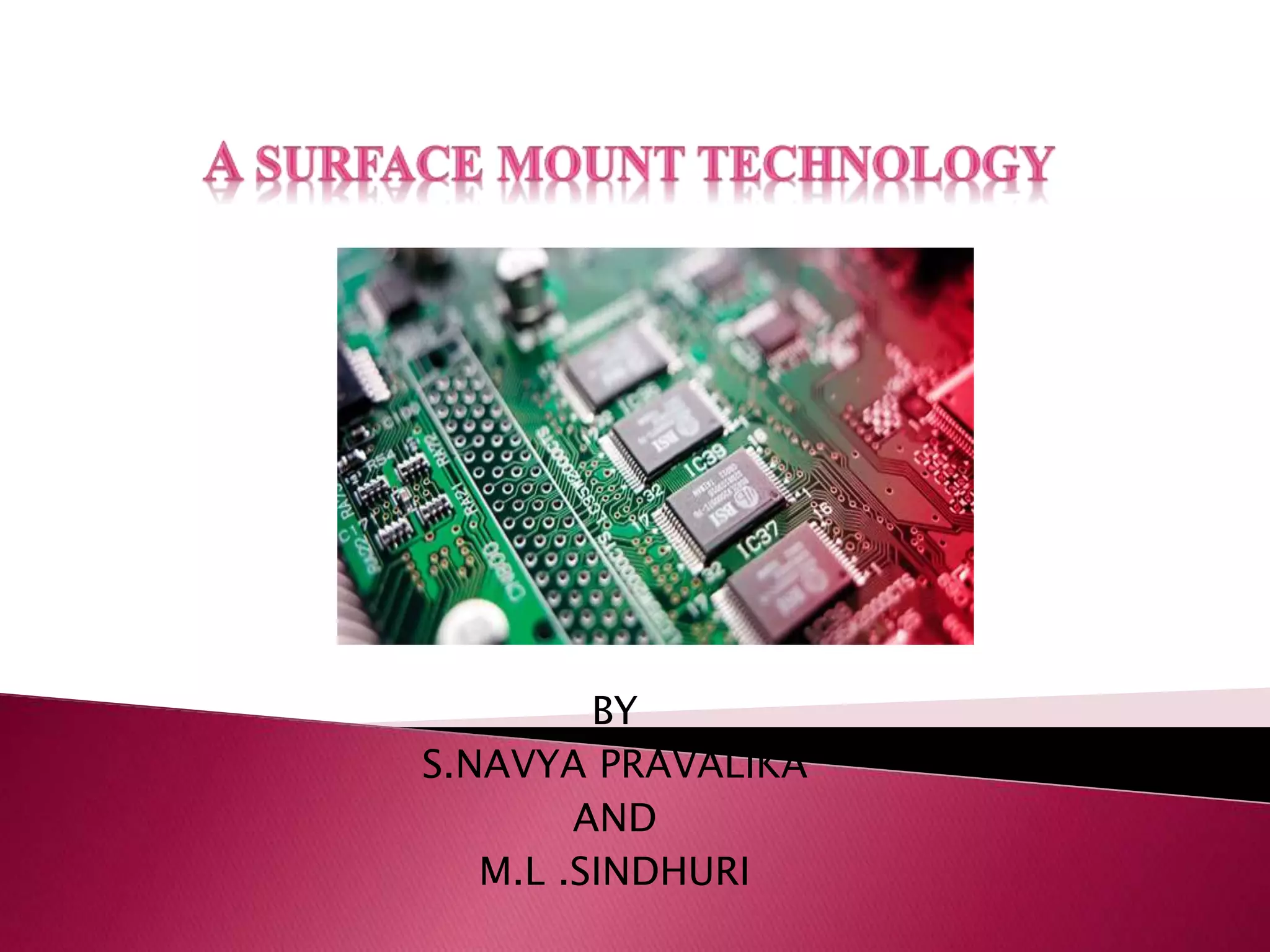
BY
S.NAVYA PRAVALIKA
AND
M.L .SINDHURI
A method of assembling printed wiring
boards or hybrid circuits, where
components are attached to pads on the
board surface, as distinct from through-hole
technology, where component leads are
inserted into holes.
There are 3 major types of Surface Mount Assemblies:
 Type I
(Full SMT board with parts on one or both sides of the
board)
 Type II
(Surface mount chip components are located on the
secondary side of the Printed Board (PB). Active SMCs
and DIPs are then found on the primary side)
 Type III
(They use passive chip SMCs on the secondary side, but
on the primary side only DIPs are used)
•SURFACE MOUNT DESIGN
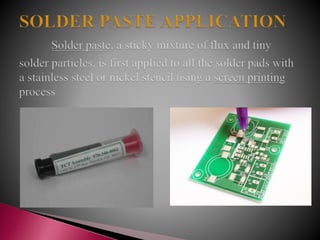
•SOLDER PASTE APPLICATION
•COMPONENT PLACEMENT
•SOLDERING
•CLEANING
•REPAIR/REWORK
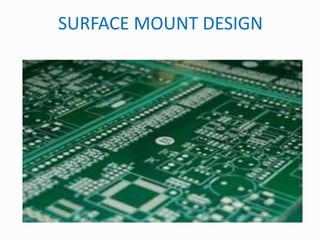
SURFACE MOUNT DESIGN
It depends on a number of factors
• Market needs
• Function
• Package moisture sensitivity
• Thermal and solder joints reliability
• As the packaging density increases, thermal problems are
compounded, with a potential adverse impact on overall
product reliability
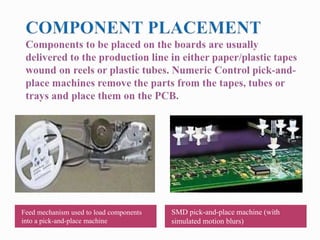
Feed mechanism used to load components
into a pick-and-place machine
SMD pick-and-place machine (with
simulated motion blurs)
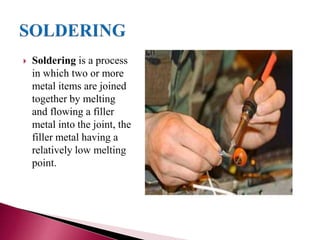
 Soldering is a process
in which two or more
metal items are joined
together by melting
and flowing a filler
metal into the joint, the
filler metal having a
relatively low melting
point.
 INFRARED SOLDERING
 CONVENTIONAL HOT GAS SOLDERING
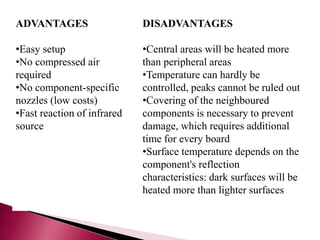
ADVANTAGES
•Easy setup
•No compressed air
required
•No component-specific
nozzles (low costs)
•Fast reaction of infrared
source
DISADVANTAGES
•Central areas will be heated more
than peripheral areas
•Temperature can hardly be
controlled, peaks cannot be ruled out
•Covering of the neighboured
components is necessary to prevent
damage, which requires additional
time for every board
•Surface temperature depends on the
component's reflection
characteristics: dark surfaces will be
heated more than lighter surfaces
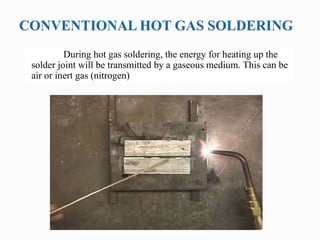
During hot gas soldering, the energy for heating up the
solder joint will be transmitted by a gaseous medium. This can be
air or inert gas (nitrogen)
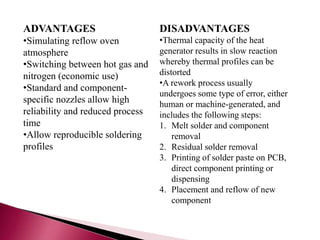
ADVANTAGES
•Simulating reflow oven
atmosphere
•Switching between hot gas and
nitrogen (economic use)
•Standard and component-
specific nozzles allow high
reliability and reduced process
time
•Allow reproducible soldering
profiles
DISADVANTAGES
•Thermal capacity of the heat
generator results in slow reaction
whereby thermal profiles can be
distorted
•A rework process usually
undergoes some type of error, either
human or machine-generated, and
includes the following steps:
1. Melt solder and component
removal
2. Residual solder removal
3. Printing of solder paste on PCB,
direct component printing or
dispensing
4. Placement and reflow of new
component
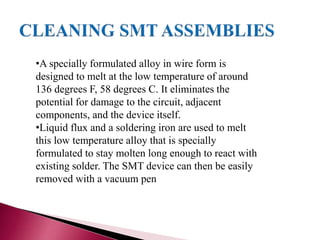
•A specially formulated alloy in wire form is
designed to melt at the low temperature of around
136 degrees F, 58 degrees C. It eliminates the
potential for damage to the circuit, adjacent
components, and the device itself.
•Liquid flux and a soldering iron are used to melt
this low temperature alloy that is specially
formulated to stay molten long enough to react with
existing solder. The SMT device can then be easily
removed with a vacuum pen
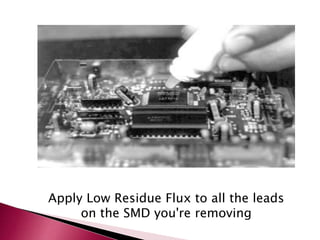
Apply Low Residue Flux to all the leads
on the SMD you're removing
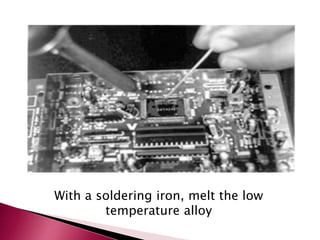
With a soldering iron, melt the low
temperature alloy
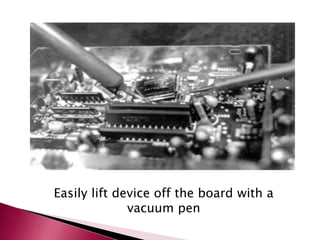
Easily lift device off the board with a
vacuum pen
•Finally, the boards are visually inspected for
missing or misaligned components and solder
bridging.
•If needed, they are sent to a rework station where
a human operator corrects any errors.
• They are then sent to the testing stations to
verify that they operate correctly.
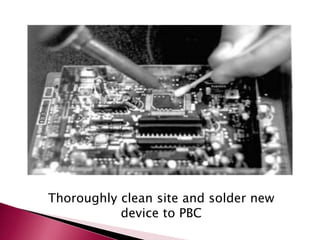
Thoroughly clean site and solder new
device to PBC
•Smaller components. Smallest is currently 0.4 x 0.2 mm.
•Much higher number of components and many more connections per
component.
•Fewer holes need to be drilled through abrasive boards.
Simpler automated assembly.
•Small errors in component placement are corrected automatically (the surface
tension of the molten solder pulls the component into alignment with the solder
pads).
•Components can be placed on both sides of the circuit board.
•Lower resistance and inductance at the connection (leading to better
performance for high frequency parts).
•Better mechanical performance under shake and vibration conditions.
•SMT parts generally cost less than through-hole parts.
•The manufacturing processes for SMT are much more
sophisticated than through-hole boards, raising the
initial cost and time of setting up for production.
•Manual prototype assembly or component-level repair
is more difficult given the very small sizes of many
SMDs.
•SMDs can't be used with breadboards , requiring a
custom PCB for every prototype. The PCB costs dozens
to hundreds of dollars to fabricate and must be
designed with specialized software.
•SMDs' solder connections may be damaged by potting
compounds going through thermal cycling.
 Surface Mount Technology
 Surface Mount Technology

Surface Mount Technology

  • 1.
  • 2.
    A method ofassembling printed wiring boards or hybrid circuits, where components are attached to pads on the board surface, as distinct from through-hole technology, where component leads are inserted into holes.
  • 3.
    There are 3major types of Surface Mount Assemblies:  Type I (Full SMT board with parts on one or both sides of the board)  Type II (Surface mount chip components are located on the secondary side of the Printed Board (PB). Active SMCs and DIPs are then found on the primary side)  Type III (They use passive chip SMCs on the secondary side, but on the primary side only DIPs are used)
  • 4.
    •SURFACE MOUNT DESIGN •SOLDERPASTE APPLICATION •COMPONENT PLACEMENT •SOLDERING •CLEANING •REPAIR/REWORK
  • 5.
  • 6.
    It depends ona number of factors • Market needs • Function • Package moisture sensitivity • Thermal and solder joints reliability • As the packaging density increases, thermal problems are compounded, with a potential adverse impact on overall product reliability
  • 8.
    Feed mechanism usedto load components into a pick-and-place machine SMD pick-and-place machine (with simulated motion blurs)
  • 9.
     Soldering isa process in which two or more metal items are joined together by melting and flowing a filler metal into the joint, the filler metal having a relatively low melting point.
  • 10.
     INFRARED SOLDERING CONVENTIONAL HOT GAS SOLDERING
  • 12.
    ADVANTAGES •Easy setup •No compressedair required •No component-specific nozzles (low costs) •Fast reaction of infrared source DISADVANTAGES •Central areas will be heated more than peripheral areas •Temperature can hardly be controlled, peaks cannot be ruled out •Covering of the neighboured components is necessary to prevent damage, which requires additional time for every board •Surface temperature depends on the component's reflection characteristics: dark surfaces will be heated more than lighter surfaces
  • 13.
    During hot gassoldering, the energy for heating up the solder joint will be transmitted by a gaseous medium. This can be air or inert gas (nitrogen)
  • 14.
    ADVANTAGES •Simulating reflow oven atmosphere •Switchingbetween hot gas and nitrogen (economic use) •Standard and component- specific nozzles allow high reliability and reduced process time •Allow reproducible soldering profiles DISADVANTAGES •Thermal capacity of the heat generator results in slow reaction whereby thermal profiles can be distorted •A rework process usually undergoes some type of error, either human or machine-generated, and includes the following steps: 1. Melt solder and component removal 2. Residual solder removal 3. Printing of solder paste on PCB, direct component printing or dispensing 4. Placement and reflow of new component
  • 15.
    •A specially formulatedalloy in wire form is designed to melt at the low temperature of around 136 degrees F, 58 degrees C. It eliminates the potential for damage to the circuit, adjacent components, and the device itself. •Liquid flux and a soldering iron are used to melt this low temperature alloy that is specially formulated to stay molten long enough to react with existing solder. The SMT device can then be easily removed with a vacuum pen
  • 16.
    Apply Low ResidueFlux to all the leads on the SMD you're removing
  • 17.
    With a solderingiron, melt the low temperature alloy
  • 18.
    Easily lift deviceoff the board with a vacuum pen
  • 19.
    •Finally, the boardsare visually inspected for missing or misaligned components and solder bridging. •If needed, they are sent to a rework station where a human operator corrects any errors. • They are then sent to the testing stations to verify that they operate correctly.
  • 20.
    Thoroughly clean siteand solder new device to PBC
  • 21.
    •Smaller components. Smallestis currently 0.4 x 0.2 mm. •Much higher number of components and many more connections per component. •Fewer holes need to be drilled through abrasive boards. Simpler automated assembly. •Small errors in component placement are corrected automatically (the surface tension of the molten solder pulls the component into alignment with the solder pads). •Components can be placed on both sides of the circuit board. •Lower resistance and inductance at the connection (leading to better performance for high frequency parts). •Better mechanical performance under shake and vibration conditions. •SMT parts generally cost less than through-hole parts.
  • 22.
    •The manufacturing processesfor SMT are much more sophisticated than through-hole boards, raising the initial cost and time of setting up for production. •Manual prototype assembly or component-level repair is more difficult given the very small sizes of many SMDs. •SMDs can't be used with breadboards , requiring a custom PCB for every prototype. The PCB costs dozens to hundreds of dollars to fabricate and must be designed with specialized software. •SMDs' solder connections may be damaged by potting compounds going through thermal cycling.

Editor's Notes

  • #17 Apply Low Residue Flux to all the leads on the SMD you're removing
  • #18 With a soldering iron, melt the low temperature alloy