Testing and Validation of Disposable / Single-
Procedure Surgical Instruments & Procedural Kits
By James B. Schultz
Executive Vice President
1
Disposables in the O.R.– The Way of the Future
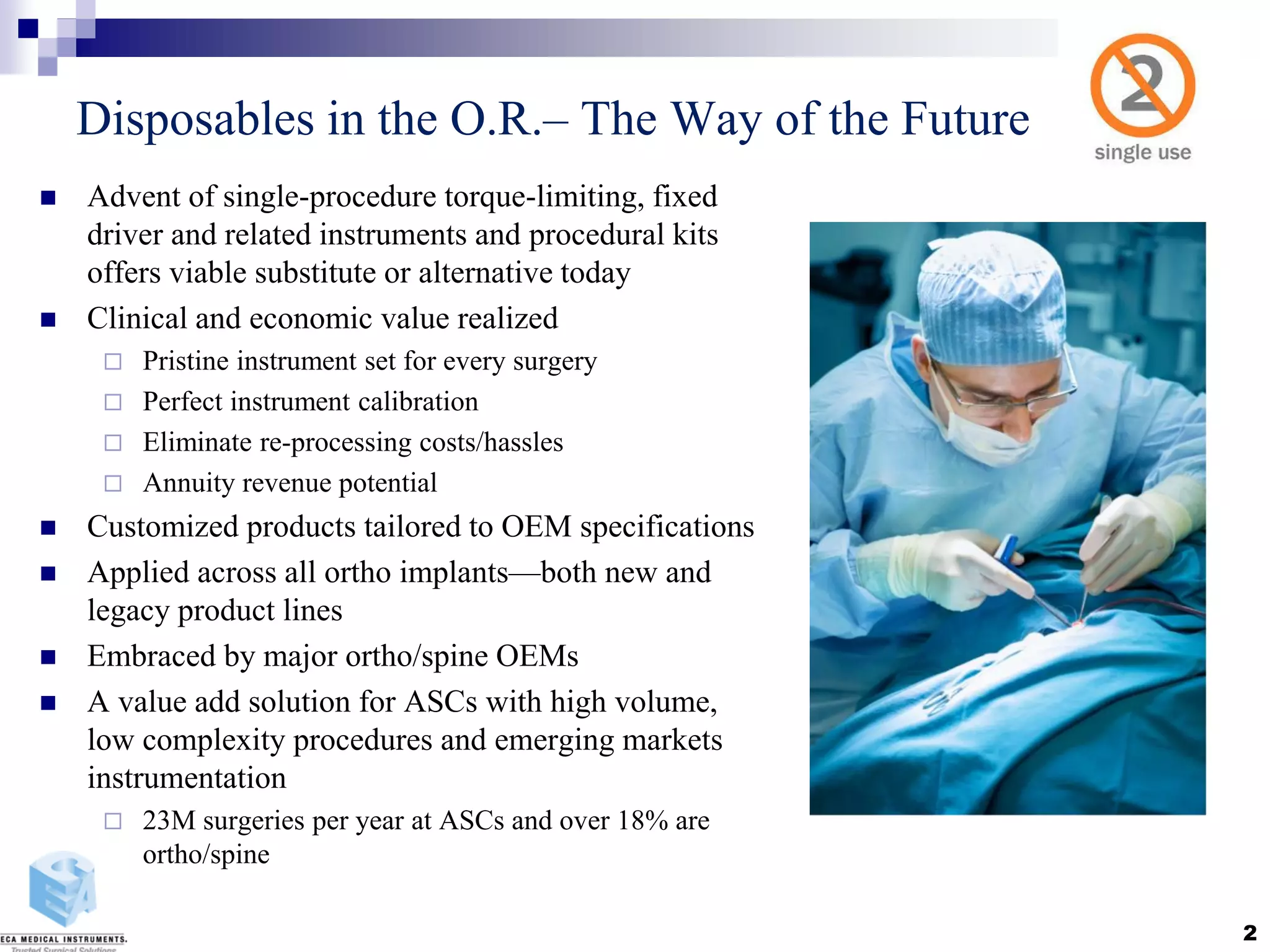
 Advent of single-procedure torque-limiting, fixed
driver and related instruments and procedural kits
offers viable substitute or alternative today
 Clinical and economic value realized
 Pristine instrument set for every surgery
 Perfect instrument calibration
 Eliminate re-processing costs/hassles
 Annuity revenue potential
 Customized products tailored to OEM specifications
 Applied across all ortho implants—both new and
legacy product lines
 Embraced by major ortho/spine OEMs
 A value add solution for ASCs with high volume,
low complexity procedures and emerging markets
instrumentation
 23M surgeries per year at ASCs and over 18% are
ortho/spine
2
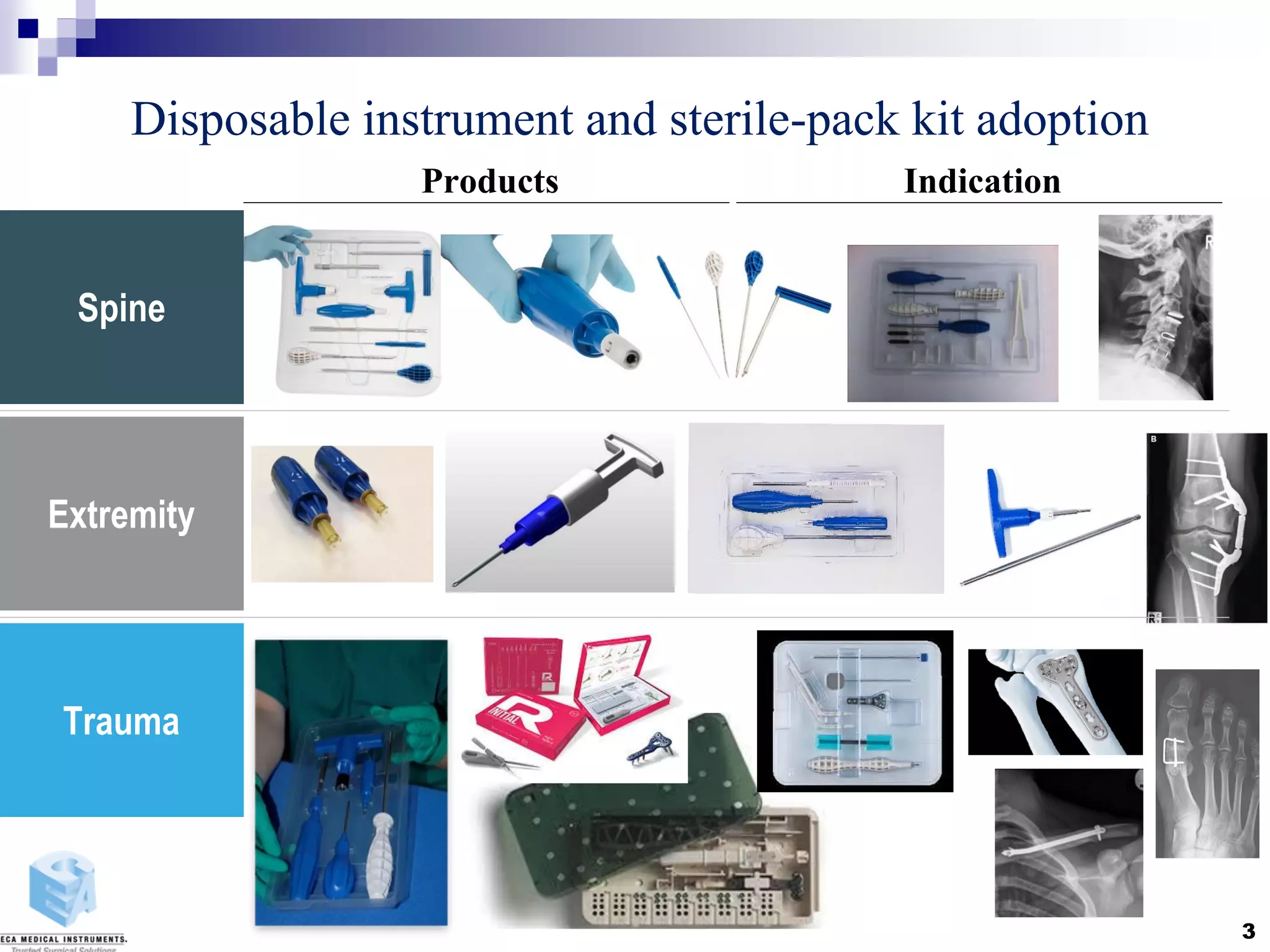
Disposable instrument and sterile-pack kit adoption
3
Products Indication
Spine
Extremity
Trauma
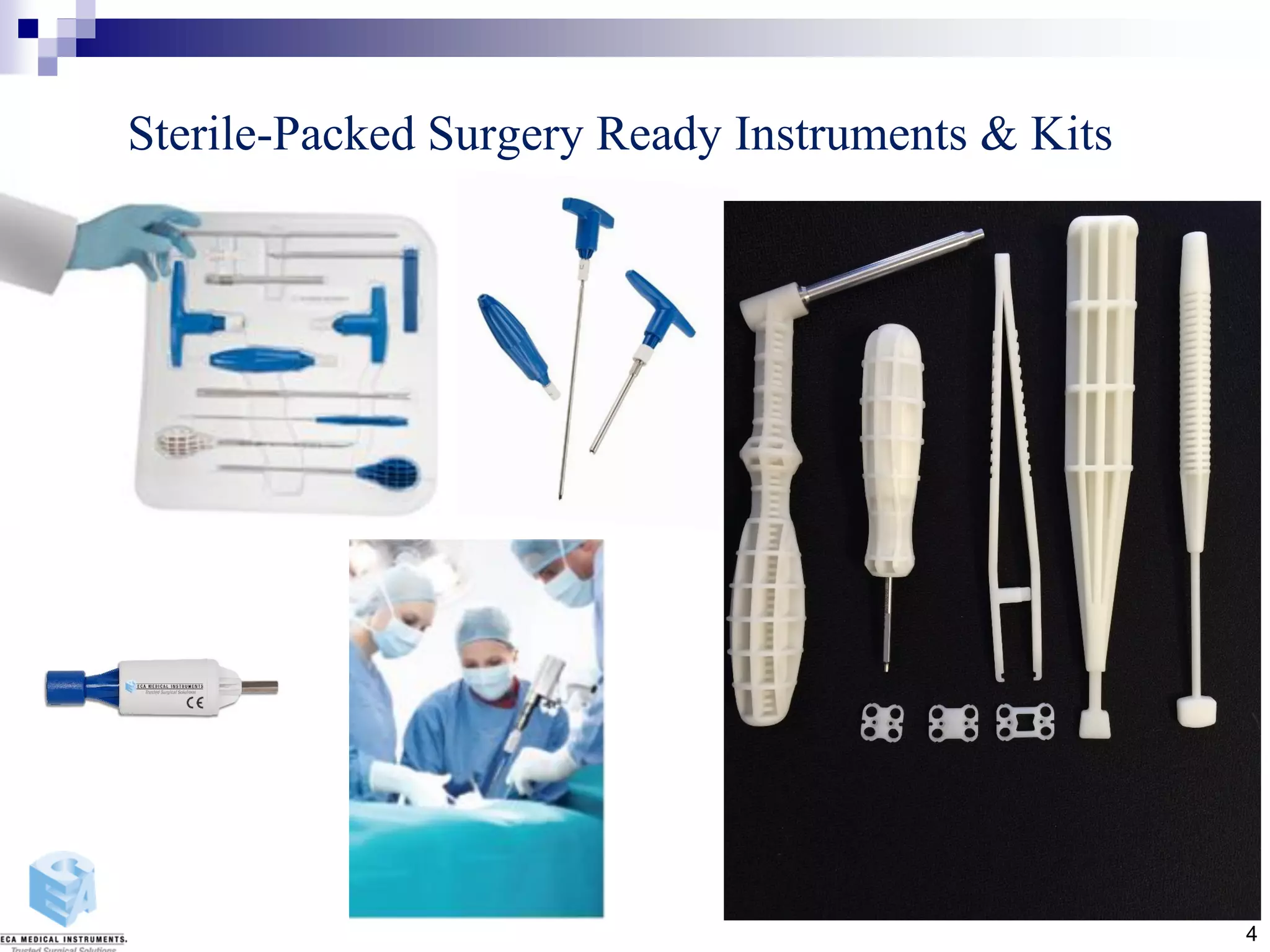
Sterile-Packed Surgery Ready Instruments & Kits
4
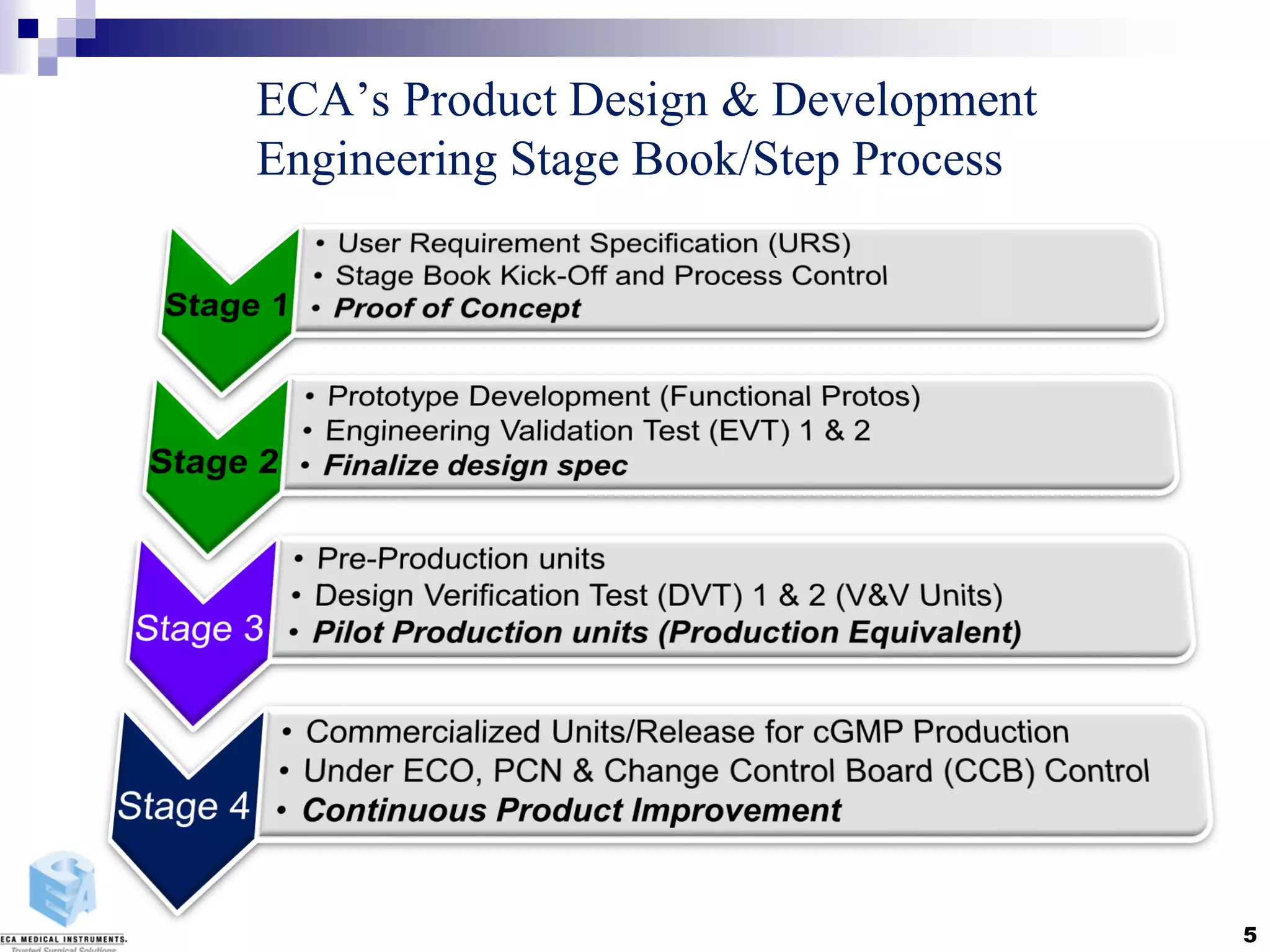
ECA’s Product Design & Development
Engineering Stage Book/Step Process
5
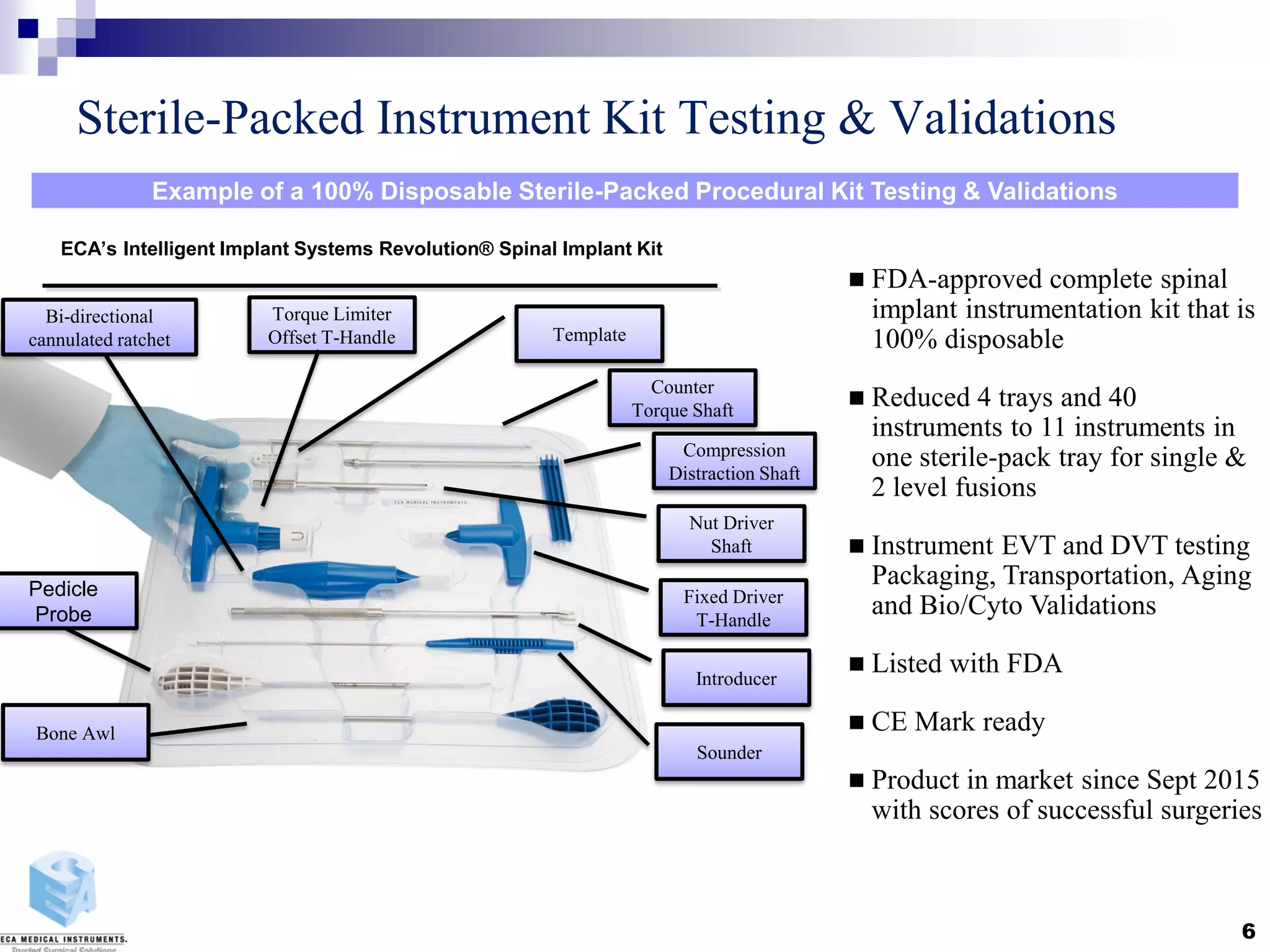
Sterile-Packed Instrument Kit Testing & Validations
Example of a 100% Disposable Sterile-Packed Procedural Kit Testing & Validations
ECA’s Intelligent Implant Systems Revolution® Spinal Implant Kit
 FDA-approved complete spinal
implant instrumentation kit that is
100% disposable
 Reduced 4 trays and 40
instruments to 11 instruments in
one sterile-pack tray for single &
2 level fusions
 Instrument EVT and DVT testing
Packaging, Transportation, Aging
and Bio/Cyto Validations
 Listed with FDA
 CE Mark ready
 Product in market since Sept 2015
with scores of successful surgeries
Pedicle
Probe
Bi-directional
cannulated ratchet
Torque Limiter
Offset T-Handle
Counter
Torque Shaft
Template
Compression
Distraction Shaft
Fixed Driver
T-Handle
Introducer
Sounder
Bone Awl
Nut Driver
Shaft
6
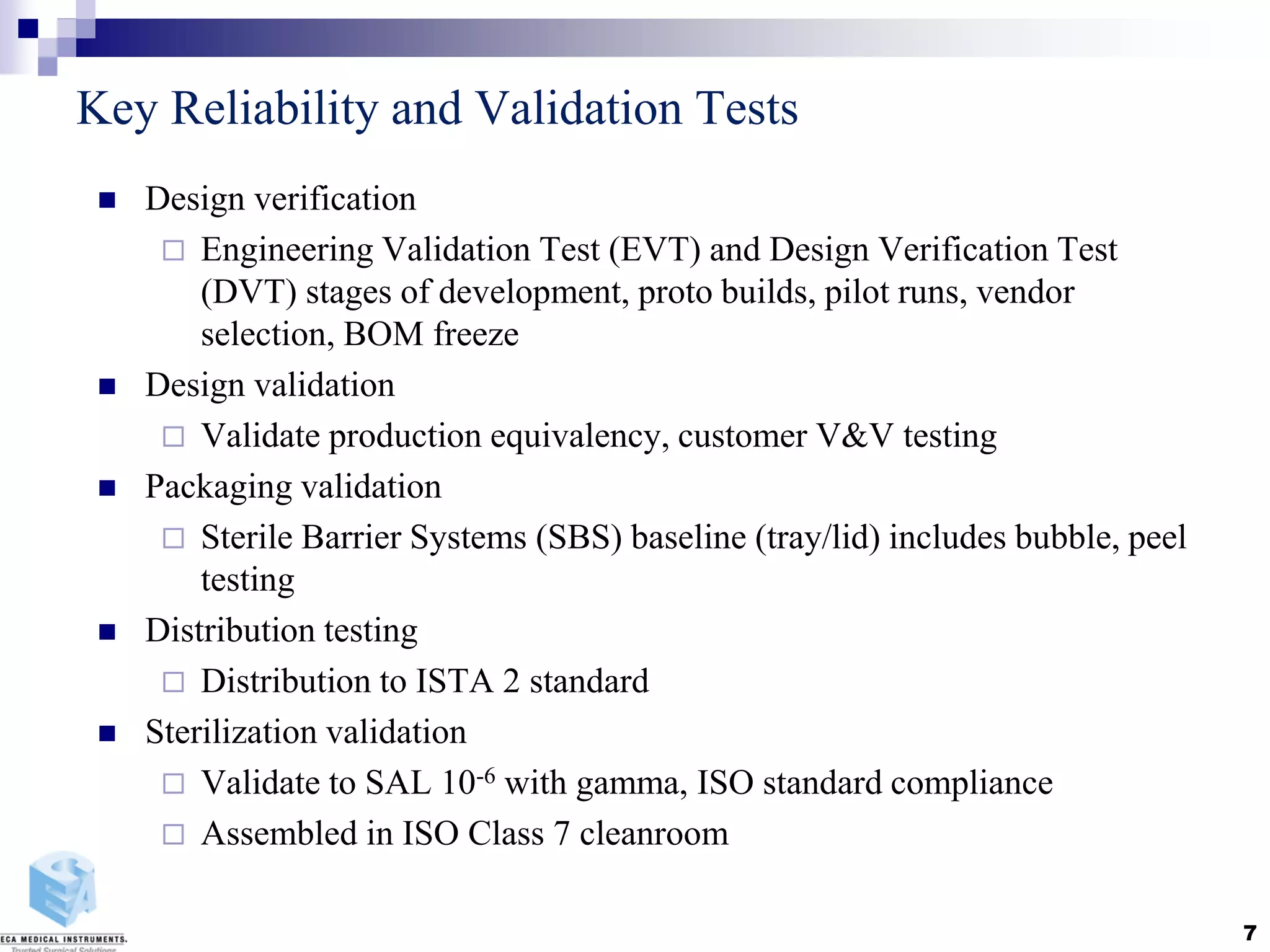
Key Reliability and Validation Tests
 Design verification
 Engineering Validation Test (EVT) and Design Verification Test
(DVT) stages of development, proto builds, pilot runs, vendor
selection, BOM freeze
 Design validation
 Validate production equivalency, customer V&V testing
 Packaging validation
 Sterile Barrier Systems (SBS) baseline (tray/lid) includes bubble, peel
testing
 Distribution testing
 Distribution to ISTA 2 standard
 Sterilization validation
 Validate to SAL 10-6 with gamma, ISO standard compliance
 Assembled in ISO Class 7 cleanroom
7
Key Reliability and Validation Tests
 Biocompatibility testing
 FTIR, LAL and TOC
 Corrosion resistance testing for stainless steel components
 Citric or nitric passivation and immersion testing
 Aging of packaging and instrumentation
 2 year or more shelf life for packaging and instruments
 NPI production hand-off
 cGMP mass production implemented
8
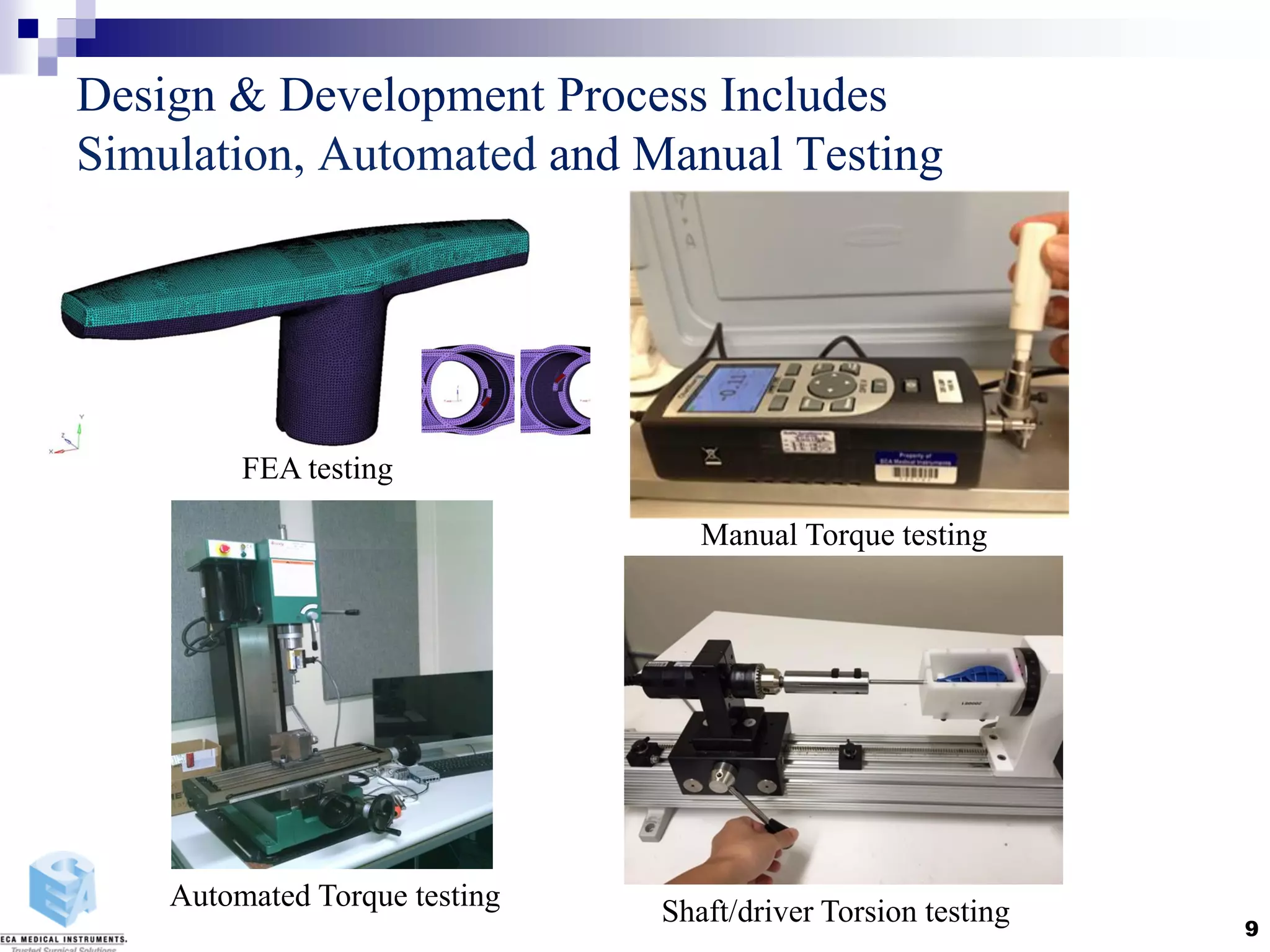
Design & Development Process Includes
Simulation, Automated and Manual Testing
9
FEA testing
Manual Torque testing
Shaft/driver Torsion testingAutomated Torque testing
Summary
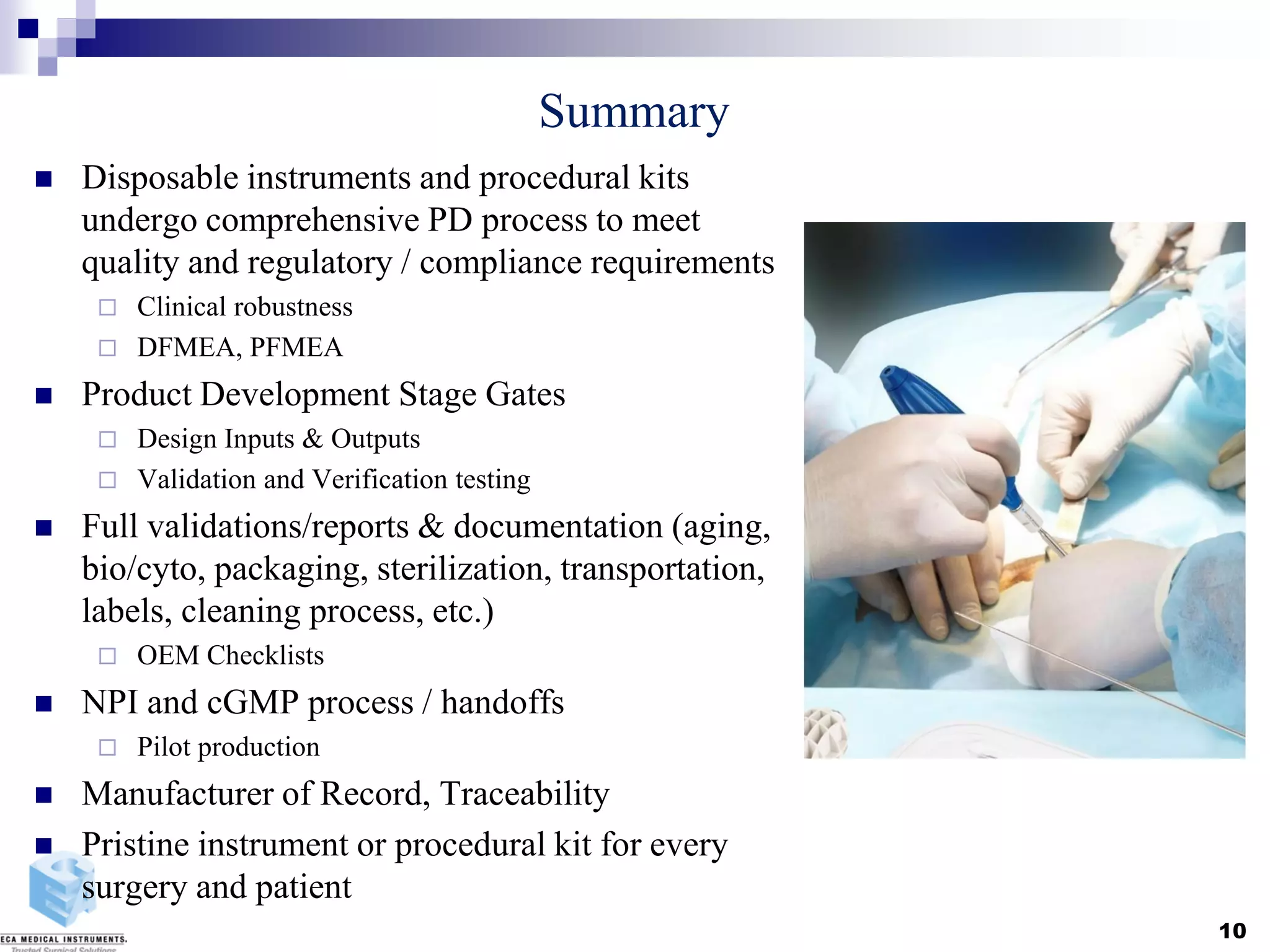
 Disposable instruments and procedural kits
undergo comprehensive PD process to meet
quality and regulatory / compliance requirements
 Clinical robustness
 DFMEA, PFMEA
 Product Development Stage Gates
 Design Inputs & Outputs
 Validation and Verification testing
 Full validations/reports & documentation (aging,
bio/cyto, packaging, sterilization, transportation,
labels, cleaning process, etc.)
 OEM Checklists
 NPI and cGMP process / handoffs
 Pilot production
 Manufacturer of Record, Traceability
 Pristine instrument or procedural kit for every
surgery and patient
10
CONFIDENTIAL ECA MEDICAL INSTRUMENTS 11
ECA Medical Instruments
Corporate Headquarters
2193 Anchor Court
Thousand Oaks, CA 91320 USA
Tel: +1 (805) 376-2509
Fax: +1 (805) 376-2189
www.ecamedical.com
Thank You!
Instrument Testing and Validation Session
Clinical Re-Processing Cycles
June 15, 2016
David M. Blakemore
BoneSim Laboratories
BoneSim Laboratories~~~
TM
OMTEC 2016 Instrument Testing and Validation Session
Clinical Re-Processing Cycles
Agenda:
• What is Clinical Re-processing
• Why is it important
• How does it affect us
• How do we respond
BoneSim Laboratories~~~
TM
OMTEC 2016 Instrument Testing and Validation Session
Clinical Re-Processing Cycles
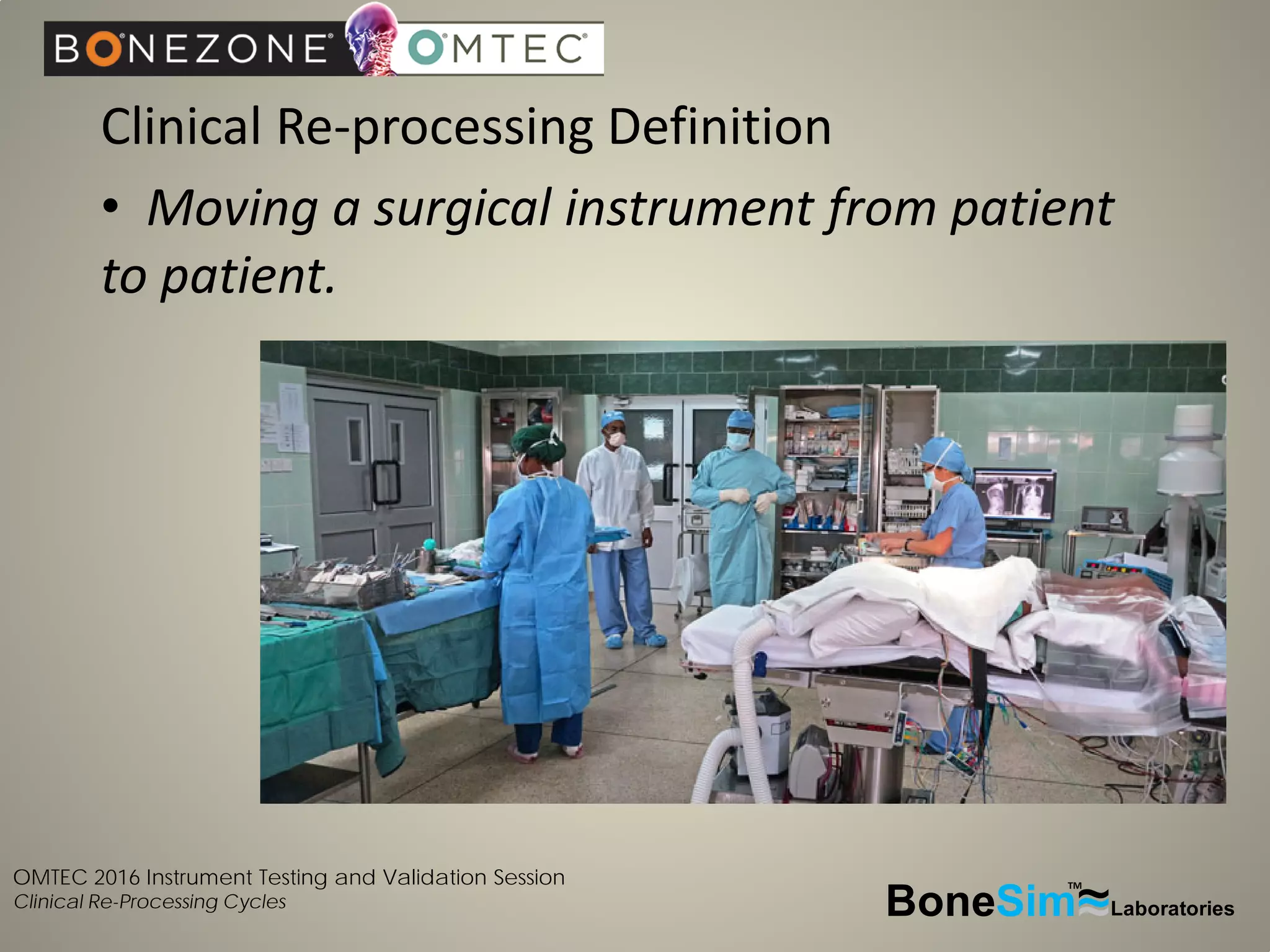
Clinical Re-processing Definition
• Moving a surgical instrument from patient
to patient.
BoneSim Laboratories~~~
TM
OMTEC 2016 Instrument Testing and Validation Session
Clinical Re-Processing Cycles
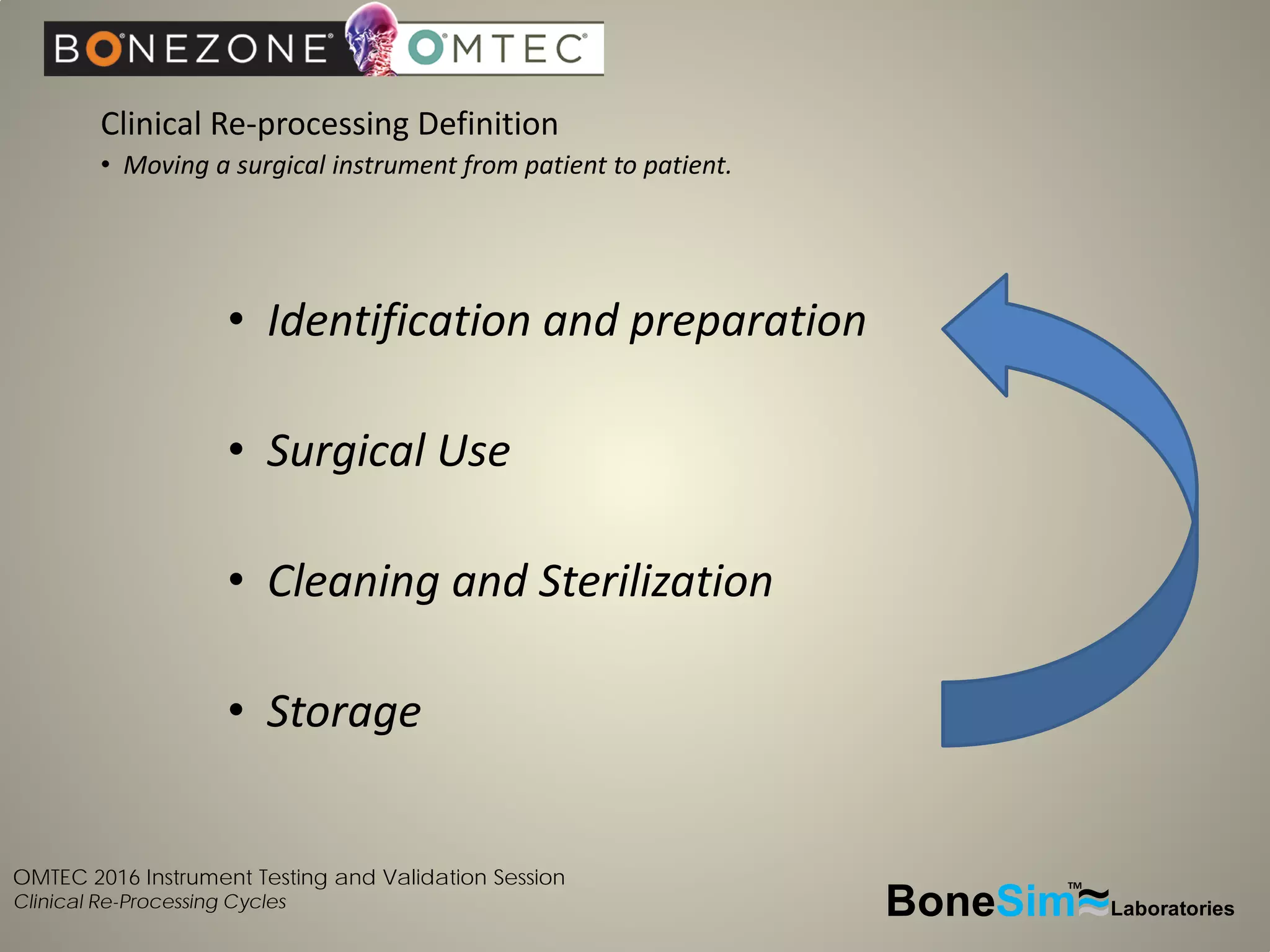
Clinical Re-processing Definition
• Moving a surgical instrument from patient to patient.
• Identification and preparation
• Surgical Use
• Cleaning and Sterilization
• Storage
BoneSim Laboratories~~~
TM
OMTEC 2016 Instrument Testing and Validation Session
Clinical Re-Processing Cycles
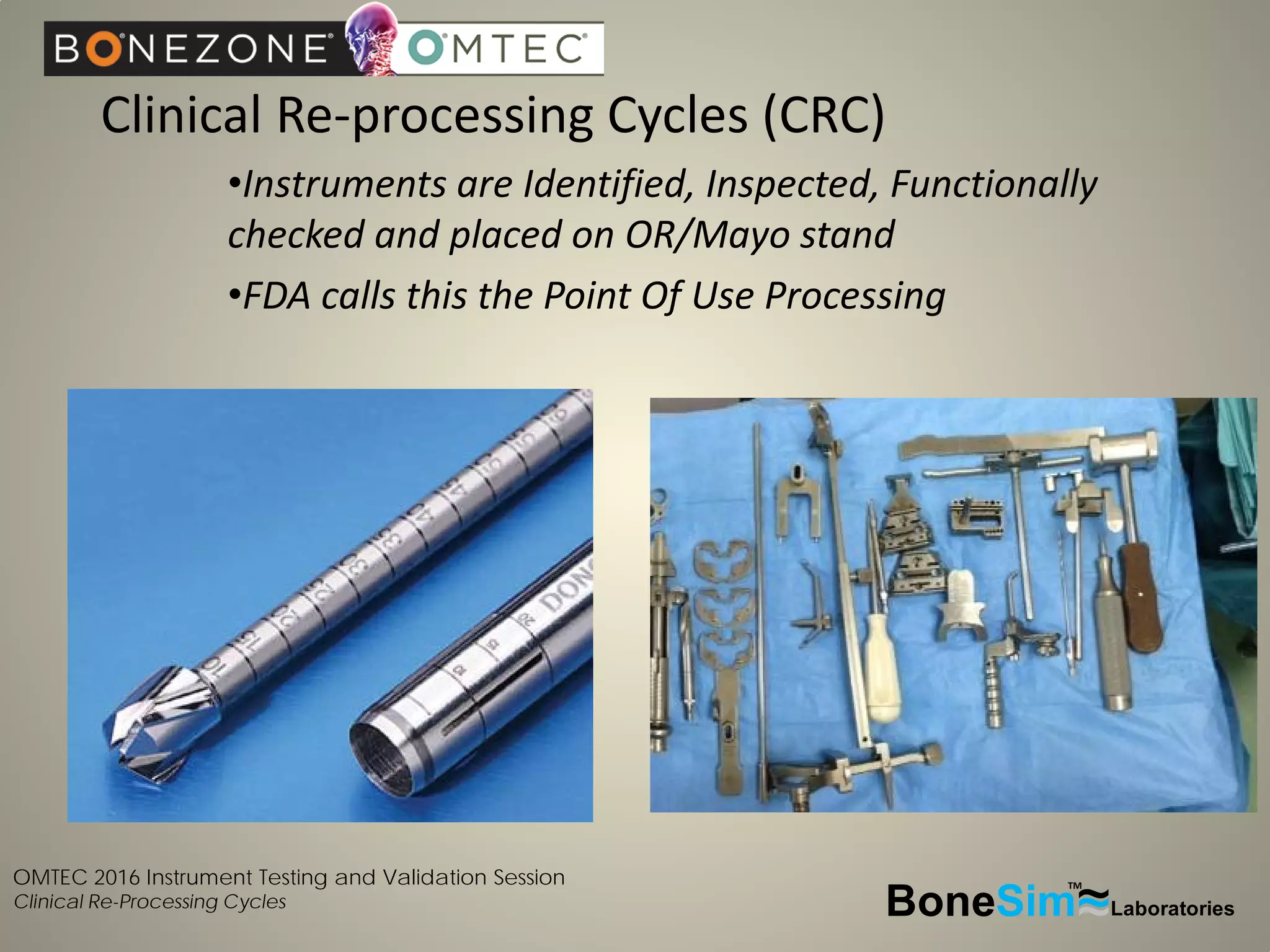
Clinical Re-processing Cycles (CRC)
•Instruments are Identified, Inspected, Functionally
checked and placed on OR/Mayo stand
•FDA calls this the Point Of Use Processing
BoneSim Laboratories~~~
TM
OMTEC 2016 Instrument Testing and Validation Session
Clinical Re-Processing Cycles
Clinical Re-processing Cycles (CRC)
BoneSim Laboratories~~~
TM
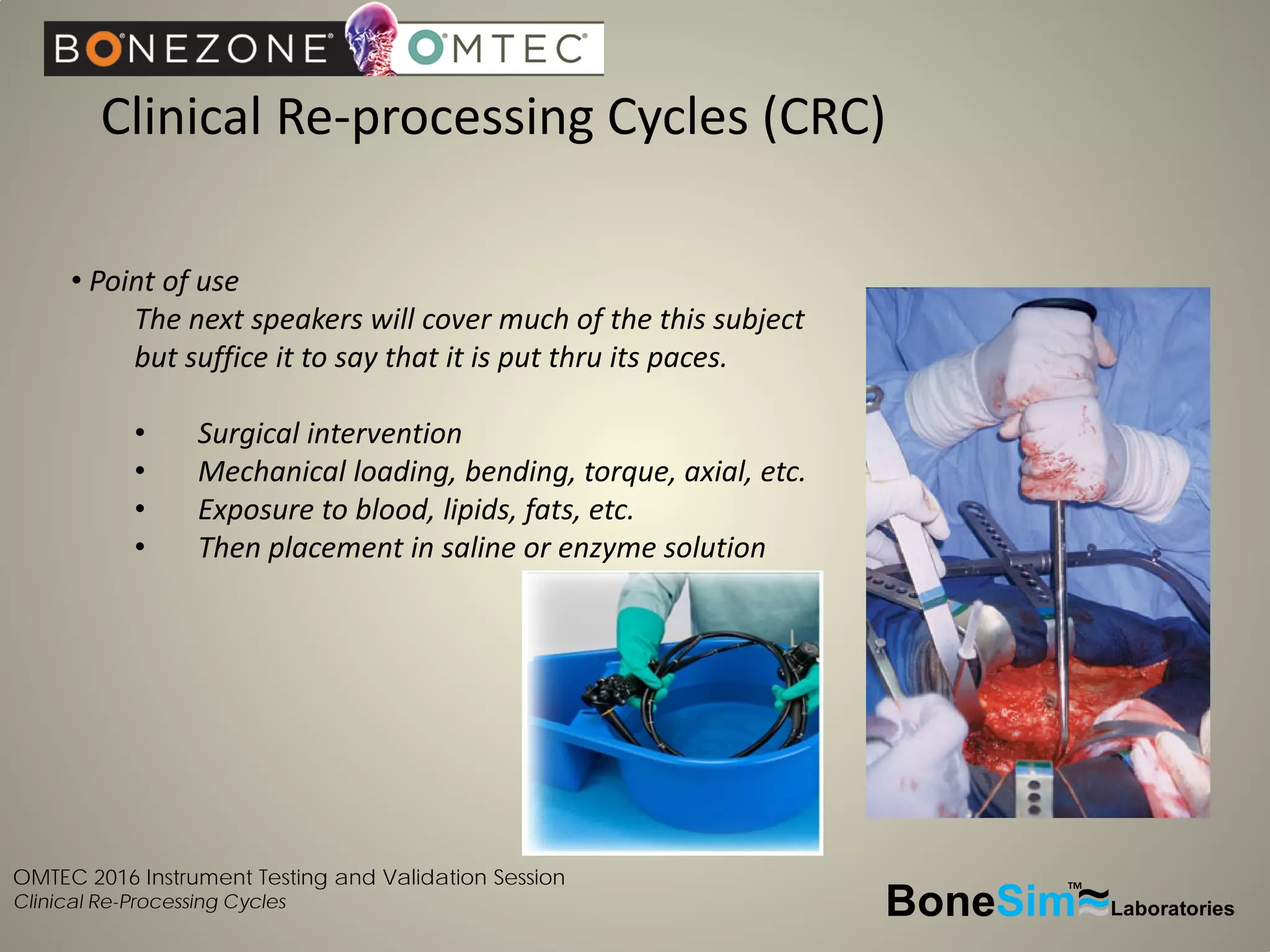
• Point of use
The next speakers will cover much of the this subject
but suffice it to say that it is put thru its paces.
• Surgical intervention
• Mechanical loading, bending, torque, axial, etc.
• Exposure to blood, lipids, fats, etc.
• Then placement in saline or enzyme solution
OMTEC 2016 Instrument Testing and Validation Session
Clinical Re-Processing Cycles
Clinical Re-processing Cycles (CRC)
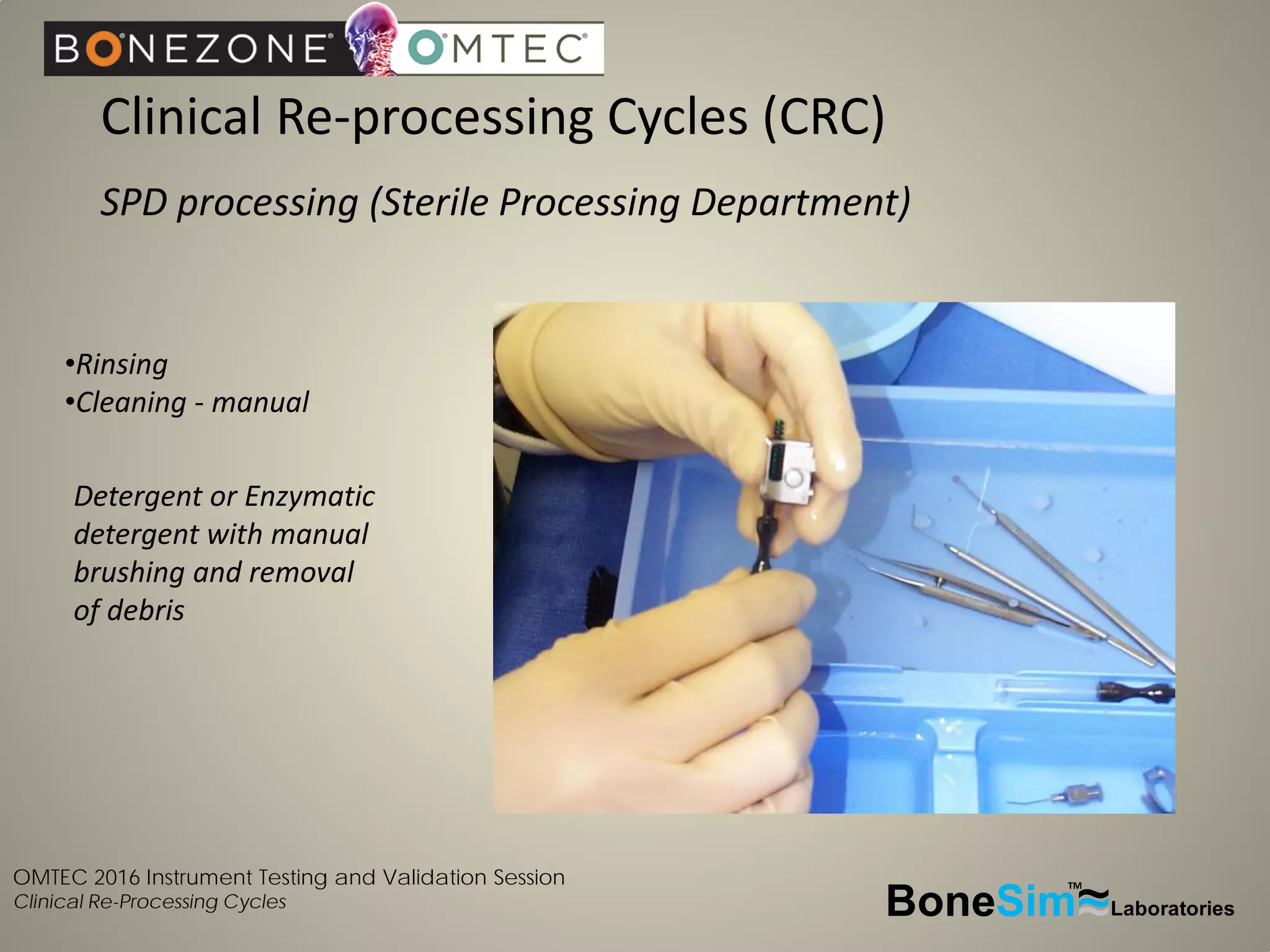
SPD processing (Sterile Processing Department)
BoneSim Laboratories~~~
TM
•Rinsing
•Cleaning - manual
Detergent or Enzymatic
detergent with manual
brushing and removal
of debris
OMTEC 2016 Instrument Testing and Validation Session
Clinical Re-Processing Cycles
Clinical Re-processing Cycles (CRC)
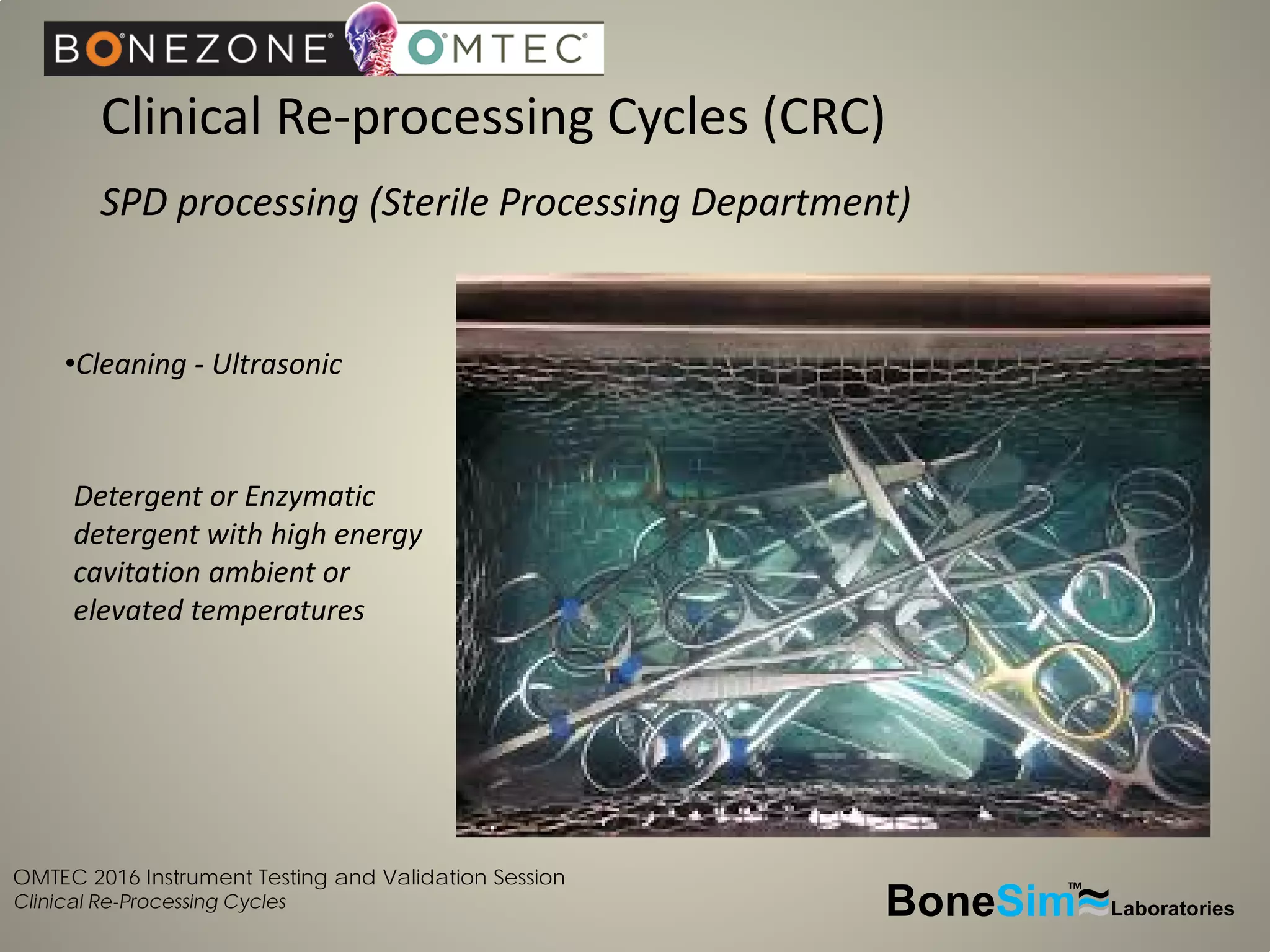
SPD processing (Sterile Processing Department)
BoneSim Laboratories~~~
TM
•Cleaning - Ultrasonic
Detergent or Enzymatic
detergent with high energy
cavitation ambient or
elevated temperatures
OMTEC 2016 Instrument Testing and Validation Session
Clinical Re-Processing Cycles
Clinical Re-processing Cycles (CRC
BoneSim Laboratories~~~
TM
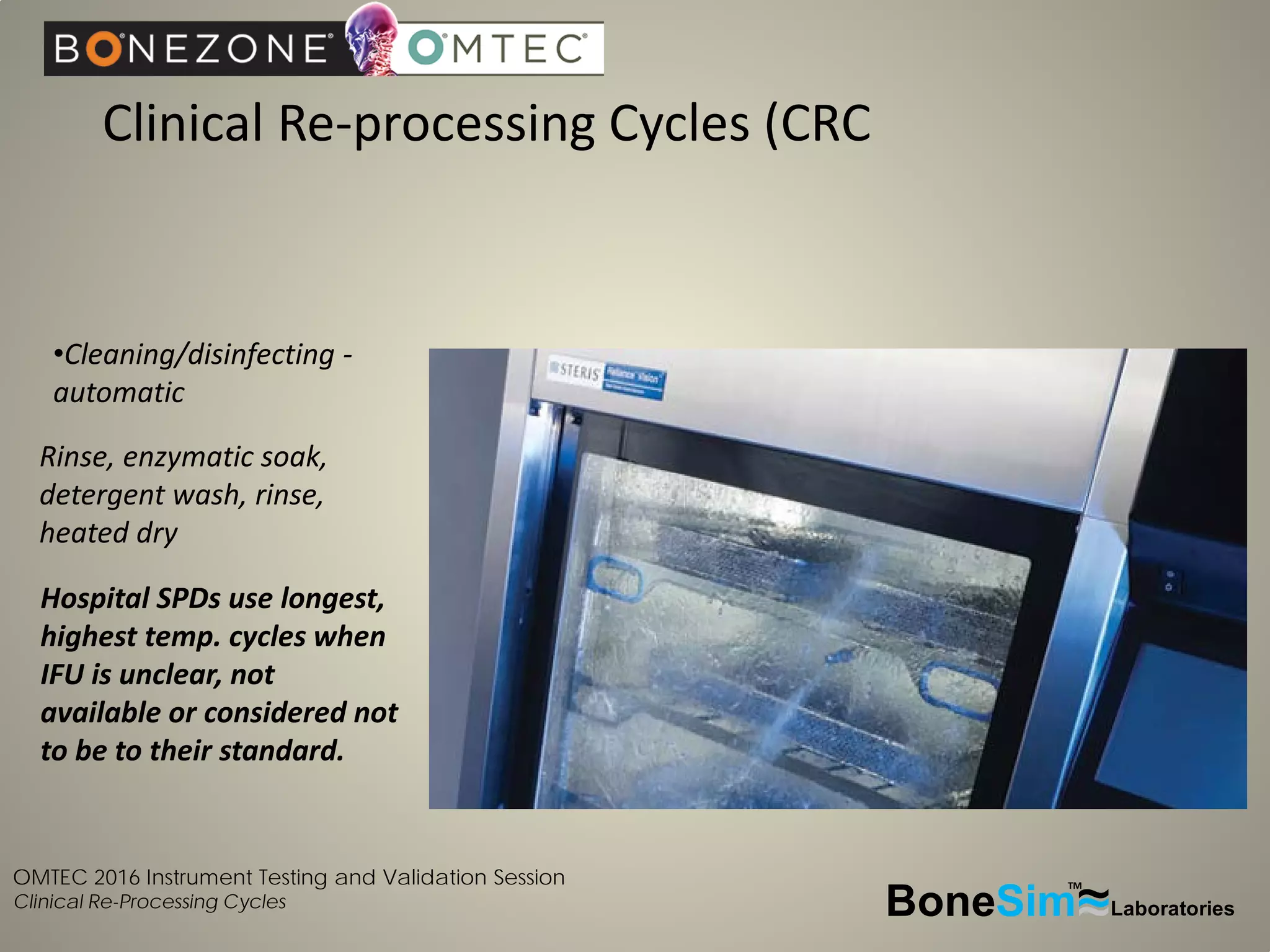
•Cleaning/disinfecting -
automatic
Rinse, enzymatic soak,
detergent wash, rinse,
heated dry
Hospital SPDs use longest,
highest temp. cycles when
IFU is unclear, not
available or considered not
to be to their standard.
OMTEC 2016 Instrument Testing and Validation Session
Clinical Re-Processing Cycles
Clinical Re-processing Cycles (CRC)
BoneSim Laboratories~~~
TM
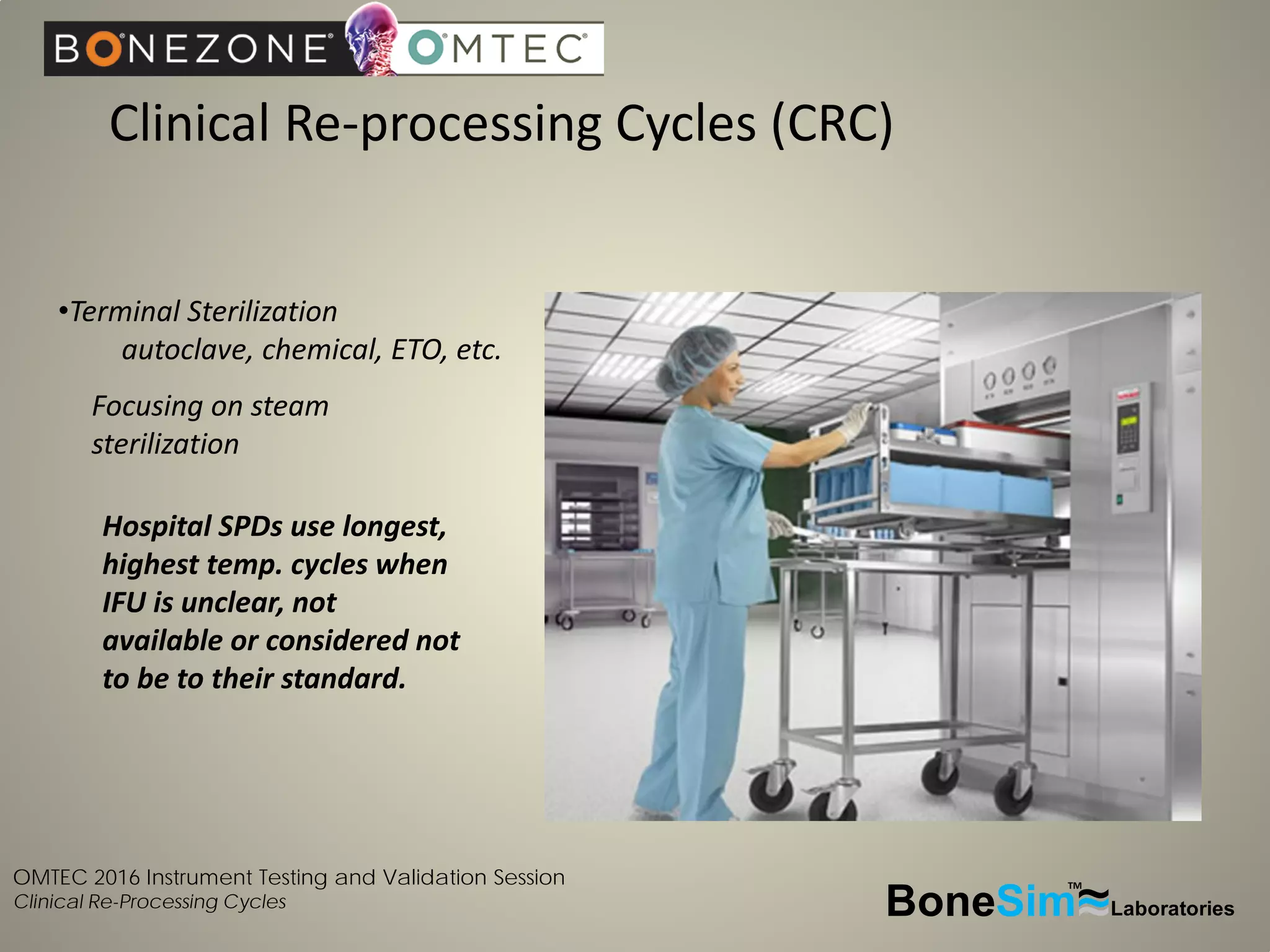
•Terminal Sterilization
autoclave, chemical, ETO, etc.
Focusing on steam
sterilization
Hospital SPDs use longest,
highest temp. cycles when
IFU is unclear, not
available or considered not
to be to their standard.
OMTEC 2016 Instrument Testing and Validation Session
Clinical Re-Processing Cycles
Clinical Re-processing Cycles (CRC)
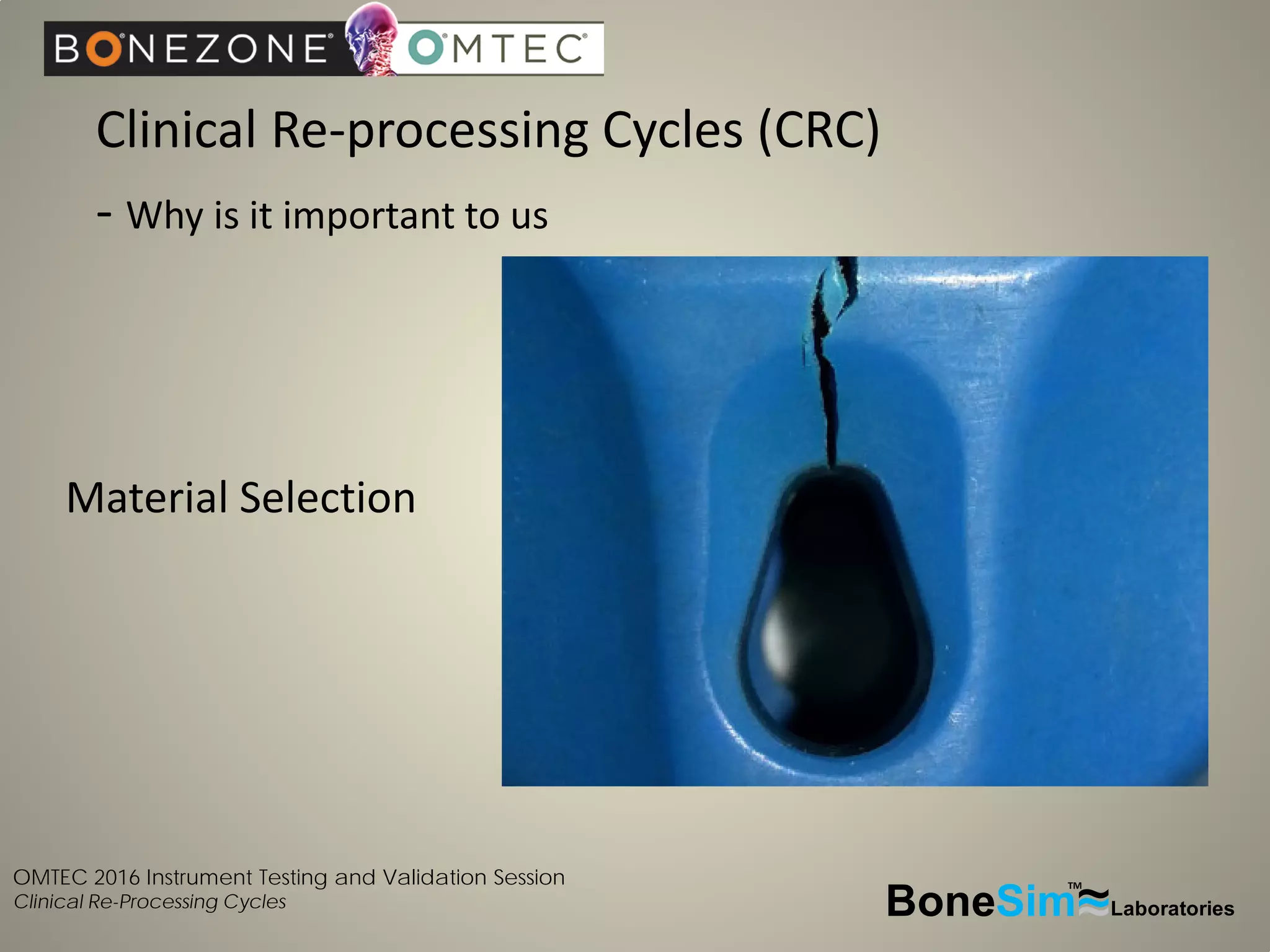
- Why is it important to us
BoneSim Laboratories~~~
TM
Material Selection
OMTEC 2016 Instrument Testing and Validation Session
Clinical Re-Processing Cycles
Clinical Re-processing Cycles (CRC)
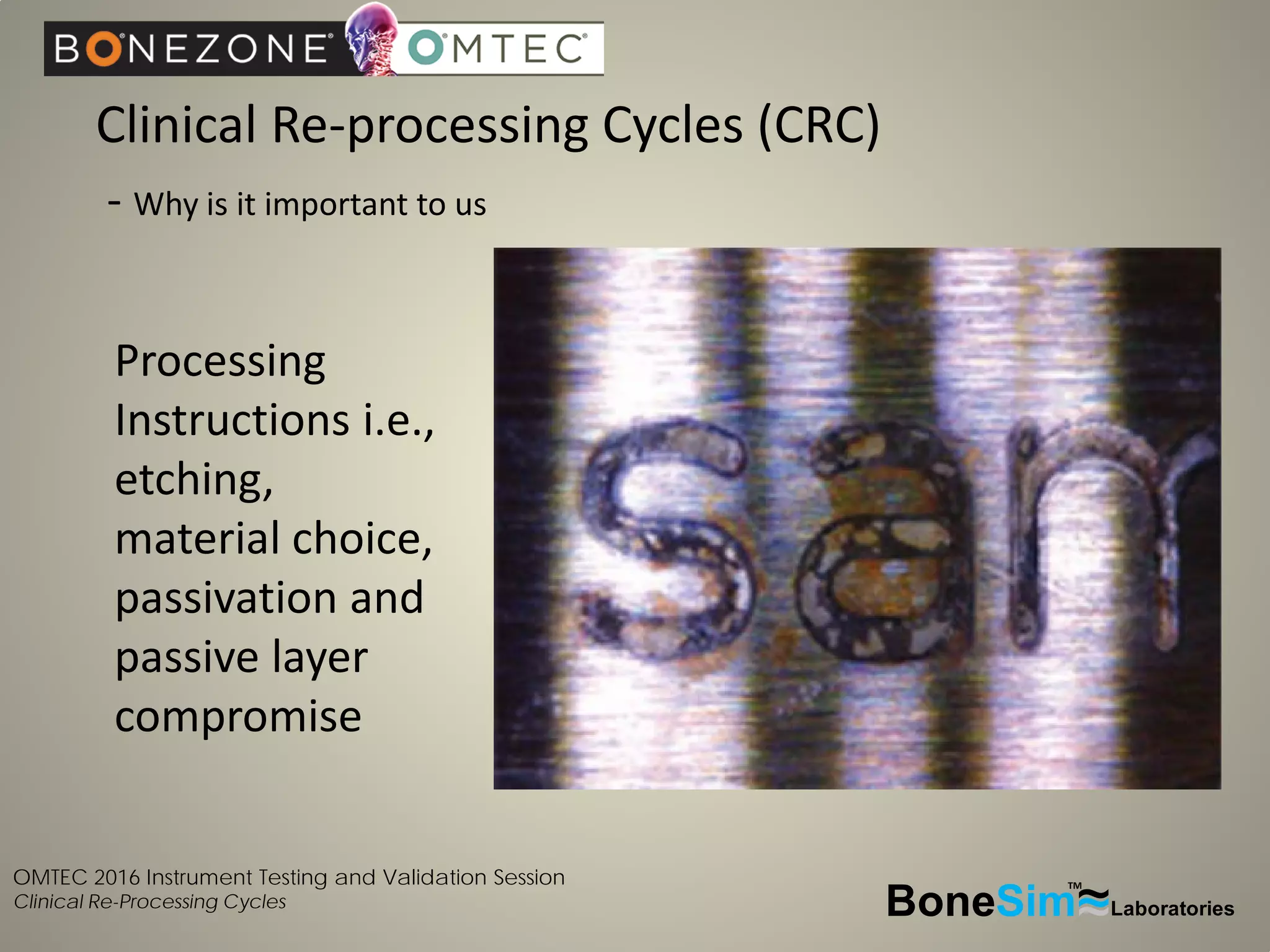
- Why is it important to us
BoneSim Laboratories~~~
TM
Processing
Instructions i.e.,
etching,
material choice,
passivation and
passive layer
compromise
OMTEC 2016 Instrument Testing and Validation Session
Clinical Re-Processing Cycles
Clinical Re-processing - FDA
BoneSim Laboratories~~~
TM
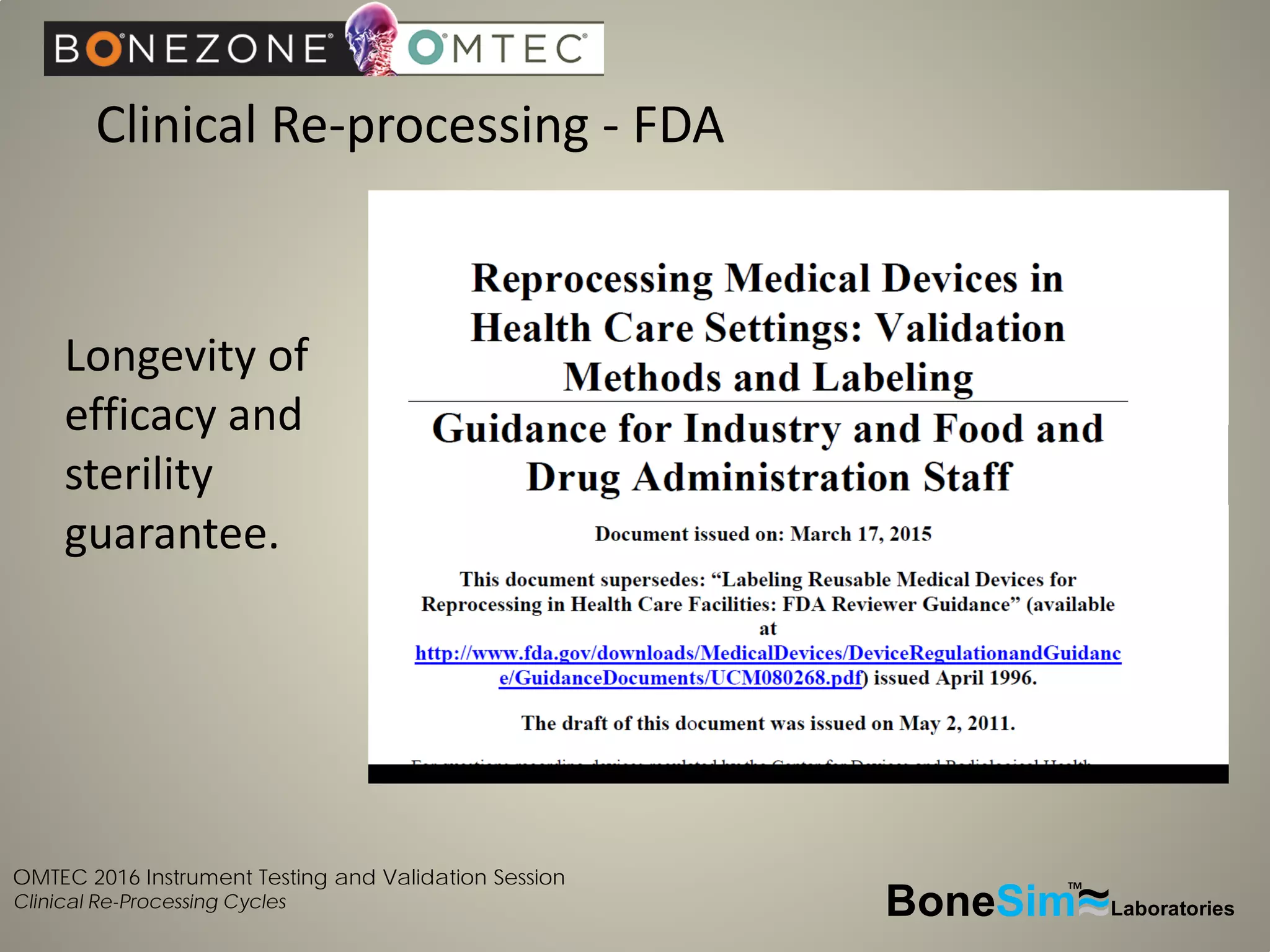
Longevity of
efficacy and
sterility
guarantee.
OMTEC 2016 Instrument Testing and Validation Session
Clinical Re-Processing Cycles
Clinical Re-processing - FDA
BoneSim Laboratories~~~
TM
What’s New in the 2015 Final Guidance(vs the 1996 Guidance)
Expanded to include information pertaining to validation of reprocessing
methods and instructions
• Specific emphasis on importance of proper cleaning & cleaning
validation, IMPORTANCE OF WORST-CASE TESTING, importance of
device designs that are less challenging to reprocess
• Human factors considerations when validating reprocessing methods
and instructions
• Provides greater clarity on documentation to be provided in the
different premarket submissions: 510(k), PMA, de novo, HDE, IDE
OMTEC 2016 Instrument Testing and Validation Session
Clinical Re-Processing Cycles
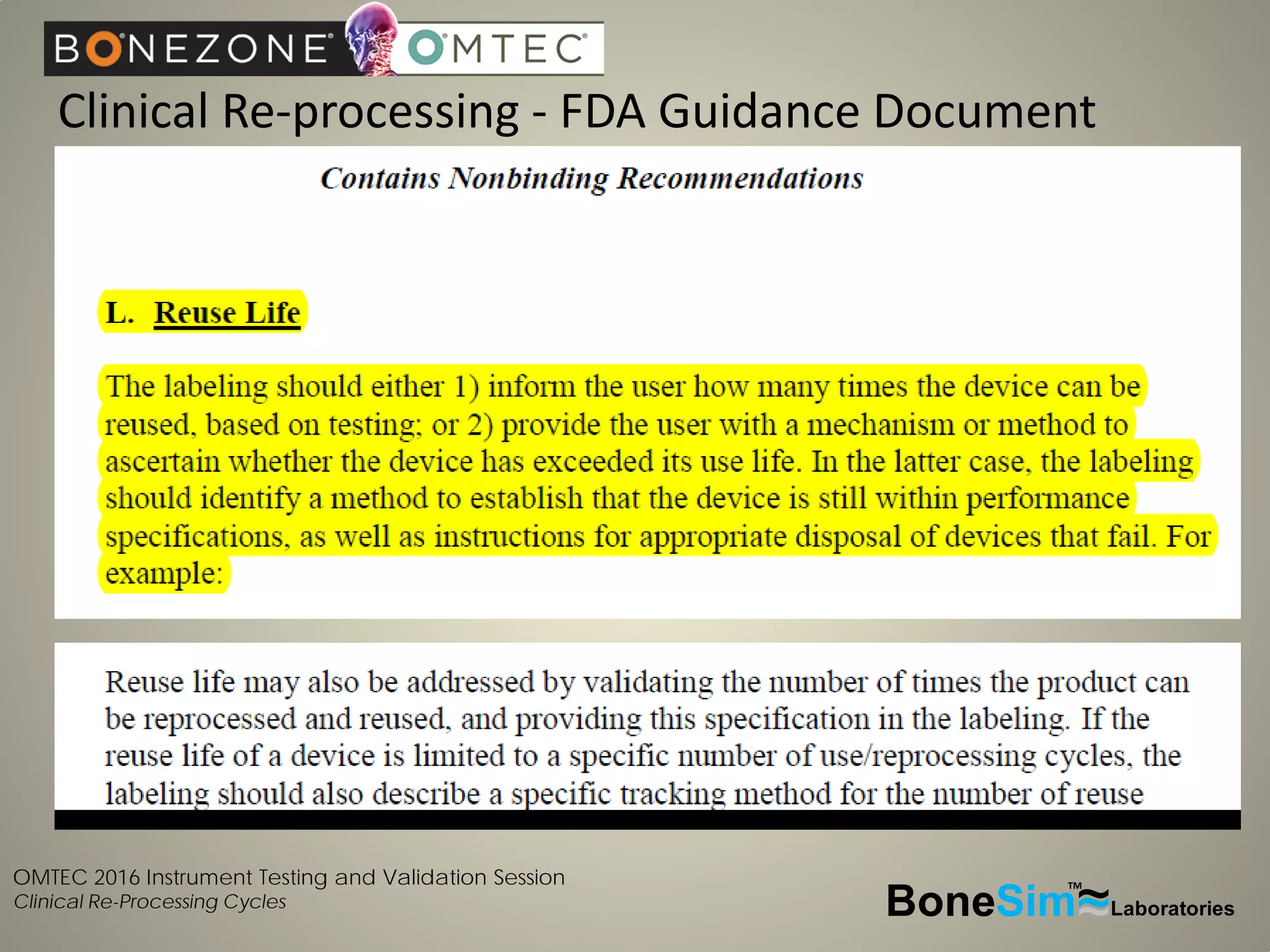
Clinical Re-processing - FDA Guidance Document
BoneSim Laboratories~~~
TM
OMTEC 2016 Instrument Testing and Validation Session
Clinical Re-Processing Cycles
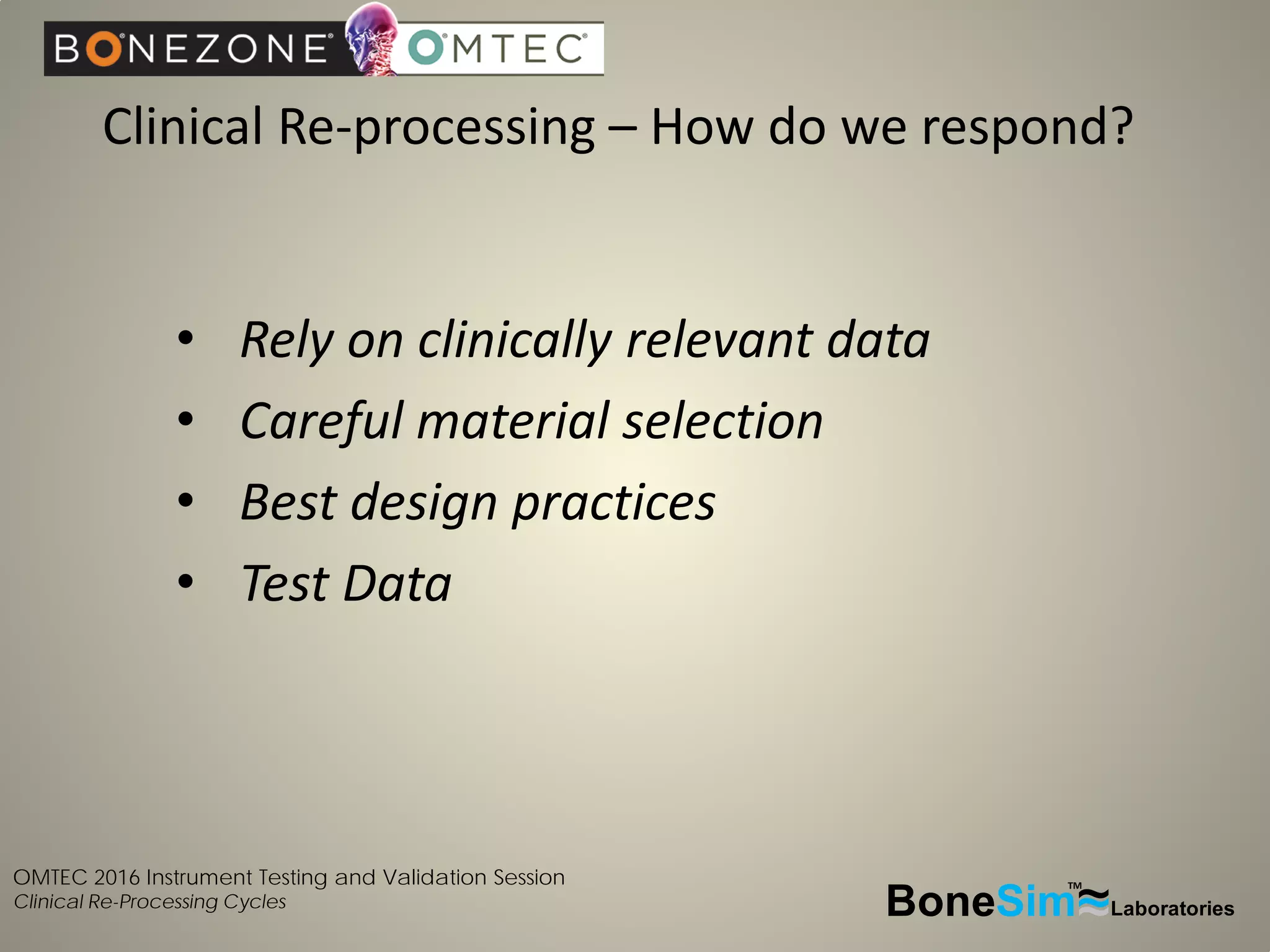
Clinical Re-processing – How do we respond?
BoneSim Laboratories~~~
TM
• Rely on clinically relevant data
• Careful material selection
• Best design practices
• Test Data
OMTEC 2016 Instrument Testing and Validation Session
Clinical Re-Processing Cycles
Clinical Re-processing
BoneSim Laboratories~~~
TM
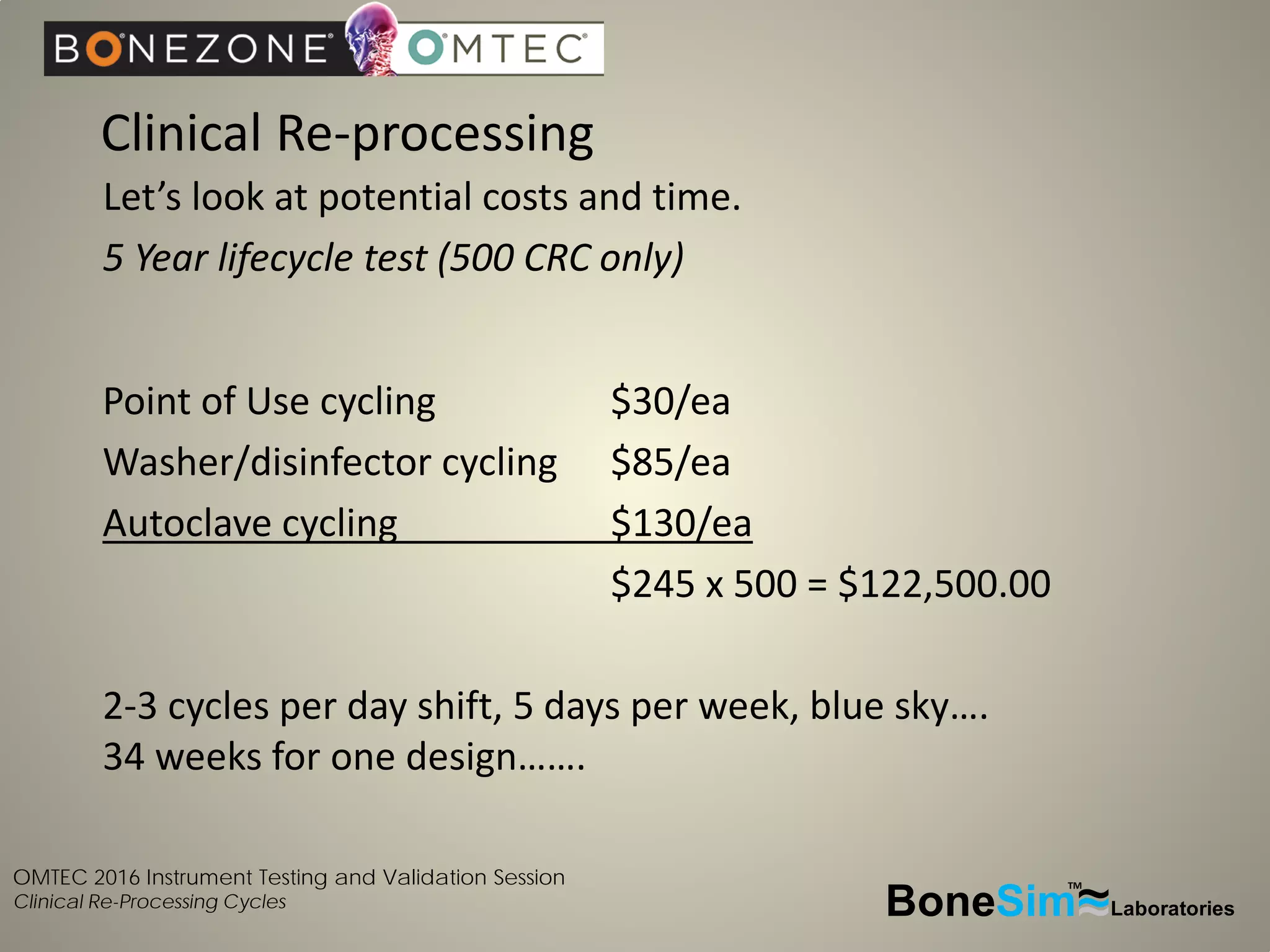
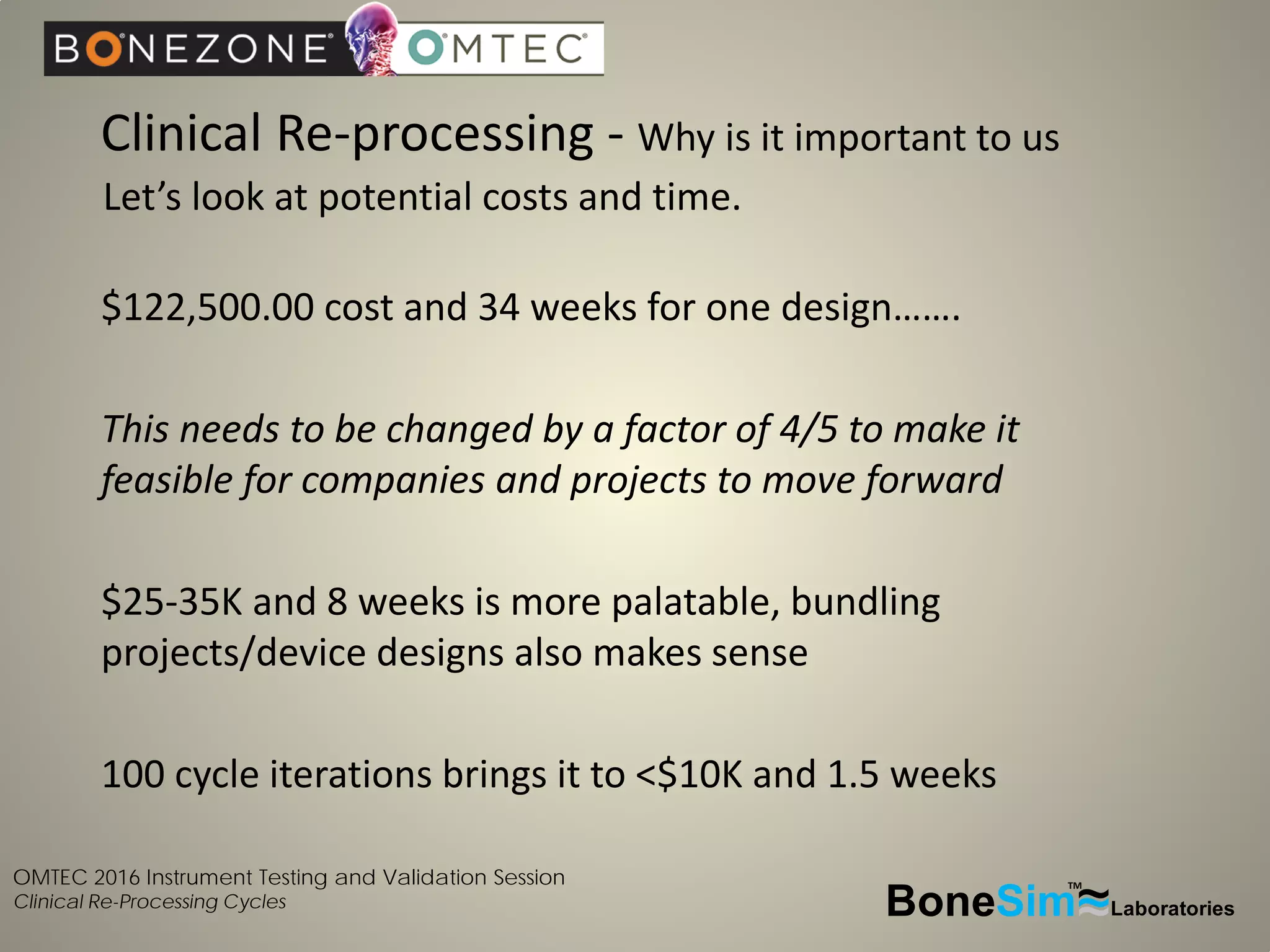
Let’s look at potential costs and time.
5 Year lifecycle test (500 CRC only)
Point of Use cycling $30/ea
Washer/disinfector cycling $85/ea
Autoclave cycling $130/ea
$245 x 500 = $122,500.00
2-3 cycles per day shift, 5 days per week, blue sky….
34 weeks for one design…….
OMTEC 2016 Instrument Testing and Validation Session
Clinical Re-Processing Cycles
Clinical Re-processing - Why is it important to us
BoneSim Laboratories~~~
TM
Let’s look at potential costs and time.
$122,500.00 cost and 34 weeks for one design…….
This needs to be changed by a factor of 4/5 to make it
feasible for companies and projects to move forward
$25-35K and 8 weeks is more palatable, bundling
projects/device designs also makes sense
100 cycle iterations brings it to <$10K and 1.5 weeks
OMTEC 2016 Instrument Testing and Validation Session
Clinical Re-Processing Cycles
Clinical Re-processing Cycles (CRC)
BoneSim Laboratories~~~
TM
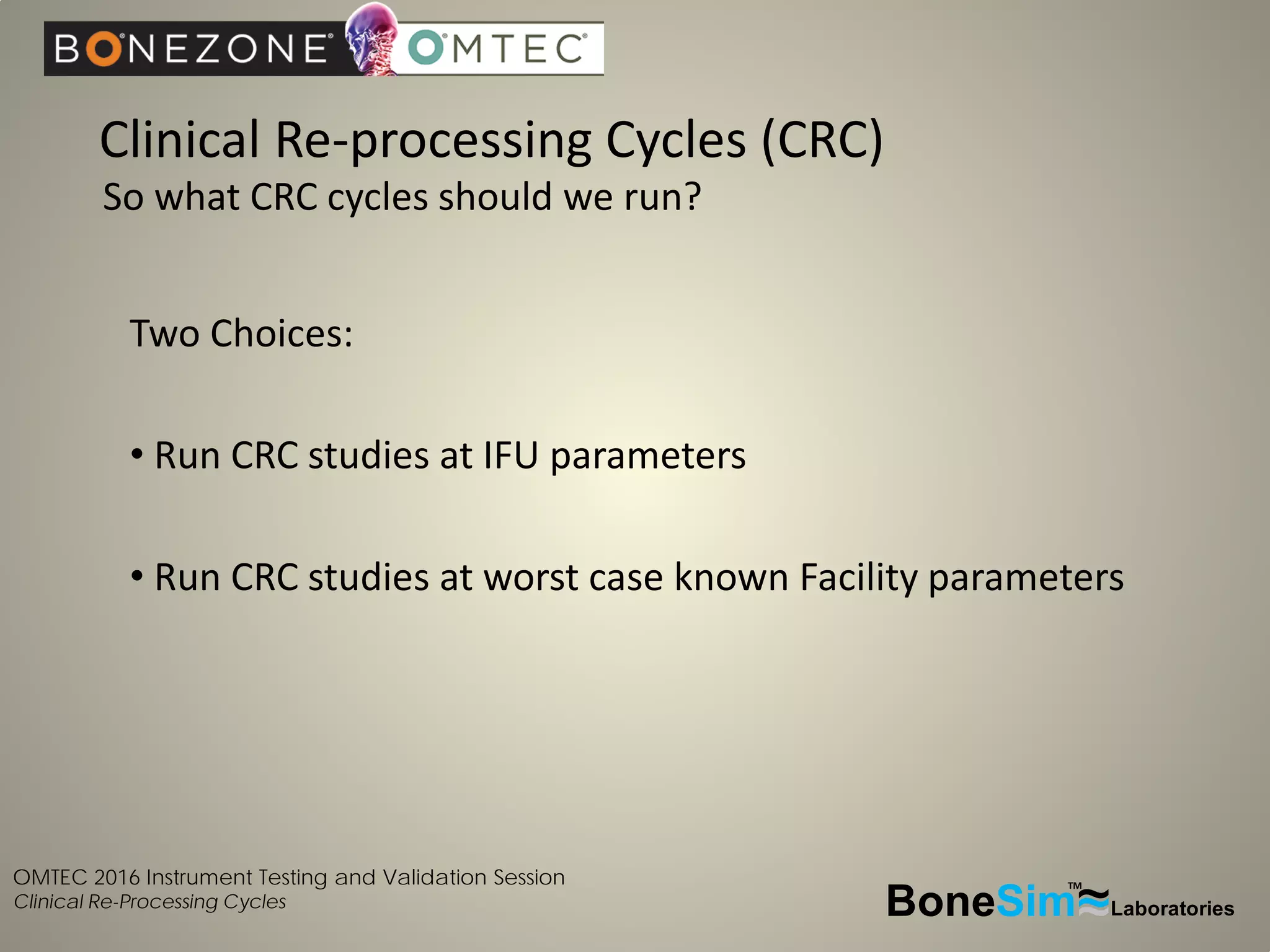
Two Choices:
• Run CRC studies at IFU parameters
• Run CRC studies at worst case known Facility parameters
So what CRC cycles should we run?
OMTEC 2016 Instrument Testing and Validation Session
Clinical Re-Processing Cycles
Clinical Re-processing Cycles (CRC)
BoneSim Laboratories~~~
TM
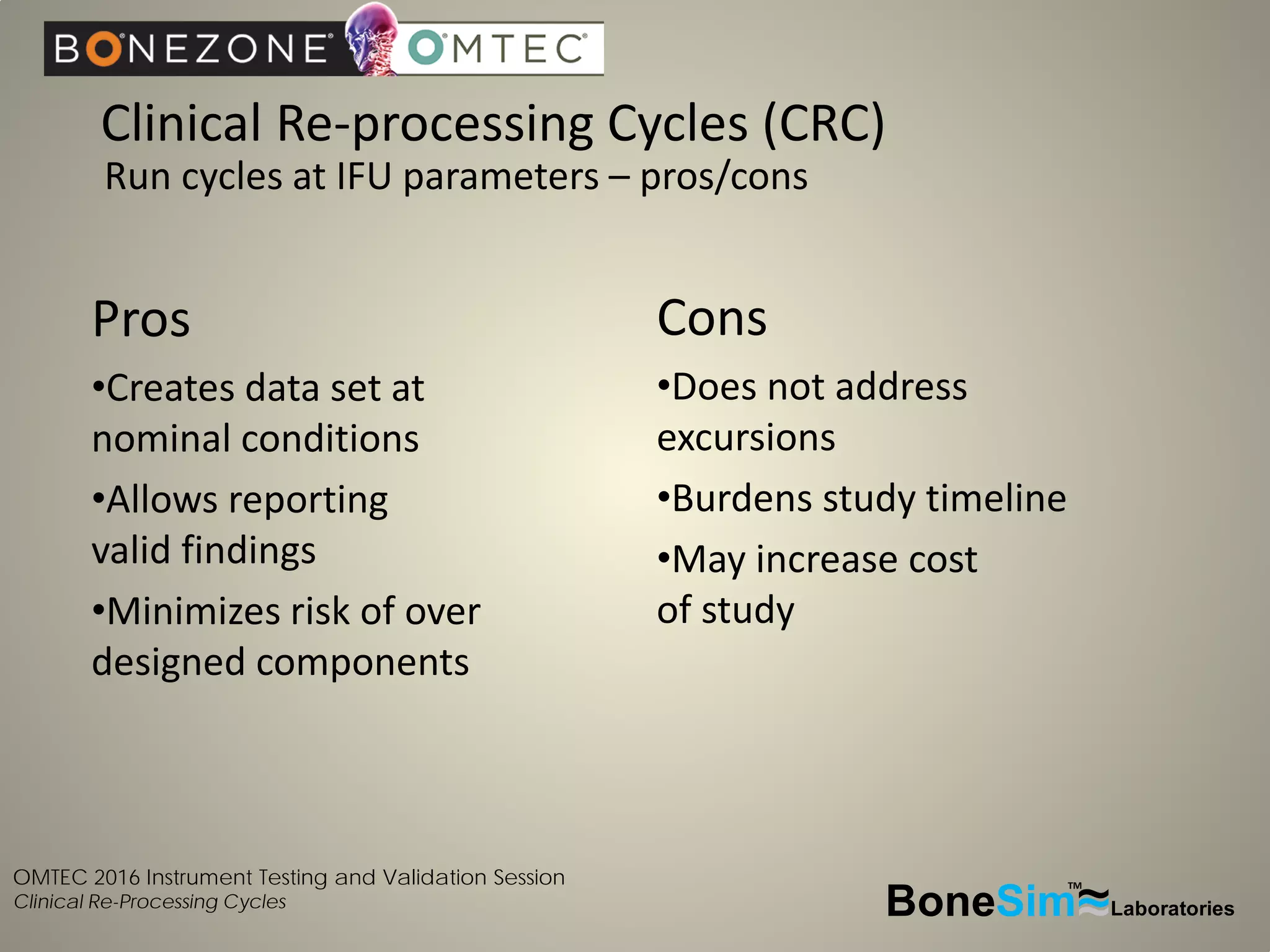
Pros
•Creates data set at
nominal conditions
•Allows reporting
valid findings
•Minimizes risk of over
designed components
Run cycles at IFU parameters – pros/cons
Cons
•Does not address
excursions
•Burdens study timeline
•May increase cost
of study
OMTEC 2016 Instrument Testing and Validation Session
Clinical Re-Processing Cycles BoneSim Laboratories~~~
TM
Pros
•Creates data set at worst
case conditions (maybe)
•Minimizes risk of failures
from facilities over
processing
•Allows standards to be
set for CRC
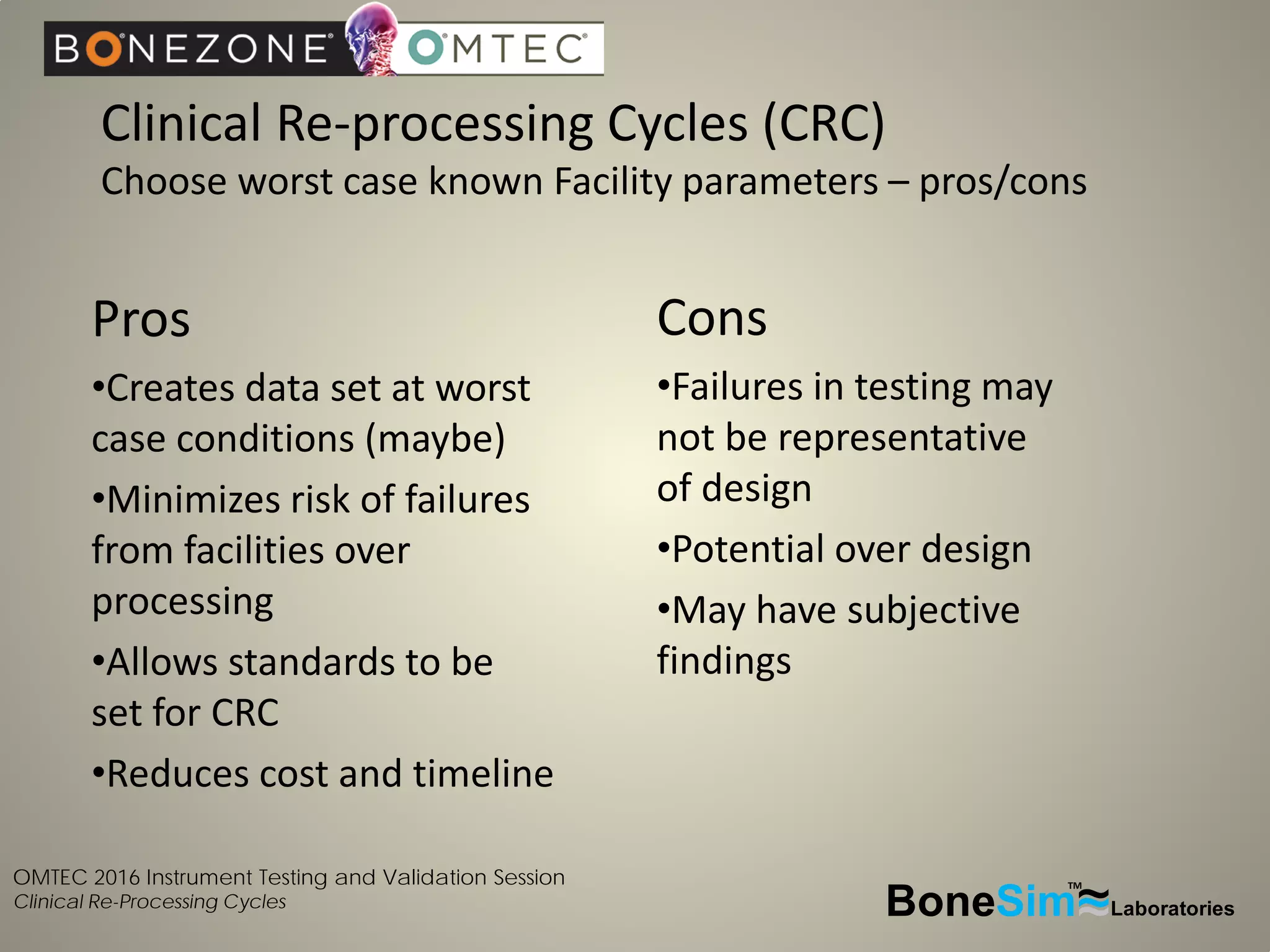
•Reduces cost and timeline
Choose worst case known Facility parameters – pros/cons
Cons
•Failures in testing may
not be representative
of design
•Potential over design
•May have subjective
findings
Clinical Re-processing Cycles (CRC)
OMTEC 2016 Instrument Testing and Validation Session
Clinical Re-Processing Cycles BoneSim Laboratories~~~
TM
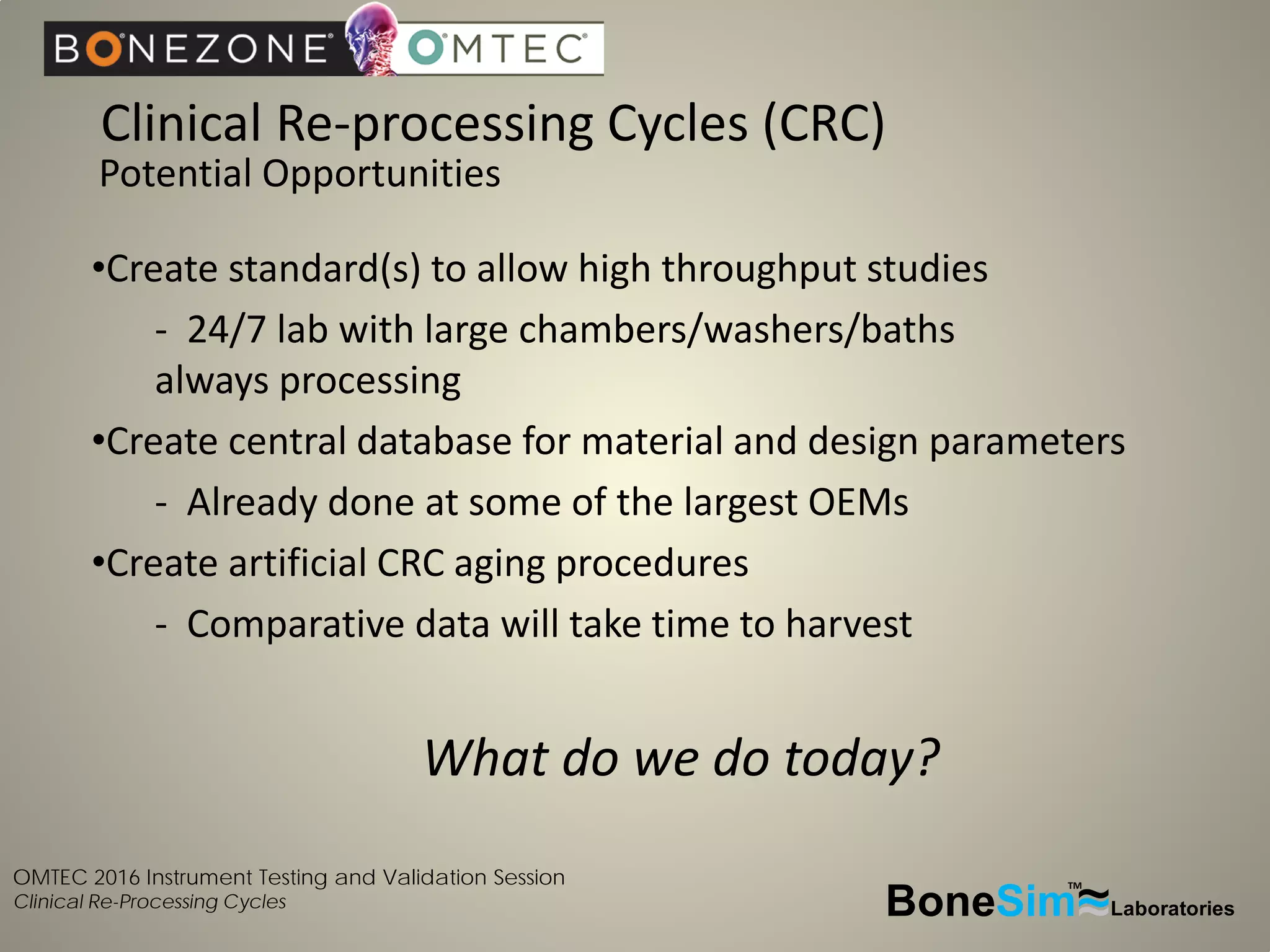
•Create standard(s) to allow high throughput studies
- 24/7 lab with large chambers/washers/baths
always processing
•Create central database for material and design parameters
- Already done at some of the largest OEMs
•Create artificial CRC aging procedures
- Comparative data will take time to harvest
What do we do today?
Clinical Re-processing Cycles (CRC)
Potential Opportunities
OMTEC 2016 Instrument Testing and Validation Session
Clinical Re-Processing Cycles
Clinical Re-processing – Bonesim Laboratories
BoneSim Laboratories~~~
TM
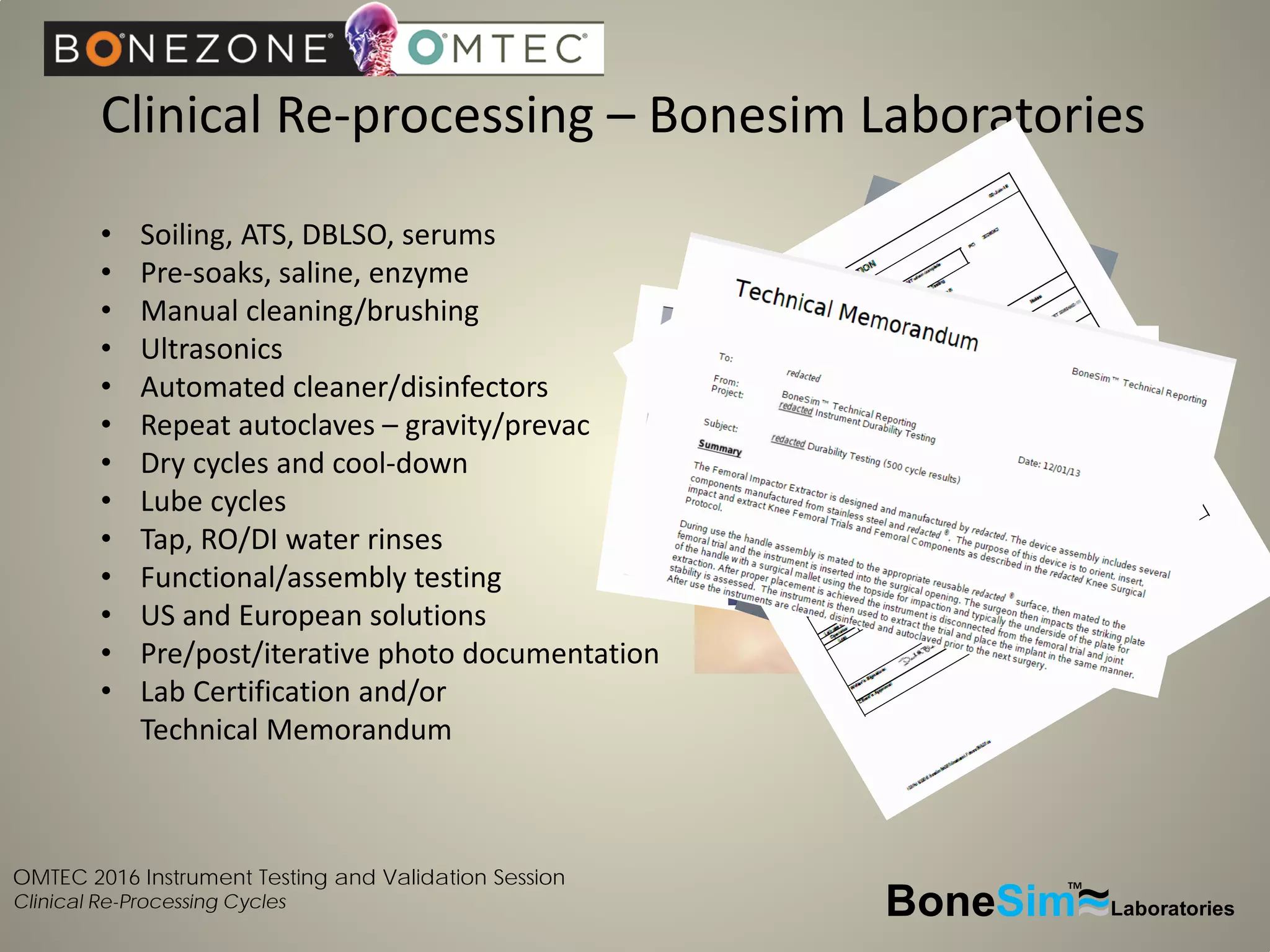
• Soiling, ATS, DBLSO, serums
• Pre-soaks, saline, enzyme
• Manual cleaning/brushing
• Ultrasonics
• Automated cleaner/disinfectors
• Repeat autoclaves – gravity/prevac
• Dry cycles and cool-down
• Lube cycles
• Tap, RO/DI water rinses
• Functional/assembly testing
• US and European solutions
• Pre/post/iterative photo documentation
• Lab Certification and/or
Technical Memorandum
OMTEC 2016 Instrument Testing and Validation Session
Clinical Re-Processing Cycles BoneSim Laboratories~~~
TM
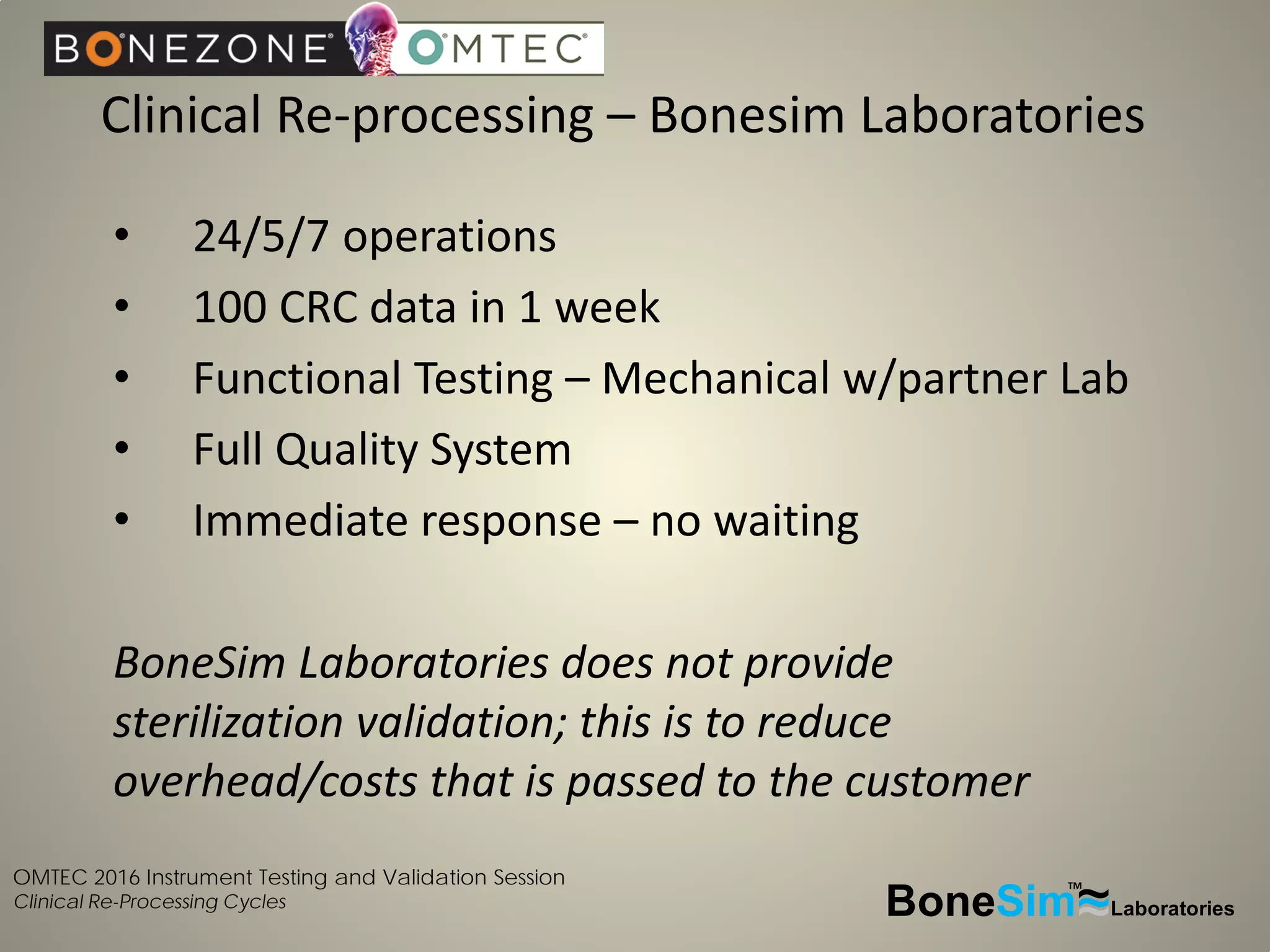
• 24/5/7 operations
• 100 CRC data in 1 week
• Functional Testing – Mechanical w/partner Lab
• Full Quality System
• Immediate response – no waiting
BoneSim Laboratories does not provide
sterilization validation; this is to reduce
overhead/costs that is passed to the customer
Clinical Re-processing – Bonesim Laboratories
OMTEC 2016 Instrument Testing and Validation Session
Clinical Re-Processing Cycles BoneSim Laboratories~~~
TM
Thank You
OMTEC 2016 Instrument Testing and Validation Session
Clinical Re-Processing Cycles
Clinical Re-processing Definition
• But as we move on, we find an abundance of articles addressing biofilm and prions, including the
increased risk posed by the breakdown of surgical instruments’ passivation layer, leading to the
formation of corrosion and rust, giving way to hidden microbial growth. It’s been well documented that
surface corrosion will harbor microorganisms that can be reanimated after sterilization and cause
nosocomial (hospital) infections. Ref. http://www.csspdmanager.com/photo6_1.html
•As a result, there is no one process that is followed from state to state, let alone hospital to hospital. At
annual conferences we hear the complaints over and over again, but keep accepting the fact that we do
not follow the same process. The recommendations have been written by AAMI, ANSI, AORN, and OSHA
as to what we should be doing, but can be interpreted in many ways
•Moreover, there are some that add phosphoric acid rust and stain removers by the gallon to their sonic
washers with little understanding as to the damage this causes to the passivation layer on stainless steel
surgical instruments. Neither sonic or washer are designed to handle these types of process, let alone
the surgical instruments.
BoneSim Laboratories~~~
TM
June 15, 2016
Kevin J. Knight
Knight Mechanical Testing
 Focus Today:
 Reusable instruments
 Class I devices, no published ASTM/ISO test methods
 Surgical instruments that are designed to be cleaned, sterilized,
and reused for subsequent surgeries
 Typical materials:
 Stainless steel:17-4PH, 18-8, 316L, high strength alloys
 Durable polymers: PEEK, silicone, Radel®, Delrin
 Three categories of instruments generally tested:
 Impaction instruments
 Torsional drivers
 Cutting instruments
2
3
 Instruments engineered with impact in mind:
 Broach/Rasp Handles
 Impactors (cup, femoral knee)
 Abusive environment
 Impact forces range from 500lb (placement) to 6000 lb
(seating) intraoperatively
 Repetitive assembly/disassembly, cleaning, autoclave
 Many points of potential failure
 Numerous small welds
 Springs, detents, u-joints, locking features, screw threads
 Etchings, ID, tolerances
 MAUDE Database Reported Failures
 Broach Handle: “During surgery the broach handle
disengaged. The ball bearing and spring came out.
The ball bearing fell into the patient.”
 Cup Impactor: “Intraoperatively, the impaction plate
broke.”
 Femoral Impactor: “The impactor broke during
impaction of the femoral trial.”
4
 Cyclic impact testing
 Impact forces based off of literature or bench
testing (3000 lb – 6000 lb)
 Typical cycle life requirement = 5000 up to 20,000
impact cycles (typical 5 year life)
 Impacts interspersed with disassembly, cleaning,
and sterilization to simulate use
 Post-test NDT (dye penetrant) to inspect for
invisible failures
5
6
 Impact testing failure examples:
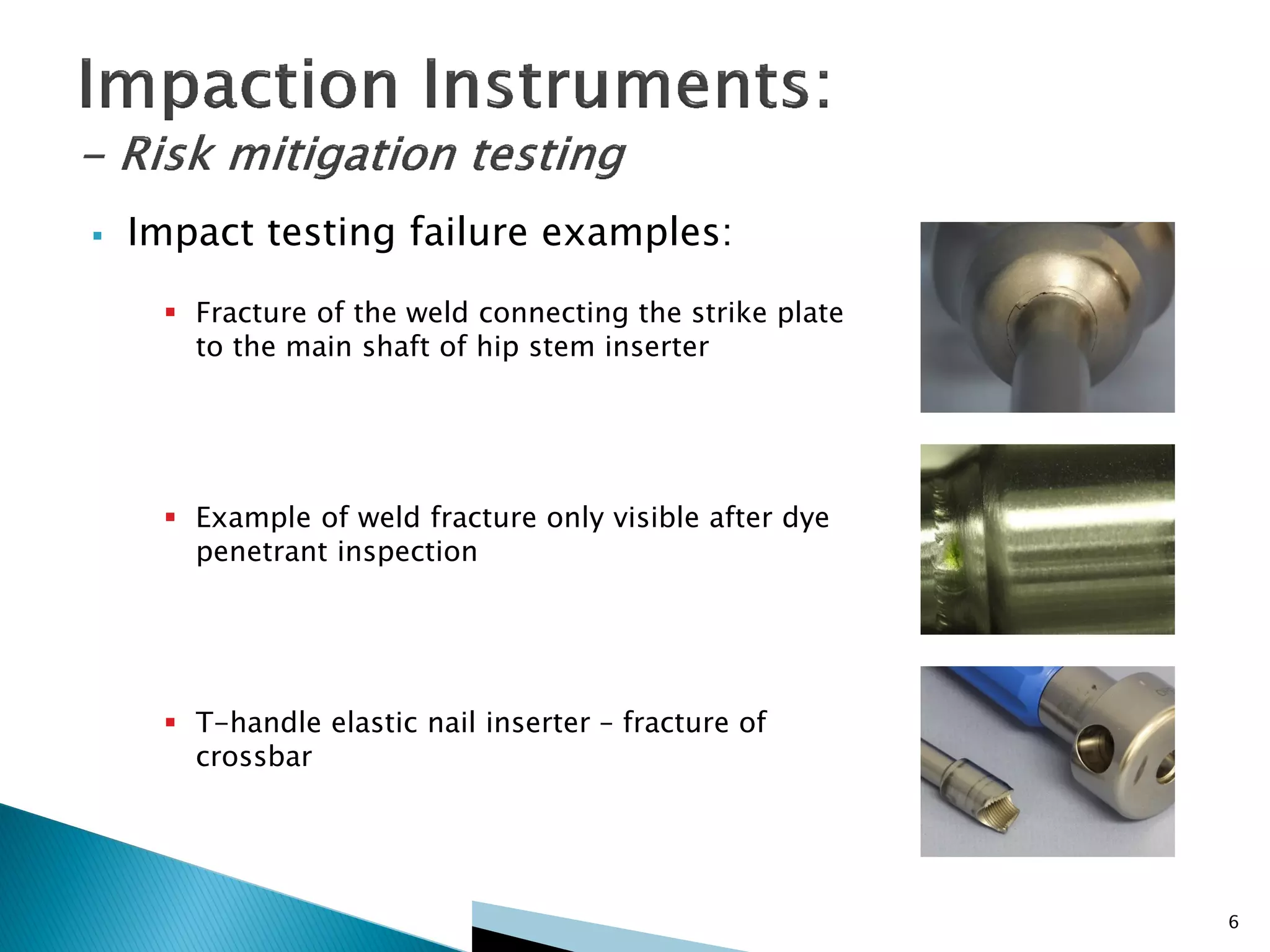
 Fracture of the weld connecting the strike plate
to the main shaft of hip stem inserter
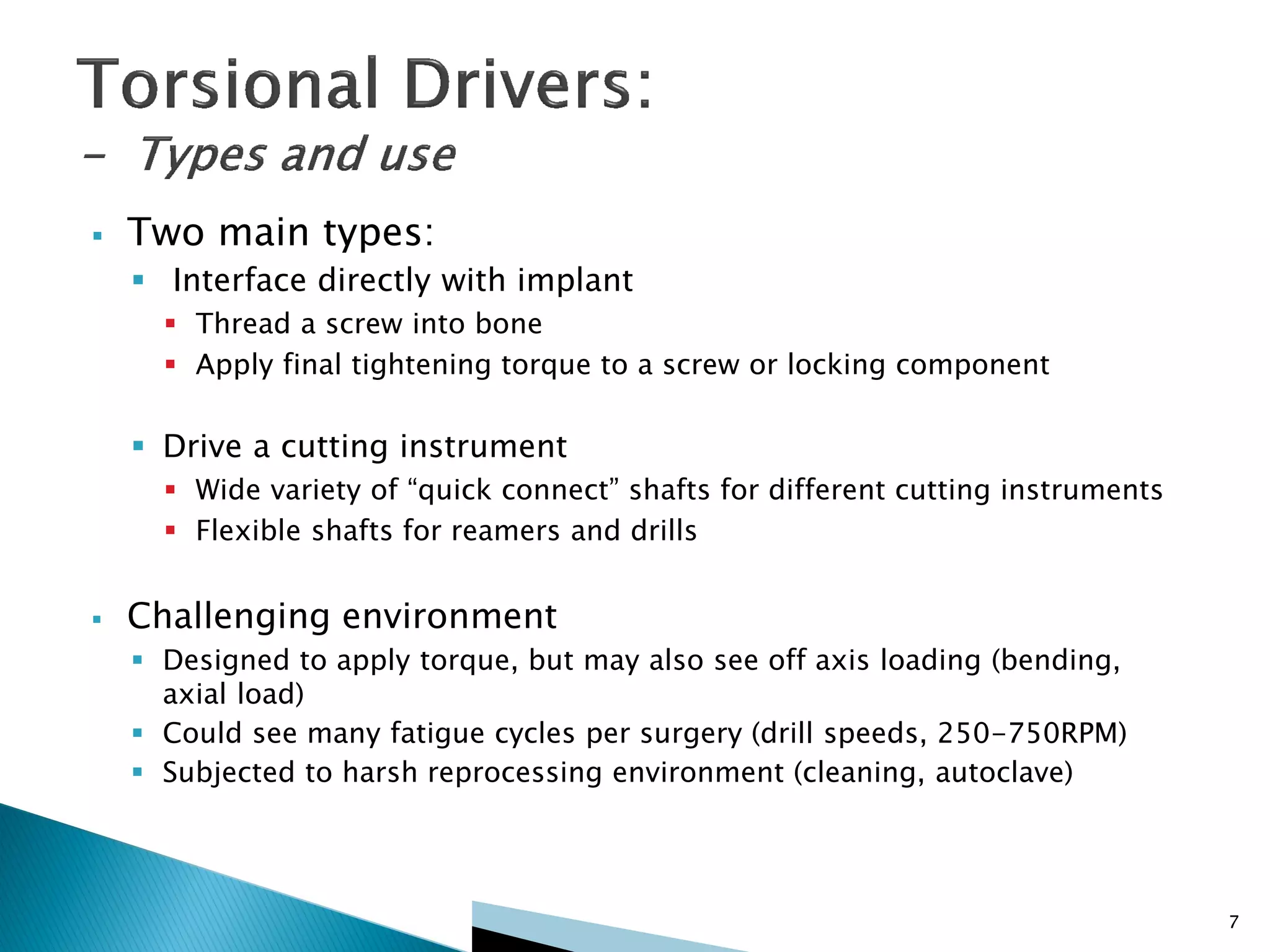
 Example of weld fracture only visible after dye
penetrant inspection
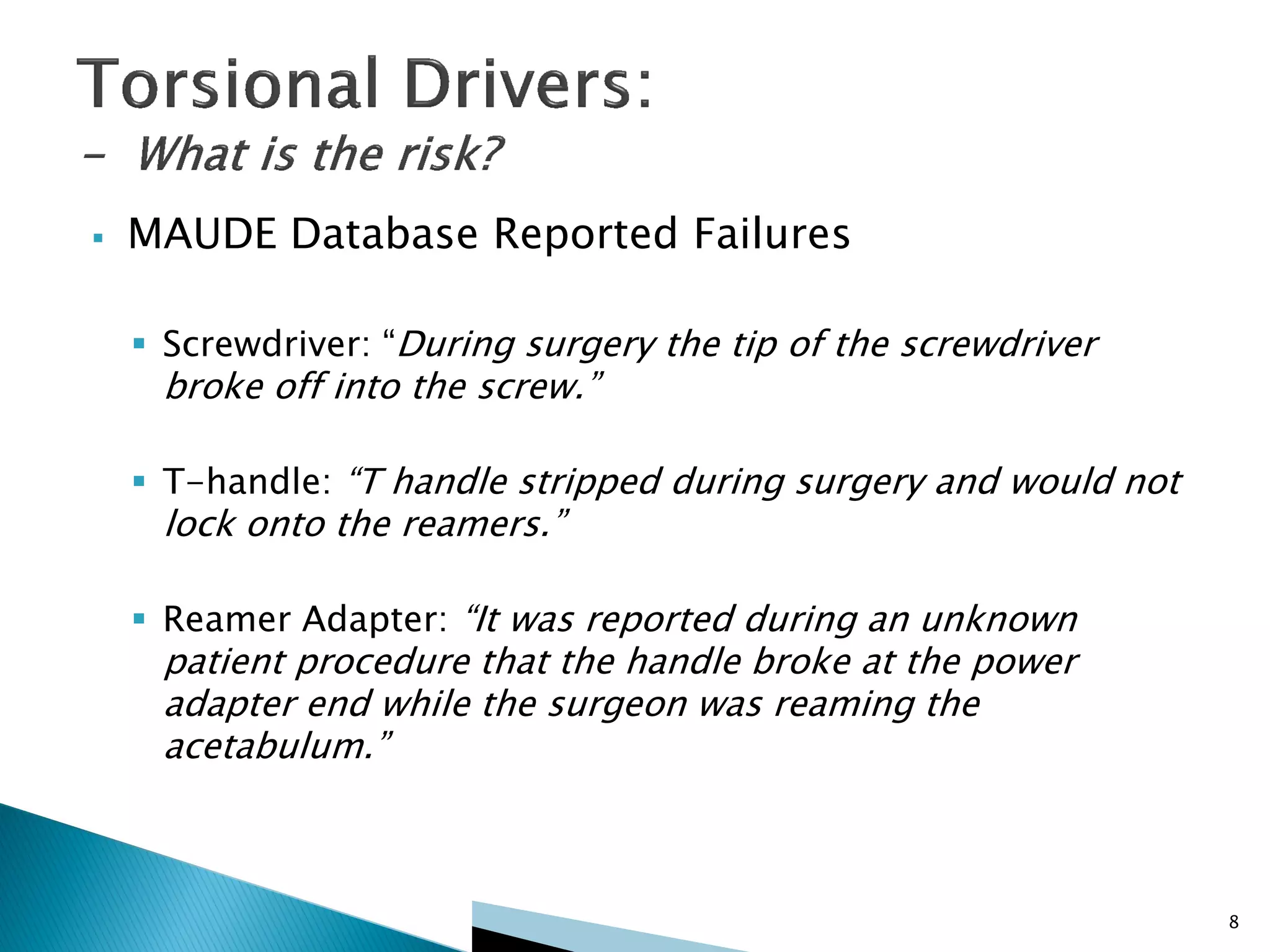
 T-handle elastic nail inserter – fracture of
crossbar
7
 Two main types:
 Interface directly with implant
 Thread a screw into bone
 Apply final tightening torque to a screw or locking component
 Drive a cutting instrument
 Wide variety of “quick connect” shafts for different cutting instruments
 Flexible shafts for reamers and drills
 Challenging environment
 Designed to apply torque, but may also see off axis loading (bending,
axial load)
 Could see many fatigue cycles per surgery (drill speeds, 250-750RPM)
 Subjected to harsh reprocessing environment (cleaning, autoclave)
 MAUDE Database Reported Failures
 Screwdriver: “During surgery the tip of the screwdriver
broke off into the screw.”
 T-handle: “T handle stripped during surgery and would not
lock onto the reamers.”
 Reamer Adapter: “It was reported during an unknown
patient procedure that the handle broke at the power
adapter end while the surgeon was reaming the
acetabulum.”
8
 Repetitive torque testing for screwdrivers and torque
setting devices
 Special attention paid to wear of tip over time, as well as functionality of screw
retention features
 Torsional ultimate strength testing for torsional
drivers to ensure expected torque load is within
linear elastic range
 Rotational testing for instruments and adapters
driven by powered drills
 Internal components effected by repetitive re-
processing, liquid intrusion, wear, galling, etc.
9
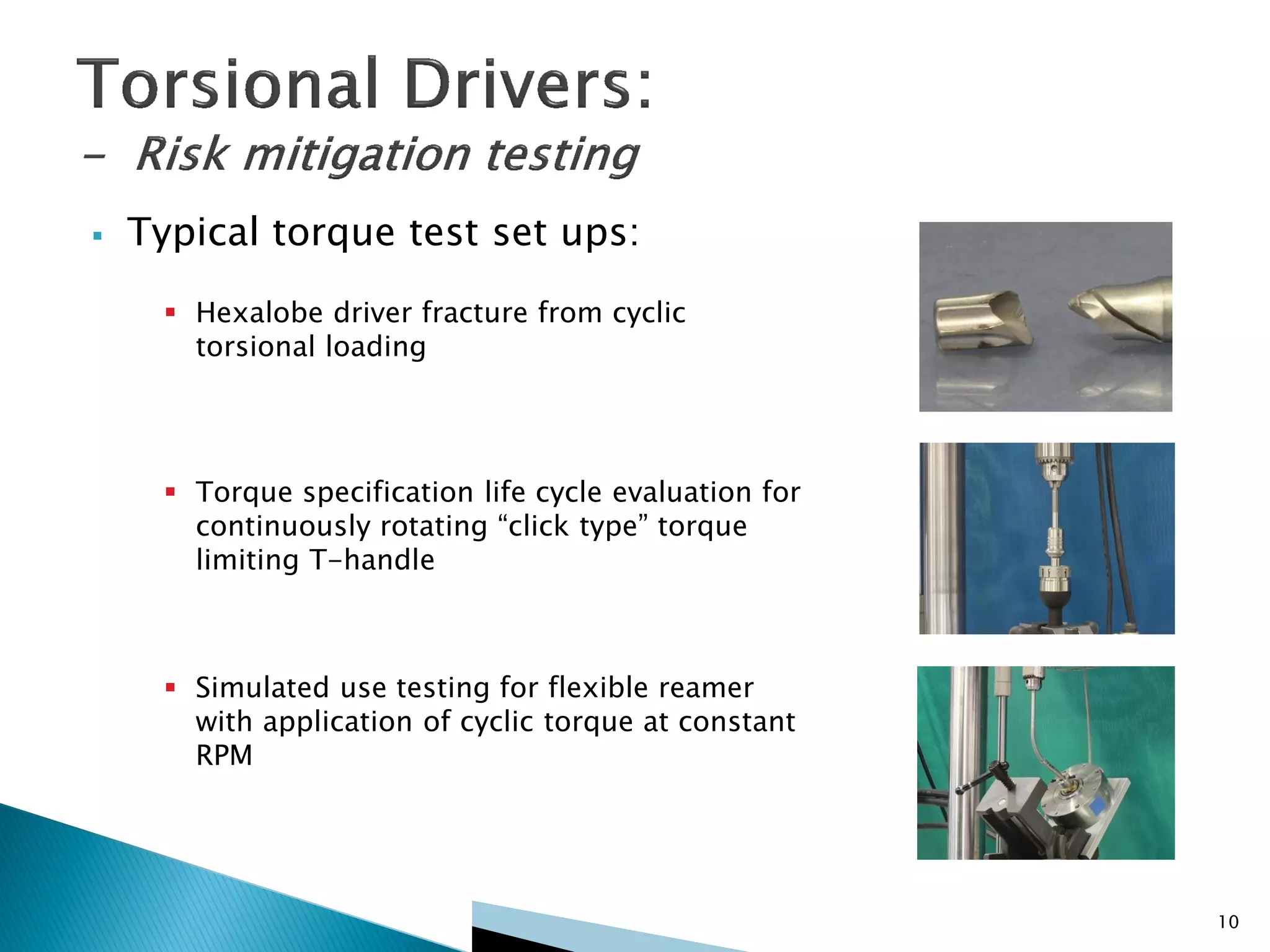
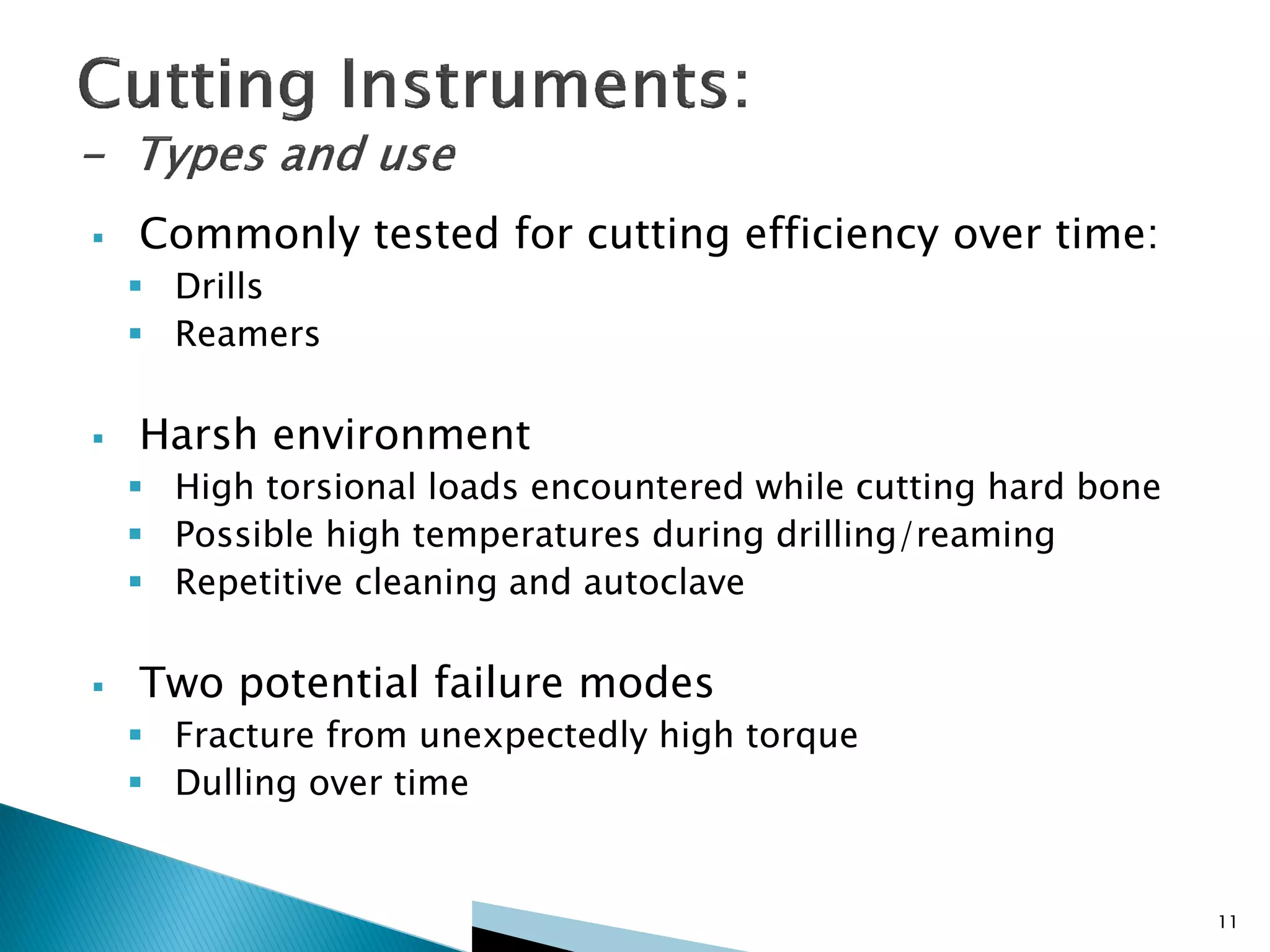
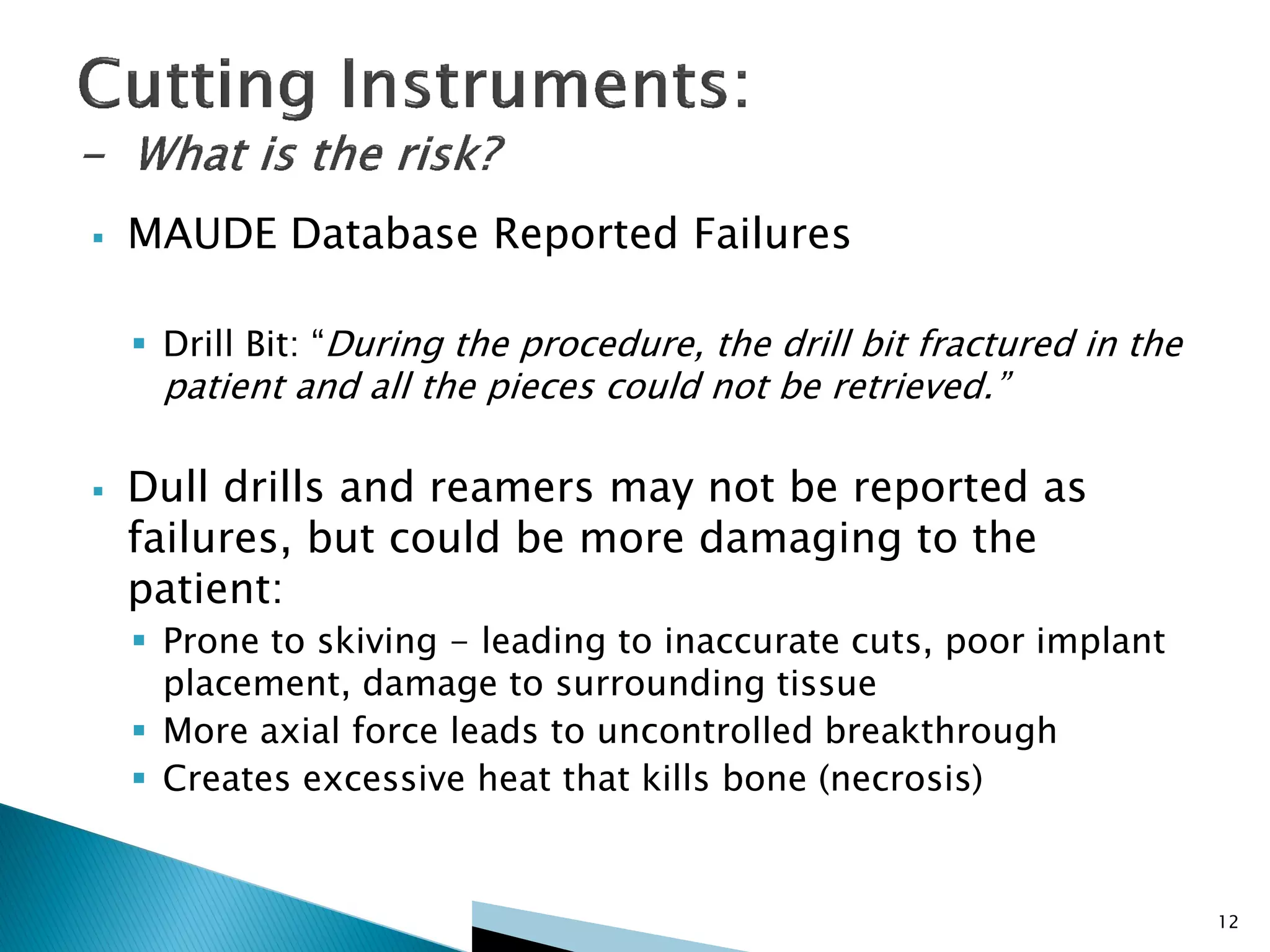
 Typical torque test set ups:
 Hexalobe driver fracture from cyclic
torsional loading
 Torque specification life cycle evaluation for
continuously rotating “click type” torque
limiting T-handle
 Simulated use testing for flexible reamer
with application of cyclic torque at constant
RPM
10
11
 Commonly tested for cutting efficiency over time:
 Drills
 Reamers
 Harsh environment
 High torsional loads encountered while cutting hard bone
 Possible high temperatures during drilling/reaming
 Repetitive cleaning and autoclave
 Two potential failure modes
 Fracture from unexpectedly high torque
 Dulling over time
 MAUDE Database Reported Failures
 Drill Bit: “During the procedure, the drill bit fractured in the
patient and all the pieces could not be retrieved.”
 Dull drills and reamers may not be reported as
failures, but could be more damaging to the
patient:
 Prone to skiving - leading to inaccurate cuts, poor implant
placement, damage to surrounding tissue
 More axial force leads to uncontrolled breakthrough
 Creates excessive heat that kills bone (necrosis)
12
 Testing consists of repetitive cutting cycles in bone
analog
 Appropriate bone analog should be chosen:
 Bovine or porcine bone is often used to get an close approximation of
actual cutting forces encountered, but is not appropriate for high
volume testing
 Sawbones foam – most commonly used, readily available and relatively
inexpensive. Variety of densities to roughly approximate differing types
and quality of bone but with polymer (local melting) limitations.
 BoneSim bone analog – Expensive, but better approximation of cortical
and cancellous bone properties, and more amenable to high volume
testing than animal bone
 Cutting efficiency can be characterized with axial force, torsional
load, and/or resulting feed rate
 Can be evaluated prior to and following repetitive cutting cycles, or
monitored continuously
13
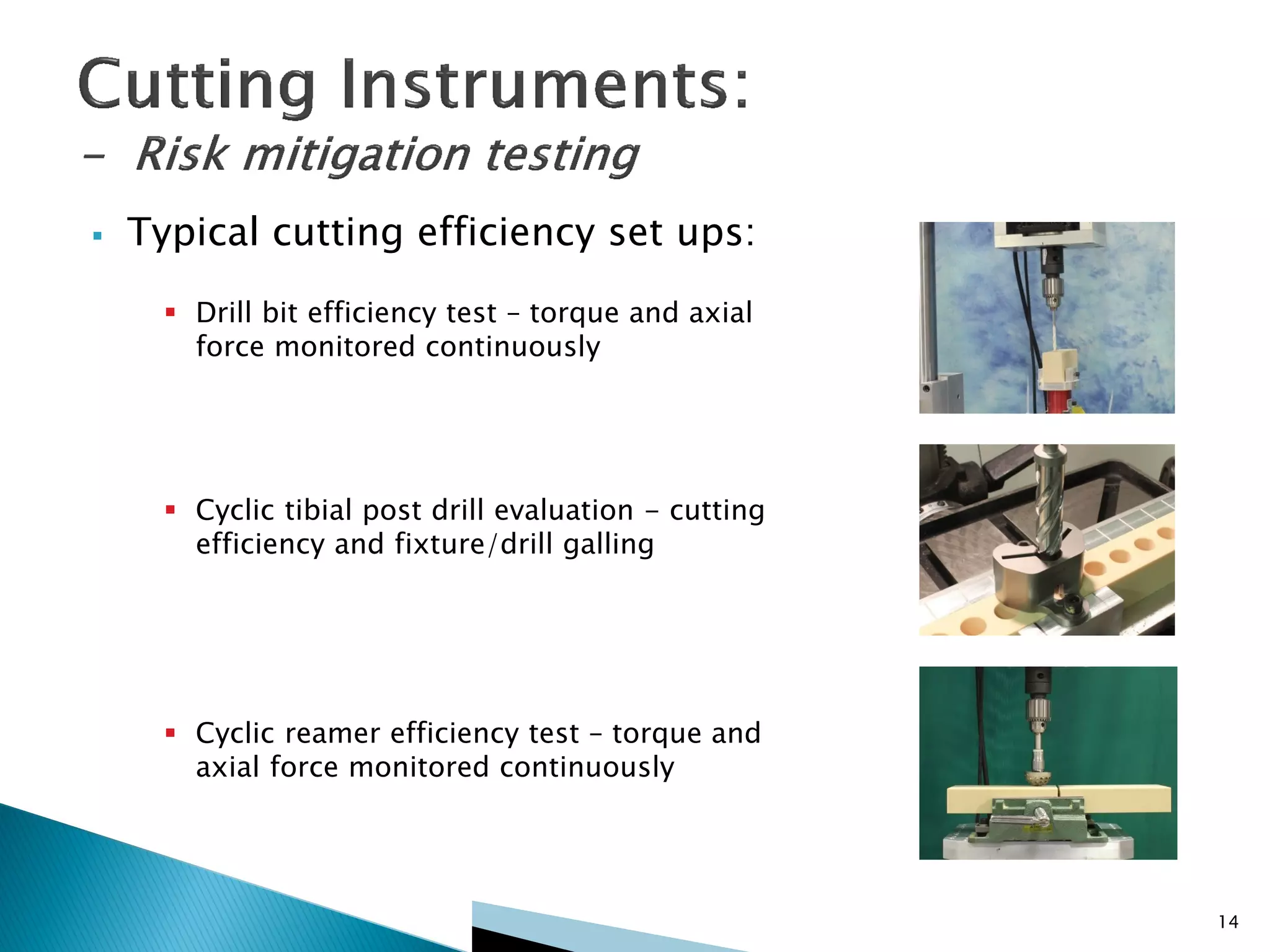
 Typical cutting efficiency set ups:
 Drill bit efficiency test – torque and axial
force monitored continuously
 Cyclic tibial post drill evaluation - cutting
efficiency and fixture/drill galling
 Cyclic reamer efficiency test – torque and
axial force monitored continuously
14
Instrument Testing and Validation

Instrument Testing and Validation

  • 2.
    Testing and Validationof Disposable / Single- Procedure Surgical Instruments & Procedural Kits By James B. Schultz Executive Vice President 1
  • 3.
    Disposables in theO.R.– The Way of the Future  Advent of single-procedure torque-limiting, fixed driver and related instruments and procedural kits offers viable substitute or alternative today  Clinical and economic value realized  Pristine instrument set for every surgery  Perfect instrument calibration  Eliminate re-processing costs/hassles  Annuity revenue potential  Customized products tailored to OEM specifications  Applied across all ortho implants—both new and legacy product lines  Embraced by major ortho/spine OEMs  A value add solution for ASCs with high volume, low complexity procedures and emerging markets instrumentation  23M surgeries per year at ASCs and over 18% are ortho/spine 2
  • 4.
    Disposable instrument andsterile-pack kit adoption 3 Products Indication Spine Extremity Trauma
  • 5.
    Sterile-Packed Surgery ReadyInstruments & Kits 4
  • 6.
    ECA’s Product Design& Development Engineering Stage Book/Step Process 5
  • 7.
    Sterile-Packed Instrument KitTesting & Validations Example of a 100% Disposable Sterile-Packed Procedural Kit Testing & Validations ECA’s Intelligent Implant Systems Revolution® Spinal Implant Kit  FDA-approved complete spinal implant instrumentation kit that is 100% disposable  Reduced 4 trays and 40 instruments to 11 instruments in one sterile-pack tray for single & 2 level fusions  Instrument EVT and DVT testing Packaging, Transportation, Aging and Bio/Cyto Validations  Listed with FDA  CE Mark ready  Product in market since Sept 2015 with scores of successful surgeries Pedicle Probe Bi-directional cannulated ratchet Torque Limiter Offset T-Handle Counter Torque Shaft Template Compression Distraction Shaft Fixed Driver T-Handle Introducer Sounder Bone Awl Nut Driver Shaft 6
  • 8.
    Key Reliability andValidation Tests  Design verification  Engineering Validation Test (EVT) and Design Verification Test (DVT) stages of development, proto builds, pilot runs, vendor selection, BOM freeze  Design validation  Validate production equivalency, customer V&V testing  Packaging validation  Sterile Barrier Systems (SBS) baseline (tray/lid) includes bubble, peel testing  Distribution testing  Distribution to ISTA 2 standard  Sterilization validation  Validate to SAL 10-6 with gamma, ISO standard compliance  Assembled in ISO Class 7 cleanroom 7
  • 9.
    Key Reliability andValidation Tests  Biocompatibility testing  FTIR, LAL and TOC  Corrosion resistance testing for stainless steel components  Citric or nitric passivation and immersion testing  Aging of packaging and instrumentation  2 year or more shelf life for packaging and instruments  NPI production hand-off  cGMP mass production implemented 8
  • 10.
    Design & DevelopmentProcess Includes Simulation, Automated and Manual Testing 9 FEA testing Manual Torque testing Shaft/driver Torsion testingAutomated Torque testing
  • 11.
    Summary  Disposable instrumentsand procedural kits undergo comprehensive PD process to meet quality and regulatory / compliance requirements  Clinical robustness  DFMEA, PFMEA  Product Development Stage Gates  Design Inputs & Outputs  Validation and Verification testing  Full validations/reports & documentation (aging, bio/cyto, packaging, sterilization, transportation, labels, cleaning process, etc.)  OEM Checklists  NPI and cGMP process / handoffs  Pilot production  Manufacturer of Record, Traceability  Pristine instrument or procedural kit for every surgery and patient 10
  • 12.
    CONFIDENTIAL ECA MEDICALINSTRUMENTS 11 ECA Medical Instruments Corporate Headquarters 2193 Anchor Court Thousand Oaks, CA 91320 USA Tel: +1 (805) 376-2509 Fax: +1 (805) 376-2189 www.ecamedical.com Thank You!
  • 13.
    Instrument Testing andValidation Session Clinical Re-Processing Cycles June 15, 2016 David M. Blakemore BoneSim Laboratories BoneSim Laboratories~~~ TM
  • 14.
    OMTEC 2016 InstrumentTesting and Validation Session Clinical Re-Processing Cycles Agenda: • What is Clinical Re-processing • Why is it important • How does it affect us • How do we respond BoneSim Laboratories~~~ TM
  • 15.
    OMTEC 2016 InstrumentTesting and Validation Session Clinical Re-Processing Cycles Clinical Re-processing Definition • Moving a surgical instrument from patient to patient. BoneSim Laboratories~~~ TM
  • 16.
    OMTEC 2016 InstrumentTesting and Validation Session Clinical Re-Processing Cycles Clinical Re-processing Definition • Moving a surgical instrument from patient to patient. • Identification and preparation • Surgical Use • Cleaning and Sterilization • Storage BoneSim Laboratories~~~ TM
  • 17.
    OMTEC 2016 InstrumentTesting and Validation Session Clinical Re-Processing Cycles Clinical Re-processing Cycles (CRC) •Instruments are Identified, Inspected, Functionally checked and placed on OR/Mayo stand •FDA calls this the Point Of Use Processing BoneSim Laboratories~~~ TM
  • 18.
    OMTEC 2016 InstrumentTesting and Validation Session Clinical Re-Processing Cycles Clinical Re-processing Cycles (CRC) BoneSim Laboratories~~~ TM • Point of use The next speakers will cover much of the this subject but suffice it to say that it is put thru its paces. • Surgical intervention • Mechanical loading, bending, torque, axial, etc. • Exposure to blood, lipids, fats, etc. • Then placement in saline or enzyme solution
  • 19.
    OMTEC 2016 InstrumentTesting and Validation Session Clinical Re-Processing Cycles Clinical Re-processing Cycles (CRC) SPD processing (Sterile Processing Department) BoneSim Laboratories~~~ TM •Rinsing •Cleaning - manual Detergent or Enzymatic detergent with manual brushing and removal of debris
  • 20.
    OMTEC 2016 InstrumentTesting and Validation Session Clinical Re-Processing Cycles Clinical Re-processing Cycles (CRC) SPD processing (Sterile Processing Department) BoneSim Laboratories~~~ TM •Cleaning - Ultrasonic Detergent or Enzymatic detergent with high energy cavitation ambient or elevated temperatures
  • 21.
    OMTEC 2016 InstrumentTesting and Validation Session Clinical Re-Processing Cycles Clinical Re-processing Cycles (CRC BoneSim Laboratories~~~ TM •Cleaning/disinfecting - automatic Rinse, enzymatic soak, detergent wash, rinse, heated dry Hospital SPDs use longest, highest temp. cycles when IFU is unclear, not available or considered not to be to their standard.
  • 22.
    OMTEC 2016 InstrumentTesting and Validation Session Clinical Re-Processing Cycles Clinical Re-processing Cycles (CRC) BoneSim Laboratories~~~ TM •Terminal Sterilization autoclave, chemical, ETO, etc. Focusing on steam sterilization Hospital SPDs use longest, highest temp. cycles when IFU is unclear, not available or considered not to be to their standard.
  • 23.
    OMTEC 2016 InstrumentTesting and Validation Session Clinical Re-Processing Cycles Clinical Re-processing Cycles (CRC) - Why is it important to us BoneSim Laboratories~~~ TM Material Selection
  • 24.
    OMTEC 2016 InstrumentTesting and Validation Session Clinical Re-Processing Cycles Clinical Re-processing Cycles (CRC) - Why is it important to us BoneSim Laboratories~~~ TM Processing Instructions i.e., etching, material choice, passivation and passive layer compromise
  • 25.
    OMTEC 2016 InstrumentTesting and Validation Session Clinical Re-Processing Cycles Clinical Re-processing - FDA BoneSim Laboratories~~~ TM Longevity of efficacy and sterility guarantee.
  • 26.
    OMTEC 2016 InstrumentTesting and Validation Session Clinical Re-Processing Cycles Clinical Re-processing - FDA BoneSim Laboratories~~~ TM What’s New in the 2015 Final Guidance(vs the 1996 Guidance) Expanded to include information pertaining to validation of reprocessing methods and instructions • Specific emphasis on importance of proper cleaning & cleaning validation, IMPORTANCE OF WORST-CASE TESTING, importance of device designs that are less challenging to reprocess • Human factors considerations when validating reprocessing methods and instructions • Provides greater clarity on documentation to be provided in the different premarket submissions: 510(k), PMA, de novo, HDE, IDE
  • 27.
    OMTEC 2016 InstrumentTesting and Validation Session Clinical Re-Processing Cycles Clinical Re-processing - FDA Guidance Document BoneSim Laboratories~~~ TM
  • 28.
    OMTEC 2016 InstrumentTesting and Validation Session Clinical Re-Processing Cycles Clinical Re-processing – How do we respond? BoneSim Laboratories~~~ TM • Rely on clinically relevant data • Careful material selection • Best design practices • Test Data
  • 29.
    OMTEC 2016 InstrumentTesting and Validation Session Clinical Re-Processing Cycles Clinical Re-processing BoneSim Laboratories~~~ TM Let’s look at potential costs and time. 5 Year lifecycle test (500 CRC only) Point of Use cycling $30/ea Washer/disinfector cycling $85/ea Autoclave cycling $130/ea $245 x 500 = $122,500.00 2-3 cycles per day shift, 5 days per week, blue sky…. 34 weeks for one design…….
  • 30.
    OMTEC 2016 InstrumentTesting and Validation Session Clinical Re-Processing Cycles Clinical Re-processing - Why is it important to us BoneSim Laboratories~~~ TM Let’s look at potential costs and time. $122,500.00 cost and 34 weeks for one design……. This needs to be changed by a factor of 4/5 to make it feasible for companies and projects to move forward $25-35K and 8 weeks is more palatable, bundling projects/device designs also makes sense 100 cycle iterations brings it to <$10K and 1.5 weeks
  • 31.
    OMTEC 2016 InstrumentTesting and Validation Session Clinical Re-Processing Cycles Clinical Re-processing Cycles (CRC) BoneSim Laboratories~~~ TM Two Choices: • Run CRC studies at IFU parameters • Run CRC studies at worst case known Facility parameters So what CRC cycles should we run?
  • 32.
    OMTEC 2016 InstrumentTesting and Validation Session Clinical Re-Processing Cycles Clinical Re-processing Cycles (CRC) BoneSim Laboratories~~~ TM Pros •Creates data set at nominal conditions •Allows reporting valid findings •Minimizes risk of over designed components Run cycles at IFU parameters – pros/cons Cons •Does not address excursions •Burdens study timeline •May increase cost of study
  • 33.
    OMTEC 2016 InstrumentTesting and Validation Session Clinical Re-Processing Cycles BoneSim Laboratories~~~ TM Pros •Creates data set at worst case conditions (maybe) •Minimizes risk of failures from facilities over processing •Allows standards to be set for CRC •Reduces cost and timeline Choose worst case known Facility parameters – pros/cons Cons •Failures in testing may not be representative of design •Potential over design •May have subjective findings Clinical Re-processing Cycles (CRC)
  • 34.
    OMTEC 2016 InstrumentTesting and Validation Session Clinical Re-Processing Cycles BoneSim Laboratories~~~ TM •Create standard(s) to allow high throughput studies - 24/7 lab with large chambers/washers/baths always processing •Create central database for material and design parameters - Already done at some of the largest OEMs •Create artificial CRC aging procedures - Comparative data will take time to harvest What do we do today? Clinical Re-processing Cycles (CRC) Potential Opportunities
  • 35.
    OMTEC 2016 InstrumentTesting and Validation Session Clinical Re-Processing Cycles Clinical Re-processing – Bonesim Laboratories BoneSim Laboratories~~~ TM • Soiling, ATS, DBLSO, serums • Pre-soaks, saline, enzyme • Manual cleaning/brushing • Ultrasonics • Automated cleaner/disinfectors • Repeat autoclaves – gravity/prevac • Dry cycles and cool-down • Lube cycles • Tap, RO/DI water rinses • Functional/assembly testing • US and European solutions • Pre/post/iterative photo documentation • Lab Certification and/or Technical Memorandum
  • 36.
    OMTEC 2016 InstrumentTesting and Validation Session Clinical Re-Processing Cycles BoneSim Laboratories~~~ TM • 24/5/7 operations • 100 CRC data in 1 week • Functional Testing – Mechanical w/partner Lab • Full Quality System • Immediate response – no waiting BoneSim Laboratories does not provide sterilization validation; this is to reduce overhead/costs that is passed to the customer Clinical Re-processing – Bonesim Laboratories
  • 37.
    OMTEC 2016 InstrumentTesting and Validation Session Clinical Re-Processing Cycles BoneSim Laboratories~~~ TM Thank You
  • 38.
    OMTEC 2016 InstrumentTesting and Validation Session Clinical Re-Processing Cycles Clinical Re-processing Definition • But as we move on, we find an abundance of articles addressing biofilm and prions, including the increased risk posed by the breakdown of surgical instruments’ passivation layer, leading to the formation of corrosion and rust, giving way to hidden microbial growth. It’s been well documented that surface corrosion will harbor microorganisms that can be reanimated after sterilization and cause nosocomial (hospital) infections. Ref. http://www.csspdmanager.com/photo6_1.html •As a result, there is no one process that is followed from state to state, let alone hospital to hospital. At annual conferences we hear the complaints over and over again, but keep accepting the fact that we do not follow the same process. The recommendations have been written by AAMI, ANSI, AORN, and OSHA as to what we should be doing, but can be interpreted in many ways •Moreover, there are some that add phosphoric acid rust and stain removers by the gallon to their sonic washers with little understanding as to the damage this causes to the passivation layer on stainless steel surgical instruments. Neither sonic or washer are designed to handle these types of process, let alone the surgical instruments. BoneSim Laboratories~~~ TM
  • 39.
    June 15, 2016 KevinJ. Knight Knight Mechanical Testing
  • 40.
     Focus Today: Reusable instruments  Class I devices, no published ASTM/ISO test methods  Surgical instruments that are designed to be cleaned, sterilized, and reused for subsequent surgeries  Typical materials:  Stainless steel:17-4PH, 18-8, 316L, high strength alloys  Durable polymers: PEEK, silicone, Radel®, Delrin  Three categories of instruments generally tested:  Impaction instruments  Torsional drivers  Cutting instruments 2
  • 41.
    3  Instruments engineeredwith impact in mind:  Broach/Rasp Handles  Impactors (cup, femoral knee)  Abusive environment  Impact forces range from 500lb (placement) to 6000 lb (seating) intraoperatively  Repetitive assembly/disassembly, cleaning, autoclave  Many points of potential failure  Numerous small welds  Springs, detents, u-joints, locking features, screw threads  Etchings, ID, tolerances
  • 42.
     MAUDE DatabaseReported Failures  Broach Handle: “During surgery the broach handle disengaged. The ball bearing and spring came out. The ball bearing fell into the patient.”  Cup Impactor: “Intraoperatively, the impaction plate broke.”  Femoral Impactor: “The impactor broke during impaction of the femoral trial.” 4
  • 43.
     Cyclic impacttesting  Impact forces based off of literature or bench testing (3000 lb – 6000 lb)  Typical cycle life requirement = 5000 up to 20,000 impact cycles (typical 5 year life)  Impacts interspersed with disassembly, cleaning, and sterilization to simulate use  Post-test NDT (dye penetrant) to inspect for invisible failures 5
  • 44.
    6  Impact testingfailure examples:  Fracture of the weld connecting the strike plate to the main shaft of hip stem inserter  Example of weld fracture only visible after dye penetrant inspection  T-handle elastic nail inserter – fracture of crossbar
  • 45.
    7  Two maintypes:  Interface directly with implant  Thread a screw into bone  Apply final tightening torque to a screw or locking component  Drive a cutting instrument  Wide variety of “quick connect” shafts for different cutting instruments  Flexible shafts for reamers and drills  Challenging environment  Designed to apply torque, but may also see off axis loading (bending, axial load)  Could see many fatigue cycles per surgery (drill speeds, 250-750RPM)  Subjected to harsh reprocessing environment (cleaning, autoclave)
  • 46.
     MAUDE DatabaseReported Failures  Screwdriver: “During surgery the tip of the screwdriver broke off into the screw.”  T-handle: “T handle stripped during surgery and would not lock onto the reamers.”  Reamer Adapter: “It was reported during an unknown patient procedure that the handle broke at the power adapter end while the surgeon was reaming the acetabulum.” 8
  • 47.
     Repetitive torquetesting for screwdrivers and torque setting devices  Special attention paid to wear of tip over time, as well as functionality of screw retention features  Torsional ultimate strength testing for torsional drivers to ensure expected torque load is within linear elastic range  Rotational testing for instruments and adapters driven by powered drills  Internal components effected by repetitive re- processing, liquid intrusion, wear, galling, etc. 9
  • 48.
     Typical torquetest set ups:  Hexalobe driver fracture from cyclic torsional loading  Torque specification life cycle evaluation for continuously rotating “click type” torque limiting T-handle  Simulated use testing for flexible reamer with application of cyclic torque at constant RPM 10
  • 49.
    11  Commonly testedfor cutting efficiency over time:  Drills  Reamers  Harsh environment  High torsional loads encountered while cutting hard bone  Possible high temperatures during drilling/reaming  Repetitive cleaning and autoclave  Two potential failure modes  Fracture from unexpectedly high torque  Dulling over time
  • 50.
     MAUDE DatabaseReported Failures  Drill Bit: “During the procedure, the drill bit fractured in the patient and all the pieces could not be retrieved.”  Dull drills and reamers may not be reported as failures, but could be more damaging to the patient:  Prone to skiving - leading to inaccurate cuts, poor implant placement, damage to surrounding tissue  More axial force leads to uncontrolled breakthrough  Creates excessive heat that kills bone (necrosis) 12
  • 51.
     Testing consistsof repetitive cutting cycles in bone analog  Appropriate bone analog should be chosen:  Bovine or porcine bone is often used to get an close approximation of actual cutting forces encountered, but is not appropriate for high volume testing  Sawbones foam – most commonly used, readily available and relatively inexpensive. Variety of densities to roughly approximate differing types and quality of bone but with polymer (local melting) limitations.  BoneSim bone analog – Expensive, but better approximation of cortical and cancellous bone properties, and more amenable to high volume testing than animal bone  Cutting efficiency can be characterized with axial force, torsional load, and/or resulting feed rate  Can be evaluated prior to and following repetitive cutting cycles, or monitored continuously 13
  • 52.
     Typical cuttingefficiency set ups:  Drill bit efficiency test – torque and axial force monitored continuously  Cyclic tibial post drill evaluation - cutting efficiency and fixture/drill galling  Cyclic reamer efficiency test – torque and axial force monitored continuously 14