www.smthelp.comwww.smthelp.com
IMPROVING YOUR WAVE SOLDERING
S-DS300 Automatic dip soldering machineS-DS300 Automatic dip soldering machine
www.smthelp.comwww.smthelp.com
6 Basic Steps of
Wave/Selective Soldering
• Component preparation
• Insert components
• Apply Flux
• Preheat PCB
• Soldering
• Cool down
www.smthelp.comwww.smthelp.com
Preforming THT components
• Cost saving
• Higher production output
• Quality
www.smthelp.comwww.smthelp.com
The effect of hole sizes
• Hole size less than 1.5 times
lead thickness – bend of slightly
less than 90º
• A dimple is formed on the lead
for hole size more than 1.5
times lead thickness
• Raised from PCB to allow for
cleaning or heat dissipation
www.smthelp.comwww.smthelp.com
Selective Pallets
• Stable support platform for PCB
• Eliminate masking by hand
• Eliminate glue dotting for SMD’s
• Reduce solder defects such as skips and bridging
• Pockets and channels promotes solder flow
• Standardize conveyor width – reduce setup time
• Multiple PCB’s on a pallet – higher throughput
www.smthelp.comwww.smthelp.com
Wave Soldering Process
www.smthelp.comwww.smthelp.com
Fluxing
Why do we need flux?
• Prevents oxidation
• Acts as a wetting agent
www.smthelp.comwww.smthelp.com
Fluxing – Wave Solder
Two common types of fluxing methods
in wave soldering:
Foam fluxing Spray fluxing
www.smthelp.comwww.smthelp.com
Foam fluxing – Wave Solder
• Flux control required
• Ideal contact area = 20mm
• Ideal flux stone pore size =
3um - 10um
• Air pressure 2 - 3bar
• Raise or lower the whole flux
station to achieve the right
contact
• Never use a foam fluxer
without an air knife
• Not suitable for water based
fluxes
www.smthelp.comwww.smthelp.com
Flux Control (foam fluxer)
Critical parameters:
• Flux density (solid content)
• Water content
• Temperature
• Contamination from PCB or
compressed air
• Replace flux in foam fluxers
completely every 40 hours
• Cleaning of foam pipe
www.smthelp.comwww.smthelp.com
Spray fluxing - Wave Solder
• Single side PCB requires 100 Micro
Gram per Cm2 of PCB surface (Check
Flux Data Sheet)
• PTH PCB’s will require 20% more
• Check the spray pattern by wrapping a
piece of photo sensitive fax paper
around a bare PCB and let it run
through the fluxer
• Combination of airflow, flux flow,
moving speed, distance of nozzle to
PCB
• Paper must be evenly gray from flux,
not wet and certainly not dripping
www.smthelp.comwww.smthelp.com
Advantages of Spray fluxing
• Quantifiable application of
the flux deposit (SPC)
• No in-process QC of the flux
• No thinner consumption
• Direct application from can
• Reduced flux consumption
• No flux drippings over the
preheat zone
www.smthelp.comwww.smthelp.com
Conversion to Spray flux
• The ‘Plug ’n Spray’ spray-
fluxer
• Stand alone fluxer
www.smthelp.comwww.smthelp.com
Incorrect Flux Volume
• Too little flux can cause soldering
defects such as bridging and skips
• Excessive flux can lead to solder
balling and unwanted and uncured
residue left on the PCB
www.smthelp.comwww.smthelp.com
Flux Classification - IPC-J-STD-004
www.smthelp.comwww.smthelp.com
Flux Types
Alcohol based (100% VOC)
• Long history of reliability & process know how
• Modest in preheat requirements
• Can be applied by spray or foam
• High residue safety and wide process window
• Hazardous & flammable material
• Contributing to the "green-house" effect
www.smthelp.comwww.smthelp.com
Flux Types
Low-VOC (40% water / 60% alcohol)
• Modest in preheat requirements
• Safer to the environment
• Can be applied by spray or foam
• High residue safety and wide process window
www.smthelp.comwww.smthelp.com
Flux Types
Water based (100% VOC-free)
• More soldering power
• Environmentally safe
• Non-flammable
• Requires more preheat
• Spray fluxing only
• Some process adjustments required
• Risk for corrosion if flux is not properly polymerized by
the heat of the wave (flux under pallets, on topside or
just too much flux applied)
www.smthelp.comwww.smthelp.com
Preheat
• Evaporation of the solvent in the flux
• Activating the flux
• Minimizing the Delta T between the PCB and the solder wave
Functions of Preheating
www.smthelp.comwww.smthelp.com
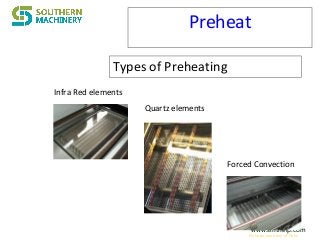
Preheat
Types of Preheating
Infra Red elements
Quartz elements
Forced Convection
Pictures courtesy of Seho
www.smthelp.comwww.smthelp.com
Preheat Profile
• Preheat temperature is measured on the top side of the PCB
• Typical max. preheat temperature Sn/Pb = 90ºC - 120ºC
• Typical max. preheat temperature Pb-Free = 100ºC - 130ºC
www.smthelp.comwww.smthelp.com
Measuring Preheat Temperature
Temperature Profiler /
Thermocouples Adhesive
Temperature
Strips
Infrared
Thermometer
www.smthelp.comwww.smthelp.com
Measuring Preheat Temperature
www.smthelp.comwww.smthelp.com
Incorrect Preheat
• Preheat too high or too long may break down the flux
activation system and cause shorts / icicles
• Preheat too low may cause problems such as skips or
unwanted residues left on the PCB
www.smthelp.comwww.smthelp.com
Soldering Phase
• Wetting Phase
• Wicking Phase
• Drain Phase
Wetting
Wicking
Draining
PCB ------ >>
W
ave
www.smthelp.comwww.smthelp.com
Soldering Phase
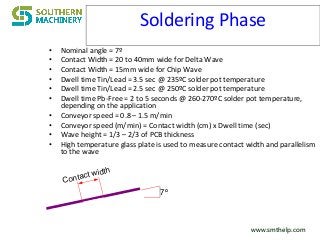
• Nominal angle = 7º
• Contact Width = 20 to 40mm wide for Delta Wave
• Contact Width = 15mm wide for Chip Wave
• Dwell time Tin/Lead = 3.5 sec @ 235ºC solder pot temperature
• Dwell time Tin/Lead = 2.5 sec @ 250ºC solder pot temperature
• Dwell time Pb-Free = 2 to 5 seconds @ 260-270ºC solder pot temperature,
depending on the application
• Conveyor speed = 0.8 – 1.5 m/min
• Conveyor speed (m/min) = Contact width (cm) x Dwell time (sec)
• Wave height = 1/3 – 2/3 of PCB thickness
• High temperature glass plate is used to measure contact width and parallelism
to the wave
7º
Contact width
www.smthelp.comwww.smthelp.com
Wave Nozzle Configuration
Delta Nozzle
• Standard Nozzle for through hole components
• Fast moving solder moving in the opposite
direction of PCB for wetting action
• Small volume of solder moving along with the PCB
for wicking action
www.smthelp.comwww.smthelp.com
Wave Nozzle Configuration
Chip Nozzle
• Turbulent wave
• Can be added in addition to the Delta Nozzle
• High Kinetic Energy
• Avoids shadowing
www.smthelp.comwww.smthelp.com
Wave Nozzle Configuration
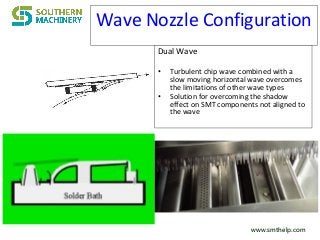
Dual Wave
• Turbulent chip wave combined with a
slow moving horizontal wave overcomes
the limitations of other wave types
• Solution for overcoming the shadow
effect on SMT components not aligned to
the wave
www.smthelp.comwww.smthelp.com
Wave Nozzle Configuration
Other Nozzles
• For components requiring high wave
pressure or high flow dynamics
• For PCB’s with high thermal mass
• To optimize contact time
www.smthelp.comwww.smthelp.com
Solder Alloy
Lead Containing Alloy Sn/Pb
• Contains Tin / Lead
• Sn63/Pb37
• Melting point of 183ºC
• Solder pot temperatures from 235 - 250ºC
• Eutectic alloy – melts and solidifies at the same temperature
• Low surface tension – good wetting
• Low viscosity – great hole fill and top side fillet forming
www.smthelp.comwww.smthelp.com
Solder Alloy
4 Popular choices for Lead-Free
• SAC (Tin/Silver/Copper)
• SAC + X (Tin/Silver/Copper + X)
• SnCu (Tin/Copper)
• SnCuNi (Tin / Copper / Nickel)
Your choice of alloy will be dependant on your
specific requirements
www.smthelp.comwww.smthelp.com
Solder Alloy
SAC
• Tin / Silver / Copper
• Typical: Sn96.5/Ag3.0/Cu0.5
• Melting point of 217 - 221ºC
• Solder pot temperature 260ºC
• High silver content
• Solder joints looks different than Tin-Lead
• Dull joints due to shrinkage
www.smthelp.comwww.smthelp.com
Solder Alloy
SAC + X
• Tin / Silver / Copper + X
• X = Co, Fe, Bi, Si, Ti, Cr, Mn, Ni, Ge, and Zn
• Typical: Sn98.3 Ag0.3 Cu0.7Bi0.7
• Melting point of 216 - 225ºC
• Solder pot temperature 265ºC
• Lower material costs vs higher silver SAC alloys
• Performance and appearance similar to higher silver SAC
alloys
www.smthelp.comwww.smthelp.com
Solder Alloy
SnCu
• Tin / Copper
• Sn99.3/Cu0.7
• Melting point of 227ºC (Eutectic alloy)
• No silver content - lowers alloy cost
• Lower tendency to leach copper - less loss of
conductive copper in tracks and pads
• Poor fluidity at typical lead free temperatures
• Poor through-hole filling and forming of solder bridges
between components
www.smthelp.comwww.smthelp.com
Solder Alloy
SnCuNi
• Tin / Copper / Nickel
• Sn99.25/Cu0.7/Ni0.05
• Melting point of 227ºC
• Eutectic alloy – free of shrinkage
• Solder pot temperatures from 265ºC
• Does not contain silver - running costs are low
• Small addition of nickel in to the SnCu alloy improves fluidity
• Good fluidity – less bridges and better hole –filling
• Dross rate equal or lower than tin-lead solder
• Lower aggressiveness towards stainless steel
• Bright smooth solder joints
www.smthelp.comwww.smthelp.com
Solder Bath Analysis
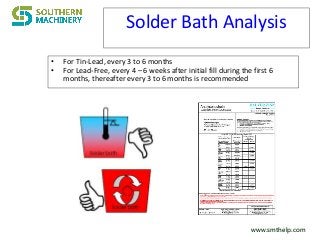
• For Tin-Lead, every 3 to 6 months
• For Lead-Free, every 4 – 6 weeks after initial fill during the first 6
months, thereafter every 3 to 6 months is recommended
www.smthelp.comwww.smthelp.com
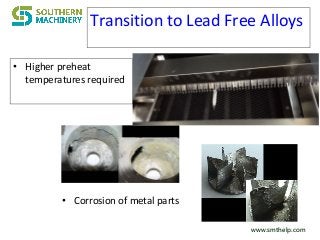
Transition to Lead Free Alloys
• Higher preheat
temperatures required
• Corrosion of metal parts
www.smthelp.comwww.smthelp.com
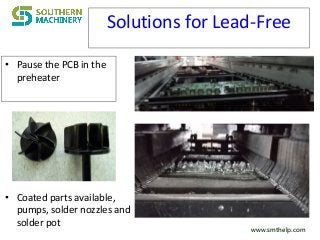
Solutions for Lead-Free
• Pause the PCB in the
preheater
• Coated parts available,
pumps, solder nozzles and
solder pot
www.smthelp.comwww.smthelp.com
Cooling Phase
• Forced cooling or not?
• No improvement in joint quality
• To speed up production
www.smthelp.comwww.smthelp.com
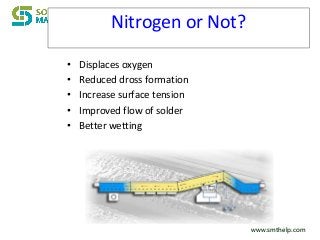
Nitrogen or Not?
• Displaces oxygen
• Reduced dross formation
• Increase surface tension
• Improved flow of solder
• Better wetting
www.smthelp.comwww.smthelp.com
Most common causes of problems
XComponent leads too long
XXSolder wave height too low
XXSolder mask properties
XXXFlux density too high
XXSolder wave height too high
XSolder temperature too high
XXXXXConveyor speed too high
XXXXPreheat temperature too high
XXXXSolder temperature too low
XXSolder is contaminated
XXMoisture trapped in PCB
Conveyor speed too low
X
X
X
Blowholes
XXXXUneven or erratic solder wave
XXXXPreheat temperature too low
XXConveyor angle too small
X
X
Solder Balls
XXXPoor solderability of the PCB or component
XXFlux density too low
Excessive flux
XXXInsufficient flux
Insufficient
Hole Fill
BridgesSkips
www.smthelp.comwww.smthelp.com
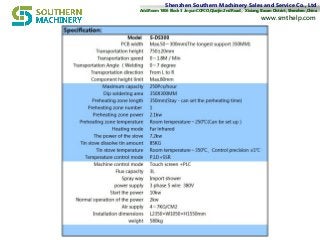
Shenzhen Southern Machinery
Sales and Service Co., Ltd
Add:Room 1806 Block 3 Jinyun COFCO, Qianjin 2nd Road, Xixiang, Baoan District, Shenzhen ,China
S-DS300 Automatic dip soldering machineS-DS300 Automatic dip soldering machine
Shenzhen Southern Machinery Sales and Service Co., LtdShenzhen Southern Machinery Sales and Service Co., Ltd
Add:Add:Room 1806 Block 3 Jinyun COFCO,Qianjin 2nd RoadRoom 1806 Block 3 Jinyun COFCO,Qianjin 2nd Road,, Xixiang, Baoan District, Shenzhen ,ChinaXixiang, Baoan District, Shenzhen ,China
www.smthelp.comwww.smthelp.com
* Help you in Long lead insertion
welding
* contrast high wave soldering energy
saving operation cost nearly
28000USD a year
* contrast double wave soldering save
running cost 16000USD each year
Shenzhen Southern Machinery Sales and Service Co., LtdShenzhen Southern Machinery Sales and Service Co., Ltd
Add:Add:Room 1806 Block 3 Jinyun COFCO,Qianjin 2nd RoadRoom 1806 Block 3 Jinyun COFCO,Qianjin 2nd Road,, Xixiang, Baoan District, Shenzhen ,ChinaXixiang, Baoan District, Shenzhen ,China
www.smthelp.comwww.smthelp.com
 7 inch touch screen + PLC intelligent control and temperature control system
 Intelligent precision step by step +Imported wire rod system
 Tracking step type automatic spray system 85 kg small capacity lead-free tin
furnace
 Maintenance free spray system + automatic welding supply system
 Three sections of transmission system + manual adjustable width
 Pure tin slag function automatically
 Tin stove liquid level automatic detection technology
 New type of far infrared heating technology, high efficiency and energy
saving heating
 Ductile cast iron heating plate (Energy saving 40%)
 Strong wind cooling device
 Automatic into the PCB
 Tin furnace overtemperature protection +Preheating overtemperature
protection
Product featuresProduct features ::
Shenzhen Southern Machinery Sales and Service Co., LtdShenzhen Southern Machinery Sales and Service Co., Ltd
Add:Add:Room 1806 Block 3 Jinyun COFCO,Qianjin 2nd RoadRoom 1806 Block 3 Jinyun COFCO,Qianjin 2nd Road,, Xixiang, Baoan District, Shenzhen ,ChinaXixiang, Baoan District, Shenzhen ,China
www.smthelp.comwww.smthelp.com
Shenzhen Southern Machinery Sales and Service Co., LtdShenzhen Southern Machinery Sales and Service Co., Ltd
Add:Add:Room 1806 Block 3 Jinyun COFCO,Qianjin 2nd RoadRoom 1806 Block 3 Jinyun COFCO,Qianjin 2nd Road,, Xixiang, Baoan District, Shenzhen ,ChinaXixiang, Baoan District, Shenzhen ,China
www.smthelp.comwww.smthelp.com
Far infrared heating technology
(more rapid heating rate + hot
air heating system)
High quality control
Details of some parts:
Shenzhen Southern Machinery Sales and Service Co., LtdShenzhen Southern Machinery Sales and Service Co., Ltd
Add:Add:Room 1806 Block 3 Jinyun COFCO,Qianjin 2nd RoadRoom 1806 Block 3 Jinyun COFCO,Qianjin 2nd Road,, Xixiang, Baoan District, Shenzhen ,ChinaXixiang, Baoan District, Shenzhen ,China
www.smthelp.comwww.smthelp.com
Step tracking precision spray system
Precision welding system .The users
can control at will, suitable for all kinds
of welding length of foot
Shenzhen Southern Machinery Sales and Service Co., LtdShenzhen Southern Machinery Sales and Service Co., Ltd
Add:Add:Room 1806 Block 3 Jinyun COFCO,Qianjin 2nd RoadRoom 1806 Block 3 Jinyun COFCO,Qianjin 2nd Road,, Xixiang, Baoan District, Shenzhen ,ChinaXixiang, Baoan District, Shenzhen ,China
www.smthelp.comwww.smthelp.com
Welcome inquiry
1,Please visit : www.smthelp.com
2, Find us more: https://www.facebook.com/autoinsertion
3, Know more our team: https://cn.linkedin.com/in/smtsupplier
4, Welcome to our factory in Shenzhen China
5, Looking forward to your email: jasonwu@smthelp.com

Improving PCBA wave soldering Quality

  • 1.
    www.smthelp.comwww.smthelp.com IMPROVING YOUR WAVESOLDERING S-DS300 Automatic dip soldering machineS-DS300 Automatic dip soldering machine
  • 2.
    www.smthelp.comwww.smthelp.com 6 Basic Stepsof Wave/Selective Soldering • Component preparation • Insert components • Apply Flux • Preheat PCB • Soldering • Cool down
  • 3.
    www.smthelp.comwww.smthelp.com Preforming THT components •Cost saving • Higher production output • Quality
  • 4.
    www.smthelp.comwww.smthelp.com The effect ofhole sizes • Hole size less than 1.5 times lead thickness – bend of slightly less than 90º • A dimple is formed on the lead for hole size more than 1.5 times lead thickness • Raised from PCB to allow for cleaning or heat dissipation
  • 5.
    www.smthelp.comwww.smthelp.com Selective Pallets • Stablesupport platform for PCB • Eliminate masking by hand • Eliminate glue dotting for SMD’s • Reduce solder defects such as skips and bridging • Pockets and channels promotes solder flow • Standardize conveyor width – reduce setup time • Multiple PCB’s on a pallet – higher throughput
  • 6.
  • 7.
    www.smthelp.comwww.smthelp.com Fluxing Why do weneed flux? • Prevents oxidation • Acts as a wetting agent
  • 8.
    www.smthelp.comwww.smthelp.com Fluxing – WaveSolder Two common types of fluxing methods in wave soldering: Foam fluxing Spray fluxing
  • 9.
    www.smthelp.comwww.smthelp.com Foam fluxing –Wave Solder • Flux control required • Ideal contact area = 20mm • Ideal flux stone pore size = 3um - 10um • Air pressure 2 - 3bar • Raise or lower the whole flux station to achieve the right contact • Never use a foam fluxer without an air knife • Not suitable for water based fluxes
  • 10.
    www.smthelp.comwww.smthelp.com Flux Control (foamfluxer) Critical parameters: • Flux density (solid content) • Water content • Temperature • Contamination from PCB or compressed air • Replace flux in foam fluxers completely every 40 hours • Cleaning of foam pipe
  • 11.
    www.smthelp.comwww.smthelp.com Spray fluxing -Wave Solder • Single side PCB requires 100 Micro Gram per Cm2 of PCB surface (Check Flux Data Sheet) • PTH PCB’s will require 20% more • Check the spray pattern by wrapping a piece of photo sensitive fax paper around a bare PCB and let it run through the fluxer • Combination of airflow, flux flow, moving speed, distance of nozzle to PCB • Paper must be evenly gray from flux, not wet and certainly not dripping
  • 12.
    www.smthelp.comwww.smthelp.com Advantages of Sprayfluxing • Quantifiable application of the flux deposit (SPC) • No in-process QC of the flux • No thinner consumption • Direct application from can • Reduced flux consumption • No flux drippings over the preheat zone
  • 13.
    www.smthelp.comwww.smthelp.com Conversion to Sprayflux • The ‘Plug ’n Spray’ spray- fluxer • Stand alone fluxer
  • 14.
    www.smthelp.comwww.smthelp.com Incorrect Flux Volume •Too little flux can cause soldering defects such as bridging and skips • Excessive flux can lead to solder balling and unwanted and uncured residue left on the PCB
  • 15.
  • 16.
    www.smthelp.comwww.smthelp.com Flux Types Alcohol based(100% VOC) • Long history of reliability & process know how • Modest in preheat requirements • Can be applied by spray or foam • High residue safety and wide process window • Hazardous & flammable material • Contributing to the "green-house" effect
  • 17.
    www.smthelp.comwww.smthelp.com Flux Types Low-VOC (40%water / 60% alcohol) • Modest in preheat requirements • Safer to the environment • Can be applied by spray or foam • High residue safety and wide process window
  • 18.
    www.smthelp.comwww.smthelp.com Flux Types Water based(100% VOC-free) • More soldering power • Environmentally safe • Non-flammable • Requires more preheat • Spray fluxing only • Some process adjustments required • Risk for corrosion if flux is not properly polymerized by the heat of the wave (flux under pallets, on topside or just too much flux applied)
  • 19.
    www.smthelp.comwww.smthelp.com Preheat • Evaporation ofthe solvent in the flux • Activating the flux • Minimizing the Delta T between the PCB and the solder wave Functions of Preheating
  • 20.
    www.smthelp.comwww.smthelp.com Preheat Types of Preheating InfraRed elements Quartz elements Forced Convection Pictures courtesy of Seho
  • 21.
    www.smthelp.comwww.smthelp.com Preheat Profile • Preheattemperature is measured on the top side of the PCB • Typical max. preheat temperature Sn/Pb = 90ºC - 120ºC • Typical max. preheat temperature Pb-Free = 100ºC - 130ºC
  • 22.
    www.smthelp.comwww.smthelp.com Measuring Preheat Temperature TemperatureProfiler / Thermocouples Adhesive Temperature Strips Infrared Thermometer
  • 23.
  • 24.
    www.smthelp.comwww.smthelp.com Incorrect Preheat • Preheattoo high or too long may break down the flux activation system and cause shorts / icicles • Preheat too low may cause problems such as skips or unwanted residues left on the PCB
  • 25.
    www.smthelp.comwww.smthelp.com Soldering Phase • WettingPhase • Wicking Phase • Drain Phase Wetting Wicking Draining PCB ------ >> W ave
  • 26.
    www.smthelp.comwww.smthelp.com Soldering Phase • Nominalangle = 7º • Contact Width = 20 to 40mm wide for Delta Wave • Contact Width = 15mm wide for Chip Wave • Dwell time Tin/Lead = 3.5 sec @ 235ºC solder pot temperature • Dwell time Tin/Lead = 2.5 sec @ 250ºC solder pot temperature • Dwell time Pb-Free = 2 to 5 seconds @ 260-270ºC solder pot temperature, depending on the application • Conveyor speed = 0.8 – 1.5 m/min • Conveyor speed (m/min) = Contact width (cm) x Dwell time (sec) • Wave height = 1/3 – 2/3 of PCB thickness • High temperature glass plate is used to measure contact width and parallelism to the wave 7º Contact width
  • 27.
    www.smthelp.comwww.smthelp.com Wave Nozzle Configuration DeltaNozzle • Standard Nozzle for through hole components • Fast moving solder moving in the opposite direction of PCB for wetting action • Small volume of solder moving along with the PCB for wicking action
  • 28.
    www.smthelp.comwww.smthelp.com Wave Nozzle Configuration ChipNozzle • Turbulent wave • Can be added in addition to the Delta Nozzle • High Kinetic Energy • Avoids shadowing
  • 29.
    www.smthelp.comwww.smthelp.com Wave Nozzle Configuration DualWave • Turbulent chip wave combined with a slow moving horizontal wave overcomes the limitations of other wave types • Solution for overcoming the shadow effect on SMT components not aligned to the wave
  • 30.
    www.smthelp.comwww.smthelp.com Wave Nozzle Configuration OtherNozzles • For components requiring high wave pressure or high flow dynamics • For PCB’s with high thermal mass • To optimize contact time
  • 31.
    www.smthelp.comwww.smthelp.com Solder Alloy Lead ContainingAlloy Sn/Pb • Contains Tin / Lead • Sn63/Pb37 • Melting point of 183ºC • Solder pot temperatures from 235 - 250ºC • Eutectic alloy – melts and solidifies at the same temperature • Low surface tension – good wetting • Low viscosity – great hole fill and top side fillet forming
  • 32.
    www.smthelp.comwww.smthelp.com Solder Alloy 4 Popularchoices for Lead-Free • SAC (Tin/Silver/Copper) • SAC + X (Tin/Silver/Copper + X) • SnCu (Tin/Copper) • SnCuNi (Tin / Copper / Nickel) Your choice of alloy will be dependant on your specific requirements
  • 33.
    www.smthelp.comwww.smthelp.com Solder Alloy SAC • Tin/ Silver / Copper • Typical: Sn96.5/Ag3.0/Cu0.5 • Melting point of 217 - 221ºC • Solder pot temperature 260ºC • High silver content • Solder joints looks different than Tin-Lead • Dull joints due to shrinkage
  • 34.
    www.smthelp.comwww.smthelp.com Solder Alloy SAC +X • Tin / Silver / Copper + X • X = Co, Fe, Bi, Si, Ti, Cr, Mn, Ni, Ge, and Zn • Typical: Sn98.3 Ag0.3 Cu0.7Bi0.7 • Melting point of 216 - 225ºC • Solder pot temperature 265ºC • Lower material costs vs higher silver SAC alloys • Performance and appearance similar to higher silver SAC alloys
  • 35.
    www.smthelp.comwww.smthelp.com Solder Alloy SnCu • Tin/ Copper • Sn99.3/Cu0.7 • Melting point of 227ºC (Eutectic alloy) • No silver content - lowers alloy cost • Lower tendency to leach copper - less loss of conductive copper in tracks and pads • Poor fluidity at typical lead free temperatures • Poor through-hole filling and forming of solder bridges between components
  • 36.
    www.smthelp.comwww.smthelp.com Solder Alloy SnCuNi • Tin/ Copper / Nickel • Sn99.25/Cu0.7/Ni0.05 • Melting point of 227ºC • Eutectic alloy – free of shrinkage • Solder pot temperatures from 265ºC • Does not contain silver - running costs are low • Small addition of nickel in to the SnCu alloy improves fluidity • Good fluidity – less bridges and better hole –filling • Dross rate equal or lower than tin-lead solder • Lower aggressiveness towards stainless steel • Bright smooth solder joints
  • 37.
    www.smthelp.comwww.smthelp.com Solder Bath Analysis •For Tin-Lead, every 3 to 6 months • For Lead-Free, every 4 – 6 weeks after initial fill during the first 6 months, thereafter every 3 to 6 months is recommended
  • 38.
    www.smthelp.comwww.smthelp.com Transition to LeadFree Alloys • Higher preheat temperatures required • Corrosion of metal parts
  • 39.
    www.smthelp.comwww.smthelp.com Solutions for Lead-Free •Pause the PCB in the preheater • Coated parts available, pumps, solder nozzles and solder pot
  • 40.
    www.smthelp.comwww.smthelp.com Cooling Phase • Forcedcooling or not? • No improvement in joint quality • To speed up production
  • 41.
    www.smthelp.comwww.smthelp.com Nitrogen or Not? •Displaces oxygen • Reduced dross formation • Increase surface tension • Improved flow of solder • Better wetting
  • 42.
    www.smthelp.comwww.smthelp.com Most common causesof problems XComponent leads too long XXSolder wave height too low XXSolder mask properties XXXFlux density too high XXSolder wave height too high XSolder temperature too high XXXXXConveyor speed too high XXXXPreheat temperature too high XXXXSolder temperature too low XXSolder is contaminated XXMoisture trapped in PCB Conveyor speed too low X X X Blowholes XXXXUneven or erratic solder wave XXXXPreheat temperature too low XXConveyor angle too small X X Solder Balls XXXPoor solderability of the PCB or component XXFlux density too low Excessive flux XXXInsufficient flux Insufficient Hole Fill BridgesSkips
  • 43.
    www.smthelp.comwww.smthelp.com Shenzhen Southern Machinery Salesand Service Co., Ltd Add:Room 1806 Block 3 Jinyun COFCO, Qianjin 2nd Road, Xixiang, Baoan District, Shenzhen ,China S-DS300 Automatic dip soldering machineS-DS300 Automatic dip soldering machine
  • 44.
    Shenzhen Southern MachinerySales and Service Co., LtdShenzhen Southern Machinery Sales and Service Co., Ltd Add:Add:Room 1806 Block 3 Jinyun COFCO,Qianjin 2nd RoadRoom 1806 Block 3 Jinyun COFCO,Qianjin 2nd Road,, Xixiang, Baoan District, Shenzhen ,ChinaXixiang, Baoan District, Shenzhen ,China www.smthelp.comwww.smthelp.com * Help you in Long lead insertion welding * contrast high wave soldering energy saving operation cost nearly 28000USD a year * contrast double wave soldering save running cost 16000USD each year
  • 45.
    Shenzhen Southern MachinerySales and Service Co., LtdShenzhen Southern Machinery Sales and Service Co., Ltd Add:Add:Room 1806 Block 3 Jinyun COFCO,Qianjin 2nd RoadRoom 1806 Block 3 Jinyun COFCO,Qianjin 2nd Road,, Xixiang, Baoan District, Shenzhen ,ChinaXixiang, Baoan District, Shenzhen ,China www.smthelp.comwww.smthelp.com  7 inch touch screen + PLC intelligent control and temperature control system  Intelligent precision step by step +Imported wire rod system  Tracking step type automatic spray system 85 kg small capacity lead-free tin furnace  Maintenance free spray system + automatic welding supply system  Three sections of transmission system + manual adjustable width  Pure tin slag function automatically  Tin stove liquid level automatic detection technology  New type of far infrared heating technology, high efficiency and energy saving heating  Ductile cast iron heating plate (Energy saving 40%)  Strong wind cooling device  Automatic into the PCB  Tin furnace overtemperature protection +Preheating overtemperature protection Product featuresProduct features ::
  • 46.
    Shenzhen Southern MachinerySales and Service Co., LtdShenzhen Southern Machinery Sales and Service Co., Ltd Add:Add:Room 1806 Block 3 Jinyun COFCO,Qianjin 2nd RoadRoom 1806 Block 3 Jinyun COFCO,Qianjin 2nd Road,, Xixiang, Baoan District, Shenzhen ,ChinaXixiang, Baoan District, Shenzhen ,China www.smthelp.comwww.smthelp.com
  • 47.
    Shenzhen Southern MachinerySales and Service Co., LtdShenzhen Southern Machinery Sales and Service Co., Ltd Add:Add:Room 1806 Block 3 Jinyun COFCO,Qianjin 2nd RoadRoom 1806 Block 3 Jinyun COFCO,Qianjin 2nd Road,, Xixiang, Baoan District, Shenzhen ,ChinaXixiang, Baoan District, Shenzhen ,China www.smthelp.comwww.smthelp.com Far infrared heating technology (more rapid heating rate + hot air heating system) High quality control Details of some parts:
  • 48.
    Shenzhen Southern MachinerySales and Service Co., LtdShenzhen Southern Machinery Sales and Service Co., Ltd Add:Add:Room 1806 Block 3 Jinyun COFCO,Qianjin 2nd RoadRoom 1806 Block 3 Jinyun COFCO,Qianjin 2nd Road,, Xixiang, Baoan District, Shenzhen ,ChinaXixiang, Baoan District, Shenzhen ,China www.smthelp.comwww.smthelp.com Step tracking precision spray system Precision welding system .The users can control at will, suitable for all kinds of welding length of foot
  • 49.
    Shenzhen Southern MachinerySales and Service Co., LtdShenzhen Southern Machinery Sales and Service Co., Ltd Add:Add:Room 1806 Block 3 Jinyun COFCO,Qianjin 2nd RoadRoom 1806 Block 3 Jinyun COFCO,Qianjin 2nd Road,, Xixiang, Baoan District, Shenzhen ,ChinaXixiang, Baoan District, Shenzhen ,China www.smthelp.comwww.smthelp.com Welcome inquiry 1,Please visit : www.smthelp.com 2, Find us more: https://www.facebook.com/autoinsertion 3, Know more our team: https://cn.linkedin.com/in/smtsupplier 4, Welcome to our factory in Shenzhen China 5, Looking forward to your email: jasonwu@smthelp.com