Surface Mount Manufacturing Basics

Familiarization information for SMT printed circuit board
production


July 9, 2012
SMT Production Processes

      1. Screen Printing
      2. Adhesives/Epoxy Dispensing (Optional)
      3. Pick and Place
      4. Reflow
      5. Inspection Post-Reflow (Optional)
      6. Secondary PCB assembly (Optional)
      7. Cleaning (Optional)
      8. Depaneling
      9. Product Sub Assembly / Product Assembly
      10. Testing
      11. Packaging
      12. Shipping


page 2 / July 9, 2012
Processes Defined

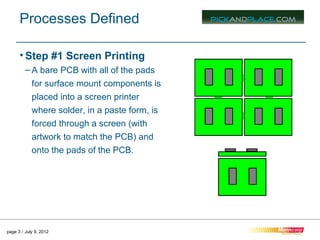
      • Step #1 Screen Printing
         – A bare PCB with all of the pads
            for surface mount components is
            placed into a screen printer
            where solder, in a paste form, is
            forced through a screen (with
            artwork to match the PCB) and
            onto the pads of the PCB.


page 3 / July 9, 2012
Processes Defined

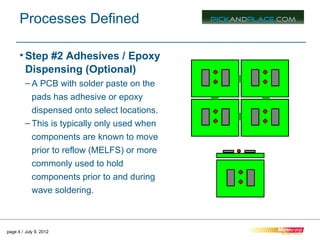
      • Step #2 Adhesives / Epoxy
        Dispensing (Optional)
         – A PCB with solder paste on the
           pads has adhesive or epoxy
           dispensed onto select locations.
         – This is typically only used when
           components are known to move
           prior to reflow (MELFS) or more
           commonly used to hold
           components prior to and during
           wave soldering.


page 4 / July 9, 2012
Processes Defined

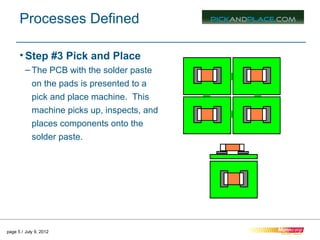
      • Step #3 Pick and Place
         – The PCB with the solder paste
            on the pads is presented to a
            pick and place machine. This
            machine picks up, inspects, and
            places components onto the
            solder paste.


page 5 / July 9, 2012
Processes Defined

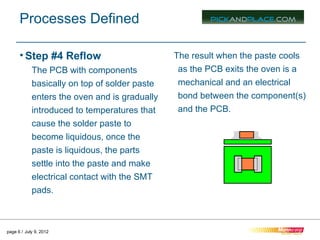
      • Step #4 Reflow                         The result when the paste cools
            The PCB with components             as the PCB exits the oven is a
            basically on top of solder paste    mechanical and an electrical
            enters the oven and is gradually    bond between the component(s)
            introduced to temperatures that     and the PCB.
            cause the solder paste to
            become liquidous, once the
            paste is liquidous, the parts
            settle into the paste and make
            electrical contact with the SMT
            pads.


page 6 / July 9, 2012
Processes Defined

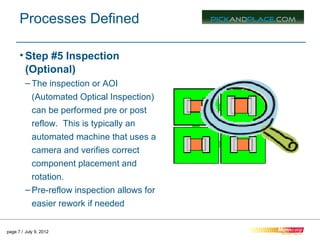
      • Step #5 Inspection
        (Optional)
         – The inspection or AOI
           (Automated Optical Inspection)
           can be performed pre or post
           reflow. This is typically an
           automated machine that uses a
           camera and verifies correct
           component placement and
           rotation.
         – Pre-reflow inspection allows for
           easier rework if needed


page 7 / July 9, 2012
Processes Defined

      • Step #6 Secondary
        Manufacturing / Insertion
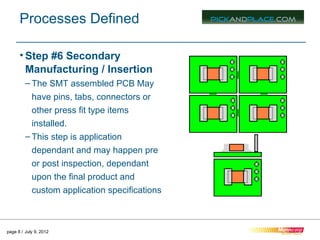
         – The SMT assembled PCB May
           have pins, tabs, connectors or
           other press fit type items
           installed.
         – This step is application
           dependant and may happen pre
           or post inspection, dependant
           upon the final product and
           custom application specifications


page 8 / July 9, 2012
Processes Defined

      • Step #7 Cleaning
        (Optional)
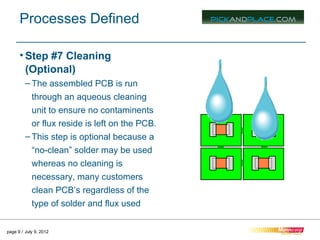
         – The assembled PCB is run
           through an aqueous cleaning
           unit to ensure no contaminents
           or flux reside is left on the PCB.
         – This step is optional because a
           “no-clean” solder may be used
           whereas no cleaning is
           necessary, many customers
           clean PCB’s regardless of the
           type of solder and flux used


page 9 / July 9, 2012
Processes Defined

       • Step #8 Depaneling
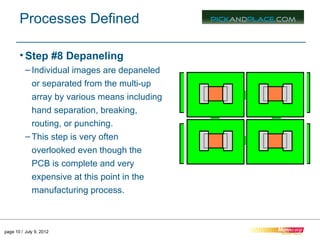
          – Individual images are depaneled
            or separated from the multi-up
            array by various means including
            hand separation, breaking,
            routing, or punching.
          – This step is very often
            overlooked even though the
            PCB is complete and very
            expensive at this point in the
            manufacturing process.


page 10 / July 9, 2012
Processes Defined

       • Step #9 Product
         Subassembly / Assembly
          – The assembled, depaneled
            PCB is placed into a housing or
            made part of the larger assembly
            being built by the manufacturer
          – This step is different depending
            upon the product(s) being
            manufactured


page 11 / July 9, 2012
Processes Defined

       • Step #10 Testing
          – The final product is tested

       • Step #11 Packaging
          – The final product is packaged for
             shipment

       • Step #12 Shipping
          – The final product is shipped to
             the end user, distributor, or
             customer


page 12 / July 9, 2012

Smt basics

  • 1.
    Surface Mount ManufacturingBasics Familiarization information for SMT printed circuit board production July 9, 2012
  • 2.
    SMT Production Processes 1. Screen Printing 2. Adhesives/Epoxy Dispensing (Optional) 3. Pick and Place 4. Reflow 5. Inspection Post-Reflow (Optional) 6. Secondary PCB assembly (Optional) 7. Cleaning (Optional) 8. Depaneling 9. Product Sub Assembly / Product Assembly 10. Testing 11. Packaging 12. Shipping page 2 / July 9, 2012
  • 3.
    Processes Defined • Step #1 Screen Printing – A bare PCB with all of the pads for surface mount components is placed into a screen printer where solder, in a paste form, is forced through a screen (with artwork to match the PCB) and onto the pads of the PCB. page 3 / July 9, 2012
  • 4.
    Processes Defined • Step #2 Adhesives / Epoxy Dispensing (Optional) – A PCB with solder paste on the pads has adhesive or epoxy dispensed onto select locations. – This is typically only used when components are known to move prior to reflow (MELFS) or more commonly used to hold components prior to and during wave soldering. page 4 / July 9, 2012
  • 5.
    Processes Defined • Step #3 Pick and Place – The PCB with the solder paste on the pads is presented to a pick and place machine. This machine picks up, inspects, and places components onto the solder paste. page 5 / July 9, 2012
  • 6.
    Processes Defined • Step #4 Reflow The result when the paste cools The PCB with components as the PCB exits the oven is a basically on top of solder paste mechanical and an electrical enters the oven and is gradually bond between the component(s) introduced to temperatures that and the PCB. cause the solder paste to become liquidous, once the paste is liquidous, the parts settle into the paste and make electrical contact with the SMT pads. page 6 / July 9, 2012
  • 7.
    Processes Defined • Step #5 Inspection (Optional) – The inspection or AOI (Automated Optical Inspection) can be performed pre or post reflow. This is typically an automated machine that uses a camera and verifies correct component placement and rotation. – Pre-reflow inspection allows for easier rework if needed page 7 / July 9, 2012
  • 8.
    Processes Defined • Step #6 Secondary Manufacturing / Insertion – The SMT assembled PCB May have pins, tabs, connectors or other press fit type items installed. – This step is application dependant and may happen pre or post inspection, dependant upon the final product and custom application specifications page 8 / July 9, 2012
  • 9.
    Processes Defined • Step #7 Cleaning (Optional) – The assembled PCB is run through an aqueous cleaning unit to ensure no contaminents or flux reside is left on the PCB. – This step is optional because a “no-clean” solder may be used whereas no cleaning is necessary, many customers clean PCB’s regardless of the type of solder and flux used page 9 / July 9, 2012
  • 10.
    Processes Defined • Step #8 Depaneling – Individual images are depaneled or separated from the multi-up array by various means including hand separation, breaking, routing, or punching. – This step is very often overlooked even though the PCB is complete and very expensive at this point in the manufacturing process. page 10 / July 9, 2012
  • 11.
    Processes Defined • Step #9 Product Subassembly / Assembly – The assembled, depaneled PCB is placed into a housing or made part of the larger assembly being built by the manufacturer – This step is different depending upon the product(s) being manufactured page 11 / July 9, 2012
  • 12.
    Processes Defined • Step #10 Testing – The final product is tested • Step #11 Packaging – The final product is packaged for shipment • Step #12 Shipping – The final product is shipped to the end user, distributor, or customer page 12 / July 9, 2012