A SEMINAR ON
BIOTRANSFORMATION
(Pharmaceutical Chemistry)
Submitted by:-
Nidhi Maheshwari
M.Sc. (Applied
Chemistry)
CONTENTS
• INTRODUCTION
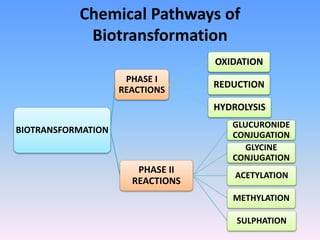
• CHEMICAL PATHWAY OF BIOTRANSFORMATION
• IMPORTANCE OF BIOTRANSFORMATION
INTRODUCTION
Biotransformation is the process by
which a substance is transformed from
one chemical to another by a chemical
reaction within the body.
Metabolism of drugs and toxins
(mainly for their effective removal) is
an important example of
biotransformation.
Chemical Pathways of
Biotransformation
BIOTRANSFORMATION
PHASE I
REACTIONS
OXIDATION
REDUCTION
HYDROLYSIS
PHASE II
REACTIONS
GLUCURONIDE
CONJUGATION
GLYCINE
CONJUGATION
ACETYLATION
METHYLATION
SULPHATION
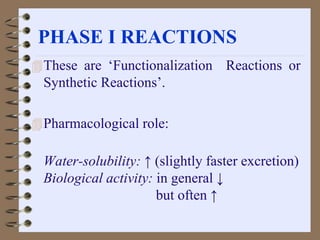
PHASE I REACTIONS
These are ‘Functionalization Reactions or
Synthetic Reactions’.
Pharmacological role:
Water-solubility: ↑ (slightly faster excretion)
Biological activity: in general ↓
but often ↑
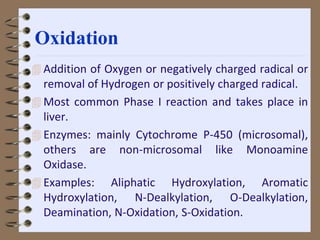
Oxidation
 Addition of Oxygen or negatively charged radical or
removal of Hydrogen or positively charged radical.
 Most common Phase I reaction and takes place in
liver.
 Enzymes: mainly Cytochrome P-450 (microsomal),
others are non-microsomal like Monoamine
Oxidase.
 Examples: Aliphatic Hydroxylation, Aromatic
Hydroxylation, N-Dealkylation, O-Dealkylation,
Deamination, N-Oxidation, S-Oxidation.
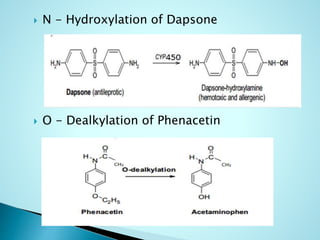
 N - Hydroxylation of Dapsone
 O - Dealkylation of Phenacetin
Reduction
Less common transformation.
Usually reversible reactions: true
reversible (catalysed by same enzyme in
both directions) or apparent reversible
(catalysed by different enzymes in both
directions).
Enzyme: Cytochrome P450.
Examples: Azo reduction,
dehalogenation, nitro reduction.
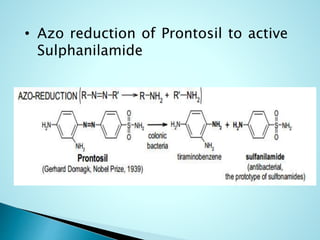
• Azo reduction of Prontosil to active
Sulphanilamide
Hydrolysis
Cleavage of xenobiotic in the presence of
water molecule.
Leads to large chemical changes as it
leads to loss of large fragments.
Enzymes: Cholinesterase and other
plasma esterases.
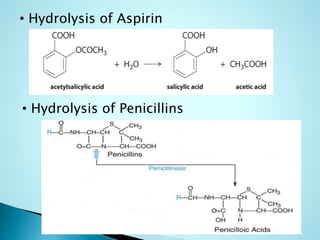
• Hydrolysis of Aspirin
• Hydrolysis of Penicillins
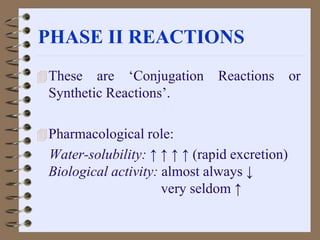
PHASE II REACTIONS
These are ‘Conjugation Reactions or
Synthetic Reactions’.
Pharmacological role:
Water-solubility: ↑ ↑ ↑ ↑ (rapid excretion)
Biological activity: almost always ↓
very seldom ↑
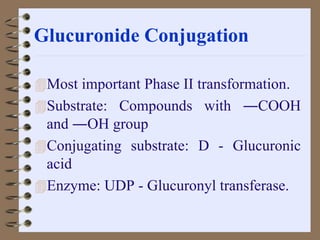
Glucuronide Conjugation
Most important Phase II transformation.
Substrate: Compounds with ―COOH
and ―OH group
Conjugating substrate: D - Glucuronic
acid
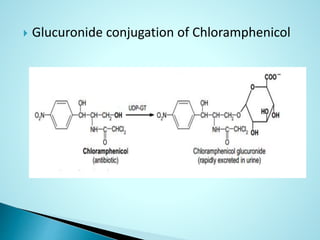
Enzyme: UDP - Glucuronyl transferase.
 Glucuronide conjugation of Chloramphenicol
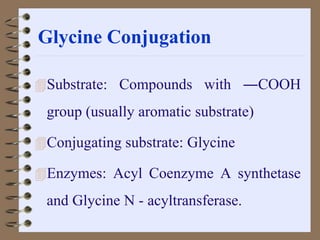
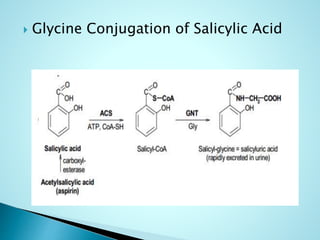
Glycine Conjugation
Substrate: Compounds with ―COOH
group (usually aromatic substrate)
Conjugating substrate: Glycine
Enzymes: Acyl Coenzyme A synthetase
and Glycine N - acyltransferase.
 Glycine Conjugation of Salicylic Acid
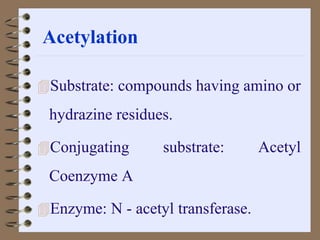
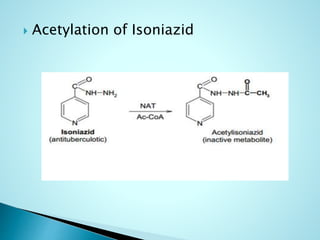
Acetylation
Substrate: compounds having amino or
hydrazine residues.
Conjugating substrate: Acetyl
Coenzyme A
Enzyme: N - acetyl transferase.
 Acetylation of Isoniazid
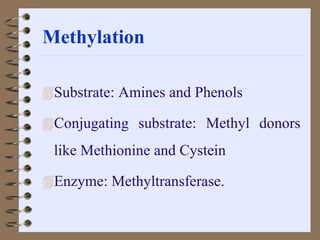
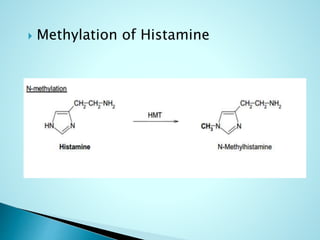
Methylation
Substrate: Amines and Phenols
Conjugating substrate: Methyl donors
like Methionine and Cystein
Enzyme: Methyltransferase.
 Methylation of Histamine
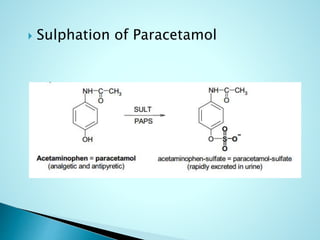
Sulphation
Substrate: Phenolic compounds and
Steroids
Conjugating substrate: 3’-
phosphoadenosine - 5’- phosphosulphate
(PAPS)
Enzyme: Sulphotransferase
 Sulphation of Paracetamol
IMPORTANCE OF
BIOTRANSFORMATION
Formation of active metabolites in the body.
Transformation of drugs from: active to
inactive form (detoxification), active to
active metabolite, inactive (prodrug) to
active form or active to toxic form
(biotoxification).
Biotransformation of pollutants is
bioremedial for contaminated environment.
THANK
YOU

Biotransformation copy