SUPPRESSION OF GRATING LOBES IN DSA
USING PRINCIPLE OF PATTERN MULTIPLICATION
by
Kavindra krishna
Research Scholar
AMU
Department of Electronics Engineering , AMU
1
Contents
 What is DSA.
 Problem with DSA.
 Grating Lobes.
 Techniques to reduce the grating lobes in DSA.
 Principle of pattern multiplication.
 Two Way pattern design with pattern multiplication.
 Condition for grating lobes & null to be occured.
 References.
2
What is DSA
DSA – Distributed Sub Arrays.
 Distributed Sub Arrays (DSA)-is a network of spatially separated sub arrays ,
connected to a common source via a transport medium that provide wireless
service with in geographic area or structure.
Figure [1] :- schematic of cruise on which DSA is present.
3
Problem with DSA
 Grating Lobes –
 Due to larger spacing between the sub arrays.
Larger spacing means more than 1λ.
4
Grating Lobes
 Grating Lobes – just like side lobes that have same amplitude as main
beam and are unintended and creates interference
with main lobes, so it might limit our System
performance.[1,3]
Figure[3] :- Grating lobes produced by linear DSA (M=5, N=5, lx =7.5λ and dx=1.5λ.) element array.
.
5
Techniques to reduces the grating lobes in DSA
 Implement sub arrays of un-equal size, with random
location of sub arrays with respect to center of array.
 Overlapping sub arrays architecture to push the grating
lobes away from main beam.
 Two-way pattern design.
6
Principle of Pattern of Multiplication
 The total field pattern of an array-is the
multiplication of the individual source pattern and
pattern of an array[2].
 Symbolically-
……..(1)
Where- Ftotal – total field pattern of an array.
Fi(θ,Ф)—field pattern of individual source.
Fa(θ,Ф)--- field pattern of an array.
7
Ftotal = Fi(θ,Ф) Χ Fa(θ,Ф)
Two Way Pattern design with
Pattern of Multiplication
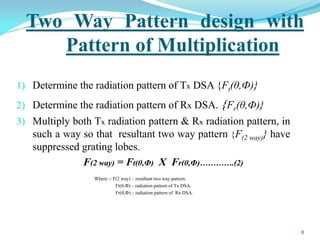
1) Determine the radiation pattern of Tx DSA {Ft(θ,Ф)}
2) Determine the radiation pattern of Rx DSA. {Fr(θ,Ф)}
3) Multiply both Tx radiation pattern & Rx radiation pattern, in
such a way so that resultant two way pattern {F(2 way)} have
suppressed grating lobes.
F(2 way) = Ft(θ,Ф) Χ Fr(θ,Ф)………….(2)
Where :- F(2 way) – resultant two way pattern.
Ft(θ,Ф) – radiation pattern of Tx DSA.
Fr(θ,Ф) – radiation pattern of Rx DSA.
8
Condition of Grating Lobes &
Null to be Occurred
 We know about Array Factor of 2D Array[5] :-
Figure [2] :- shows the placement of sub arrays in DSA network.
Figure [3] :- shows the internal view of sub-arrays placed along X & Y axis.
Where :- Nx—number of element present in sub-arrays along x-axis.
Ny—number of element present in sub-arrays along y-axis.
dx—spacing b/w the elements present in sub-array X.
dy--spacing b/w the elements present in sub-array Y.
9
contd….
 The array factor can be expressed as[5] :-
AF=AFxAFy= 𝐴 𝑛 𝑒𝑗𝑛𝛽𝑙𝑥𝑆𝑖𝑛𝜃𝐶𝑜𝑠∅𝑀 𝑥
𝑛=1 𝐴 𝑚 𝑒𝑗𝑚𝛽𝑙𝑦𝑆𝑖𝑛𝜃𝐶𝑜𝑠∅𝑀 𝑦
𝑚=1 …..(4)
Where :- β - phase constant ; λ- wavelength.
 Furthermore,if phases are introduces due to scan of beam in the direction
(θs,Фs) then[5]-
AF= 𝐴 𝑛
𝑀 𝑥
𝑛=1 ejnβlx{SinθCosФ-SinθsCosФs} 𝐴 𝑚
𝑀 𝑦
𝑚=1 ejmβly{sinθCosФ-SinθsCosФs}
…………(5)
 Finally, if the array have the uniform excitation (An=Am=1),then Eq.(0) can
be expressed as a sum of geometric series as[5] :-
…………(6)
where :- ……….(7)
………(8)
10
Contd……
 the grating lobes of this equation can be predicted because it
have uniform spacing[5] :-
 Grating lobes can occurs at the locations when ξx & ξy are the multiple of 2π .
……..(9a)
………(9b)
Where :- p , q = 0,1,2,3…….∞.
 The location of nulls of this equation can occurs at[5] :-
…….(10a)
…..(10b)
where :- p , q are integer values start from 0,1,2,3…..
λ - wavelength ; Nx &Ny are number of element in sub arrays along x & y axis.
dx & dy are the spacing bw the element in sub arrays ; lx & ly spacing bw the sub-arrays.
11
Contd………
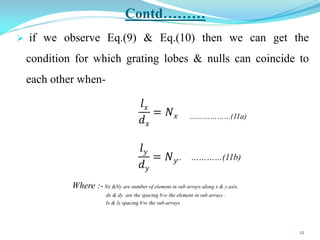
 if we observe Eq.(9) & Eq.(10) then we can get the
condition for which grating lobes & nulls can coincide to
each other when-
………………(11a)
… …………(11b)
Where :-Nx &Ny are number of element in sub arrays along x & y axis.
dx & dy are the spacing bw the element in sub arrays .
lx & ly spacing bw the sub-arrays.
12
Contd…..
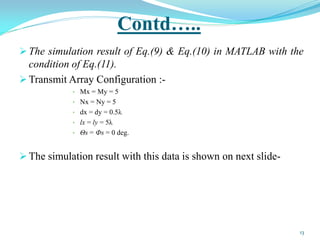
 The simulation result of Eq.(9) & Eq.(10) in MATLAB with the
condition of Eq.(11).
 Transmit Array Configuration :-
• Mx = My = 5
• Nx = Ny = 5
• dx = dy = 0.5λ
• lx = ly = 5λ
• Θs = Фs = 0 deg.
 The simulation result with this data is shown on next slide-
13
Contd…..
Figure[4] :- shows the grating lobes & null location for transmit array at f = 100MHz.
(Mx=My=5;Nx=Ny=5;dx=dy=0.5λ;lx=ly=5λ)
14
Contd…..
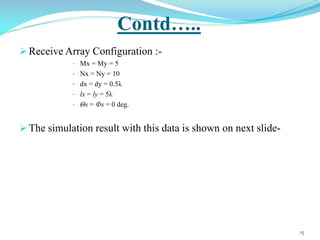
 Receive Array Configuration :-
• Mx = My = 5
• Nx = Ny = 10
• dx = dy = 0.5λ
• lx = ly = 5λ
• Θs = Фs = 0 deg.
 The simulation result with this data is shown on next slide-
15
Contd…..
Figure[5] :- shows the grating lobes & null location for receive array at f = 100MHz.
(Mx=My=10;Nx=Ny=10;dx=dy=0.5λ;lx=ly=5λ)
16
Contd…..
 Final , two way pattern with pattern of multiplication is-
F(2 way) = Ft(θ,Ф) Χ Fr(θ,Ф)
• .
Table [A] :- shows the configuration data of both transmit & receive distributed sub arrays.
 The simulation result with this data is shown on next slide-
17
Transmit Array Configuration Receive Array Configuration
Mx = My = 5 Mx = My = 10
Nx = Ny = 5 Nx = Ny = 10
dx = dy = 0.5λ dx = dy = 0.5λ
lx = ly = 5λ lx = ly = 5λ
Θs = Фs = 0 deg. Θs = Фs = 0 deg
Contd…..
Figure[6] :- shows the overlap pattern of both transmit & receive array at f = 100MHz.
18
Conclusion
 It is understood that undesired grating lobes produced by
widely-spaced sub arrays can be suppressed using the
principle of pattern multiplication by intentional placement
of nulls coincident to grating lobe locations.
 To visualize the placement of grating lobes and nulls for
transmit and receive array patterns, their locations are
plotted in direction cosine space using a simple program
developed in MATLAB.
 This forms the basis of two-way pattern synthesis in deciding
the optimum element spacing, sub array spacing, and
number of elements in each sub array, for the transmit and
receive arrays.
19
[1] Mahafza R Basseam, Radar System Analysis and Design Using MATLAB, 3rd Edition, CHAPMAN & HALL/CRC New York
Washington, D.C.2000.
[2]Prasad .K.D, Introduction to Antenna and Wave Propagation,2nd Edition,pp.335-336,Satya Prakashan New Delhi India 2007
[3] Hovanessian A.S, Radar Systems Design and Analysis, 2nd Edition, pp. 271-290, ArTech House,INC, Norwood, MA, 1998.
[4] ]Ong.Chin.Siang,Jin Wang “ 2.4GHz Digital Phased Array Architectures For Distributed Sub Arrays" The Proceeding of the IEEE thirty
seventh South-eastern Symposium,march,20012.
[5] Jun Liu,zi-Jing Zhang ,Yun Yang “Implementation of Two way Pattern design in DSA”The IEEE Phased Array Radar LETTER,VOL 19
NO.10 August 2012.
[6] Jay Hyuk Choi “Distributed Sub Array Antennas for Multi Function Phased Array Radar”The IEEE International Conference on
Automation, Robotics and Application, held at Wellington,6-8 December 2011.
[7] Dr. Probir K. Bondyopadhyay, “The First Application of Distributed Sub Arrays” 2000 The Proceedings of IEEE International
Conference on Phased Array Systems & Technology, Dr. Michael Thorburn, ed., pp. 29-33, IEEE Operations Center, New Jersey, 2005.
[8] David K. Barton, Radar System Analysis, pp.83-89, 327-331, Artech House, Dedham, MA, 1979.
[9] Filippo Neri, Introduction to Electronic Defense Systems, 2nd Edition, pp. 156- 170, Artech House, Norwood, MA, 2009.
[10] Merrill I. Skolnik, Introduction to Radar Systems, 3rd Edition, pp. 210-238, McGr aw-Hill, New York, NY, 2005.
THANK-YOU
References
20

Suppression of grating lobes

  • 1.
    SUPPRESSION OF GRATINGLOBES IN DSA USING PRINCIPLE OF PATTERN MULTIPLICATION by Kavindra krishna Research Scholar AMU Department of Electronics Engineering , AMU 1
  • 2.
    Contents  What isDSA.  Problem with DSA.  Grating Lobes.  Techniques to reduce the grating lobes in DSA.  Principle of pattern multiplication.  Two Way pattern design with pattern multiplication.  Condition for grating lobes & null to be occured.  References. 2
  • 3.
    What is DSA DSA– Distributed Sub Arrays.  Distributed Sub Arrays (DSA)-is a network of spatially separated sub arrays , connected to a common source via a transport medium that provide wireless service with in geographic area or structure. Figure [1] :- schematic of cruise on which DSA is present. 3
  • 4.
    Problem with DSA Grating Lobes –  Due to larger spacing between the sub arrays. Larger spacing means more than 1λ. 4
  • 5.
    Grating Lobes  GratingLobes – just like side lobes that have same amplitude as main beam and are unintended and creates interference with main lobes, so it might limit our System performance.[1,3] Figure[3] :- Grating lobes produced by linear DSA (M=5, N=5, lx =7.5λ and dx=1.5λ.) element array. . 5
  • 6.
    Techniques to reducesthe grating lobes in DSA  Implement sub arrays of un-equal size, with random location of sub arrays with respect to center of array.  Overlapping sub arrays architecture to push the grating lobes away from main beam.  Two-way pattern design. 6
  • 7.
    Principle of Patternof Multiplication  The total field pattern of an array-is the multiplication of the individual source pattern and pattern of an array[2].  Symbolically- ……..(1) Where- Ftotal – total field pattern of an array. Fi(θ,Ф)—field pattern of individual source. Fa(θ,Ф)--- field pattern of an array. 7 Ftotal = Fi(θ,Ф) Χ Fa(θ,Ф)
  • 8.
    Two Way Patterndesign with Pattern of Multiplication 1) Determine the radiation pattern of Tx DSA {Ft(θ,Ф)} 2) Determine the radiation pattern of Rx DSA. {Fr(θ,Ф)} 3) Multiply both Tx radiation pattern & Rx radiation pattern, in such a way so that resultant two way pattern {F(2 way)} have suppressed grating lobes. F(2 way) = Ft(θ,Ф) Χ Fr(θ,Ф)………….(2) Where :- F(2 way) – resultant two way pattern. Ft(θ,Ф) – radiation pattern of Tx DSA. Fr(θ,Ф) – radiation pattern of Rx DSA. 8
  • 9.
    Condition of GratingLobes & Null to be Occurred  We know about Array Factor of 2D Array[5] :- Figure [2] :- shows the placement of sub arrays in DSA network. Figure [3] :- shows the internal view of sub-arrays placed along X & Y axis. Where :- Nx—number of element present in sub-arrays along x-axis. Ny—number of element present in sub-arrays along y-axis. dx—spacing b/w the elements present in sub-array X. dy--spacing b/w the elements present in sub-array Y. 9
  • 10.
    contd….  The arrayfactor can be expressed as[5] :- AF=AFxAFy= 𝐴 𝑛 𝑒𝑗𝑛𝛽𝑙𝑥𝑆𝑖𝑛𝜃𝐶𝑜𝑠∅𝑀 𝑥 𝑛=1 𝐴 𝑚 𝑒𝑗𝑚𝛽𝑙𝑦𝑆𝑖𝑛𝜃𝐶𝑜𝑠∅𝑀 𝑦 𝑚=1 …..(4) Where :- β - phase constant ; λ- wavelength.  Furthermore,if phases are introduces due to scan of beam in the direction (θs,Фs) then[5]- AF= 𝐴 𝑛 𝑀 𝑥 𝑛=1 ejnβlx{SinθCosФ-SinθsCosФs} 𝐴 𝑚 𝑀 𝑦 𝑚=1 ejmβly{sinθCosФ-SinθsCosФs} …………(5)  Finally, if the array have the uniform excitation (An=Am=1),then Eq.(0) can be expressed as a sum of geometric series as[5] :- …………(6) where :- ……….(7) ………(8) 10
  • 11.
    Contd……  the gratinglobes of this equation can be predicted because it have uniform spacing[5] :-  Grating lobes can occurs at the locations when ξx & ξy are the multiple of 2π . ……..(9a) ………(9b) Where :- p , q = 0,1,2,3…….∞.  The location of nulls of this equation can occurs at[5] :- …….(10a) …..(10b) where :- p , q are integer values start from 0,1,2,3….. λ - wavelength ; Nx &Ny are number of element in sub arrays along x & y axis. dx & dy are the spacing bw the element in sub arrays ; lx & ly spacing bw the sub-arrays. 11
  • 12.
    Contd………  if weobserve Eq.(9) & Eq.(10) then we can get the condition for which grating lobes & nulls can coincide to each other when- ………………(11a) … …………(11b) Where :-Nx &Ny are number of element in sub arrays along x & y axis. dx & dy are the spacing bw the element in sub arrays . lx & ly spacing bw the sub-arrays. 12
  • 13.
    Contd…..  The simulationresult of Eq.(9) & Eq.(10) in MATLAB with the condition of Eq.(11).  Transmit Array Configuration :- • Mx = My = 5 • Nx = Ny = 5 • dx = dy = 0.5λ • lx = ly = 5λ • Θs = Фs = 0 deg.  The simulation result with this data is shown on next slide- 13
  • 14.
    Contd….. Figure[4] :- showsthe grating lobes & null location for transmit array at f = 100MHz. (Mx=My=5;Nx=Ny=5;dx=dy=0.5λ;lx=ly=5λ) 14
  • 15.
    Contd…..  Receive ArrayConfiguration :- • Mx = My = 5 • Nx = Ny = 10 • dx = dy = 0.5λ • lx = ly = 5λ • Θs = Фs = 0 deg.  The simulation result with this data is shown on next slide- 15
  • 16.
    Contd….. Figure[5] :- showsthe grating lobes & null location for receive array at f = 100MHz. (Mx=My=10;Nx=Ny=10;dx=dy=0.5λ;lx=ly=5λ) 16
  • 17.
    Contd…..  Final ,two way pattern with pattern of multiplication is- F(2 way) = Ft(θ,Ф) Χ Fr(θ,Ф) • . Table [A] :- shows the configuration data of both transmit & receive distributed sub arrays.  The simulation result with this data is shown on next slide- 17 Transmit Array Configuration Receive Array Configuration Mx = My = 5 Mx = My = 10 Nx = Ny = 5 Nx = Ny = 10 dx = dy = 0.5λ dx = dy = 0.5λ lx = ly = 5λ lx = ly = 5λ Θs = Фs = 0 deg. Θs = Фs = 0 deg
  • 18.
    Contd….. Figure[6] :- showsthe overlap pattern of both transmit & receive array at f = 100MHz. 18
  • 19.
    Conclusion  It isunderstood that undesired grating lobes produced by widely-spaced sub arrays can be suppressed using the principle of pattern multiplication by intentional placement of nulls coincident to grating lobe locations.  To visualize the placement of grating lobes and nulls for transmit and receive array patterns, their locations are plotted in direction cosine space using a simple program developed in MATLAB.  This forms the basis of two-way pattern synthesis in deciding the optimum element spacing, sub array spacing, and number of elements in each sub array, for the transmit and receive arrays. 19
  • 20.
    [1] Mahafza RBasseam, Radar System Analysis and Design Using MATLAB, 3rd Edition, CHAPMAN & HALL/CRC New York Washington, D.C.2000. [2]Prasad .K.D, Introduction to Antenna and Wave Propagation,2nd Edition,pp.335-336,Satya Prakashan New Delhi India 2007 [3] Hovanessian A.S, Radar Systems Design and Analysis, 2nd Edition, pp. 271-290, ArTech House,INC, Norwood, MA, 1998. [4] ]Ong.Chin.Siang,Jin Wang “ 2.4GHz Digital Phased Array Architectures For Distributed Sub Arrays" The Proceeding of the IEEE thirty seventh South-eastern Symposium,march,20012. [5] Jun Liu,zi-Jing Zhang ,Yun Yang “Implementation of Two way Pattern design in DSA”The IEEE Phased Array Radar LETTER,VOL 19 NO.10 August 2012. [6] Jay Hyuk Choi “Distributed Sub Array Antennas for Multi Function Phased Array Radar”The IEEE International Conference on Automation, Robotics and Application, held at Wellington,6-8 December 2011. [7] Dr. Probir K. Bondyopadhyay, “The First Application of Distributed Sub Arrays” 2000 The Proceedings of IEEE International Conference on Phased Array Systems & Technology, Dr. Michael Thorburn, ed., pp. 29-33, IEEE Operations Center, New Jersey, 2005. [8] David K. Barton, Radar System Analysis, pp.83-89, 327-331, Artech House, Dedham, MA, 1979. [9] Filippo Neri, Introduction to Electronic Defense Systems, 2nd Edition, pp. 156- 170, Artech House, Norwood, MA, 2009. [10] Merrill I. Skolnik, Introduction to Radar Systems, 3rd Edition, pp. 210-238, McGr aw-Hill, New York, NY, 2005. THANK-YOU References 20