Download to read offline
![A.M.Prasanna kumar et al. Int. Journal of Engineering Research and Applications www.ijera.com
ISSN: 2248-9622, Vol. 5, Issue 7, (Part - 2) July 2015, pp.68-73
www.ijera.com 68 | P a g e
Performance Analysis of Adaptive DOA Estimation Algorithms
For Mobile Applications
A.M.Prasanna kumar, Dr. Ramesha K
Professor in ECE Department, ACS College of Engineering, Bangalore-560074, India
Professor in ECE Department, Dr. Ambedkar Institute of Technology, Bangalore-560056, India
Abstract –
Spatial filtering for mobile communications has attracted a lot of attention over the last decade and is cur-
rently considered a very promising technique that will help future cellular networks achieve their ambi-
tious goals. One way to accomplish this is via array signal processing with algorithms which estimate the
Direction-Of-Arrival (DOA) of the received waves from the mobile users. This paper evaluates the per-
formance of a number of DOA estimation algorithms. In all cases a linear antenna array at the base station
is assumed to be operating typical cellular environment.
Index Terms - Direction of arrival (DOA), MUSIC, ESPRIT, Quaternion MUSIC.
I. Introduction
Adaptive Antennas have attracted a lot of at-
tention over the past few years as possible solu-
tions to some of the main problems associated with
current mobile systems [1]. For this purpose a
number of research activities are being carried out
in order to properly design, analyse, and implement
adaptive antennas for mobile communications ap-
plications, e.g. TSUNAMI Project (Technology in
Smart antenna for the UNiversal Advanced Mobile
Infrastructure) [2]. Direction of arrival (DOA) es-
timation algorithms are used to improve the per-
formance of an antenna by controlling the directivi-
ty of the antenna to reduce effects like interference,
delay spread, and multipath fading. Several DOA
estimation algorithms are available which are catego-
rised by Krim and Viberg [3] into three categories:
spectral estimation, parametric subspace-based esti-
mation (PSBE), and deterministic parametric estima-
tion (DPE).
Algorithm of the first category are MUSIC (MUl-
tiple SIgnal Classification) algorithm [4]. ESPRIT
(Estimation of Signal Parameters via Rotational
Invariance Techniques) [5] and all its variants such
as, LS- (Least Square), TLS- (Total Least Square)
[6], and Unitary-ESPRIT [7] belong to the PSBE
techniques. The DPE techniques include: Maxi-
mum Entropy (ME) [8], Maximum Likelihood
(ML) [9], Space-Alternating Generalised Expecta-
tion-maximisation (SAGE) [10], and Weighted
Subspace Fitting (WSF) [11] methods.
The aim is to provide a comprehensive comparison
of DOA estimation algorithms. The results from
such a comparison can then be used to indicate
solutions for different levels of applications, e.g.
for measurement systems with the capability to
provide spatial information, for cellular base sta-
tions with the capability to improve range-
capacity-service quality etc., for user positioning
systems.
II. Basic Channel Model
Consider a uniformly spaced, linear array con-
sisting of N sensors on which plane waves from M
(M < N) narrow-band sources impinge from direc-
tions 01. Taking the first element in the array as the
phase reference and assuming that the signal
sources are in the far-field, the complex vector
received by the array can be expressed as [13]:
𝒚 𝒕 = 𝒂 𝛉𝐦 𝑺𝒎 𝒕 + 𝒘 𝒕𝑴
𝒎=𝟏 (1)
where s(t) is the signal vector, w(t) is the additive
noise vector and a(θ) is referred to as the array re-
sponse or array steering vector for the direction
θ,i.e.:
a(θ)=[ 1 e-j Ø
…….e-j(N-1) Ø
]T
, Ø=2π (d/λ)sinθ (2)
Where T is the transposition operator, d in
the spacing between sensors and λ is the
wavelength of the received signal
Representing (1) in a more compact matrix form of
size N X 1:
y(t)=As(t) + w(t) (3)
where s(t) is Mxl vector and A=[ a(θ1), . a(θM)] is
the NxM matrix of steering vectors.
RESEARCH ARTICLE OPEN ACCESS](https://image.slidesharecdn.com/j56026873-150803064834-lva1-app6891/85/Performance-Analysis-of-Adaptive-DOA-Estimation-Algorithms-For-Mobile-Applications-1-320.jpg)
![A.M.Prasanna kumar et al. Int. Journal of Engineering Research and Applications www.ijera.com
ISSN: 2248-9622, Vol. 5, Issue 7, (Part - 2) July 2015, pp.68-73
www.ijera.com 68 | P a g e
Performance Analysis of Adaptive DOA Estimation Algorithms
For Mobile Applications
A.M.Prasanna kumar, Dr. Ramesha K
Professor in ECE Department, ACS College of Engineering, Bangalore-560074, India
Professor in ECE Department, Dr. Ambedkar Institute of Technology, Bangalore-560056, India
Abstract –
Spatial filtering for mobile communications has attracted a lot of attention over the last decade and is cur-
rently considered a very promising technique that will help future cellular networks achieve their ambi-
tious goals. One way to accomplish this is via array signal processing with algorithms which estimate the
Direction-Of-Arrival (DOA) of the received waves from the mobile users. This paper evaluates the per-
formance of a number of DOA estimation algorithms. In all cases a linear antenna array at the base station
is assumed to be operating typical cellular environment.
Index Terms - Direction of arrival (DOA), MUSIC, ESPRIT, Quaternion MUSIC.
I. Introduction
Adaptive Antennas have attracted a lot of at-
tention over the past few years as possible solu-
tions to some of the main problems associated with
current mobile systems [1]. For this purpose a
number of research activities are being carried out
in order to properly design, analyse, and implement
adaptive antennas for mobile communications ap-
plications, e.g. TSUNAMI Project (Technology in
Smart antenna for the UNiversal Advanced Mobile
Infrastructure) [2]. Direction of arrival (DOA) es-
timation algorithms are used to improve the per-
formance of an antenna by controlling the directivi-
ty of the antenna to reduce effects like interference,
delay spread, and multipath fading. Several DOA
estimation algorithms are available which are catego-
rised by Krim and Viberg [3] into three categories:
spectral estimation, parametric subspace-based esti-
mation (PSBE), and deterministic parametric estima-
tion (DPE).
Algorithm of the first category are MUSIC (MUl-
tiple SIgnal Classification) algorithm [4]. ESPRIT
(Estimation of Signal Parameters via Rotational
Invariance Techniques) [5] and all its variants such
as, LS- (Least Square), TLS- (Total Least Square)
[6], and Unitary-ESPRIT [7] belong to the PSBE
techniques. The DPE techniques include: Maxi-
mum Entropy (ME) [8], Maximum Likelihood
(ML) [9], Space-Alternating Generalised Expecta-
tion-maximisation (SAGE) [10], and Weighted
Subspace Fitting (WSF) [11] methods.
The aim is to provide a comprehensive comparison
of DOA estimation algorithms. The results from
such a comparison can then be used to indicate
solutions for different levels of applications, e.g.
for measurement systems with the capability to
provide spatial information, for cellular base sta-
tions with the capability to improve range-
capacity-service quality etc., for user positioning
systems.
II. Basic Channel Model
Consider a uniformly spaced, linear array con-
sisting of N sensors on which plane waves from M
(M < N) narrow-band sources impinge from direc-
tions 01. Taking the first element in the array as the
phase reference and assuming that the signal
sources are in the far-field, the complex vector
received by the array can be expressed as [13]:
𝒚 𝒕 = 𝒂 𝛉𝐦 𝑺𝒎 𝒕 + 𝒘 𝒕𝑴
𝒎=𝟏 (1)
where s(t) is the signal vector, w(t) is the additive
noise vector and a(θ) is referred to as the array re-
sponse or array steering vector for the direction
θ,i.e.:
a(θ)=[ 1 e-j Ø
…….e-j(N-1) Ø
]T
, Ø=2π (d/λ)sinθ (2)
Where T is the transposition operator, d in
the spacing between sensors and λ is the
wavelength of the received signal
Representing (1) in a more compact matrix form of
size N X 1:
y(t)=As(t) + w(t) (3)
where s(t) is Mxl vector and A=[ a(θ1), . a(θM)] is
the NxM matrix of steering vectors.
RESEARCH ARTICLE OPEN ACCESS](https://image.slidesharecdn.com/j56026873-150803064834-lva1-app6891/75/Performance-Analysis-of-Adaptive-DOA-Estimation-Algorithms-For-Mobile-Applications-1-2048.jpg)
![A.M.Prasanna kumar et al. Int. Journal of Engineering Research and Applications www.ijera.com
ISSN: 2248-9622, Vol. 5, Issue 7, (Part - 2) July 2015, pp.00-00
www.ijera.com 69 | P a g e
We assume that the w(t) is modelled as temporally
white and zero-mean complex Gaussian process.
Now, the NxN spatial correla-tion matrix of the ob-
served signal vector y(t) can be defined as:
R=E[y(t)yH
(t)] (4)
where E[•] and H
denote expectation operator and
conjugate transpose, respectively. R is sometimes also
referred to as the array covariance matrix.From
our assumptions this can also be represented as fol-
lows recognising also that s(t) and w(t) are statis-
tically independent.
R=ASAH
+ σ2
wI (5)
Where S is the signals covariance matrix
The subspace methods utilise the special eigenstruc-
ture of R which is expressed in terms of its eigenva-
lues, and their corresponding eigenvectors en
(n=1,2,...,N).
We assume that λ1 ≥ λ2 ≥ λ3 …… ≥ λN . The first M
eigenvalues will correspond to the directional sources
and their values are larger than σ2
, and the remaining
(N-M) eigenvalues are equal to σ2
. The eigenvec-
tors corresponding to the signal eigenvalues can be
used to describe the signal subspace : Es = [el ...
CM]. En is the matrix containing the remaining N-M
noise eigenvectors that describe the noise sub-
space, which is the orthogonal complement to the
signal subspace: En = [eM+1….eN ] .
The estimation of the number of sources M is carried
by using information theoretic criteria [14] e.g.
Akaike's or the Minimum Description Length
(MDL) criterion [15].
M USIC
The MUSIC algorithm developed by Schmidt [4]
tends to exploit the orthogonality between the signal
subspace and noise subspace. This is done by search-
ing for peaks in the MUSIC spectrum which are a
function of the look direction, 0, given by:
P M U ( θ) = 1
a H
( θ) E n E n
H
a(θ) (6)
The peaks in the spectrum occur at the points where
the steering vector is orthogonal to the noise sub-
space, i.e. the denominator in (6) goes to zero and
therefore PMC(® peaks. The accuracy of the signal
arrival directions estimated by MUSIC depend on the
accuracy of the correlation matrix R. This can be
improved by using more snapshots of data and/or
having high Signal-to-Noise Ratio (SNR) [16]. Also,
the accuracy of MUSIC estimate degrades when the
incident signals are coherent, which can be improved
by using spatial smoothing preprocessing before the
MUSIC algorithm [17]. Root-MUSIC is a mod-
ified version of the MUSIC algorithm in which the
DOA's are determined from the roots of a poly-
nomial formed from the noise subspace [18]. Unlike
MUSIC which is applicable to general array configu-
rations, Root-MUSIC is restricted to uniform linear
arrays. If we define polynomials using the noise ei-
genvectors [19][20]:
𝑫𝒌 𝒛 = 𝒆𝑵
𝒏=𝟏 nkz-(n-1)
, k=M+1,….,N (7)
Where enk are components of En. The above poly-
nomials have roots at
Z=ej2π(d/ λ)sin θ , i = 1 , … . . , M . Now define the
polynomial:
Q(z)= 𝑫𝑵
𝒌=𝑴+𝟏 k(z)Dk(1/z (8)
It can be seen that Q(z) will have the same roots as
Dk(z) and there will be M double roots lying on the
unit circle in the z-plane. These roots will cor-
respond to the actual incident signals and the other
roots which do not lie on the unit circle will not cor-
respond to the signals and they are called spurious
roots [8]. It has been reported in many studies that
Root-MUSIC shows better performance than MUSIC
especially in environments where the signals are lo-
cated closer and/or they have low SNR [16], [19] and
[20]
ESPRIT
ESPRIT [5] is a computationally efficient and robust
method for estimating DOA which was developed in
order to overcome the disadvantages of MUSIC.
Other versions of ESPRIT have been developed to
improve the technique, e.g. Least Squares (LS-
ESPRIT), Total Least Squares (TLS-ESPRIT) [6],
Unitary-ESPRIT [7]. Unitary-ESPRIT further reduc-
es the computational complexity of the standard
ESPRIT algorithm by using real-valued computations
from start to finish. It not only estimates the DOA but
it can be used to estimate the number of sources
present. It also it incorporates forward-backward av-
eraging which overcomes the problem of coherent
signal sources. In this paper, the standard version of
ESPRIT and Unitary-ESPRIT are tested.
III. Test Scenarios
The propagation scenarios used in testing the
DOA estimation algorithms are divided into two main
categories: Macro- and Micro-cells. This cate-
gorisation is based on the size of the cells and the
height of the base station antenna. Macrocells are
further divided, based on the environmental characte-
ristics, into four sub-categories: urban, bad urban,
sub-urban, and rural. Results for all these envi-
ronments were produced according to the parameters
described in [12] and the values suggested therein.](https://image.slidesharecdn.com/j56026873-150803064834-lva1-app6891/85/Performance-Analysis-of-Adaptive-DOA-Estimation-Algorithms-For-Mobile-Applications-2-320.jpg)
![A.M.Prasanna kumar et al. Int. Journal of Engineering Research and Applications www.ijera.com
ISSN: 2248-9622, Vol. 5, Issue 7, (Part - 2) July 2015, pp.00-00
www.ijera.com 70 | P a g e
The different DOA estimation algorithms were
tested for the uplink of a W-CDMA (wideband-
code division multiple access) signal transmitted by a
single static mobile station (MS) and received at the
base station (BS) by an 8-elements linear antenna
array. The W-CDMA signal was generated following
the ETSI UMTS Terrestrial Radio Access (UTRA)
RTT.
Table 1 summarises the values of some of the pa-
rameters employed in the test scenarios.
Parameter Value
Frequency (MHz) 1800
No. of Antenna Elements ( N) 8
Inter-Element Spacing (d) 2/2
Azimuth angle of MS (Degrees) 20
W-CDMA chip rate (k chips/sec) 4096
W-CDMA data rate (kbps) 16
SNR range (dB) -5 to 20
Power Window (dB) 1, 5, 15
DOA estimation algorithm when applied to the differ-
ent simulated channel types with different values of
power window for the impulse responses of the radio
channel.
IV. Simulation Results
The channel impulse responses (CIR) for 100
snapshots were produced by the propagation
model, for different channel types. The CIRs were
then filtered with different power windows, ap-
plying the DOA estimation algorithms on the
filtered CIRs for a range of SNR values and in
order to estimate the number of sources present
the MDL criterion was employed [15]. The mean
(over 100 snapshots) of the DOA error at each
SNR level, for the different algorithms, for the
different environments, with a power window for
the CIRs of 1dB. The figure also includes the
mean estimate of M found by the MDL algorithm
for the same SNR range. It is evident from the
figure that as the SNR level increases the DOA
estimate error decreases with a different rate for
the different environments, with the highest val-
ues for the Microcellular Urban scenario (Figure
le). It can be seen that the tested DOA estimation
algorithms have the smallest error in the Macro-
cell Sub-Urban and Rural scenarios, Figure lc
and d, respectively. This is due to that in these
environments the BS receives small number of
multipaths with relatively small angular spread.
The Macrocell Urban and Bad Urban scenarios,
Figure la and b, respectively, have a slightly high-
er level of DOA estimation error than the Macro-
cell Sub-Urban and Rural scenarios. This is due to
the increase in the mean number of received mul-
tipaths that arrive at the BS with a higher angular
spread. The DOA estimation algorithms produced
the highest error in the Microcellular Urban
environment, Figure le. This is due to that in this
environment most of the time the BS receives at
least two multipath with high angular spread From
the figures it can be seen that Root-MUSIC pro-
duced the best results for all environments except
the Bad Urban case. Also the figures show that
the DOA estimation error of Unitary-
ESPRIT is the most sensitive to the change in the
SNR levels as it produced high DOA error levels
for low values of SNR that decrease by the in-
crease in SNR.When using a power window of
5 0 , the performance of the DOA estimation me-
thods degrades except from the Sub-Urban and
Rural scenarios .
Figure 1: Mean DOA Error of the DOA estimation algorithms for the different propogation environ-
ments with 1dB Power Window
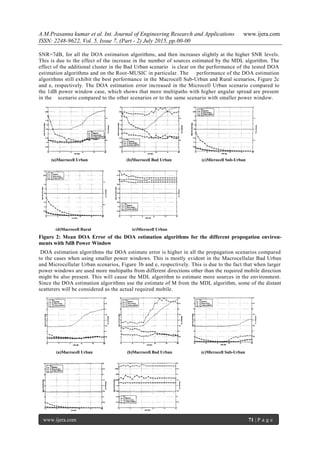
For the Macrocell Urban scenario (Figure 2a) the DOA estimate error reaches its lowest point at
(a)Macrocell Urban (b)Macrocell Bad Urban (c)Microcell Sub-Urban
(d)Macrocell Rural (e)Microcell Urban](https://image.slidesharecdn.com/j56026873-150803064834-lva1-app6891/85/Performance-Analysis-of-Adaptive-DOA-Estimation-Algorithms-For-Mobile-Applications-3-320.jpg)
![A.M.Prasanna kumar et al. Int. Journal of Engineering Research and Applications www.ijera.com
ISSN: 2248-9622, Vol. 5, Issue 7, (Part - 2) July 2015, pp.00-00
www.ijera.com 72 | P a g e
Figure 3: Mean DOA Error of the DOA estimation algorithms for the different propogation environ-
ments with 15dB Power Window
We have tried to solve this problem by using the estimate of number of sources (M) calculated by the Uni-
tary-ESPRIT from the most dominant eigenvectors [7] and tested it on the worst case scenarios with worst
case power window. DOA estimate error in the Macrocell Urban, Macrocell Bad Urban and Microcell
Urban scenarios when using the estimate of M calculated by the Unitary-ESPRIT algorithm with a power
window of 15dB. The figure shows how the performance of the DOA estimation algorithms improved by
using the better estimate of the number of sources. Root-MUSIC is more susceptible to the multipath
cluster from the remote scatterers present in the Bad Urban sce DOA estimation error increases when
the power window size for the CIRs increases, especially in scenarios with more than one clusters of
rays, e.g. Macrocell Bad Urban and Microcell Urban. Figure 4 showed how the performance of the DOA
estimation techniques could be improved by employing more accurate estimate of the number of sources
(M) present in the environment.
Figure 4: Mean DOA Error of the DOA estimation using estimate of M from Unitary –ESPRIT with a
15dB Power Window.
Macrocell Bad Urban, Macrocell Sub-Urban, Macro-
cell Rural and Microcell Urban. The algorithms have
been applied at the BS to find the DOA of a W-
CDMA signal transmitted by a single static MS. The
received complex impulse responses (CIR) have been
filtered using power window sizes of 1, 5 and 15dB
for an SNR range from - 5dB to 20dB. The results
showed that Root-MUSIC out-performed the other
algorithms in the Macrocell Sub-Urban and Rural
scenarios, and for the Macrocell Urban scenario when
the power window was small. However, Root-
MUSIC produced high DOA estimation errors in
scenarios with more than one clusters of rays, e.g.
Macrocell Bad Urban and Microcell Urban. The DOA
estimation error produced by the Unitary-ESPRIT
algorithm showed that this algorithm is more sensi-
tive to the SNR changes than the other algorithms, in
Al the tested scenarios. Comparing the results when
using the MDL algorithm to estimate the number of
sources present, using the estimate calculated by Uni-
tary-ESPRIT it was seen that Unitary-ESPRIT pro-
duces more accurate estimates. Generally, the results
showed the importance of power windows and good
estimates for the number of sources in improving the
accuracy of the DOA estimation algorithms.
V. Conclusion
In this paper the performance of Root-MUSIC,
standard version of ESPRIT and Unitary-ESPRIT
have been tested in terms of the mean DOA error.
This is carried out in five different scenarios: Macro-
cell Urban, Macrocell Bad Urban, Macrocell Sub-
urban, Macrocell Rural and Microcell Urban. The
algorithms have been applied at the BS to find the
DOA of a W-CDMA signal transmitted by a
single static MS. The received complex impulse re-
sponses (CIR) have been filtered using power win-
dow sizes of 1.5 and 15dB for an SNR range from -
5dB to 20dB. The results showed that Root-MUSIC
outperformed the other algorithms in the Macrocell
Sub-Urban and Rural scenarios, and for the Macrocell
Urban scenario when the power window was small.
The DOA estimation error produced by the Unitary-
ESPRIT algorithm showed that this algorithm is more
sensitive to the SNR changes than the other algo-
rithms, in all the tested scenarios. Comparing the
results when using the MDL algorithm to estimate the
number of sources present and when using the esti-
mate calculated by Unitary-ESPRIT it was seen that
Unitary-ESPRIT produces more accurate estimates.
Generally, the results showed the importance of
power windows and good estimates for the number of
sources in improving the accuracy of the DOA
estimation algorithms.
VI. Acknowledgement
The author is deeply grateful to
Hon.A.C.Shanmugam Chairman MCET and
(d)Macrocell Rural (e)Microcell Urban
(a)Macrocell Urban (b)Macrocell Bad Urban (c)Microcell Urban](https://image.slidesharecdn.com/j56026873-150803064834-lva1-app6891/85/Performance-Analysis-of-Adaptive-DOA-Estimation-Algorithms-For-Mobile-Applications-5-320.jpg)
![A.M.Prasanna kumar et al. Int. Journal of Engineering Research and Applications www.ijera.com
ISSN: 2248-9622, Vol. 5, Issue 7, (Part - 2) July 2015, pp.00-00
www.ijera.com 73 | P a g e
Hon.S.Vijayanand Executive Director, and
Hon.Dr.H.B.PhaniRaju Principal, ACS College of
Engineering Bangalore for their kind encouragement
and help during the progress of this work.
References
[1] Tsoulos, G: "Smart Antennas for Mobile
Communication Systems: Benefits and Chal-
lenges", IEE Electron. Commun. Eng. Jour-
nal, 11(2): 84-94, Apr. 1999.
[2] Tsoulos, G, et al.: "Space Division Multiple
Access (SDMA) Field Trials. Part 1: Tracking
and BER Performance"
& `Part 2: Calibration
and Linearity Issues", IEE Proc. on Radar,
Sonar and Nav., 145(1): 73-84, Feb. 1998.
[3] Krim, H and Viberg, M: "Two Decades of
Array Signal Processing Research", IEEE SP
Mag., pp. 67-94, Jul. 1996.
[4] Schmidt, R: "Multiple Emitter Location and
Signal Parameter Estimation", IEEE Trans. on
AP, 34(3): 276-280, Mar. 1986.
[5] Paulraj, A, et. al. "A Subspace Rotation Ap-
proach to Signal Parameter Estimation", Proc.
of the IEEE, 74(7): 1044-1045, .Jul. 1986.
[6] Roy, R and Kailath, T: "ESPRIT-Estimation
of Signal Parameters Via Rotational Inva-
riance Techniques", IEEE Trans. on ASSP,
37(7): 984-995, Jul. 1989.
[7] Haardt, M and Nossek, 7: "Unitary ESPRIT:
How to Obtain Increased Estimation Accuracy
with a Reduced Computational Burden", IEEE
Trans. on SP, 43(5): 1232-1242, May 1995.
[8] Therrien, C: "Discrete Random Signals and
Statistical Signal Processing", Prentice Hall,
NJ, 1992.
[9] Capon, J, et al.: "Multidimensional Maxi-
mum Likelihood Processing of a Large Aper-
ture Seismic Array"
, Proc. of the IE.E.E.,
55(2): 192-211, Feb. 1967.
[10] Fleury, B, et al.: "Wideband Angle of Arriv-
al Estimation using the SAGE Algorithm",
Proc. of ISSSTA '96, pp. 79-85, Mainz, Ger-
many, Sep. 1996.
[11] Viberg, M, et al.: "Detection and Estimation
in Sensor Arrays Using Weighted Subspace
Fitting", IEEE Trans. on SP, 39(11): 2436-
2449, Nov. 1991.
[12] Piechocki, R and Tsoulos, G: "A Mcrocellular
Radio Channel Model for Smart Antenna
Tracking Algorithms", Proc. of VTC'99, pp.
1754-1758, Houston, TX, May 1999.
[13] Haykin, S (Ed.): "Army Signal Processing",
Prentice-Hall, NJ, 1985.
[14] Wax, M and Kailath, T: "Detection of Signals
by Information Theoretic Criteria", IEEE
Trans. on ASSP, 33(2): 387-392, Apr. 1985.
[15] Wax, M and Ziskind, I: "Detection of the
Number of Coherent Signals by the MDL
Principle", IEEE Trans. on ASSP, 37(8):
1190-1196, Aug. 1989.
[16] Ogawa, Y and Kikuma, N: "High-Resolution
Techniques in Signal Processing Antennas",
IEICE Trans. on Commun., E78-B(11): 1435-
1441, Nov. 1995.
[17] Shan, T-J, et al.: "On Spatial Smoothing for
Direction-of-Arrival Estimation of Coherent
Signals", IEEE Trans. on ASSP, 33(4): 806-
811, Aug. 1985.
[18] Barabell, A: "Improving the Resolution Per-
formance of Eigenstructure-Based Direction-
Finding Algorithms", Proc. of ICASSP '83, pp.
336-339, Boston, MA, 1983.
[19] Rao, B and Had, K: "Performance Analysis of
Root-MUSIC",IEEE Trans.on
ASSP,37(12):1939-1949, Dec. 1989.
[20] Zoltowski, M, et al.: "Beamspace Root-
MUSIC", IEEE Trans. on SP, 41(1): Dec.
2011,344-36](https://image.slidesharecdn.com/j56026873-150803064834-lva1-app6891/85/Performance-Analysis-of-Adaptive-DOA-Estimation-Algorithms-For-Mobile-Applications-6-320.jpg)

This paper evaluates the performance of various direction-of-arrival (DOA) estimation algorithms for mobile communication applications using a linear antenna array in typical cellular environments. The study compares spectral estimation, parametric subspace-based estimation, and deterministic parametric estimation methods, illustrating their effectiveness in different scenarios such as urban and rural settings. Results indicate that algorithms like Root-MUSIC outperform others, especially in environments with lower signal-to-noise ratios.


![1687 1499-2008-601346[1]](https://cdn.slidesharecdn.com/ss_thumbnails/1687-1499-2008-6013461-131222110733-phpapp02-thumbnail.jpg?width=640&height=640&fit=bounds)


