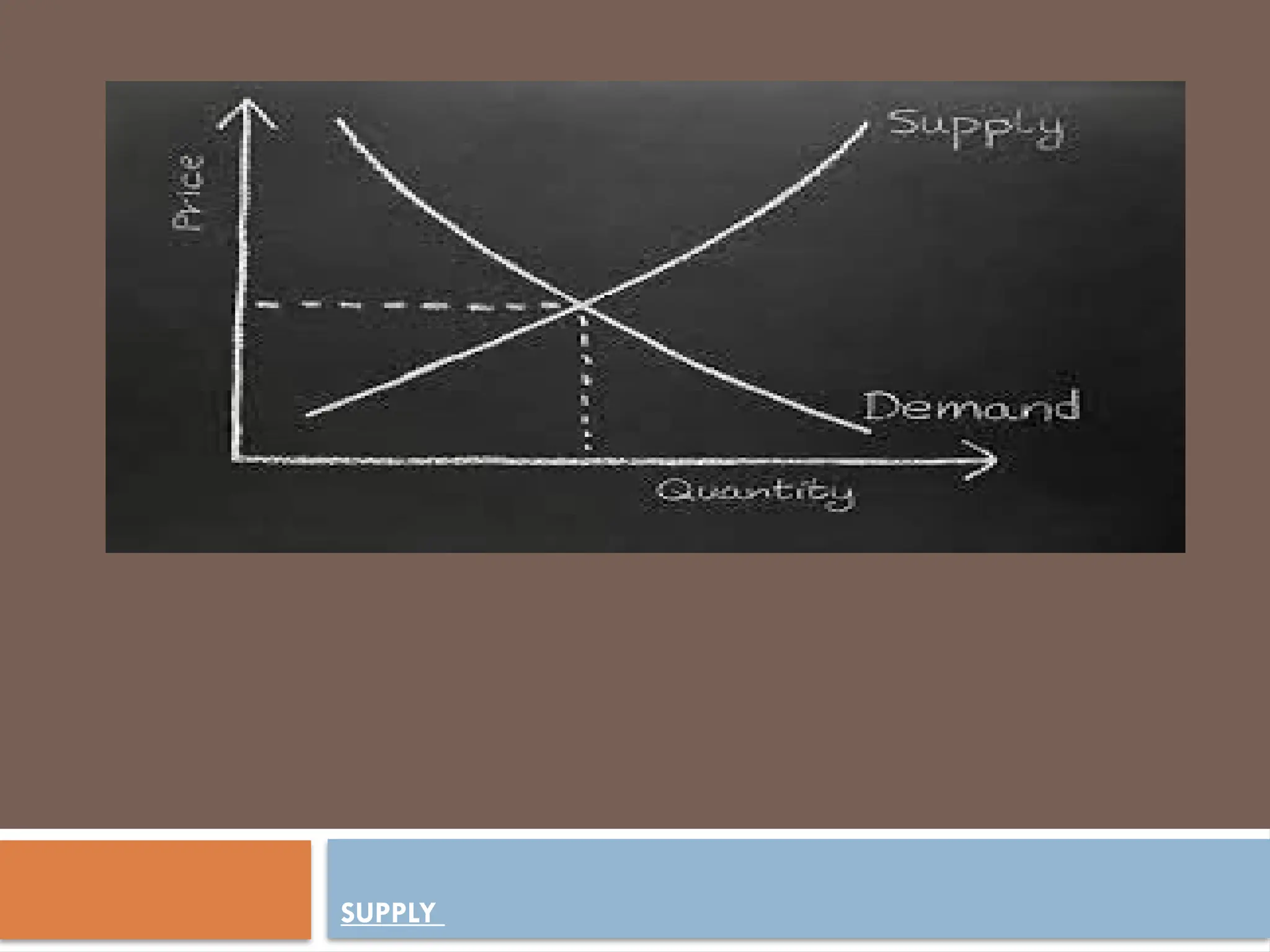
SUPPLY
 In a market economy, sellers for products and services constitute the
supply side. As the term ‘demand’ refers to the quantity of a good or
service that the consumers are willing and able to purchase at various
prices during a given period of time, the term ‘supply’ refers to the
amount of a good or service that the producers are willing and able to
offer to the market at various prices during a given period of time.
 Two important points apply to supply:
 Supply refers to what a firm offer for sale in the market, not necessarily
to what they succeed in selling. What is offered may not get sold.
 Supply is a flow. The quantity supplied is ‘so much’ per unit of time, per
day, per week, or per year.

DETERMINANTS OF SUPPLY
 Price of the good: Other things being equal, the higher the relative
price of a good the greater the quantity of it that will be supplied.
This is because goods and services are produced by the firm in order
to earn profits and, ceteris paribus, profits rise if the price of its
product rises.
 Prices of related goods: If the prices of other goods rise, they
become relatively more profitable to the firm to produce and sell than
the good in question. It implies that, if the price of Y rises, the quantity
supplied of X will fall. For example, if price of wheat rises, the
farmers may shift their land to wheat production away from corn and
soya beans.
 Prices of factors of production: Cost of production is a significant
factor that affects supply. A rise in the price of a particular factor
of production will cause an increase in the cost of making those
goods that use a great deal of that factor than in the costs of
producing those that use relatively small amount of the factor.
 For example, a rise in the cost of land will have a large
effect on the cost of producing wheat and a very small
effect on the cost of producing automobiles. Thus, a change
in the price of one factor of production will cause changes
in the relative profitability of different lines of production
and will cause producers to shift from one line to another
and thus supplies of different commodities will change.
 State of technology: The supply of a particular product depends upon the state of
technology also. Inventions and innovations tend to make it possible to produce more or
better goods with the same resources, and thus they tend to increase the quantity supplied
of some products and to reduce the quantity supplied of products that are displaced.
Availability of spare production capacity and the ease with which factor substitution can be
made and the cost of such substitution also determine supply.
 Government Policy: The production of a good may be subject to the imposition of
commodity taxes such as excise duty, sales tax and import duties. These raise the cost of
production and so the quantity supplied of a good would increase only when its price in the
market rises. Subsidies, on the other hand, reduce the cost of production and thus provide
an incentive to the firm to increase supply. When government imposes restrictions such as
import quota on inputs, rationing of input supply etc, production tends to fall.
 Nature of competition and size of industry: Under competitive conditions, supply will
be more than that under monopolized conditions. If there are large number of firms in the
market, supply will be more. Besides, entry of new firms, either domestic or foreign,
causes the industry supply curve to shift rightwards.
LAW OF SUPPLY
 The law of supply can be stated as: Other things
remaining constant, the quantity of a good produced
and offered for sale will increase as the price of the
good rises and decrease as the price falls.
 The table shows the quantities of good X that would be
produced and offered for sale at a number of alternative
prices. At ` 1, for example, 5 kilograms of good X are
offered for sale and at ` 3 per kg. 45 kg. would be
forthcoming.

We can now plot the data from Table 9 on a graph. In
Figure 19, price is plotted on the vertical axis and quantity
on the horizontal axis, and various price-quantity
combinations of the schedule 9 are plotted.

 When we draw a smooth curve through the plotted points, what
we get is the supply curve for good X. The supply curve is a
graphical presentation of the supply schedule. It shows the
quantity of X that will be offered for sale at each price of X. It
slopes upwards towards right (positive slope) showing that as
price increases, the quantity supplied of X increases and vice-
versa.
 The market supply, like market demand, is the sum of supplies of
a commodity made by all individual firms or their supply
agencies. The market supply is governed by the law of supply.
The market supply curve for ‘X’ can be obtained by adding
horizontally the supply curves of various firms.
 MOVEMENTS ON THE SUPPLY CURVE –
INCREASE OR DECREASE IN THE QUANTITY
SUPPLIED
 When the supply of a good increase as a result of
an increase in its price, we say that there is an
increase in the quantity supplied and there is a
upward movement on the supply curve. The reverse
is the case when there is a fall in the price of the
good.
SHIFTS IN SUPPLY CURVE – INCREASE OR DECREASE IN SUPPLY
 When the supply curve bodily shifts towards the
right as a result of a change in one of the factors
that influence the quantity supplied other than the
commodity’s own price, we say there is an increase
in supply. When these factors cause the supply
curve to shift to the left, we call it decrease in
supply
Shifts in Supply Curve
ELASTICITY OF SUPPLY
 The elasticity of supply is defined as the
responsiveness of the quantity supplied of a good
to a change in its price. Elasticity of supply is
measured by dividing the percentage change in
quantity supplied of a good by the percentage
change in its price i.e.,
Type of Supply Elasticity
 The elasticity of supply can be classified as under:
Perfectly inelastic supply: If as a result of a change
in price, the quantity supplied of a good remains
unchanged, we say that the elasticity of supply is
zero or the good has perfectly inelastic supply. The
vertical supply curve in Figure shows that
irrespective of price change, the quantity supplied
remains unchanged.
Supply curve of zero elasticity/perfectly inlastic
 Relatively less-elastic supply: If as a result of a
change in the price of a good its supply changes
less than proportionately, we say that the supply of
the good is relatively less elastic or elasticity of
supply is less than one. Figure 23 shows that the
relative change in the quantity supplied (∆q) is less
than the
 relative change in the price (∆p).
Showing relatively less elastic supply
 Relatively greater-elastic supply: If elasticity of
supply is greater than one i.e., when the quantity
supplied of a good changes substantially in
response to a small change in the price of the good
we say that supply is relatively elastic. Figure
shows that the relative change in the quantity
supplied (∆q) is greater than the relative change in
the price.
Showing relatively greater elastic supply

Unit-elastic: If the relative change in the quantity
supplied is exactly equal to the relative change in
the price, the supply is said to be unitary elastic.
Here the coefficient of elasticity of supply is equal
to one. In Figure the relative change in the quantity
supplied (∆q) is equal to the relative change in the
price (∆p).
Showing unitary elasticity
 Perfectly elastic supply: Elasticity of supply said to
be infinite when nothing is supplied at a lower price,
but a small increase in price causes supply to rise
from zero to an infinitely large amount indicating
that producers will supply any quantity demanded
at that price. Figure shows infinitely elastic supply.
Determinants of Supply and law of supply.pptx

Determinants of Supply and law of supply.pptx

  • 1.
  • 2.
     In amarket economy, sellers for products and services constitute the supply side. As the term ‘demand’ refers to the quantity of a good or service that the consumers are willing and able to purchase at various prices during a given period of time, the term ‘supply’ refers to the amount of a good or service that the producers are willing and able to offer to the market at various prices during a given period of time.  Two important points apply to supply:  Supply refers to what a firm offer for sale in the market, not necessarily to what they succeed in selling. What is offered may not get sold.  Supply is a flow. The quantity supplied is ‘so much’ per unit of time, per day, per week, or per year. 
  • 3.
    DETERMINANTS OF SUPPLY Price of the good: Other things being equal, the higher the relative price of a good the greater the quantity of it that will be supplied. This is because goods and services are produced by the firm in order to earn profits and, ceteris paribus, profits rise if the price of its product rises.  Prices of related goods: If the prices of other goods rise, they become relatively more profitable to the firm to produce and sell than the good in question. It implies that, if the price of Y rises, the quantity supplied of X will fall. For example, if price of wheat rises, the farmers may shift their land to wheat production away from corn and soya beans.
  • 4.
     Prices offactors of production: Cost of production is a significant factor that affects supply. A rise in the price of a particular factor of production will cause an increase in the cost of making those goods that use a great deal of that factor than in the costs of producing those that use relatively small amount of the factor.  For example, a rise in the cost of land will have a large effect on the cost of producing wheat and a very small effect on the cost of producing automobiles. Thus, a change in the price of one factor of production will cause changes in the relative profitability of different lines of production and will cause producers to shift from one line to another and thus supplies of different commodities will change.
  • 5.
     State oftechnology: The supply of a particular product depends upon the state of technology also. Inventions and innovations tend to make it possible to produce more or better goods with the same resources, and thus they tend to increase the quantity supplied of some products and to reduce the quantity supplied of products that are displaced. Availability of spare production capacity and the ease with which factor substitution can be made and the cost of such substitution also determine supply.  Government Policy: The production of a good may be subject to the imposition of commodity taxes such as excise duty, sales tax and import duties. These raise the cost of production and so the quantity supplied of a good would increase only when its price in the market rises. Subsidies, on the other hand, reduce the cost of production and thus provide an incentive to the firm to increase supply. When government imposes restrictions such as import quota on inputs, rationing of input supply etc, production tends to fall.  Nature of competition and size of industry: Under competitive conditions, supply will be more than that under monopolized conditions. If there are large number of firms in the market, supply will be more. Besides, entry of new firms, either domestic or foreign, causes the industry supply curve to shift rightwards.
  • 6.
    LAW OF SUPPLY The law of supply can be stated as: Other things remaining constant, the quantity of a good produced and offered for sale will increase as the price of the good rises and decrease as the price falls.
  • 8.
     The tableshows the quantities of good X that would be produced and offered for sale at a number of alternative prices. At ` 1, for example, 5 kilograms of good X are offered for sale and at ` 3 per kg. 45 kg. would be forthcoming.  We can now plot the data from Table 9 on a graph. In Figure 19, price is plotted on the vertical axis and quantity on the horizontal axis, and various price-quantity combinations of the schedule 9 are plotted. 
  • 10.
     When wedraw a smooth curve through the plotted points, what we get is the supply curve for good X. The supply curve is a graphical presentation of the supply schedule. It shows the quantity of X that will be offered for sale at each price of X. It slopes upwards towards right (positive slope) showing that as price increases, the quantity supplied of X increases and vice- versa.  The market supply, like market demand, is the sum of supplies of a commodity made by all individual firms or their supply agencies. The market supply is governed by the law of supply. The market supply curve for ‘X’ can be obtained by adding horizontally the supply curves of various firms.
  • 11.
     MOVEMENTS ONTHE SUPPLY CURVE – INCREASE OR DECREASE IN THE QUANTITY SUPPLIED  When the supply of a good increase as a result of an increase in its price, we say that there is an increase in the quantity supplied and there is a upward movement on the supply curve. The reverse is the case when there is a fall in the price of the good.
  • 13.
    SHIFTS IN SUPPLYCURVE – INCREASE OR DECREASE IN SUPPLY  When the supply curve bodily shifts towards the right as a result of a change in one of the factors that influence the quantity supplied other than the commodity’s own price, we say there is an increase in supply. When these factors cause the supply curve to shift to the left, we call it decrease in supply
  • 14.
  • 15.
    ELASTICITY OF SUPPLY The elasticity of supply is defined as the responsiveness of the quantity supplied of a good to a change in its price. Elasticity of supply is measured by dividing the percentage change in quantity supplied of a good by the percentage change in its price i.e.,
  • 19.
    Type of SupplyElasticity  The elasticity of supply can be classified as under: Perfectly inelastic supply: If as a result of a change in price, the quantity supplied of a good remains unchanged, we say that the elasticity of supply is zero or the good has perfectly inelastic supply. The vertical supply curve in Figure shows that irrespective of price change, the quantity supplied remains unchanged.
  • 20.
    Supply curve ofzero elasticity/perfectly inlastic
  • 21.
     Relatively less-elasticsupply: If as a result of a change in the price of a good its supply changes less than proportionately, we say that the supply of the good is relatively less elastic or elasticity of supply is less than one. Figure 23 shows that the relative change in the quantity supplied (∆q) is less than the  relative change in the price (∆p).
  • 22.
  • 23.
     Relatively greater-elasticsupply: If elasticity of supply is greater than one i.e., when the quantity supplied of a good changes substantially in response to a small change in the price of the good we say that supply is relatively elastic. Figure shows that the relative change in the quantity supplied (∆q) is greater than the relative change in the price.
  • 24.
  • 25.
     Unit-elastic: If therelative change in the quantity supplied is exactly equal to the relative change in the price, the supply is said to be unitary elastic. Here the coefficient of elasticity of supply is equal to one. In Figure the relative change in the quantity supplied (∆q) is equal to the relative change in the price (∆p).
  • 26.
  • 27.
     Perfectly elasticsupply: Elasticity of supply said to be infinite when nothing is supplied at a lower price, but a small increase in price causes supply to rise from zero to an infinitely large amount indicating that producers will supply any quantity demanded at that price. Figure shows infinitely elastic supply.