Supply
Chapter 3-4
Supply
• Individuals control the factors of
production – inputs, or resources,
necessary to produce goods.
• Individuals supply factors of production to
intermediaries or firms.
Supply
• The analysis of the supply of produced
goods has two parts:
– An analysis of the supply of the factors of
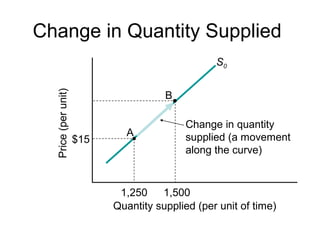
production to households and firms.
– An analysis of why firms transform those
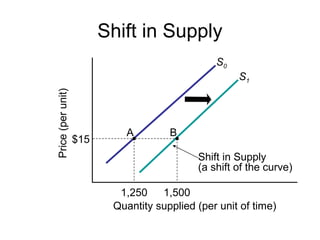
factors of production into usable goods and
services.
The Law of Supply
• There is a direct relationship between
price and quantity supplied.
– Quantity supplied rises as price rises, other
things constant.
– Quantity supplied falls as price falls, other
things constant.
Law of Supply
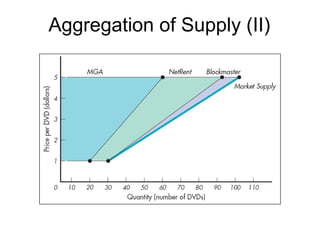
• Law of Supply
– As the price of a product rises, producers will be
willing to supply more.
– The height of the supply curve at any quantity shows
the minimum price necessary to induce producers
to supply that next unit to market.
– The height of the supply curve at any quantity also
shows the opportunity cost of producing the next
unit of the good.
The Law of Supply
• The law of supply is accounted for by two
factors:
– When prices rise, firms substitute
production of one good for another.
– Assuming firms’ costs are constant, a
higher price means higher profits.
Not in your book but something to think about!
The Supply Curve
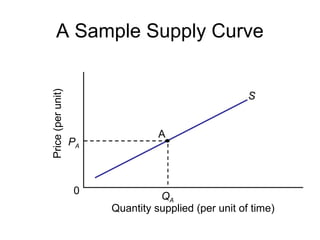
• The supply curve is the graphic
representation of the law of supply.
• The supply curve slopes upward to the
right.
• The slope tells us that the quantity
supplied varies directly – in the same
direction – with the price.
S
A
Quantity supplied (per unit of time)
0
Price(perunit)
PA
QA
A Sample Supply Curve
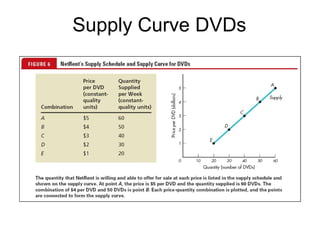
Supply Curve DVDs
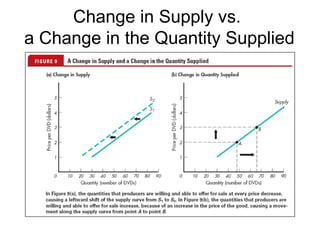
Shifts in Supply Versus Movements
Along a Supply Curve
• Supply refers to a schedule of quantities a
seller is willing to sell per unit of time at
various prices, other things constant.
• Quantity supplied refers to a specific
amount that will be supplied at a specific
price.
Shifts in Supply Versus Movements
Along a Supply Curve
• Changes in price causes changes in
quantity supplied represented by a
movement along a supply curve.
Shifts in Supply Versus Movements
Along a Supply Curve
• A movement along a supply curve – the
graphic representation of the effect of a
change in price on the quantity supplied.
Shifts in Supply Versus Movements
Along a Supply Curve
• If the amount supplied is affected by
anything other than a change in price,
there will be a shift in supply.
Shifts in Supply Versus Movements
Along a Supply Curve
• Shift in supply – the graphic
representation of the effect of a change in
a factor other than price on supply.
Shifts in Supply Versus Movements
Along a Supply Curve
Change in quantity
supplied (a movement
along the curve)
Change in Quantity Supplied
Price(perunit)
Quantity supplied (per unit of time)
S0
$15
A
1,250 1,500
B
Shift in Supply
Price(perunit)
Quantity supplied (per unit of time)
S0
Shift in Supply
(a shift of the curve)
S1
$15
A B
1,250 1,500
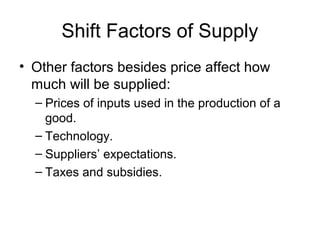
Shift Factors of Supply
• Other factors besides price affect how
much will be supplied:
– Prices of inputs used in the production of a
good.
– Technology.
– Suppliers’ expectations.
– Taxes and subsidies.
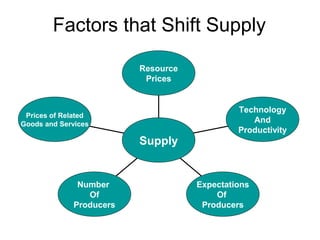
Factors that Shift Supply
Prices of Related
Goods and Services
Number
Of
Producers
Expectations
Of
Producers
Technology
And
Productivity
Resource
Prices
Supply
Price of Inputs (Resource Prices)
• When costs go up, profits go down, so that
the incentive to supply also goes down.
Technology
• Advances in technology reduce the
number of inputs needed to produce a
given supply of goods.
• Costs go down, profits go up, leading to
increased supply.
Expectations
• If suppliers expect prices to rise in the
future, they may store today's supply to
reap higher profits later.
Number of Suppliers
• As more people decide to supply a good
the market supply increases (Rightward
Shift).
Individual and Market Supply
Curves
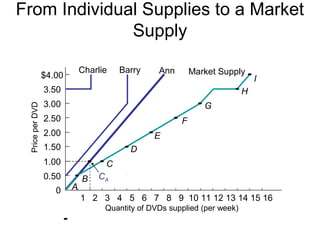
• The market supply curve is derived by
horizontally adding the individual supply
curves of each supplier.
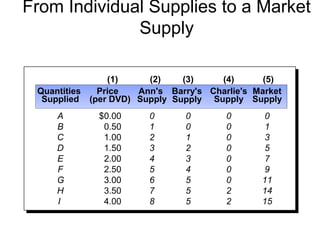
From Individual Supplies to a Market
Supply
Quantities
Supplied
A
B
C
D
E
F
G
H
I
(1)
Price
(per DVD)
(2)
Ann's
Supply
(5)
Market
Supply
(4)
Charlie's
Supply
$0.00
0.50
1.00
1.50
2.00
2.50
3.00
3.50
4.00
0
1
2
3
4
5
6
7
8
0
0
1
2
3
4
5
5
5
0
0
0
0
0
0
0
2
2
0
1
3
5
7
9
11
14
15
(3)
Barry's
Supply
1 2 3 4 5 6 7 8 9 10 11 12 13 14 15 16
From Individual Supplies to a Market
SupplyPriceperDVD
Charlie Barry Ann
Quantity of DVDs supplied (per week)
$4.00
3.50
3.00
2.50
2.00
1.50
1.00
0.50
0
I
H
G
F
E
D
C
B
A
Market Supply
CA
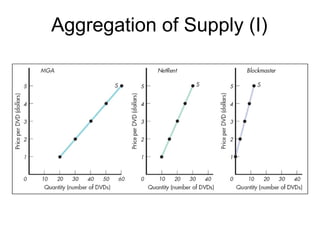
Aggregation of Supply (I)
Aggregation of Supply (II)
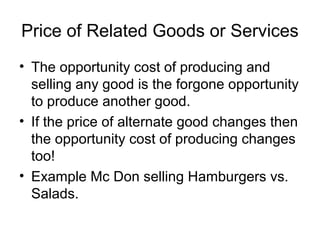
Price of Related Goods or Services
• The opportunity cost of producing and
selling any good is the forgone opportunity
to produce another good.
• If the price of alternate good changes then
the opportunity cost of producing changes
too!
• Example Mc Don selling Hamburgers vs.
Salads.
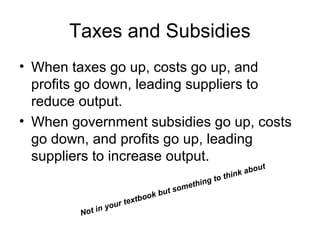
Taxes and Subsidies
• When taxes go up, costs go up, and
profits go down, leading suppliers to
reduce output.
• When government subsidies go up, costs
go down, and profits go up, leading
suppliers to increase output.
Not in your textbook but something to think about
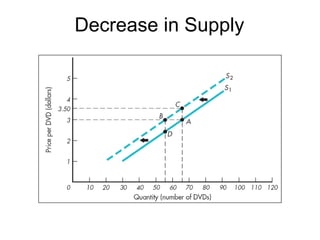
Decrease in Supply
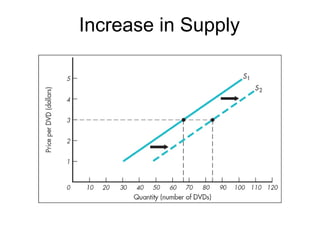
Increase in Supply
Change in Supply vs.
a Change in the Quantity Supplied

3 4 supply

  • 1.
  • 2.
    Supply • Individuals controlthe factors of production – inputs, or resources, necessary to produce goods. • Individuals supply factors of production to intermediaries or firms.
  • 3.
    Supply • The analysisof the supply of produced goods has two parts: – An analysis of the supply of the factors of production to households and firms. – An analysis of why firms transform those factors of production into usable goods and services.
  • 4.
    The Law ofSupply • There is a direct relationship between price and quantity supplied. – Quantity supplied rises as price rises, other things constant. – Quantity supplied falls as price falls, other things constant.
  • 5.
    Law of Supply •Law of Supply – As the price of a product rises, producers will be willing to supply more. – The height of the supply curve at any quantity shows the minimum price necessary to induce producers to supply that next unit to market. – The height of the supply curve at any quantity also shows the opportunity cost of producing the next unit of the good.
  • 6.
    The Law ofSupply • The law of supply is accounted for by two factors: – When prices rise, firms substitute production of one good for another. – Assuming firms’ costs are constant, a higher price means higher profits. Not in your book but something to think about!
  • 7.
    The Supply Curve •The supply curve is the graphic representation of the law of supply. • The supply curve slopes upward to the right. • The slope tells us that the quantity supplied varies directly – in the same direction – with the price.
  • 8.
    S A Quantity supplied (perunit of time) 0 Price(perunit) PA QA A Sample Supply Curve
  • 9.
  • 10.
    Shifts in SupplyVersus Movements Along a Supply Curve • Supply refers to a schedule of quantities a seller is willing to sell per unit of time at various prices, other things constant.
  • 11.
    • Quantity suppliedrefers to a specific amount that will be supplied at a specific price. Shifts in Supply Versus Movements Along a Supply Curve
  • 12.
    • Changes inprice causes changes in quantity supplied represented by a movement along a supply curve. Shifts in Supply Versus Movements Along a Supply Curve
  • 13.
    • A movementalong a supply curve – the graphic representation of the effect of a change in price on the quantity supplied. Shifts in Supply Versus Movements Along a Supply Curve
  • 14.
    • If theamount supplied is affected by anything other than a change in price, there will be a shift in supply. Shifts in Supply Versus Movements Along a Supply Curve
  • 15.
    • Shift insupply – the graphic representation of the effect of a change in a factor other than price on supply. Shifts in Supply Versus Movements Along a Supply Curve
  • 16.
    Change in quantity supplied(a movement along the curve) Change in Quantity Supplied Price(perunit) Quantity supplied (per unit of time) S0 $15 A 1,250 1,500 B
  • 17.
    Shift in Supply Price(perunit) Quantitysupplied (per unit of time) S0 Shift in Supply (a shift of the curve) S1 $15 A B 1,250 1,500
  • 18.
    Shift Factors ofSupply • Other factors besides price affect how much will be supplied: – Prices of inputs used in the production of a good. – Technology. – Suppliers’ expectations. – Taxes and subsidies.
  • 19.
    Factors that ShiftSupply Prices of Related Goods and Services Number Of Producers Expectations Of Producers Technology And Productivity Resource Prices Supply
  • 20.
    Price of Inputs(Resource Prices) • When costs go up, profits go down, so that the incentive to supply also goes down.
  • 21.
    Technology • Advances intechnology reduce the number of inputs needed to produce a given supply of goods. • Costs go down, profits go up, leading to increased supply.
  • 22.
    Expectations • If suppliersexpect prices to rise in the future, they may store today's supply to reap higher profits later.
  • 23.
    Number of Suppliers •As more people decide to supply a good the market supply increases (Rightward Shift).
  • 24.
    Individual and MarketSupply Curves • The market supply curve is derived by horizontally adding the individual supply curves of each supplier.
  • 25.
    From Individual Suppliesto a Market Supply Quantities Supplied A B C D E F G H I (1) Price (per DVD) (2) Ann's Supply (5) Market Supply (4) Charlie's Supply $0.00 0.50 1.00 1.50 2.00 2.50 3.00 3.50 4.00 0 1 2 3 4 5 6 7 8 0 0 1 2 3 4 5 5 5 0 0 0 0 0 0 0 2 2 0 1 3 5 7 9 11 14 15 (3) Barry's Supply
  • 26.
    1 2 34 5 6 7 8 9 10 11 12 13 14 15 16 From Individual Supplies to a Market SupplyPriceperDVD Charlie Barry Ann Quantity of DVDs supplied (per week) $4.00 3.50 3.00 2.50 2.00 1.50 1.00 0.50 0 I H G F E D C B A Market Supply CA
  • 27.
  • 28.
  • 29.
    Price of RelatedGoods or Services • The opportunity cost of producing and selling any good is the forgone opportunity to produce another good. • If the price of alternate good changes then the opportunity cost of producing changes too! • Example Mc Don selling Hamburgers vs. Salads.
  • 30.
    Taxes and Subsidies •When taxes go up, costs go up, and profits go down, leading suppliers to reduce output. • When government subsidies go up, costs go down, and profits go up, leading suppliers to increase output. Not in your textbook but something to think about
  • 31.
  • 32.
  • 33.
    Change in Supplyvs. a Change in the Quantity Supplied