Theoretical Part Topics
 Introduction to International Trade
 Trade Barrier & Imperfect Competition
 Trade Body, Trade Law and Product introduction
 World Apparel Market and BDG RMG Sector
 Market and Demand Analysis
 World Market analysis and Potentialities
 Introduction to Marketing and Export Promotion
 Communication Strategy
 Process of Export and Import
Some Basic Concept
 GDP
 GNP
 Growth Rate
 Exchange rate
 Terms of Trade
 Monetary Policy
 Fiscal Policy
 Unemployment rate
 Age structure
 Population Size
 Purchasing Power
Parity (PPP)
 Country’s Trade
Openness
Intro. to Int. Trade (Cont.)
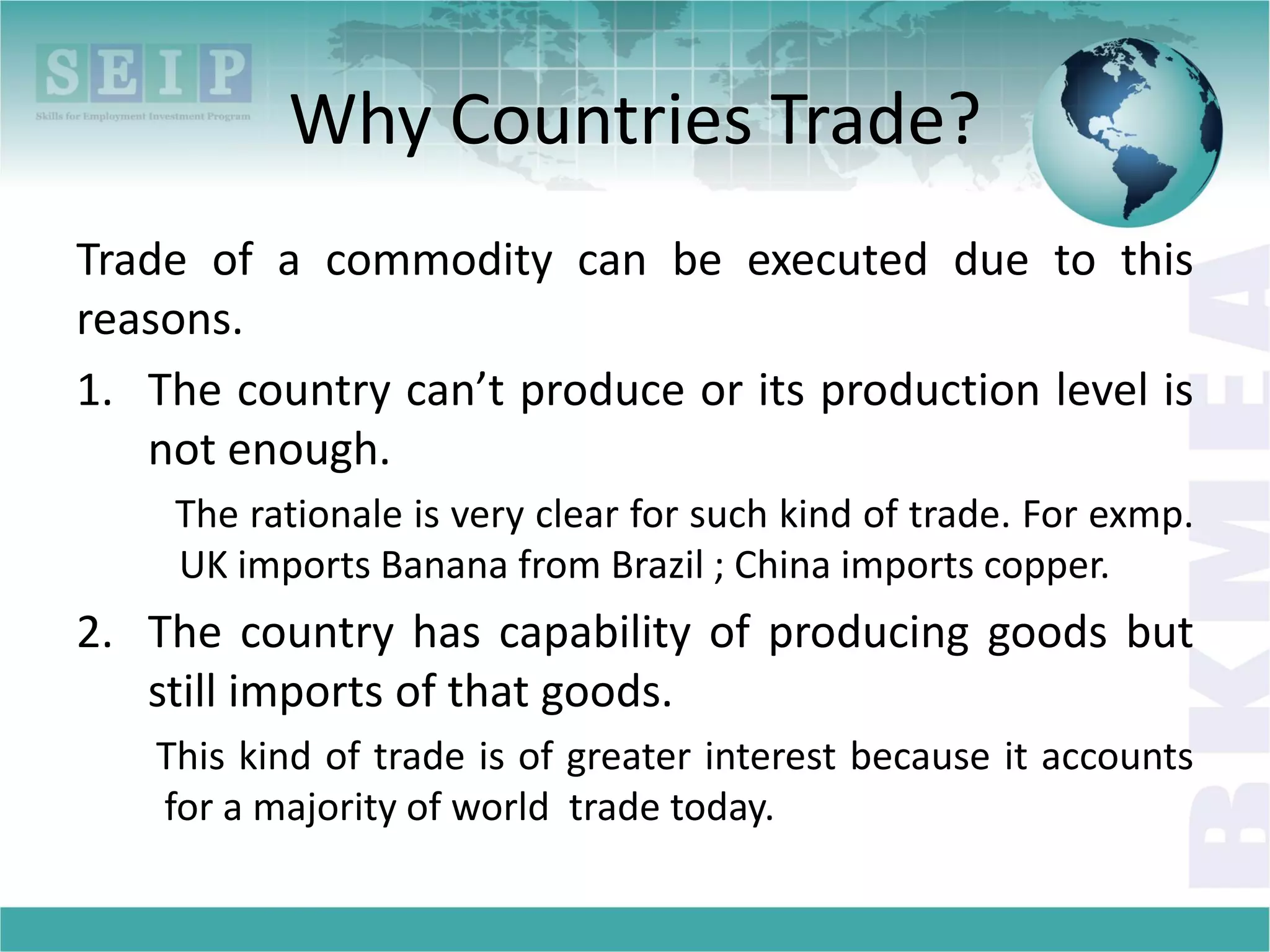
Why Countries Trade?
Trade of a commodity can be executed due to this
reasons.
1. The country can’t produce or its production level is
not enough.
The rationale is very clear for such kind of trade. For exmp.
UK imports Banana from Brazil ; China imports copper.
2. The country has capability of producing goods but
still imports of that goods.
This kind of trade is of greater interest because it accounts
for a majority of world trade today.
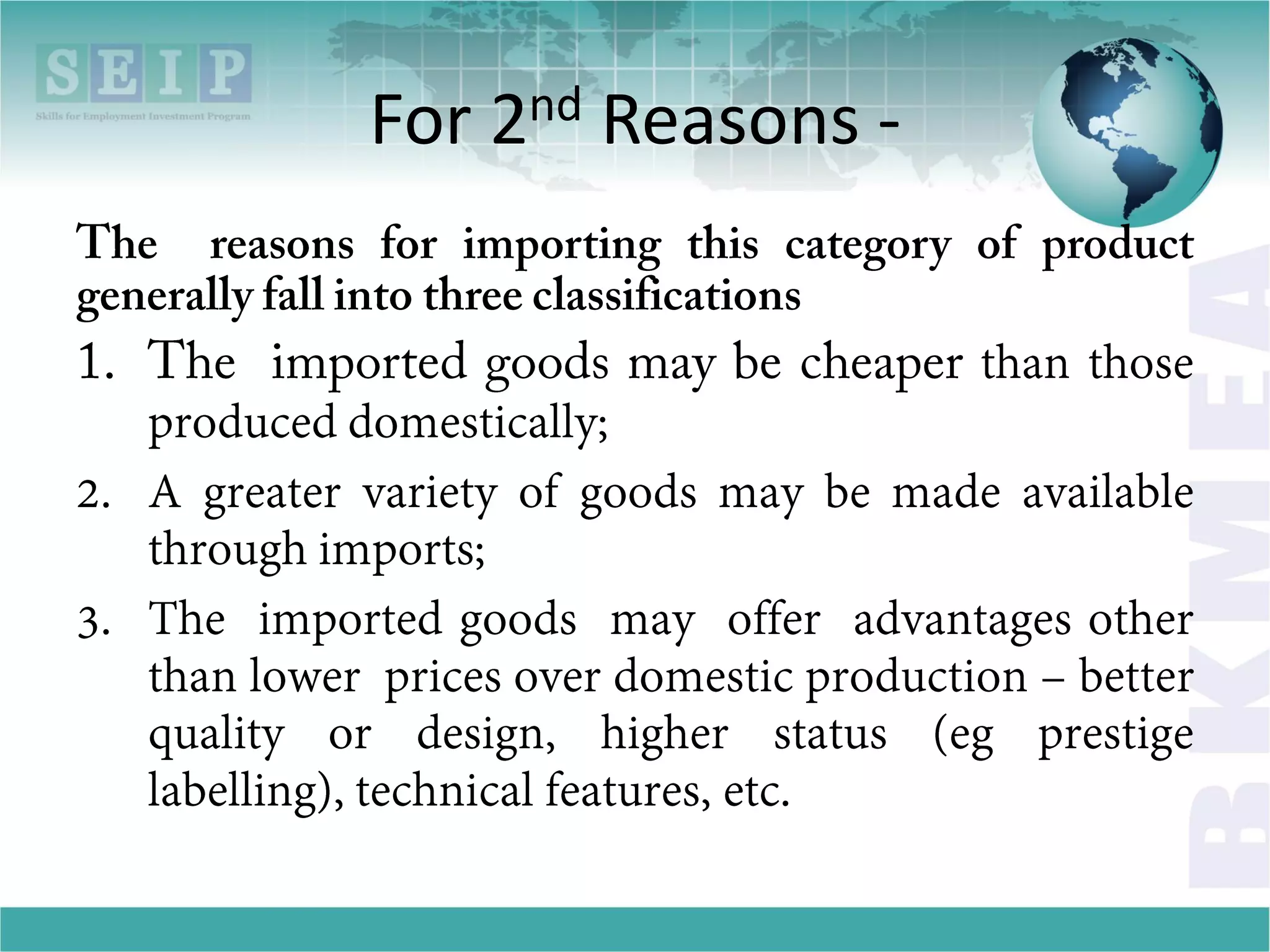
For 2nd Reasons -
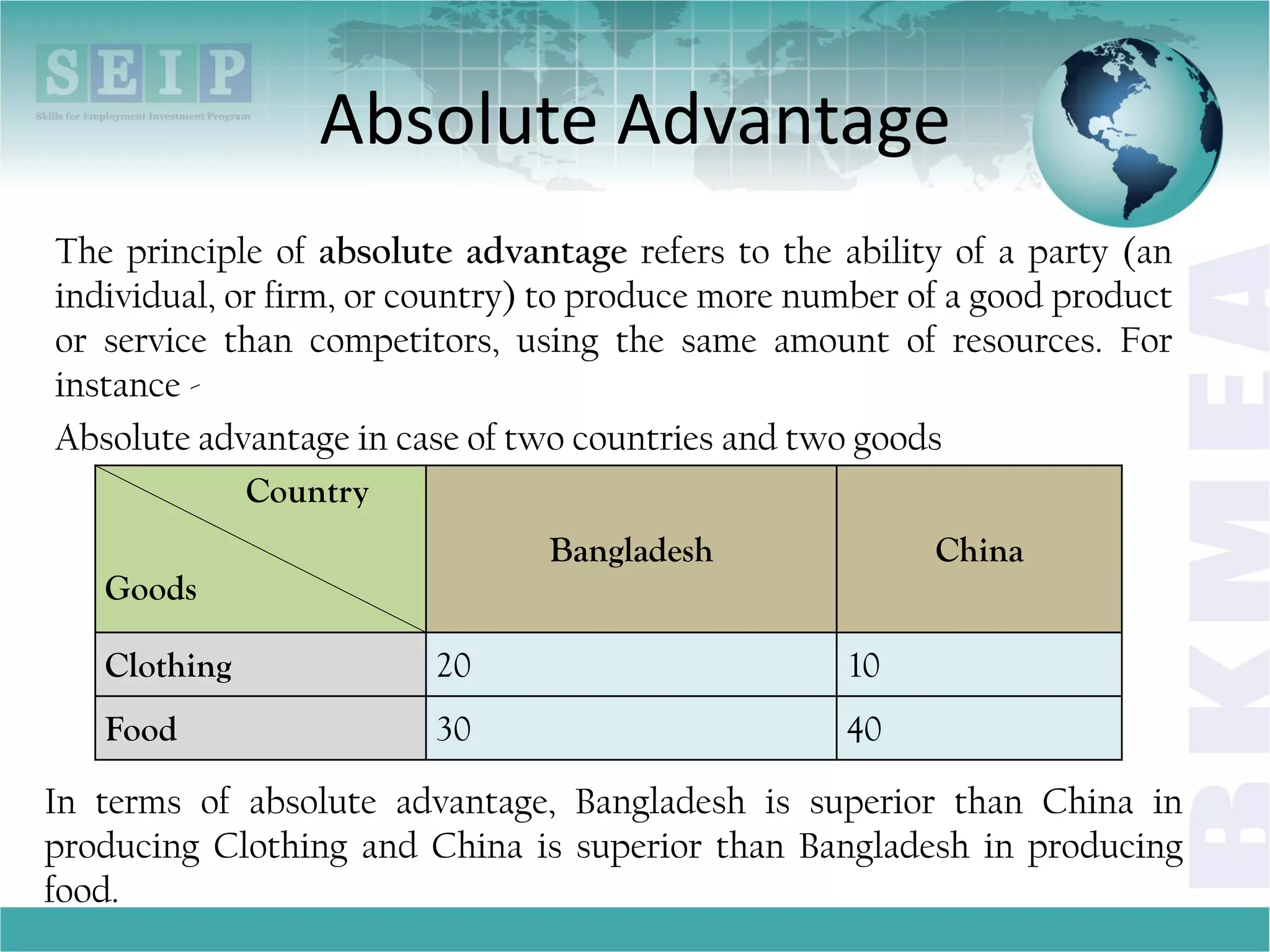
Absolute Advantage
The principle of absolute advantage refers to the ability of a party (an
individual, or firm, or country) to produce more number of a good product
or service than competitors, using the same amount of resources. For
instance -
Absolute advantage in case of two countries and two goods
Country
Goods
Bangladesh China
Clothing 20 10
Food 30 40
In terms of absolute advantage, Bangladesh is superior than China in
producing Clothing and China is superior than Bangladesh in producing
food.
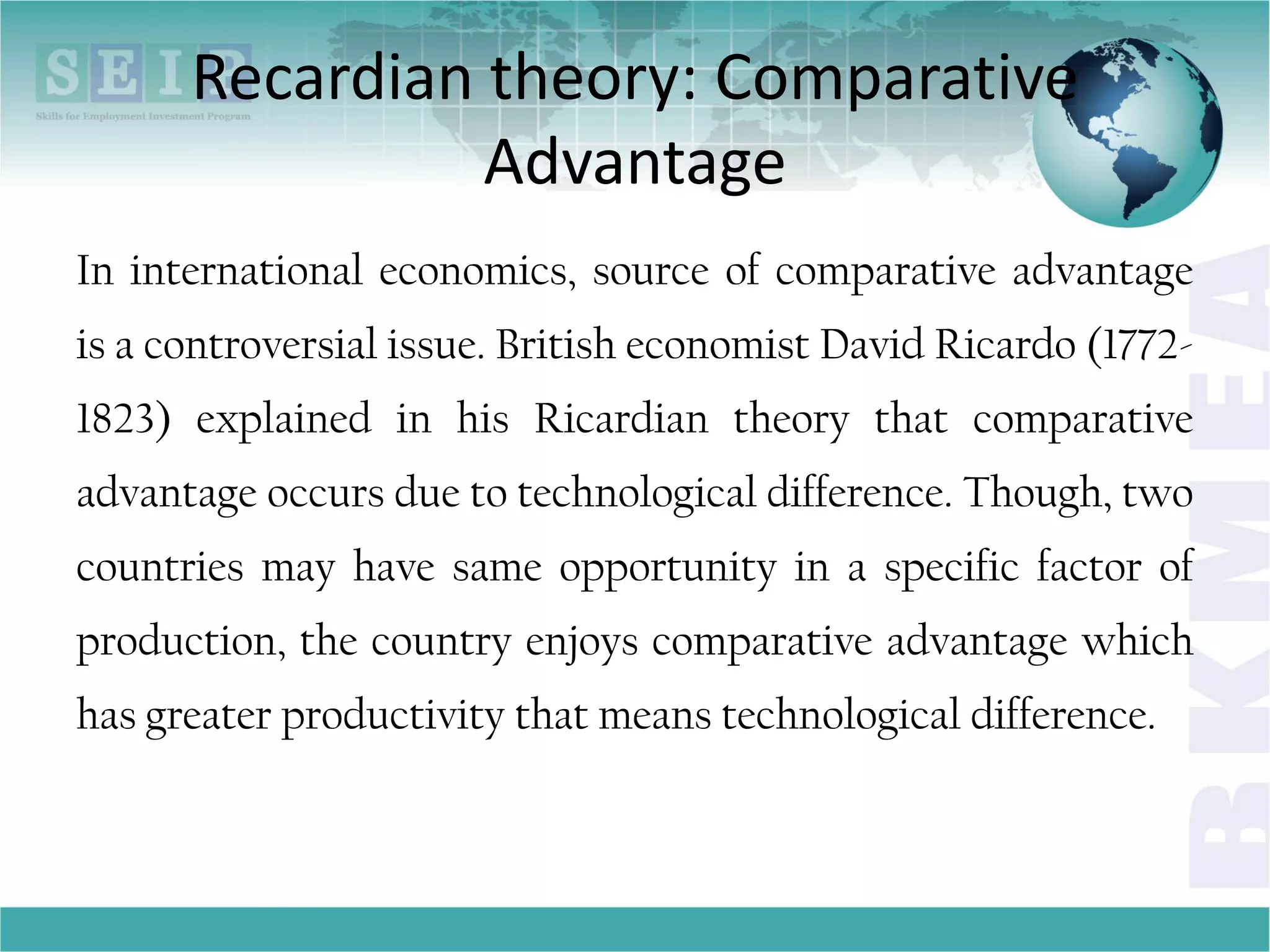
Recardian theory: Comparative
Advantage
In international economics, source of comparative advantage
is a controversial issue. British economist David Ricardo (1772-
1823) explained in his Ricardian theory that comparative
advantage occurs due to technological difference. Though, two
countries may have same opportunity in a specific factor of
production, the country enjoys comparative advantage which
has greater productivity that means technological difference.
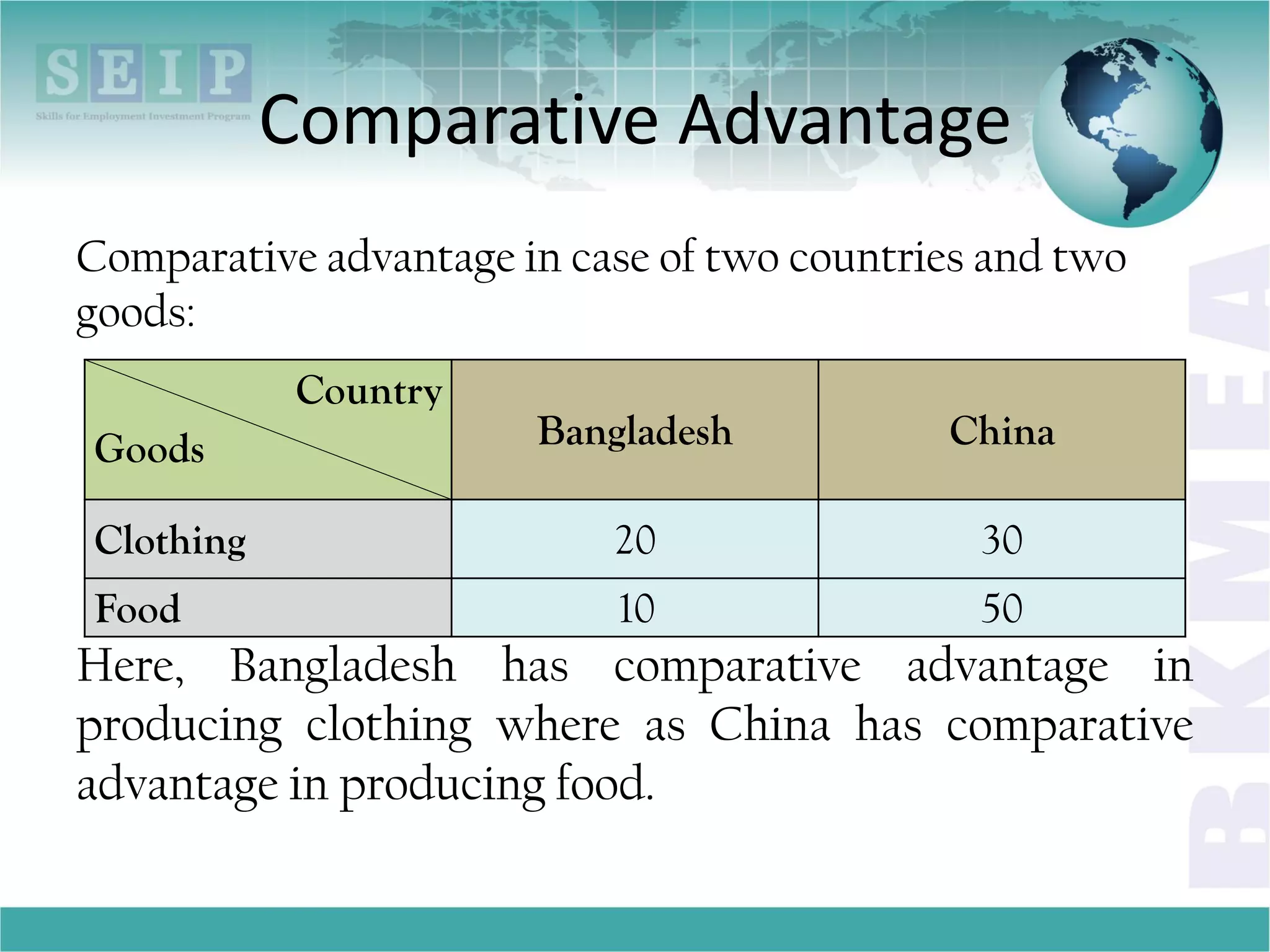
Comparative Advantage
Comparative advantage in case of two countries and two
goods:
Here, Bangladesh has comparative advantage in
producing clothing where as China has comparative
advantage in producing food.
Country
Goods Bangladesh China
Clothing 20 30
Food 10 50
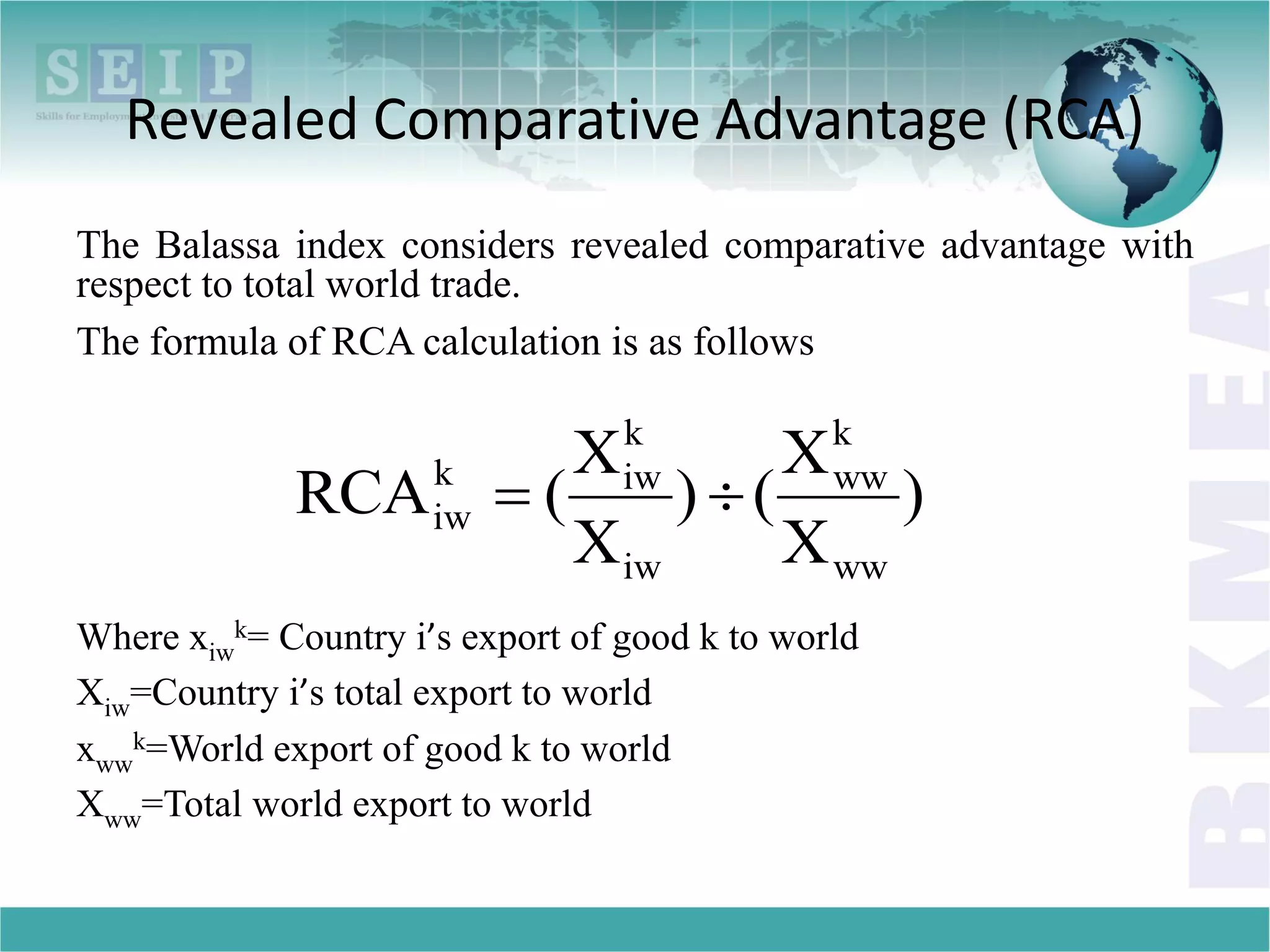
Revealed Comparative Advantage (RCA)
The Balassa index considers revealed comparative advantage with
respect to total world trade.
The formula of RCA calculation is as follows
Where xiw
k= Country i’s export of good k to world
Xiw=Country i’s total export to world
xww
k=World export of good k to world
Xww=Total world export to world
)
X
X
()
X
X
(RCA
ww
k
ww
iw
k
iwk
iw 
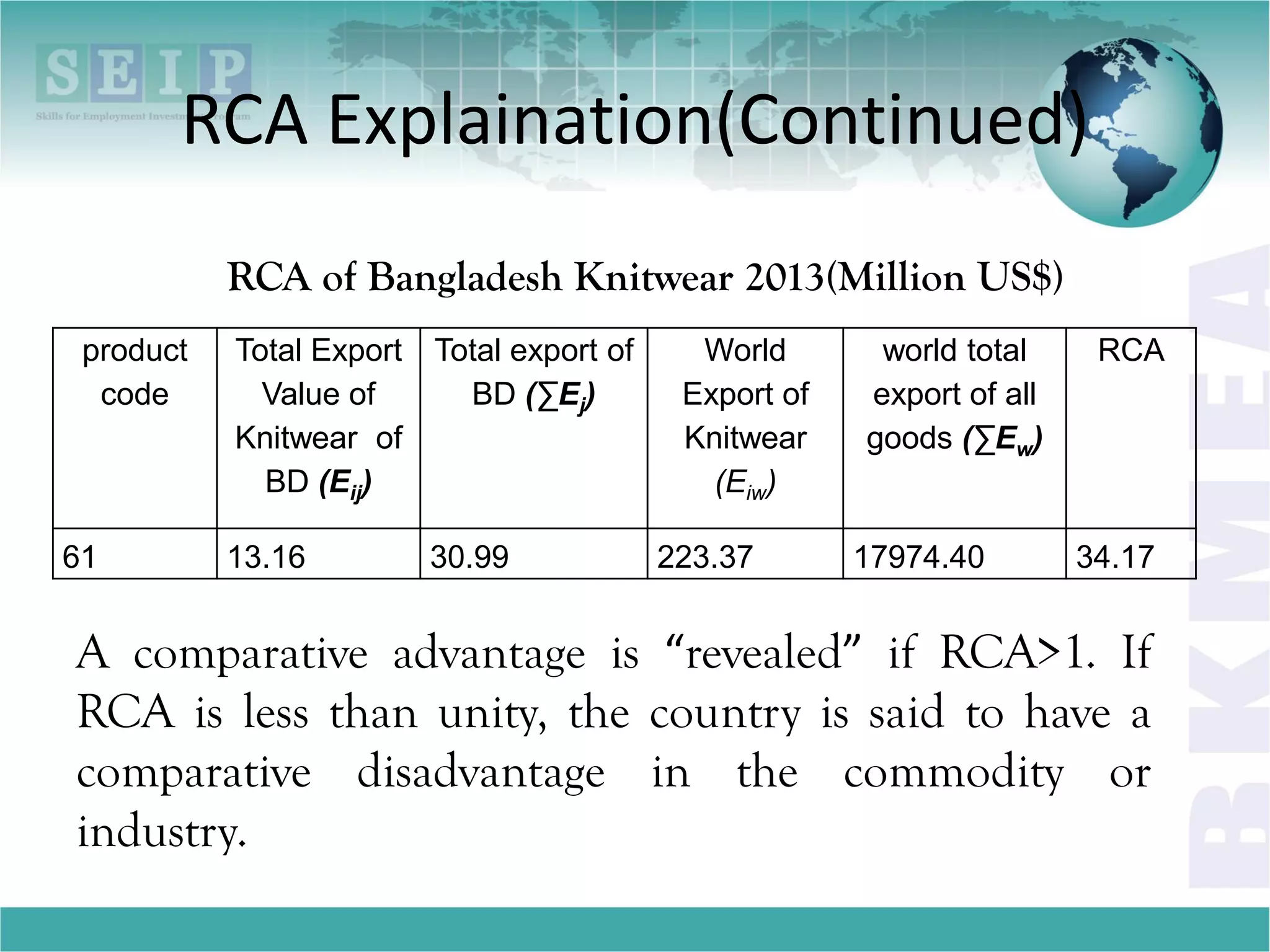
RCA Explaination(Continued)
product
code
Total Export
Value of
Knitwear of
BD (Eij)
Total export of
BD (∑Ej)
World
Export of
Knitwear
(Eiw)
world total
export of all
goods (∑Ew)
RCA
61 13.16 30.99 223.37 17974.40 34.17
A comparative advantage is “revealed” if RCA>1. If
RCA is less than unity, the country is said to have a
comparative disadvantage in the commodity or
industry.
RCA of Bangladesh Knitwear 2013(Million US$)
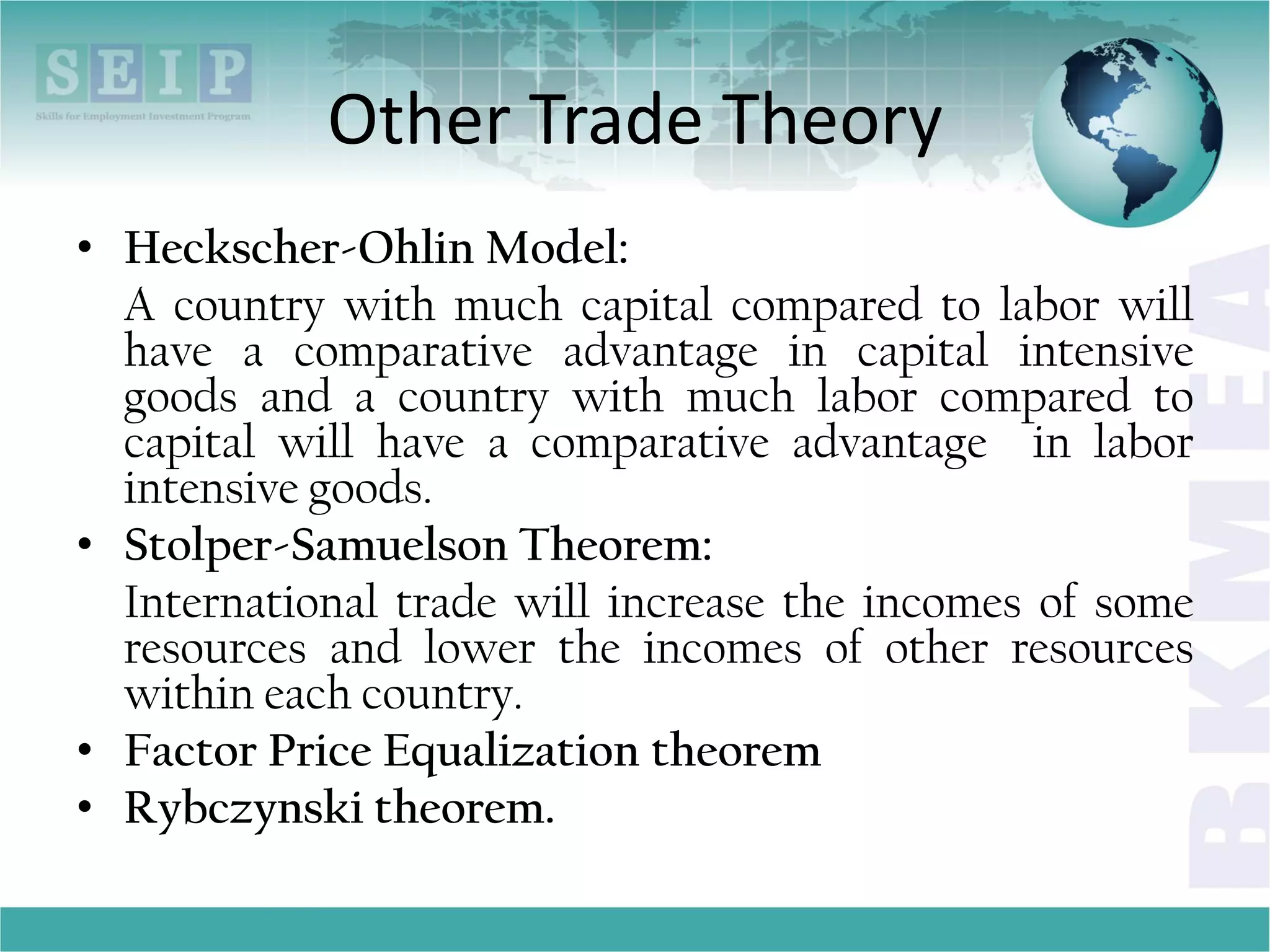
Other Trade Theory
• Heckscher-Ohlin Model:
A country with much capital compared to labor will
have a comparative advantage in capital intensive
goods and a country with much labor compared to
capital will have a comparative advantage in labor
intensive goods.
• Stolper-Samuelson Theorem:
International trade will increase the incomes of some
resources and lower the incomes of other resources
within each country.
• Factor Price Equalization theorem
• Rybczynski theorem.
Balance of Payment
Balance of Payment (BoP) is a statement of accounts of
a country of all economic transactions that it engages in
with the rest of the world. Transactions include trade
in goods, services, and financial instruments and each
transaction is noted either as a credit (+) or a debit (-)
item. In general
where Balancing Item is simply an amount that
accounts for any statistical errors.
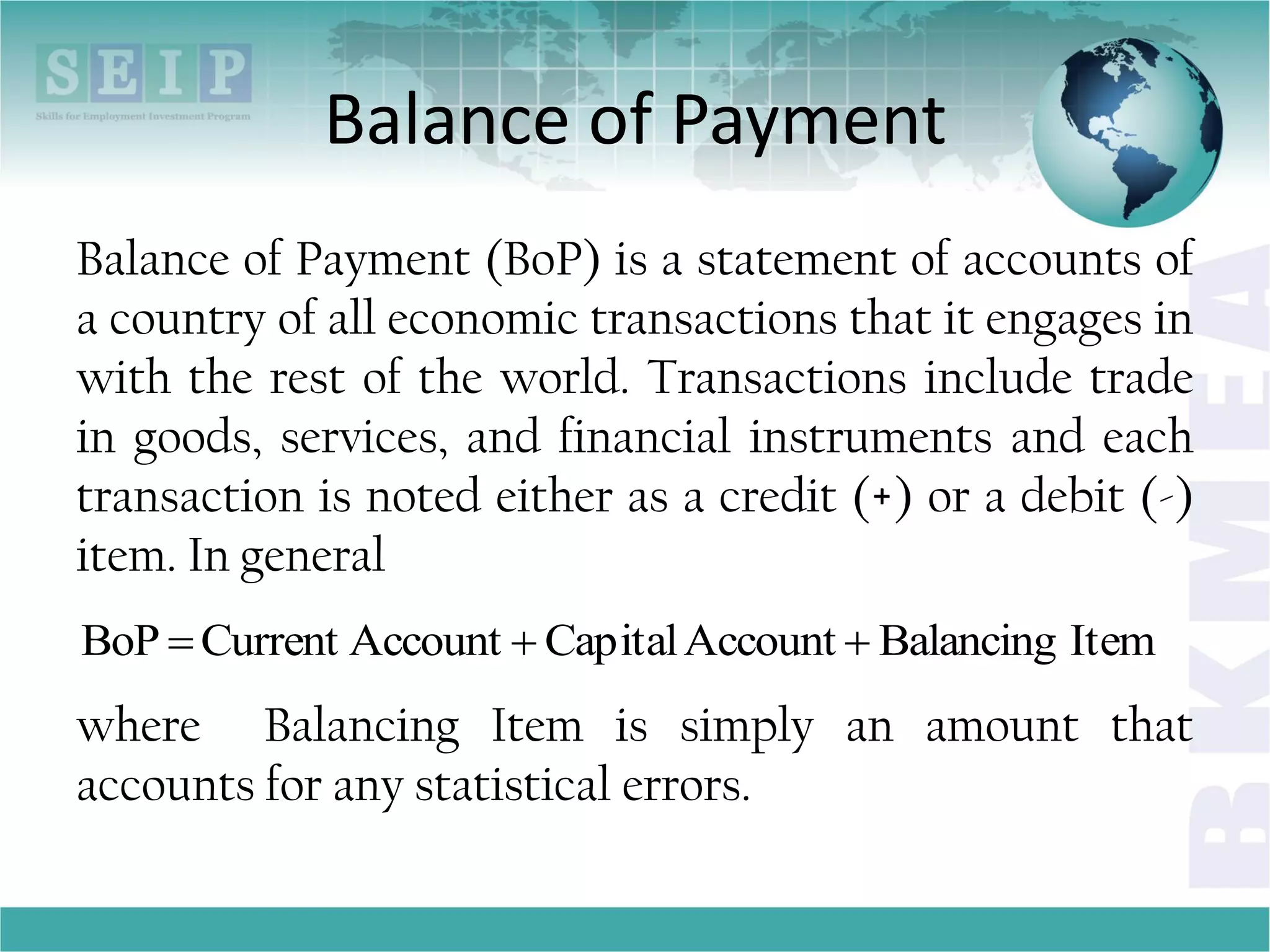
ItemBalancingAccountCapitalAccountCurrentBoP 
Terms of Trade
A country’s terms of trade measures a country’s
export prices in relation to its import prices, and is
expressed as:
When the terms of trade rise above 100 they are said
to be improving and when they fall below 100 they
are said to be worsening. This is an indicator of
competitiveness.
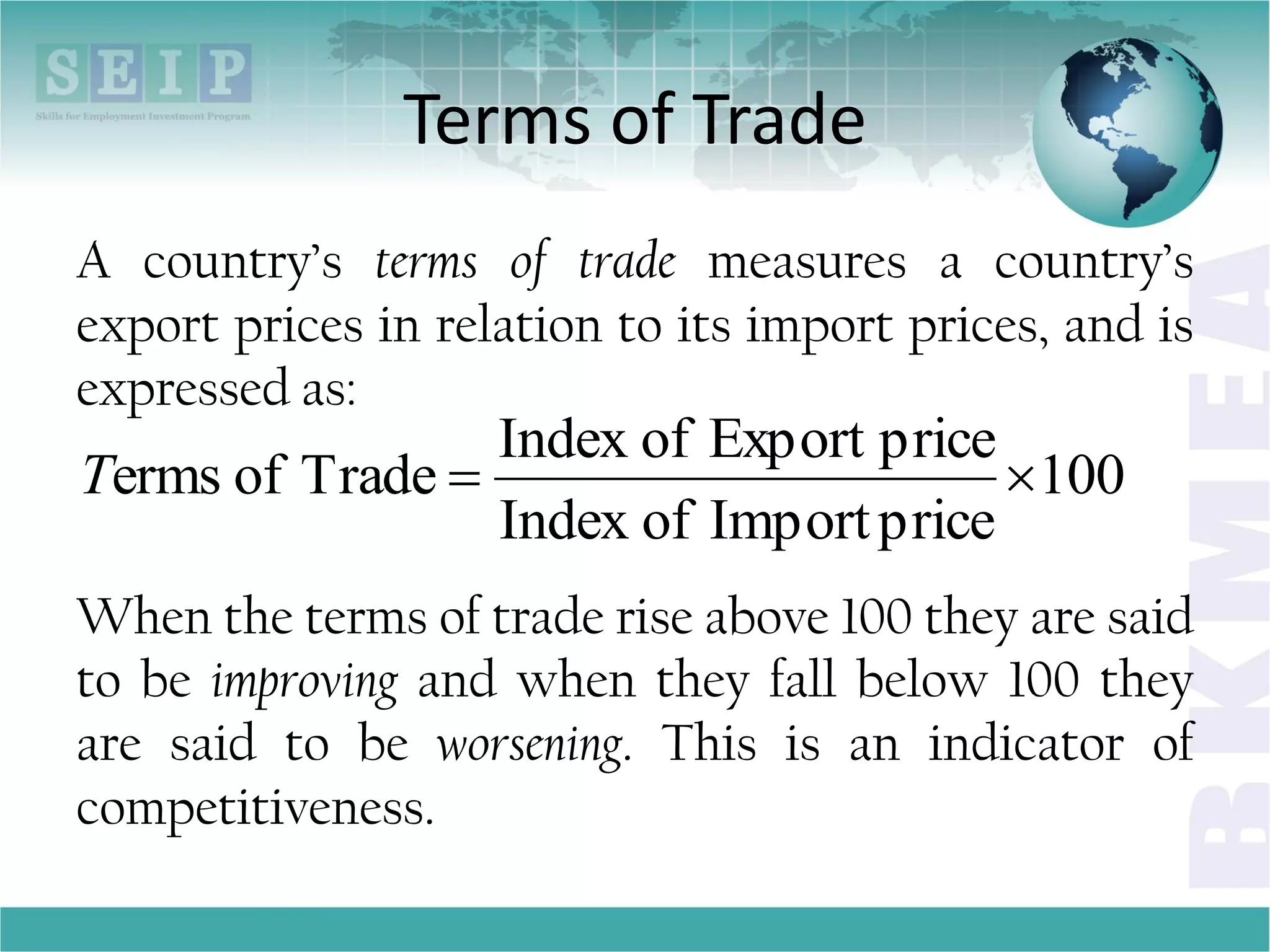
100
priceImportofIndex
priceExportofIndex
Tradeoferms T
Terms of Trade (cont.)
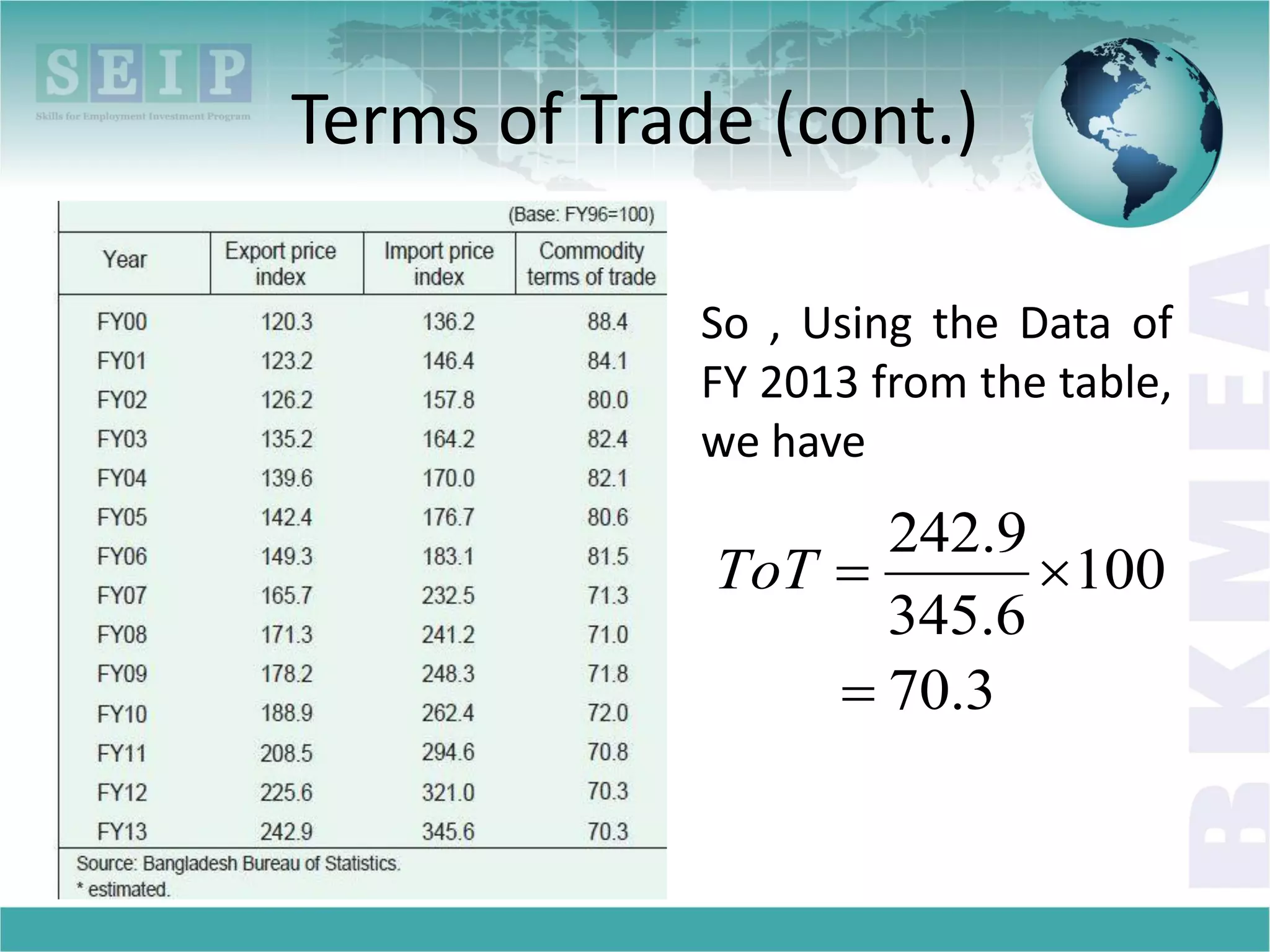
So , Using the Data of
FY 2013 from the table,
we have
3.70
100
6.345
9.242

ToT
Trade openness
Trade openness is a measure of the value of total trade (export +
import) as a percentage of GDP.
It shows the importance of international trade in the overall economy.
It can give an indication of the degree to which an economy is open to
trade. However it largely determined by factors like tariffs, non-tariffs
barriers, foreign exchange, non trade policies and structure of national
economies. Mathematically
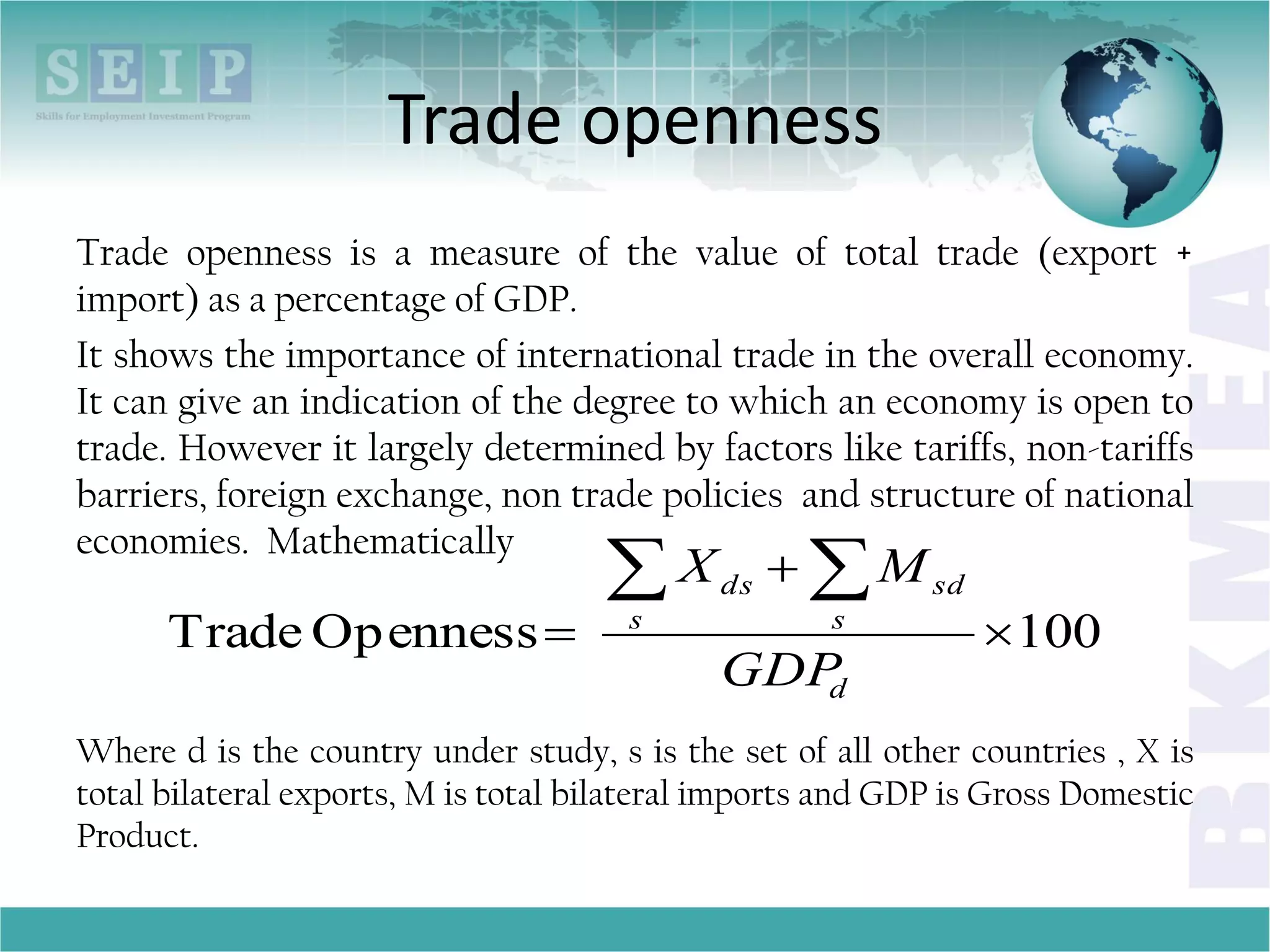
Where d is the country under study, s is the set of all other countries , X is
total bilateral exports, M is total bilateral imports and GDP is Gross Domestic
Product.
100OpennessTrade 


 
d
s s
sdds
GDP
MX
Monetary and Fiscal Policy
These two policy measures has significant impact on
international Trade.
Monetary Policy which is adopted by Central Bank of a country.
For instance, Bangladesh Bank promulgates half yearly
monetary policy on regular basis.
Fiscal Policy is adopted by Government of a country. It is
basically an account of income and expanse of govt. i.e. govt.
budget. A government can also reduce spending power more
directly by means of higher taxation, hire-purchase controls,
etc.
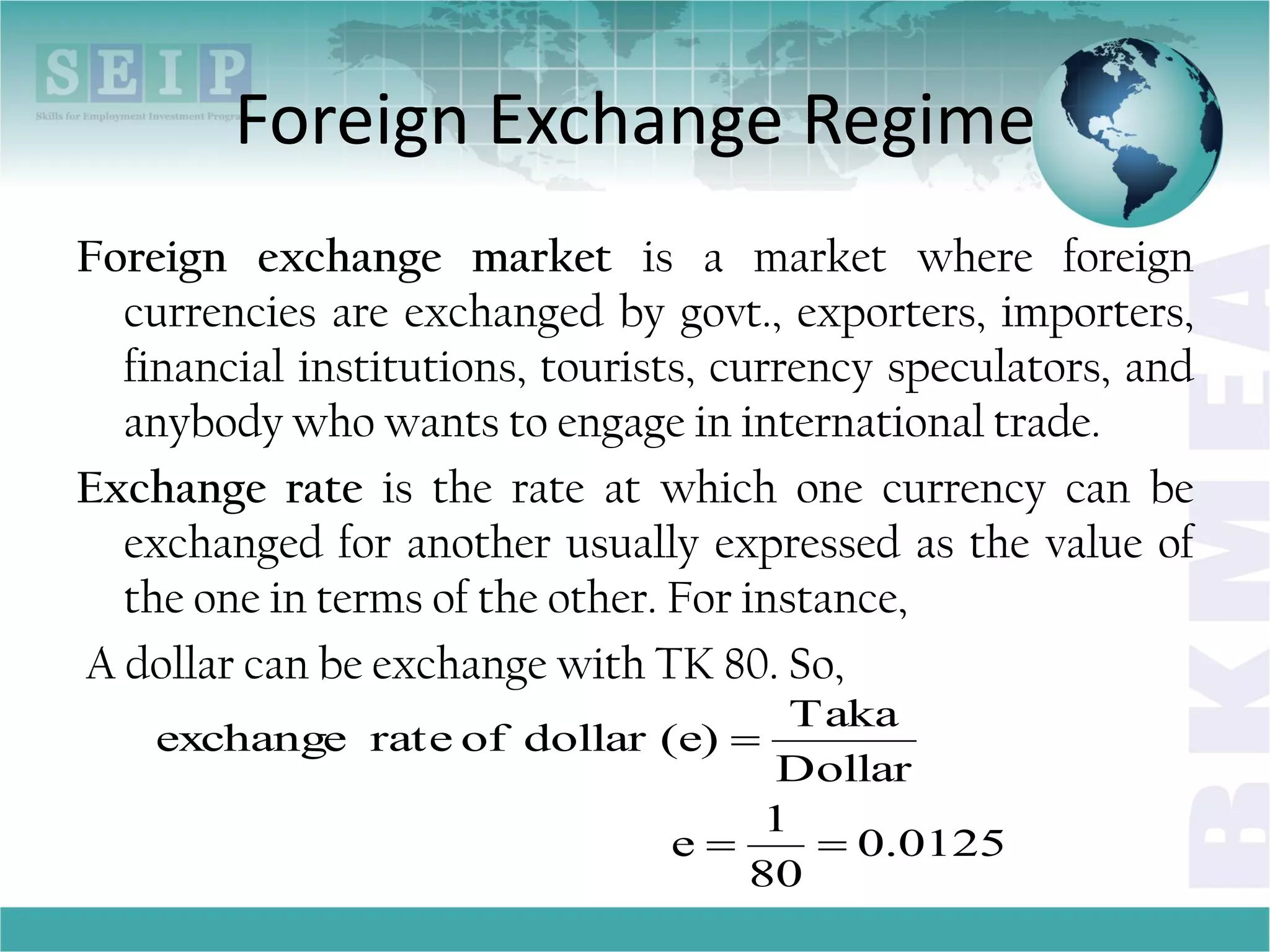
Foreign Exchange Regime
Foreign exchange market is a market where foreign
currencies are exchanged by govt., exporters, importers,
financial institutions, tourists, currency speculators, and
anybody who wants to engage in international trade.
Exchange rate is the rate at which one currency can be
exchanged for another usually expressed as the value of
the one in terms of the other. For instance,
A dollar can be exchange with TK 80. So,
0.0125
80
1
e
Dollar
Taka
(e)dollarofrateexchange


Types of Exchange rate
The followings are the types of exchange rate regime
 Flexible or Floating Exchange Rate Regime
 Managed Floating Exchange Rate Regime
 Fixed or “Pegged” Exchange Rate Regime
Other things that should keep in mind:
 Appreciation is the Strengthening of one currency against
another
 Depreciation is the weakening of one currency against
another.
 Exchange Rate appreciation would lead to trade deficit.
 Exchange Rate depreciation would lead to trade surplus.
Reference
For further study
“Principal of Economics”
Greg Mankiw.
“International Trade Theory and Policy”
Miltiades Chacholiades.
“International Trade: Theory and Policy”
Paul R. Krugman.
Any ?
Thank You

Lecture 1: Introduction to International Trade

  • 1.
    Theoretical Part Topics Introduction to International Trade  Trade Barrier & Imperfect Competition  Trade Body, Trade Law and Product introduction  World Apparel Market and BDG RMG Sector  Market and Demand Analysis  World Market analysis and Potentialities  Introduction to Marketing and Export Promotion  Communication Strategy  Process of Export and Import
  • 2.
    Some Basic Concept GDP  GNP  Growth Rate  Exchange rate  Terms of Trade  Monetary Policy  Fiscal Policy  Unemployment rate  Age structure  Population Size  Purchasing Power Parity (PPP)  Country’s Trade Openness
  • 3.
    Intro. to Int.Trade (Cont.)
  • 4.
    Intro. to Int.Trade (Cont.)
  • 5.
    Why Countries Trade? Tradeof a commodity can be executed due to this reasons. 1. The country can’t produce or its production level is not enough. The rationale is very clear for such kind of trade. For exmp. UK imports Banana from Brazil ; China imports copper. 2. The country has capability of producing goods but still imports of that goods. This kind of trade is of greater interest because it accounts for a majority of world trade today.
  • 6.
  • 7.
    Absolute Advantage The principleof absolute advantage refers to the ability of a party (an individual, or firm, or country) to produce more number of a good product or service than competitors, using the same amount of resources. For instance - Absolute advantage in case of two countries and two goods Country Goods Bangladesh China Clothing 20 10 Food 30 40 In terms of absolute advantage, Bangladesh is superior than China in producing Clothing and China is superior than Bangladesh in producing food.
  • 8.
    Recardian theory: Comparative Advantage Ininternational economics, source of comparative advantage is a controversial issue. British economist David Ricardo (1772- 1823) explained in his Ricardian theory that comparative advantage occurs due to technological difference. Though, two countries may have same opportunity in a specific factor of production, the country enjoys comparative advantage which has greater productivity that means technological difference.
  • 9.
    Comparative Advantage Comparative advantagein case of two countries and two goods: Here, Bangladesh has comparative advantage in producing clothing where as China has comparative advantage in producing food. Country Goods Bangladesh China Clothing 20 30 Food 10 50
  • 10.
    Revealed Comparative Advantage(RCA) The Balassa index considers revealed comparative advantage with respect to total world trade. The formula of RCA calculation is as follows Where xiw k= Country i’s export of good k to world Xiw=Country i’s total export to world xww k=World export of good k to world Xww=Total world export to world ) X X () X X (RCA ww k ww iw k iwk iw 
  • 11.
    RCA Explaination(Continued) product code Total Export Valueof Knitwear of BD (Eij) Total export of BD (∑Ej) World Export of Knitwear (Eiw) world total export of all goods (∑Ew) RCA 61 13.16 30.99 223.37 17974.40 34.17 A comparative advantage is “revealed” if RCA>1. If RCA is less than unity, the country is said to have a comparative disadvantage in the commodity or industry. RCA of Bangladesh Knitwear 2013(Million US$)
  • 12.
    Other Trade Theory •Heckscher-Ohlin Model: A country with much capital compared to labor will have a comparative advantage in capital intensive goods and a country with much labor compared to capital will have a comparative advantage in labor intensive goods. • Stolper-Samuelson Theorem: International trade will increase the incomes of some resources and lower the incomes of other resources within each country. • Factor Price Equalization theorem • Rybczynski theorem.
  • 13.
    Balance of Payment Balanceof Payment (BoP) is a statement of accounts of a country of all economic transactions that it engages in with the rest of the world. Transactions include trade in goods, services, and financial instruments and each transaction is noted either as a credit (+) or a debit (-) item. In general where Balancing Item is simply an amount that accounts for any statistical errors. ItemBalancingAccountCapitalAccountCurrentBoP 
  • 14.
    Terms of Trade Acountry’s terms of trade measures a country’s export prices in relation to its import prices, and is expressed as: When the terms of trade rise above 100 they are said to be improving and when they fall below 100 they are said to be worsening. This is an indicator of competitiveness. 100 priceImportofIndex priceExportofIndex Tradeoferms T
  • 15.
    Terms of Trade(cont.) So , Using the Data of FY 2013 from the table, we have 3.70 100 6.345 9.242  ToT
  • 16.
    Trade openness Trade opennessis a measure of the value of total trade (export + import) as a percentage of GDP. It shows the importance of international trade in the overall economy. It can give an indication of the degree to which an economy is open to trade. However it largely determined by factors like tariffs, non-tariffs barriers, foreign exchange, non trade policies and structure of national economies. Mathematically Where d is the country under study, s is the set of all other countries , X is total bilateral exports, M is total bilateral imports and GDP is Gross Domestic Product. 100OpennessTrade      d s s sdds GDP MX
  • 17.
    Monetary and FiscalPolicy These two policy measures has significant impact on international Trade. Monetary Policy which is adopted by Central Bank of a country. For instance, Bangladesh Bank promulgates half yearly monetary policy on regular basis. Fiscal Policy is adopted by Government of a country. It is basically an account of income and expanse of govt. i.e. govt. budget. A government can also reduce spending power more directly by means of higher taxation, hire-purchase controls, etc.
  • 18.
    Foreign Exchange Regime Foreignexchange market is a market where foreign currencies are exchanged by govt., exporters, importers, financial institutions, tourists, currency speculators, and anybody who wants to engage in international trade. Exchange rate is the rate at which one currency can be exchanged for another usually expressed as the value of the one in terms of the other. For instance, A dollar can be exchange with TK 80. So, 0.0125 80 1 e Dollar Taka (e)dollarofrateexchange  
  • 19.
    Types of Exchangerate The followings are the types of exchange rate regime  Flexible or Floating Exchange Rate Regime  Managed Floating Exchange Rate Regime  Fixed or “Pegged” Exchange Rate Regime Other things that should keep in mind:  Appreciation is the Strengthening of one currency against another  Depreciation is the weakening of one currency against another.  Exchange Rate appreciation would lead to trade deficit.  Exchange Rate depreciation would lead to trade surplus.
  • 20.
    Reference For further study “Principalof Economics” Greg Mankiw. “International Trade Theory and Policy” Miltiades Chacholiades. “International Trade: Theory and Policy” Paul R. Krugman.
  • 21.