Supply Chain Management (SCM)
The Business Network
Supply Chain Management (SCM)
• Supply chain management helps a company
• Get the right products
• To the right place
• At the right time
• In the proper quantity
• At an acceptable cost
SCM
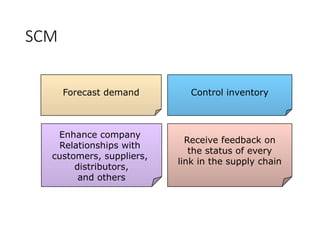
Forecast demand
Enhance company
Relationships with
customers, suppliers,
distributors,
and others
Receive feedback on
the status of every
link in the supply chain
Control inventory
Supply Chain:
• The interrelationships
• With suppliers, customers, distributors, and other businesses
• Needed to design, build, and sell a product
makeup the network of business entities, relationships and
processes.
• Because each supply chain process should add value to the products
or services a company produces, a supply chain is Frequently called a
“value chain”.
Supply Chain Life Cycle
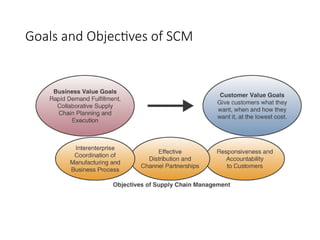
Goals and Objectives of SCM
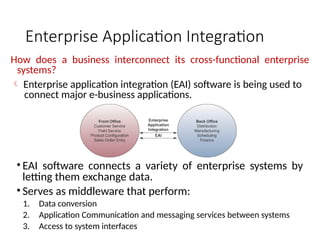
Enterprise Application Integration
• EAI software connects a variety of enterprise systems by
letting them exchange data.
• Serves as middleware that perform:
1. Data conversion
2. Application Communication and messaging services between systems
3. Access to system interfaces
How does a business interconnect its cross-functional enterprise
systems?
 Enterprise application integration (EAI) software is being used to
connect major e-business applications.
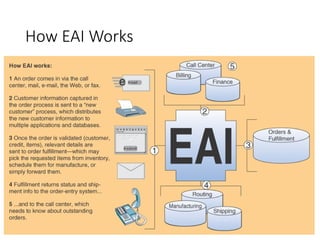
How EAI Works
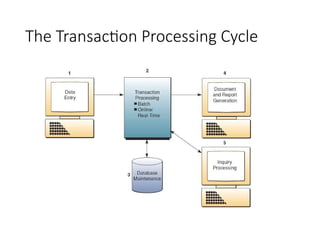
Transaction Processing Systems
• Transaction Processing Systems: are Cross-functional information systems
that process data resulting from the occurrence of business transactions.
• Transactions are events that occur as part of doing business, such as sales,
purchases, deposits, withdrawals, refunds, and payments
• Online transaction processing (OLTP) is a real-time system that captures
transactions immediately.
The Transaction Processing Cycle
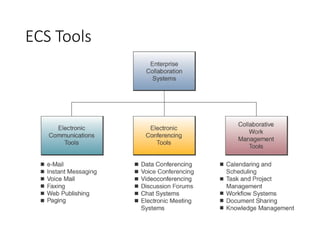
Enterprise Collaboration Systems (ECS)
• EC systems are cross-functional information systems that support and
enhance team and workgroup:
• Communication
• Coordination
• Collaboration
• Systems may include:
• Networked PC workstations
• Servers
• Databases
• Groupware and application packages
ECS Tools
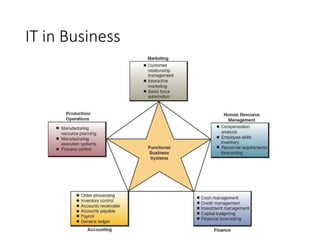
Functional Business Systems
Various types of information systems that support
the business functions of
…
Accounting
Finance
Marketing
Operations management
Human resource management
IT in Business

Enterprise collaborative systems and its impact

  • 1.
    Supply Chain Management(SCM) The Business Network
  • 2.
    Supply Chain Management(SCM) • Supply chain management helps a company • Get the right products • To the right place • At the right time • In the proper quantity • At an acceptable cost
  • 3.
    SCM Forecast demand Enhance company Relationshipswith customers, suppliers, distributors, and others Receive feedback on the status of every link in the supply chain Control inventory
  • 4.
    Supply Chain: • Theinterrelationships • With suppliers, customers, distributors, and other businesses • Needed to design, build, and sell a product makeup the network of business entities, relationships and processes. • Because each supply chain process should add value to the products or services a company produces, a supply chain is Frequently called a “value chain”.
  • 6.
  • 7.
  • 8.
    Enterprise Application Integration •EAI software connects a variety of enterprise systems by letting them exchange data. • Serves as middleware that perform: 1. Data conversion 2. Application Communication and messaging services between systems 3. Access to system interfaces How does a business interconnect its cross-functional enterprise systems?  Enterprise application integration (EAI) software is being used to connect major e-business applications.
  • 9.
  • 10.
    Transaction Processing Systems •Transaction Processing Systems: are Cross-functional information systems that process data resulting from the occurrence of business transactions. • Transactions are events that occur as part of doing business, such as sales, purchases, deposits, withdrawals, refunds, and payments • Online transaction processing (OLTP) is a real-time system that captures transactions immediately.
  • 11.
  • 12.
    Enterprise Collaboration Systems(ECS) • EC systems are cross-functional information systems that support and enhance team and workgroup: • Communication • Coordination • Collaboration • Systems may include: • Networked PC workstations • Servers • Databases • Groupware and application packages
  • 13.
  • 14.
    Functional Business Systems Varioustypes of information systems that support the business functions of … Accounting Finance Marketing Operations management Human resource management
  • 15.