SUPPLY CHAIN MANAGEMENT
Operations Management
Muhammad Asad Shafique
BBA-20-037
Supply Chain
Management:
The management of the flow of goods and services , involves
the movement and storage of raw materials of work-in
process inventory and finished goods from point of origin to
point of consumption.
Also referred to as a value chain.
Supplier
Supplier
Supplier
Storage Mfg. Dist. Retailer Customer
Storage
Typical Supply Chain
for a Manufacturer
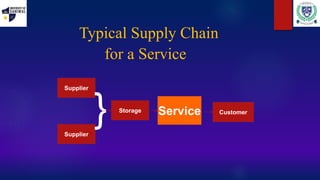
Supplier
Supplier
Storage
} Service Customer
Typical Supply Chain
for a Service
•Improve operations
•Increasing levels of outsourcing
•Increasing transportation costs
•Competitive pressures
•Increasing globalization
•Increasing importance of e-commerce
Need for Supply Chain
Management
Name : Muhammad Talha Younas
Roll No : BBA – 20 – 01
 Key Elements of Supply
Chain Management:
• There are most important five elements :
 Planning
 Sourcing
 Manufacturing
 Delivering
 Returning
1. P lanning
• How to meet customers demand ?
• Forecasting demand
• How to improve efficiency of supply
chain
2. P lanning
• Selection of suppliers
• Selection of raw material
• Ordering / invoicing /
payments
3. Manufacturing
• Raw material inspection
• Creating product
• Quality control
• Packaging
• Employee productivity
4. Delivering
• Order taking
• Shipping of consignment
• Invoicing / Billing
• Logistics management
5. Returning
• Customer care
• Warranty claims
• Scrapping / Defect removal
 Purchasing in Supply Chain Management
• Increasing outsourcing
• Increasing conversion to lean
production and JIT requirements
• Increasing globalization
 Supply Chain Issues
 Strategic Issues
• Design of the supply chain Partnering
 Tactical Issues
• Inventory and Purchasing policies
• Production and Transportation policies
• Quality policies
 Operating Issues
• Quality control
• Production planning and control
Perspective Performance Measure
Reliability On-time delivery
Order fulfillment lead time
Fill rate (fraction of demand met from
stock)
Perfect order fulfillment
Flexibility Supply chain response time
Upside production flexibility
Expenses Supply chain management costs
Warranty cost as a percent of revenue
Value added per employee
Assets/utilization Total inventory days of supply
Cash-to-cash cycle time
Net asset turns
 SCOR Performance Measure
Muhammad Shehroz Maqsood
BBA-20-12
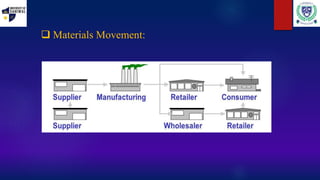
 Materials Movement:
o Transportation of
Raw Material
Parts
Work-in-progress Inventory
Final Product As Flow
o Company’s Performance Judge by this GOOD or Bad
steadily and predictability movement of Goods
lots of stops and starts in the movement
 Materials Movement:
 Traffic Management:
• Traffic Management is the management and control
of transportation modes, carriers, and services
• Overseeing the shipment of incoming and outgoing
materials and goods
• reduced costs
• timely delivery
• improved Company & supply chain performance
 Electronic Data Interchange (EDI)
• Is an Inter-organizational information system
• replacing paper-based transactions
• computer-to-computer exchange of data
• Through a web of business-to-business communication network
 Benefits or Why to Use EDI
• Reduce time and cost
• save documentation processing cost
• eliminate errors
• enhance strategic alliances
• Accurately work
• Security
Iqra Khalid
BBA-20-29
 DRP
 Distribution Requirement
Planning:
o A system for inventory management
and distribution planning.
o Extends the concept of material
requirements planning(MRP) to
warehousing systems.
o Useful in planning and coordinating
transportation, warehousing, workers,
equipment and financial flows.
 Just-In-Time Deliveries:
• Suppliers are required to make frequent small
deliveries on a precise schedule.
• Increases traffic into the customer firm
• May be an increase in transportation cost per unit
• Any disruption in the supply chain is felt very quickly
throughout the chain
• Some firm employ third-party logistics
E-Commerce
• The use of electronic technology to facilitate business transactions
• Applications include
• Internet buying and selling
• e-mail
• Order and shipment tracking
• EDI
 Advantages E-commerce
• Companies can
– have a global presence
– improve competitiveness and
quality
– analyze customer interests
– collect detailed information
– shorten supply chain response
times
– realize substantial cost savings
– create virtual companies
– level the playing field for small
companies
Disadvantage E-commerce
• Customer expectations
–Order quickly -> fast delivery
• Order fulfillment
–Order rate often exceeds ability to fulfill it
• Inventory holding
–Outsourcing loss of control
–Internal holding costs
Muhammad Abdullah Butt
BBA-E-20-040
B2B:
 Business to Business.
 Widely used terminology.
 Occurred between two Businesses.
 Business supplies to another Business.
Market Place:
 Supplier to Manufacturer.
 Manufacturer to Whole Saler.
 Whole Saler to Retailer.
 Manufacturer to Online Store.
Creating Supply Chain:
 Supply Planning.
 Production Planning.
 Demand Planning.
 Operations Planning.
 Sales Planning.
Supply Chain Drivers:
 Production.
 Inventory.
 Location.
 Transportation.
 Information.
Supply Chain Challenges:
 Increased costs throughout the supply chain.
 Supply chain complexity due to multiple
channels to market.
 Consumer demand need for improved speed.
 The impact of supply chain volatility.
Supply Chain Benefits:
 Cost efficiency.
 Enhance output.
 Avoids delay in process.
 Easily identify problem areas.
Supply Chain Drawbacks:
 Expensive to implement.
 Complicated.
 Lack of co-ordination among departments.
 Requires trained and personalized staff.
ANY QUESTION!
THANKS!

Sample Supply Chain PPT12.pptx

  • 1.
  • 2.
  • 3.
    Supply Chain Management: The managementof the flow of goods and services , involves the movement and storage of raw materials of work-in process inventory and finished goods from point of origin to point of consumption. Also referred to as a value chain.
  • 4.
    Supplier Supplier Supplier Storage Mfg. Dist.Retailer Customer Storage Typical Supply Chain for a Manufacturer
  • 5.
  • 6.
    •Improve operations •Increasing levelsof outsourcing •Increasing transportation costs •Competitive pressures •Increasing globalization •Increasing importance of e-commerce Need for Supply Chain Management
  • 7.
    Name : MuhammadTalha Younas Roll No : BBA – 20 – 01
  • 8.
     Key Elementsof Supply Chain Management: • There are most important five elements :  Planning  Sourcing  Manufacturing  Delivering  Returning
  • 9.
    1. P lanning •How to meet customers demand ? • Forecasting demand • How to improve efficiency of supply chain
  • 10.
    2. P lanning •Selection of suppliers • Selection of raw material • Ordering / invoicing / payments
  • 11.
    3. Manufacturing • Rawmaterial inspection • Creating product • Quality control • Packaging • Employee productivity
  • 12.
    4. Delivering • Ordertaking • Shipping of consignment • Invoicing / Billing • Logistics management
  • 13.
    5. Returning • Customercare • Warranty claims • Scrapping / Defect removal
  • 14.
     Purchasing inSupply Chain Management • Increasing outsourcing • Increasing conversion to lean production and JIT requirements • Increasing globalization
  • 15.
     Supply ChainIssues  Strategic Issues • Design of the supply chain Partnering  Tactical Issues • Inventory and Purchasing policies • Production and Transportation policies • Quality policies  Operating Issues • Quality control • Production planning and control
  • 16.
    Perspective Performance Measure ReliabilityOn-time delivery Order fulfillment lead time Fill rate (fraction of demand met from stock) Perfect order fulfillment Flexibility Supply chain response time Upside production flexibility Expenses Supply chain management costs Warranty cost as a percent of revenue Value added per employee Assets/utilization Total inventory days of supply Cash-to-cash cycle time Net asset turns  SCOR Performance Measure
  • 17.
  • 18.
     Materials Movement: oTransportation of Raw Material Parts Work-in-progress Inventory Final Product As Flow o Company’s Performance Judge by this GOOD or Bad steadily and predictability movement of Goods lots of stops and starts in the movement
  • 19.
  • 20.
     Traffic Management: •Traffic Management is the management and control of transportation modes, carriers, and services • Overseeing the shipment of incoming and outgoing materials and goods • reduced costs • timely delivery • improved Company & supply chain performance
  • 21.
     Electronic DataInterchange (EDI) • Is an Inter-organizational information system • replacing paper-based transactions • computer-to-computer exchange of data • Through a web of business-to-business communication network
  • 22.
     Benefits orWhy to Use EDI • Reduce time and cost • save documentation processing cost • eliminate errors • enhance strategic alliances • Accurately work • Security
  • 23.
  • 24.
  • 25.
     Distribution Requirement Planning: oA system for inventory management and distribution planning. o Extends the concept of material requirements planning(MRP) to warehousing systems. o Useful in planning and coordinating transportation, warehousing, workers, equipment and financial flows.
  • 26.
     Just-In-Time Deliveries: •Suppliers are required to make frequent small deliveries on a precise schedule. • Increases traffic into the customer firm • May be an increase in transportation cost per unit • Any disruption in the supply chain is felt very quickly throughout the chain • Some firm employ third-party logistics
  • 27.
    E-Commerce • The useof electronic technology to facilitate business transactions • Applications include • Internet buying and selling • e-mail • Order and shipment tracking • EDI
  • 28.
     Advantages E-commerce •Companies can – have a global presence – improve competitiveness and quality – analyze customer interests – collect detailed information – shorten supply chain response times – realize substantial cost savings – create virtual companies – level the playing field for small companies
  • 29.
    Disadvantage E-commerce • Customerexpectations –Order quickly -> fast delivery • Order fulfillment –Order rate often exceeds ability to fulfill it • Inventory holding –Outsourcing loss of control –Internal holding costs
  • 30.
  • 31.
    B2B:  Business toBusiness.  Widely used terminology.  Occurred between two Businesses.  Business supplies to another Business. Market Place:  Supplier to Manufacturer.  Manufacturer to Whole Saler.  Whole Saler to Retailer.  Manufacturer to Online Store.
  • 32.
    Creating Supply Chain: Supply Planning.  Production Planning.  Demand Planning.  Operations Planning.  Sales Planning.
  • 33.
    Supply Chain Drivers: Production.  Inventory.  Location.  Transportation.  Information.
  • 34.
    Supply Chain Challenges: Increased costs throughout the supply chain.  Supply chain complexity due to multiple channels to market.  Consumer demand need for improved speed.  The impact of supply chain volatility.
  • 35.
    Supply Chain Benefits: Cost efficiency.  Enhance output.  Avoids delay in process.  Easily identify problem areas. Supply Chain Drawbacks:  Expensive to implement.  Complicated.  Lack of co-ordination among departments.  Requires trained and personalized staff.
  • 36.
  • 37.