SUPPLY CHAIN MANAGEMENT
BY M. EISSA
OUTCOMES
 Supply Chain Management
 Value Chain & Value Network
 Restructuring Options for Supply Chain
 E-business & Supply Chain
 Trends in SCM
OUTCOMES
 Supply Chain Management
 Value Chain & Value Network
 Restructuring Options for Supply Chain
 E-business & Supply Chain
 Trends in SCM
SUPPLY CHAIN MANAGEMENT
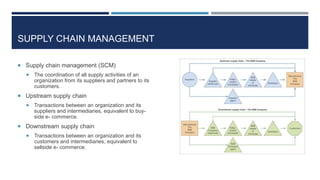
 Supply chain management (SCM)


The coordination of all supply activities of an
organization from its suppliers and partners to its
customers.

 Upstream supply chain


Transactions between an organization and its
suppliers and intermediaries, equivalent to buyside e- commerce.

 Downstream supply chain


Transactions between an organization and its
customers and intermediaries, equivalent to
sellside e- commerce.
SUPPLY CHAIN MANAGEMENT (CONT.)

 SCM Definition (Tan, 2001)


Purchasing and supply activities of manufacturers.



Transportation and logistics function of merchants and retailers.



All value-adding activities from raw materials extractor to the end users, including recycling.

 Achieving Competitive Advantage through Supply Chain Integration.
SUPPLY CHAIN MANAGEMENT (CONT.)
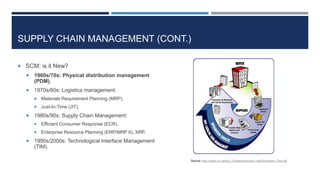
 SCM: is it New?


1960s/70s: Physical distribution management
(PDM).



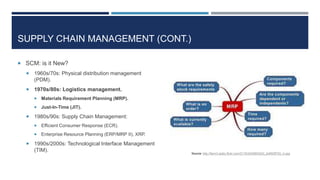
1970s/80s: Logistics management.





Materials Requirement Planning (MRP).
Just-In-Time (JIT).

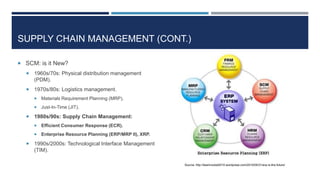
1980s/90s: Supply Chain Management:





Efficient Consumer Response (ECR).
Enterprise Resource Planning (ERP/MRP II), XRP.

1990s/2000s: Technological Interface Management
(TIM).
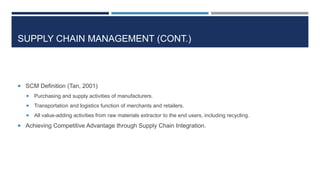
Source: http://www.icc.net/en_US/export/pics/icc.net/Document_Flow.gif
SUPPLY CHAIN MANAGEMENT (CONT.)
 SCM: is it New?


1960s/70s: Physical distribution management
(PDM).



1970s/80s: Logistics management.





Materials Requirement Planning (MRP).
Just-In-Time (JIT).

1980s/90s: Supply Chain Management:





Efficient Consumer Response (ECR).
Enterprise Resource Planning (ERP/MRP II), XRP.

1990s/2000s: Technological Interface Management
(TIM).

Source: http://farm3.static.flickr.com/2116/2429853243_2e692ff720_m.jpg
SUPPLY CHAIN MANAGEMENT (CONT.)
 SCM: is it New?


1960s/70s: Physical distribution management
(PDM).



1970s/80s: Logistics management.





Materials Requirement Planning (MRP).
Just-In-Time (JIT).

1980s/90s: Supply Chain Management:





Efficient Consumer Response (ECR).
Enterprise Resource Planning (ERP/MRP II), XRP.

1990s/2000s: Technological Interface Management
(TIM).
Source: http://teamrocket2010.wordpress.com/2010/05/31/erp-is-the-future/
SUPPLY CHAIN MANAGEMENT (CONT.)
 SCM: is it New?


1960s/70s: Physical distribution management
(PDM).



1970s/80s: Logistics management.





Materials Requirement Planning (MRP).
Just-In-Time (JIT).

1980s/90s: Supply Chain Management:





Efficient Consumer Response (ECR).
Enterprise Resource Planning (ERP/MRP II), XRP.

1990s/2000s: Technological Interface
Management (TIM).

Source: http://www.elemica.com/wp-content/uploads/2013/04/quicklinkdisc13j.png
SUPPLY CHAIN MANAGEMENT (CONT.)

 Other definitions


Logistics: Broad definition




Inbound logistics




Strategic management of the total supply chain (includes procurement, manufacture, distribution, transport, storage,…)

Management of material resources entering organization from suppliers and partners

Outbound logistics


Management of resources from organization to customers and intermediaries
SUPPLY CHAIN MANAGEMENT (CONT.)
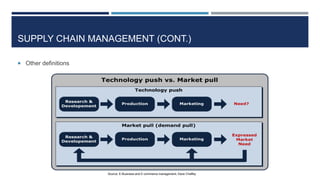
 Other definitions

Source: E-Business and E-commerce management, Dave Chaffey
OUTCOMES
 Supply Chain Management
 Value Chain & Value Network
 Restructuring Options for Supply Chain
 E-business & Supply Chain
 Trends in SCM
VALUE CHAIN / VALUE NETWORK

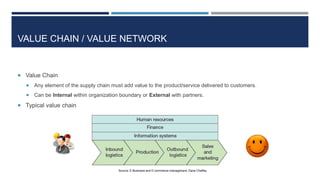
 Value Chain


Any element of the supply chain must add value to the product/service delivered to customers.



Can be Internal within organization boundary or External with partners.

 Typical value chain

Source: E-Business and E-commerce management, Dave Chaffey
VALUE CHAIN / VALUE NETWORK

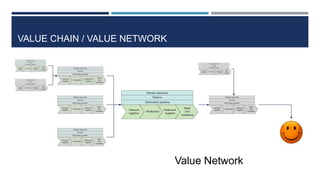
Value Network
OUTCOMES
 Supply Chain Management
 Value Chain & Value Network
 Restructuring Options for Supply Chain
 E-business & Supply Chain
 Trends in SCM
RESTRUCTURING OPTIONS FOR SUPPLY CHAIN

 Does Internet primarily affect SCM restructuring or only supporting tool?
RESTRUCTURING OPTIONS FOR SUPPLY CHAIN (CONT.)

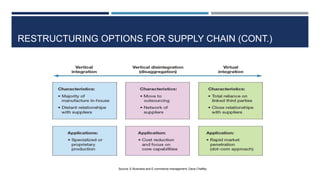
 Vertical integration


The extent to which supply chain activities are undertaken and controlled within the organization.

 Virtual integration


The majority of supply chain activities are undertaken and controlled outside the organization by third parties.
RESTRUCTURING OPTIONS FOR SUPPLY CHAIN (CONT.)

Source: E-Business and E-commerce management, Dave Chaffey
OUTCOMES
 Supply Chain Management
 Value Chain & Value Network
 Restructuring Options for Supply Chain
 E-business & Supply Chain
 Trends in SCM
E-BUSINESS & SUPPLY CHAIN

 Challenge?


achieving standardized data formats and data exchange

 Information supply chain ISC


Marinos & Sun and Yen (2005): an information-centric view of physical and virtual supply chains where each
entity adds value to the chain by providing the right information to the right entity at the right time in a secure
manner.
E-BUSINESS & SUPPLY CHAIN (CONT.)

 Technology standards in SCM


EDI: communications protocol for exchanging documents among computers.



XML: promotes a message-oriented view of e-commerce that isolates business transactions from differences in
software, hardware…programming languages.



Middleware: integrate or translate requests from external systems so they are understood by internal systems.



Manual ordering emails or web portal.
E-BUSINESS & SUPPLY CHAIN (CONT.)
 IS-supported upstream SCM


Key activities


Procurement (Next prezi).



Upstream logistics.

 IS-supported downstream SCM


Key activities


Outbound logistics.



Fulfillment.
E-BUSINESS & SUPPLY CHAIN (CONT.)

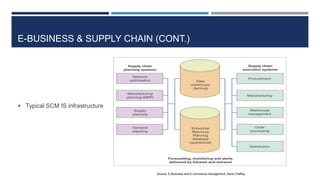
 Typical SCM IS infrastructure

Source: E-Business and E-commerce management, Dave Chaffey
E-BUSINESS & SUPPLY CHAIN (CONT.)

 Increased efficiency of individual processes.
 Reduced complexity of the supply chain.
 Improved data integration between elements of the supply chain.
 Reduced cost through outsourcing.
 Innovation.
OUTCOMES
 Supply Chain Management
 Value Chain & Value Network
 Restructuring Options for Supply Chain
 E-business & Supply Chain
 Trends in SCM
TRENDS IN SCM
 Just-in-Time production


Method of inventory cost management



Seeks to eliminate excess inventory to bare minimum

 Lean production


Set of production methods and tools



Focuses on elimination of waste throughout customer value chain, not just inventory

 Supply Chain Simplification


Process standardization.



Use of Technologies.
TRENDS IN SCM (CONT.)
 Adaptive Supply Chains


Reducing centralization.



Creating regional or product-based supply chains.

 Sustainable Supply Chains


Considering social and ecological interests.



Using most efficient environmental means of production, distribution, logistics.

 Collaborative Commerce


Use of technologies.



Moves focus from transactions to relationships among supply chain participants.
THANKS
TIME FOR QUESTIONS

Supply chain management

  • 1.
  • 2.
    OUTCOMES  Supply ChainManagement  Value Chain & Value Network  Restructuring Options for Supply Chain  E-business & Supply Chain  Trends in SCM
  • 3.
    OUTCOMES  Supply ChainManagement  Value Chain & Value Network  Restructuring Options for Supply Chain  E-business & Supply Chain  Trends in SCM
  • 4.
    SUPPLY CHAIN MANAGEMENT Supply chain management (SCM)  The coordination of all supply activities of an organization from its suppliers and partners to its customers.  Upstream supply chain  Transactions between an organization and its suppliers and intermediaries, equivalent to buyside e- commerce.  Downstream supply chain  Transactions between an organization and its customers and intermediaries, equivalent to sellside e- commerce.
  • 5.
    SUPPLY CHAIN MANAGEMENT(CONT.)  SCM Definition (Tan, 2001)  Purchasing and supply activities of manufacturers.  Transportation and logistics function of merchants and retailers.  All value-adding activities from raw materials extractor to the end users, including recycling.  Achieving Competitive Advantage through Supply Chain Integration.
  • 6.
    SUPPLY CHAIN MANAGEMENT(CONT.)  SCM: is it New?  1960s/70s: Physical distribution management (PDM).  1970s/80s: Logistics management.    Materials Requirement Planning (MRP). Just-In-Time (JIT). 1980s/90s: Supply Chain Management:    Efficient Consumer Response (ECR). Enterprise Resource Planning (ERP/MRP II), XRP. 1990s/2000s: Technological Interface Management (TIM). Source: http://www.icc.net/en_US/export/pics/icc.net/Document_Flow.gif
  • 7.
    SUPPLY CHAIN MANAGEMENT(CONT.)  SCM: is it New?  1960s/70s: Physical distribution management (PDM).  1970s/80s: Logistics management.    Materials Requirement Planning (MRP). Just-In-Time (JIT). 1980s/90s: Supply Chain Management:    Efficient Consumer Response (ECR). Enterprise Resource Planning (ERP/MRP II), XRP. 1990s/2000s: Technological Interface Management (TIM). Source: http://farm3.static.flickr.com/2116/2429853243_2e692ff720_m.jpg
  • 8.
    SUPPLY CHAIN MANAGEMENT(CONT.)  SCM: is it New?  1960s/70s: Physical distribution management (PDM).  1970s/80s: Logistics management.    Materials Requirement Planning (MRP). Just-In-Time (JIT). 1980s/90s: Supply Chain Management:    Efficient Consumer Response (ECR). Enterprise Resource Planning (ERP/MRP II), XRP. 1990s/2000s: Technological Interface Management (TIM). Source: http://teamrocket2010.wordpress.com/2010/05/31/erp-is-the-future/
  • 9.
    SUPPLY CHAIN MANAGEMENT(CONT.)  SCM: is it New?  1960s/70s: Physical distribution management (PDM).  1970s/80s: Logistics management.    Materials Requirement Planning (MRP). Just-In-Time (JIT). 1980s/90s: Supply Chain Management:    Efficient Consumer Response (ECR). Enterprise Resource Planning (ERP/MRP II), XRP. 1990s/2000s: Technological Interface Management (TIM). Source: http://www.elemica.com/wp-content/uploads/2013/04/quicklinkdisc13j.png
  • 10.
    SUPPLY CHAIN MANAGEMENT(CONT.)  Other definitions  Logistics: Broad definition   Inbound logistics   Strategic management of the total supply chain (includes procurement, manufacture, distribution, transport, storage,…) Management of material resources entering organization from suppliers and partners Outbound logistics  Management of resources from organization to customers and intermediaries
  • 11.
    SUPPLY CHAIN MANAGEMENT(CONT.)  Other definitions Source: E-Business and E-commerce management, Dave Chaffey
  • 12.
    OUTCOMES  Supply ChainManagement  Value Chain & Value Network  Restructuring Options for Supply Chain  E-business & Supply Chain  Trends in SCM
  • 13.
    VALUE CHAIN /VALUE NETWORK  Value Chain  Any element of the supply chain must add value to the product/service delivered to customers.  Can be Internal within organization boundary or External with partners.  Typical value chain Source: E-Business and E-commerce management, Dave Chaffey
  • 14.
    VALUE CHAIN /VALUE NETWORK Value Network
  • 15.
    OUTCOMES  Supply ChainManagement  Value Chain & Value Network  Restructuring Options for Supply Chain  E-business & Supply Chain  Trends in SCM
  • 16.
    RESTRUCTURING OPTIONS FORSUPPLY CHAIN  Does Internet primarily affect SCM restructuring or only supporting tool?
  • 17.
    RESTRUCTURING OPTIONS FORSUPPLY CHAIN (CONT.)  Vertical integration  The extent to which supply chain activities are undertaken and controlled within the organization.  Virtual integration  The majority of supply chain activities are undertaken and controlled outside the organization by third parties.
  • 18.
    RESTRUCTURING OPTIONS FORSUPPLY CHAIN (CONT.) Source: E-Business and E-commerce management, Dave Chaffey
  • 19.
    OUTCOMES  Supply ChainManagement  Value Chain & Value Network  Restructuring Options for Supply Chain  E-business & Supply Chain  Trends in SCM
  • 20.
    E-BUSINESS & SUPPLYCHAIN  Challenge?  achieving standardized data formats and data exchange  Information supply chain ISC  Marinos & Sun and Yen (2005): an information-centric view of physical and virtual supply chains where each entity adds value to the chain by providing the right information to the right entity at the right time in a secure manner.
  • 21.
    E-BUSINESS & SUPPLYCHAIN (CONT.)  Technology standards in SCM  EDI: communications protocol for exchanging documents among computers.  XML: promotes a message-oriented view of e-commerce that isolates business transactions from differences in software, hardware…programming languages.  Middleware: integrate or translate requests from external systems so they are understood by internal systems.  Manual ordering emails or web portal.
  • 22.
    E-BUSINESS & SUPPLYCHAIN (CONT.)  IS-supported upstream SCM  Key activities  Procurement (Next prezi).  Upstream logistics.  IS-supported downstream SCM  Key activities  Outbound logistics.  Fulfillment.
  • 23.
    E-BUSINESS & SUPPLYCHAIN (CONT.)  Typical SCM IS infrastructure Source: E-Business and E-commerce management, Dave Chaffey
  • 24.
    E-BUSINESS & SUPPLYCHAIN (CONT.)  Increased efficiency of individual processes.  Reduced complexity of the supply chain.  Improved data integration between elements of the supply chain.  Reduced cost through outsourcing.  Innovation.
  • 25.
    OUTCOMES  Supply ChainManagement  Value Chain & Value Network  Restructuring Options for Supply Chain  E-business & Supply Chain  Trends in SCM
  • 26.
    TRENDS IN SCM Just-in-Time production  Method of inventory cost management  Seeks to eliminate excess inventory to bare minimum  Lean production  Set of production methods and tools  Focuses on elimination of waste throughout customer value chain, not just inventory  Supply Chain Simplification  Process standardization.  Use of Technologies.
  • 27.
    TRENDS IN SCM(CONT.)  Adaptive Supply Chains  Reducing centralization.  Creating regional or product-based supply chains.  Sustainable Supply Chains  Considering social and ecological interests.  Using most efficient environmental means of production, distribution, logistics.  Collaborative Commerce  Use of technologies.  Moves focus from transactions to relationships among supply chain participants.
  • 28.

Editor's Notes

  • #7 focused upon the physical movement of goods by treating stock management, warehousing, order processing and delivery as related rather than separate activities
  • #8 process of raw materials acquisition, production and distribution as efficient and flexible as possible in terms of material supply and customer serviceMinimum order quantities and stock levels were sought by the customerThe Design for Manufacture technique was used to simplify the number of components required for manufacture
  • #9 involved much closer integration between the supplier, customer and intermediaries
  • #10 supply chain will shift from a focus on physically distributing goods to a process of collection, collation, interpretation and dissemination of vast amounts of information
  • #18 AIRTEL: virtual integrationGoogle + Motorola, Microsoft + Nokia: Vertical integration
  • #23 E-fulfillment:to fulfil a single order by shipping items from multiple locations increases costs for postage and the labour to assemble and dispatch goodsstocking all distribution centres with every product is financially prohibitive