DELL COMPUTERS
Presentation by: Salomika Jena, Anu
Arya, Aditi Singh, Ashwarya
Chaudhary, Prachi Jha
DELL COMPUTERS INC. OVERVIEW
•Dell Inc. is an American privately
owned multinational computer technology company based
in Round Rock, Texas, United States, that develops, sells,
repairs, and supports computers and related products and
services.
•Named after its founder ,Michael Dell, the company is one
of the largest technological corporations in the world,
employing more than 103,300 people worldwide.
•Dell sells personal computers (PCs), servers, data storage
devices, network switches, software,
computer peripherals, HDTVs, cameras, printers, MP3
players, and electronics built by other manufacturers.
• The company is well known for its innovations in supply
chain management and electronic commerce. particularly
its direct-sales model and its "build-to-order" or "configure
to order" approach to manufacturing—delivering individual
PCs configured to customer specifications.
THE SUPPLY CHAIN OVERVIEW
Supply Chain integrates all these features such as
manufacturer, supplier, transport, wholesalers,
retailers, customers and all other elements which
link the above. Its main objective is to fulfill
customer demands by adding value to the
products and services.
SUPPLY CHAIN DECISIONS
• For the supply chain to be strategically effective it has to be implemented in all
the levels in the organization. Therefore in all the three levels of DELL;
• Strategic
• Tactical
• Operational,
supply chain practices are being made use of.
• In the strategic level decisions will be made regarding the whole organization
considering the supply chain. These decisions are critical since it reflects the
overall corporate strategy of the company.
• In the case of DELL the unconventional idea of using direct sales method has to
be come from the strategic level.
• Senior management of DELL is giving the strategic
direction when considering the product that the
company should manufacture and offer to their
customers.
SUPPLY CHAIN DECISIONS
Dell applies the theory of manufacturing overseas. It is needed to analyze and predict the
capacity in supply chain therefore measures can be taken to expand the facilities
accordingly. The middle level management team has the responsibility of this. There is
more significance when it comes to the operational level. All the supply chain activities in
DELL are done thoroughly by this cluster.
PUSH- PULL VIEW
• Dell’s approach can be classified as a push-pull
strategy.
• The company pushes several options to
customers, options the company controls but
ones that allow customers to choose a
customized product.
• The customer’s choice then pulls demand for the
computer manufacturer by dictating what parts,
components and consumables are needed within
its supply chain and assembly line.
• The customer makes a decision and that decision
then determines what inventory is pulled through
the supply chain.
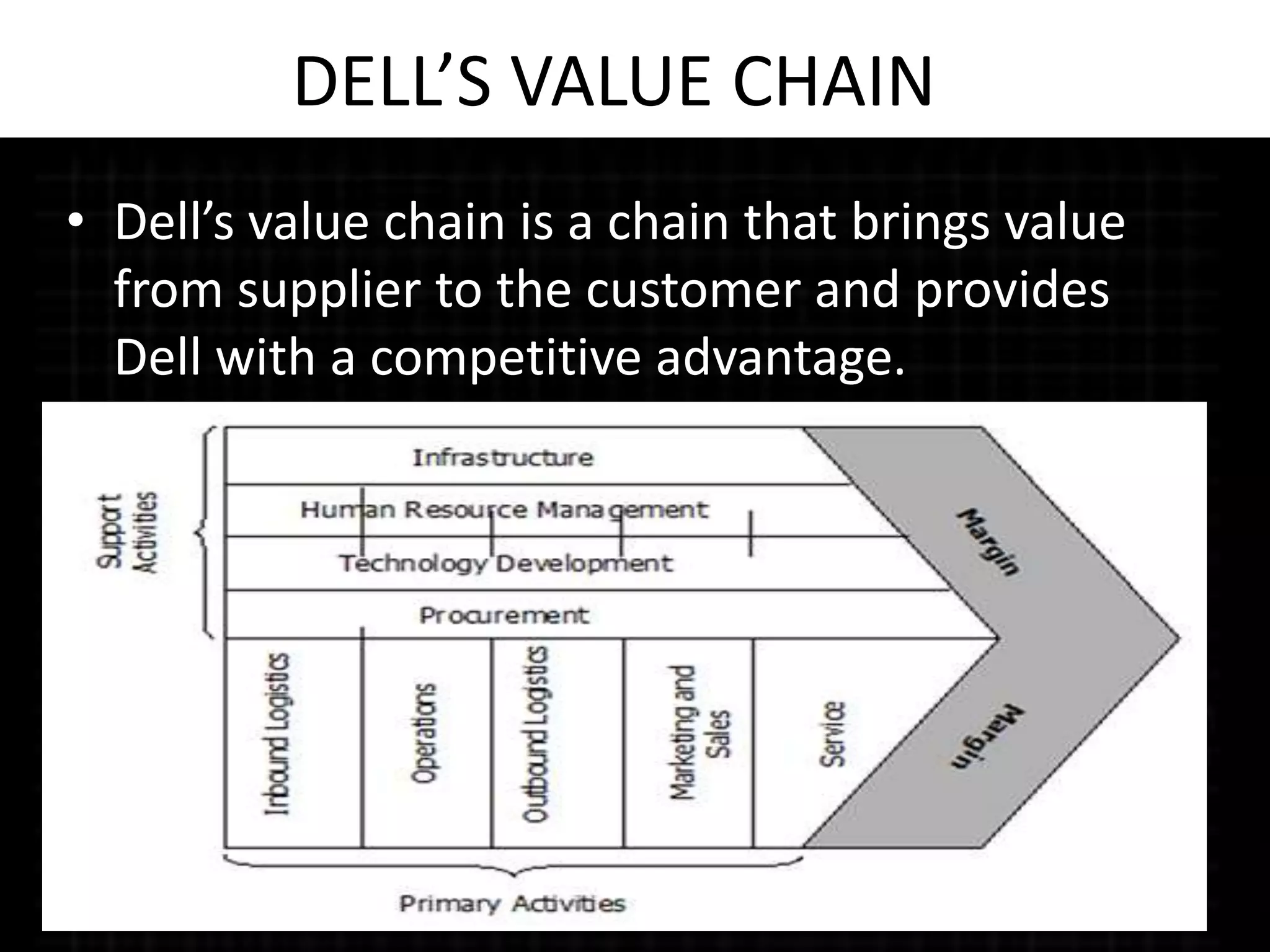
DELL’S VALUE CHAIN
• Dell’s value chain is a chain that brings value
from supplier to the customer and provides
Dell with a competitive advantage.
DELL’S VALUE CHAIN
• Inbound logistics.
• Dell works with more than 165,000 channel
partners in inbound logistics annually.
• The company utilizes Just-in-Time (JIT) philosophy
in dealing with inbound logistics.
• Thus Dell is able to save on huge inventory costs
and sustain cost leadership for the majority of its
products and services.
• Customer orders are registered by Dell and its
vendors simultaneously by an integrated system.
Then, materials are shipped by
suppliers within 2 hours and shortly received at
Dell’s assembly unit due to geographical proximity
DELL’S VALUE CHAIN
• Operations.
• The main distinctive point between operations of
Dell and its competitors relates to the fact that Dell
is not a computer manufacturer; the company
merely assembles parts manufactured by other
companies.
• At the same time, high level of product
customization is adapted as one of the bases of
competitive advantage by the business.
• Therefore, operations mainly consist
of three stages – assembly of
standard parts, installation of custom parts and
testing product configurations
DELL’S VALUE CHAIN
• Outbound logistics
• Thanks to the practice of mass customization,
Dell is able to complete order fulfilment in a
short duration of time.
• Generally, Dell completes customer shipments
in a timely basis, staying committed to its
promise of product customization as a result of
cumulative advantages of part
modularity, inventory program managed by
vendors, demand management and mass
customization.
DELL’S VALUE CHAIN
• Marketing and sales
• It is acknowledged by Dell as a critically
important primary activity and the company’s
marketing strategy has changed since the
company became private in August 2013.
• Specifically, Dell marketing management aims to
associate the brand image with an
entrepreneurial spirit by shifting
attention to the fact that the
company is no longer publicly listed, hence the
management is freed from the need to track
stock prices on a daily basis.
EFFICIENY v/s RESPONSIVENESS
• The Dell supply chain would be considered very responsive.
• COMPETITIVE STRATEGY : For Dell, the competitive strategy targets customers
who value having the latest PC models customized to their needs. Further,
these customers want the PCs delivered within days.
• DEMAND UNCERTAINTY : Given the vast variety of PCs, the high level of
innovation, and rapid delivery, demand from Dell customers can be
characterized as having high demand uncertainty.
• An efficient supply chain uses slow, inexpensive modes of transportation and
economies of scale in production.
• If Dell chose this it would have
difficulty supporting the customer's desire for
rapid delivery and a wide variety of customizable products
• Building a responsive supply chain, however, will allow Dell to meet its
customers' needs. Therefore, a responsive supply chain strategy is best suited
to meet the needs of Dell's targeted customers.
UNDERSTANDING SUPPLY CHAIN UNCERTAINTY
• Dell computers which uses the direct order model
where customers can configure computers and place
orders online. Dell gives a choice to customers to
make customized models for their requirement, and
delivers them at their door steps.
• This increases the implied demand uncertainty for
Dell which needs a responsive supply chain. To
provide these services to the customer there will be
additional costs involved for carrying
huge inventory for all the parts which
cannot be charged to the customers because
Dell has to be competitive in the market to survive.
STRATEGIC FIT
STRATEGIC FIT
• As a solution to this increased cost Dell closely collaborates
with suppliers, which allows Dell to operate with only a few
hours of inventory for some parts and a few days of inventory
for other common components.
• This way the supplier will have less demand uncertainty which
can be handled through an efficient supply chain.
• Thus Dell absorbs most the uncertainty and provides
responsiveness in supply chain and its supplier being
efficient absorbs very little uncertainty.
• To achieve strategic fit Dell brings consistency
between implied demand uncertainty and
supply chain responsiveness.
ACHIEVING STRATEGIC FIT
• Dell's competitive strategy is to provide a large variety of
customizable products at a reasonable price.
• A supply chain strategy that emphasizes flexibility and
responsiveness has a better strategic fit with Dell's
competitive strategy of providing a large variety of
customizable products.
• This notion of fit also extends to Dell's other functional
strategies. For instance, its new product development
strategy should emphasize designing products that are
easily customizable, which may include designing common
platforms across several products and the
use of common components.
• This feature allows Dell to assemble
customized PCs quickly in response to a customer demand.
• Dell clearly has achieved strong strategic fit between its
different functional strategies and its competitive strategy.
FACILITIES
• Manufacturing
• From its early beginnings, Dell operated as a pioneer in the
"configure to order" approach to manufacturing—delivering
individual PCs configured to customer specifications. In
contrast, most PC manufacturers in those times delivered large
orders to intermediaries on a quarterly basis.
• To minimize the delay between purchase and delivery, Dell has
a general policy of manufacturing its products close to its
customers.
• This also allows for implementing a
just-in-time (JIT) manufacturing approach,
which minimizes inventory costs.
FACILITIES
• Dell facilities in the United States are located in Texas; New
Hampshire; Tennessee; Oklahoma; Illinois; Oregon ; North
Carolina; Minnesota (Dell Compellent); Kentucky; and
Florida.
• Facilities located abroad include Malaysia ;China; UK;
Philippines, Brazil; Slovakia ; Panama; Dublin Ireland; and
Morocco.
• In India there are manufacturing units at Chennai,
Hyderabad and Noida.
• The US and India are the only countries that
have all Dell's business functions and provide support
globally: research and development, manufacturing,
finance, analysis, and customer care.
INVENTORY
• The Zero Inventory Strategy
• Dell computer sales follow the Build-to-Order strategy for
selling PC’s. In this method the products do not sit in the
inventory and lose their value before they are sold and
also the inventory does not need to be cleared for the new
products.
• The reason for Dells success in inventory management is
due to the strategy of
having low or “Zero Inventory”.
Computers depreciate at a very high rate
and therefore the product loses value even before it is
sold. For every 7days that a computer sits in the Dell
warehouse it loses 1% of its value.
TRANSPORTATION
• Shipping by sea helps minimize environmental impact
• Recently Dell switched to greener transport.
• Dell developed their air-to-sea initiative, converting many
of Dell's longer-lead, overseas shipments (such as those
from retailers and other channel partners) to transport
via ocean freight rather than aircraft.
• They found this allowed us to pack more products on each
vehicle. Moving products by sea rather than air reduced
emissions and fuel usage per product shipped.
• They also achieved further efficiency
through truck-to-rail initiative.
For many routes, such as Asia to Europe and
China to South Asia, they now use rail rather than trucks to
transfer shipments from ocean terminals to Dell fulfillment
centers.
SOURCING
• Dell makes strategic sourcing the foundation of its
business model. When the company works with
suppliers, it opens up both the design and the
production processes, providing them with the
targets they need to hit for cost, timing and
quality.
• By doing so, they eliminate the burden of hiring
employees, managing them and paying their
benefits, all the while ensuring that they are
getting parts and labour from best-in-class
suppliers.
SOURCING
• Dell chose outsourcing to IBM, who was expert in this
area. IBM choice could guarantee customer
satisfaction and brand control, IBM was their fierce
competitor in PC market.
• Dell ultimately chose IBM to outsource its field
service, considering the merit of its wide network of
consultants, experts and technicians.
• But Dell didn't stop there. Subsequently,
it acquired small companies to expand
its IT capabilities.
PRICING
• Pricing Objective of Dell
• The specific price what Dell Company set for any product that has two
factors.
• One is demand for the goods and services and the other factors is the
cost of those products.
• By improving Global IT spending, Dell is targeting in operating income and
also cash flow from net income. Recently, Dell is offering different kinds of
hot deals such as all-in-one for desktop, free virus protection software,
buy one get one etc.
• In the past coupe of years Dell has been cutting its product prices in order
to maintain market share and sales.
• We continued to face a competitive pricing environment
and have aligned our pricing strategy to invest in growth
ahead of planned reductions in our cost structure and this has affected
our profitability,” Dell CFO Brian Gladden said on a conference call in
2013.
INFORMATION TECHNOLOGY
• The Dell supply chain management (SCM) database systems
handle key business functions that support worldwide
manufacturing operations, including the efficient Dell
inventory management model and fast, direct delivery of
computers, accessories, parts, and supplies.
• These systems must be designed for reliability and cost-
effective scalability.
• The Dell IT group ran its SCM database applications on large,
expensive, proprietary servers based on the UNIX® OS.
However, as the company grew, servers lacking the necessary
capacity had to be replaced with even larger, more powerful
servers.
• The increased performance of industry-standard
Dell PowerEdge servers, however, has enabled
Dell IT to create cost-effective, highly scalable systems using
Oracle Real Application Clusters (RAC) 10g.
DISTRIBUTION
DISTRIBUTION
• Dell figured out a new way to sell computers to the
consumer, which is through direct distribution.
• By using a direct distribution approach, Dell was able to
gain a competitive advantage for several reasons:
• First of all, direct distribution allows Dell to eliminate
wholesalers. This is advantageous because Dell does
not have to deal with wholesalers and have to be
responsible for keeping track of inventory for
numerous wholesalers.
• Second, Dell has eliminated retailers. This is effective
because without retailers, Dell does not
have to receive customer orders through
thousands of different retailers- they can take orders
directly from the customer, and eliminate the hassle of
selling their product through retailers.
DISTRIBUTION
• Dell impressed many in its early years with its
distinct model of supply chain management,
selling customized computers directly to customers to
meet burgeoning PC demand. By using this innovative sales model, Dell
became an industry and shareholders’ darling, a high-tech pioneer with
seemingly limitless growth. times.
DISTRIBUTION
• Eventually with lowering profits…Dell had to
consider selling through retail channels such as
Costco or local computer stores.
• In 2006 Dell announced that it would offer
Dimension PCs and Inspiron notebooks through
Wal-Mart and Sam’s Club. And in 2007 Dell
announced that it would take this channel strategy
overseas, selling computers through China’s largest
electronics retailer.
• In the present scenario Dell has
integrated its Direct Distribution channel along with
the new retail distribution.
PREPARED BY:
SALOMIKA JENA, ASHWARYA CHAUDHARY,
ANU ARYA,ADITI SINGH,PRACHI JHA

DELL supply chain management

  • 1.
    DELL COMPUTERS Presentation by:Salomika Jena, Anu Arya, Aditi Singh, Ashwarya Chaudhary, Prachi Jha
  • 2.
    DELL COMPUTERS INC.OVERVIEW •Dell Inc. is an American privately owned multinational computer technology company based in Round Rock, Texas, United States, that develops, sells, repairs, and supports computers and related products and services. •Named after its founder ,Michael Dell, the company is one of the largest technological corporations in the world, employing more than 103,300 people worldwide. •Dell sells personal computers (PCs), servers, data storage devices, network switches, software, computer peripherals, HDTVs, cameras, printers, MP3 players, and electronics built by other manufacturers. • The company is well known for its innovations in supply chain management and electronic commerce. particularly its direct-sales model and its "build-to-order" or "configure to order" approach to manufacturing—delivering individual PCs configured to customer specifications.
  • 3.
    THE SUPPLY CHAINOVERVIEW Supply Chain integrates all these features such as manufacturer, supplier, transport, wholesalers, retailers, customers and all other elements which link the above. Its main objective is to fulfill customer demands by adding value to the products and services.
  • 4.
    SUPPLY CHAIN DECISIONS •For the supply chain to be strategically effective it has to be implemented in all the levels in the organization. Therefore in all the three levels of DELL; • Strategic • Tactical • Operational, supply chain practices are being made use of. • In the strategic level decisions will be made regarding the whole organization considering the supply chain. These decisions are critical since it reflects the overall corporate strategy of the company. • In the case of DELL the unconventional idea of using direct sales method has to be come from the strategic level. • Senior management of DELL is giving the strategic direction when considering the product that the company should manufacture and offer to their customers.
  • 5.
    SUPPLY CHAIN DECISIONS Dellapplies the theory of manufacturing overseas. It is needed to analyze and predict the capacity in supply chain therefore measures can be taken to expand the facilities accordingly. The middle level management team has the responsibility of this. There is more significance when it comes to the operational level. All the supply chain activities in DELL are done thoroughly by this cluster.
  • 7.
    PUSH- PULL VIEW •Dell’s approach can be classified as a push-pull strategy. • The company pushes several options to customers, options the company controls but ones that allow customers to choose a customized product. • The customer’s choice then pulls demand for the computer manufacturer by dictating what parts, components and consumables are needed within its supply chain and assembly line. • The customer makes a decision and that decision then determines what inventory is pulled through the supply chain.
  • 9.
    DELL’S VALUE CHAIN •Dell’s value chain is a chain that brings value from supplier to the customer and provides Dell with a competitive advantage.
  • 10.
    DELL’S VALUE CHAIN •Inbound logistics. • Dell works with more than 165,000 channel partners in inbound logistics annually. • The company utilizes Just-in-Time (JIT) philosophy in dealing with inbound logistics. • Thus Dell is able to save on huge inventory costs and sustain cost leadership for the majority of its products and services. • Customer orders are registered by Dell and its vendors simultaneously by an integrated system. Then, materials are shipped by suppliers within 2 hours and shortly received at Dell’s assembly unit due to geographical proximity
  • 11.
    DELL’S VALUE CHAIN •Operations. • The main distinctive point between operations of Dell and its competitors relates to the fact that Dell is not a computer manufacturer; the company merely assembles parts manufactured by other companies. • At the same time, high level of product customization is adapted as one of the bases of competitive advantage by the business. • Therefore, operations mainly consist of three stages – assembly of standard parts, installation of custom parts and testing product configurations
  • 12.
    DELL’S VALUE CHAIN •Outbound logistics • Thanks to the practice of mass customization, Dell is able to complete order fulfilment in a short duration of time. • Generally, Dell completes customer shipments in a timely basis, staying committed to its promise of product customization as a result of cumulative advantages of part modularity, inventory program managed by vendors, demand management and mass customization.
  • 13.
    DELL’S VALUE CHAIN •Marketing and sales • It is acknowledged by Dell as a critically important primary activity and the company’s marketing strategy has changed since the company became private in August 2013. • Specifically, Dell marketing management aims to associate the brand image with an entrepreneurial spirit by shifting attention to the fact that the company is no longer publicly listed, hence the management is freed from the need to track stock prices on a daily basis.
  • 15.
    EFFICIENY v/s RESPONSIVENESS •The Dell supply chain would be considered very responsive. • COMPETITIVE STRATEGY : For Dell, the competitive strategy targets customers who value having the latest PC models customized to their needs. Further, these customers want the PCs delivered within days. • DEMAND UNCERTAINTY : Given the vast variety of PCs, the high level of innovation, and rapid delivery, demand from Dell customers can be characterized as having high demand uncertainty. • An efficient supply chain uses slow, inexpensive modes of transportation and economies of scale in production. • If Dell chose this it would have difficulty supporting the customer's desire for rapid delivery and a wide variety of customizable products • Building a responsive supply chain, however, will allow Dell to meet its customers' needs. Therefore, a responsive supply chain strategy is best suited to meet the needs of Dell's targeted customers.
  • 16.
    UNDERSTANDING SUPPLY CHAINUNCERTAINTY • Dell computers which uses the direct order model where customers can configure computers and place orders online. Dell gives a choice to customers to make customized models for their requirement, and delivers them at their door steps. • This increases the implied demand uncertainty for Dell which needs a responsive supply chain. To provide these services to the customer there will be additional costs involved for carrying huge inventory for all the parts which cannot be charged to the customers because Dell has to be competitive in the market to survive.
  • 17.
  • 18.
    STRATEGIC FIT • Asa solution to this increased cost Dell closely collaborates with suppliers, which allows Dell to operate with only a few hours of inventory for some parts and a few days of inventory for other common components. • This way the supplier will have less demand uncertainty which can be handled through an efficient supply chain. • Thus Dell absorbs most the uncertainty and provides responsiveness in supply chain and its supplier being efficient absorbs very little uncertainty. • To achieve strategic fit Dell brings consistency between implied demand uncertainty and supply chain responsiveness.
  • 19.
    ACHIEVING STRATEGIC FIT •Dell's competitive strategy is to provide a large variety of customizable products at a reasonable price. • A supply chain strategy that emphasizes flexibility and responsiveness has a better strategic fit with Dell's competitive strategy of providing a large variety of customizable products. • This notion of fit also extends to Dell's other functional strategies. For instance, its new product development strategy should emphasize designing products that are easily customizable, which may include designing common platforms across several products and the use of common components. • This feature allows Dell to assemble customized PCs quickly in response to a customer demand. • Dell clearly has achieved strong strategic fit between its different functional strategies and its competitive strategy.
  • 21.
    FACILITIES • Manufacturing • Fromits early beginnings, Dell operated as a pioneer in the "configure to order" approach to manufacturing—delivering individual PCs configured to customer specifications. In contrast, most PC manufacturers in those times delivered large orders to intermediaries on a quarterly basis. • To minimize the delay between purchase and delivery, Dell has a general policy of manufacturing its products close to its customers. • This also allows for implementing a just-in-time (JIT) manufacturing approach, which minimizes inventory costs.
  • 22.
    FACILITIES • Dell facilitiesin the United States are located in Texas; New Hampshire; Tennessee; Oklahoma; Illinois; Oregon ; North Carolina; Minnesota (Dell Compellent); Kentucky; and Florida. • Facilities located abroad include Malaysia ;China; UK; Philippines, Brazil; Slovakia ; Panama; Dublin Ireland; and Morocco. • In India there are manufacturing units at Chennai, Hyderabad and Noida. • The US and India are the only countries that have all Dell's business functions and provide support globally: research and development, manufacturing, finance, analysis, and customer care.
  • 23.
    INVENTORY • The ZeroInventory Strategy • Dell computer sales follow the Build-to-Order strategy for selling PC’s. In this method the products do not sit in the inventory and lose their value before they are sold and also the inventory does not need to be cleared for the new products. • The reason for Dells success in inventory management is due to the strategy of having low or “Zero Inventory”. Computers depreciate at a very high rate and therefore the product loses value even before it is sold. For every 7days that a computer sits in the Dell warehouse it loses 1% of its value.
  • 24.
    TRANSPORTATION • Shipping bysea helps minimize environmental impact • Recently Dell switched to greener transport. • Dell developed their air-to-sea initiative, converting many of Dell's longer-lead, overseas shipments (such as those from retailers and other channel partners) to transport via ocean freight rather than aircraft. • They found this allowed us to pack more products on each vehicle. Moving products by sea rather than air reduced emissions and fuel usage per product shipped. • They also achieved further efficiency through truck-to-rail initiative. For many routes, such as Asia to Europe and China to South Asia, they now use rail rather than trucks to transfer shipments from ocean terminals to Dell fulfillment centers.
  • 25.
    SOURCING • Dell makesstrategic sourcing the foundation of its business model. When the company works with suppliers, it opens up both the design and the production processes, providing them with the targets they need to hit for cost, timing and quality. • By doing so, they eliminate the burden of hiring employees, managing them and paying their benefits, all the while ensuring that they are getting parts and labour from best-in-class suppliers.
  • 26.
    SOURCING • Dell choseoutsourcing to IBM, who was expert in this area. IBM choice could guarantee customer satisfaction and brand control, IBM was their fierce competitor in PC market. • Dell ultimately chose IBM to outsource its field service, considering the merit of its wide network of consultants, experts and technicians. • But Dell didn't stop there. Subsequently, it acquired small companies to expand its IT capabilities.
  • 27.
    PRICING • Pricing Objectiveof Dell • The specific price what Dell Company set for any product that has two factors. • One is demand for the goods and services and the other factors is the cost of those products. • By improving Global IT spending, Dell is targeting in operating income and also cash flow from net income. Recently, Dell is offering different kinds of hot deals such as all-in-one for desktop, free virus protection software, buy one get one etc. • In the past coupe of years Dell has been cutting its product prices in order to maintain market share and sales. • We continued to face a competitive pricing environment and have aligned our pricing strategy to invest in growth ahead of planned reductions in our cost structure and this has affected our profitability,” Dell CFO Brian Gladden said on a conference call in 2013.
  • 28.
    INFORMATION TECHNOLOGY • TheDell supply chain management (SCM) database systems handle key business functions that support worldwide manufacturing operations, including the efficient Dell inventory management model and fast, direct delivery of computers, accessories, parts, and supplies. • These systems must be designed for reliability and cost- effective scalability. • The Dell IT group ran its SCM database applications on large, expensive, proprietary servers based on the UNIX® OS. However, as the company grew, servers lacking the necessary capacity had to be replaced with even larger, more powerful servers. • The increased performance of industry-standard Dell PowerEdge servers, however, has enabled Dell IT to create cost-effective, highly scalable systems using Oracle Real Application Clusters (RAC) 10g.
  • 29.
  • 30.
    DISTRIBUTION • Dell figuredout a new way to sell computers to the consumer, which is through direct distribution. • By using a direct distribution approach, Dell was able to gain a competitive advantage for several reasons: • First of all, direct distribution allows Dell to eliminate wholesalers. This is advantageous because Dell does not have to deal with wholesalers and have to be responsible for keeping track of inventory for numerous wholesalers. • Second, Dell has eliminated retailers. This is effective because without retailers, Dell does not have to receive customer orders through thousands of different retailers- they can take orders directly from the customer, and eliminate the hassle of selling their product through retailers.
  • 31.
    DISTRIBUTION • Dell impressedmany in its early years with its distinct model of supply chain management, selling customized computers directly to customers to meet burgeoning PC demand. By using this innovative sales model, Dell became an industry and shareholders’ darling, a high-tech pioneer with seemingly limitless growth. times.
  • 32.
    DISTRIBUTION • Eventually withlowering profits…Dell had to consider selling through retail channels such as Costco or local computer stores. • In 2006 Dell announced that it would offer Dimension PCs and Inspiron notebooks through Wal-Mart and Sam’s Club. And in 2007 Dell announced that it would take this channel strategy overseas, selling computers through China’s largest electronics retailer. • In the present scenario Dell has integrated its Direct Distribution channel along with the new retail distribution.
  • 33.
    PREPARED BY: SALOMIKA JENA,ASHWARYA CHAUDHARY, ANU ARYA,ADITI SINGH,PRACHI JHA