



Name: Salah Ud Din
Id: 4636
Topic: Walmart Case Study
Presented to Sir Adil Adnan
Iqra National University Peshawar
https://www.facebook.com/salah302
Contents
• About Walmart ………………………………………………………………… 1
• About Case …………………………………………………........................ 2
• Walmart supply chain management ………………………………….. 3
Procurement and Distributions ………………………………………….. 3.1
Bullwhip effects ………………………........... 3.1.2
Vendor Managed Inventory ……………….. 3.1.3
Logistic Management …………………………………………………………. 3.2
Cross Docking …………………………………… 3.2.1
Hub and Spoke …………………………………. 3.2.2
Inventory management ……………………………………………………….. 4
Use of IT in Supply chain ………………………………………………………. 5
Conclusions …………………………………………………………………………… 6
About Walmart
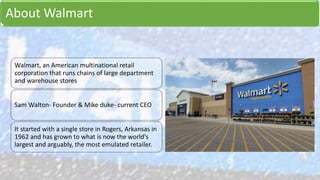
Walmart, an American multinational retail
corporation that runs chains of large department
and warehouse stores
Sam Walton- Founder & Mike duke- current CEO
It started with a single store in Rogers, Arkansas in
1962 and has grown to what is now the world's
largest and arguably, the most emulated retailer.
About Walmart
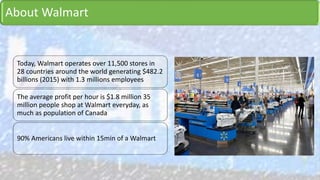
Today, Walmart operates over 11,500 stores in
28 countries around the world generating $482.2
billions (2015) with 1.3 millions employees
The average profit per hour is $1.8 million 35
million people shop at Walmart everyday, as
much as population of Canada
90% Americans live within 15min of a Walmart
About the case
Walmart has envious supply chain management that change the way business is
done.
This case present how Successfully Walmart manage supply chain and how it is
beneficial for Walmart.
This case also talks about the best practices by Walmart in the IT integration to
ensures efficiency and effectiveness of supply chain.
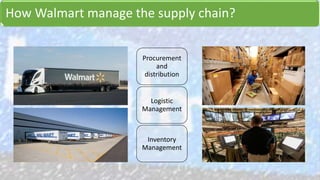
How Walmart manage the supply chain?
Procurement
and
distribution
Logistic
Management
Inventory
Management
Procurement and distribution
Wal-Mart emphasized the need to reduce purchasing costs and offer the best
price to the customer.
They spends a significant amount of time meeting vendors and understanding
their cost structure.
The company directly procured from manufacturers, by passing all intermediaries.
Procurement And Distribution
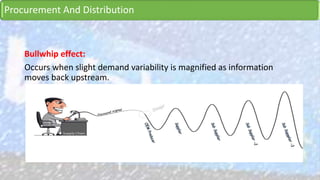
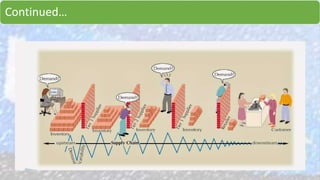
Bullwhip effect:
Occurs when slight demand variability is magnified as information
moves back upstream.
Continued…
Using EDI for procurement
The computer systems of Wal-Mart are connected to those of its suppliers.
EDI enabled the suppliers to download purchase orders along with store-to-
store sales information relating to their products sold.
On receiving information about the sales of various products, the suppliers
shipped the required goods to Wal-Mart’s distribution centers.
EDI not only save time and made procurement efficient but also reduce the
bullwhip effects.
Share information:
Walmart Data warehouse has the capacity of storage of 570 Terabytes
Second only to the U.S Government.
But all data is useless until it is shared
P&G could monitor Wal-Mart’s sales and inventory data, and then use that
information to make its own production and shipping plans more efficiently
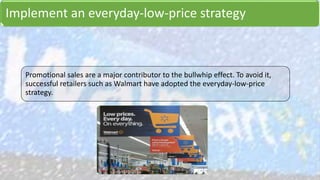
Implement an everyday-low-price strategy
Promotional sales are a major contributor to the bullwhip effect. To avoid it,
successful retailers such as Walmart have adopted the everyday-low-price
strategy.
Vendor managed inventory
A means of optimizing Supply Chain performance in which the manufacturer is responsible for
maintaining the distributors inventory levels.
The manufacturer has access to the distributors inventory data and is responsible for generating
purchase orders. Manufacturers generate orders, not distributors or retailers Stocking information
is accessed using EDI
A first step towards supply chain collaboration
Increased speed, reduced errors, and improved service
Logistic Management
Cross Docking
Hub and Spoke
Cross Docking
The practice in logistics
management of unloading
materials from an incoming trailer
trucks and directly loading the
materials into outbound trucks with
little or no storage in between the
transfer process. It is also a
mechanism to combine goods from
two or more different origins into
one transport container or vehicle
with the same destination.
Continued…
At Wal-Mart’s new distribution centers, P&G’s trucks are unloaded directly to trucks that will head for Wal-
Mart Stores.
Products are put on the shelf within 4 hours, and are usually sold within 24 hours.
The cross docking strategy has helped Wal-Mart to streamline the supply chain from origin point to the final
point of sale and it has reduced the handling cost, operating cost and drastically reduce the inventory storage
cost. It has also helped them to get products to the final customer faster.
Despite this tight delivery schedule, Wal-Mart has 10 days to pay P&G
Benefits of Cross Docking
“Sell the goods before
we have to pay.”
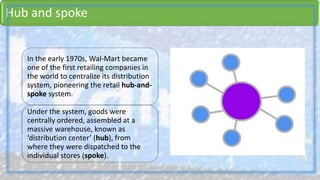
Hub and spoke
In the early 1970s, Wal-Mart became
one of the first retailing companies in
the world to centralize its distribution
system, pioneering the retail hub-and-
spoke system.
Under the system, goods were
centrally ordered, assembled at a
massive warehouse, known as
‘distribution center’ (hub), from
where they were dispatched to the
individual stores (spoke).
Hub and spoke
The hub and spoke system enabled Wal-Mart to achieve significant cost
advantages by the centralized purchasing of goods in huge quantities..
and distributing them through its own logistics infrastructure to the retail stores
spread across the U.S
84 distributions centers in the United State, each serves 150 stores within a 150
mile radius
The distribution centers are serviced by more than 3500 company owned trucks.
The company hired only experienced drivers who had driven more than 300,000
accident-free miles, with no major traffic violation.
Inventory Management
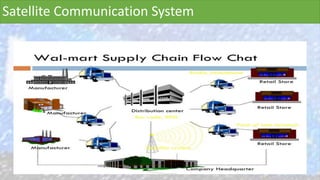
Wal-Mart invested heavily in IT and communication systems to effectively
track sales and merchandise inventories in stores across the country.
With the rapid expansion, it was essential to have a good communication
system.
Hence, Wal-Mart set up its own satellite communication system in 1983.
Satellite Communication System
Continued…
Wal-Mart was able to reduce unproductive inventory by allowing stores to
manage their own stocks, reducing pack sizes across many product categories,
and timely price markdowns.
Instead of cutting the inventory across the board, Wal-Mart made full use of its IT
capabilities to make more inventories available in the case of items that
customers wanted most, while reducing the overall inventory levels.
Use of IT in the Supply Chain
The order management and store replenishment of goods were entirely executed
with the help of computers through the Point-of-Sales (POS) system.
Through this system, it was possible to monitor and track the sales and
merchandise stock levels on the store shelves.
Continued…
Employees at the stores had the “Magic Wand,” a hand-held
computer which was linked to in-store terminals through a radio
frequency network.
These helped them to keep track of the inventory in stores, deliveries,
and backup merchandise in stock at the distribution centers.
Voice-base order filling (VOF) System
In 1998, Wal-Mart installed a voice-based order filling (VOF) system in all its
grocery distribution centers.
Each person responsible for order picking was provided with a
microphone/speaker headset, connected to the portable (VOF) system that
could be worn on waist belt.
They were guided by the voice to item locations in the distribution centers.
Quick replenishment
Since the floor area of any Wal-Mart store varied between 40,000 to 200,000
square feet, movement of goods within the store was an important part of
logistics operations.
Wal-Mart made significant investments in IT to quickly locate and replenish goods
at the stores.
Retail link system
In 1991, Wal-Mart had invested approximately $4 billion to build a retail link
system.
More than 10,000 Wal-Mart retail suppliers used the retail link system to monitor
the sales of their goods at stores and replenish inventories.
Benefits of retail links system
As a result lead time was cut to 11 days from 21 days
On the hand inventory was reduced by two weeks
Sales grew by $8.5 million in six months
By 1990’s about 90% of suppliers were doing business through retail link
CPFR
By the mid 1990s, Retail Link had emerged into an Internet-enabled
SCM system whose functions were not confined to inventory
management alone, but also covered collaborative planning,
forecasting and replenishment (CPFR).
CPFR is defined as a business practice for business partners to
share forecasts and results data through the Internet, in order to
reduce inventory costs while at the same time, enhancing product
availability across the supply chain.
Radio Frequency Identification (RFID)
Wal-Mart planned to replace bar-code technology with RFID technology.
Because of the implementation of RFID, employees were no longer required to
physically scan the bar codes of goods entering the stores and distribution centers,
saving labor cost and time.
Benefits from RFID
Drastic decrease in stock out situations
Lesser labor requirements
Decrease in merchandise thefts
Real time tracking of consumption patterns
Would help enhance JIT inventory management system
Conclusion:
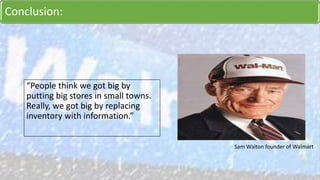
“People think we got big by
putting big stores in small towns.
Really, we got big by replacing
inventory with information.”
Sam Walton founder of Walmart
Hope You Enjoy it

Walmart Supply Chain Management ( Case study)

  • 1.
    Name: Salah UdDin Id: 4636 Topic: Walmart Case Study Presented to Sir Adil Adnan Iqra National University Peshawar https://www.facebook.com/salah302
  • 2.
    Contents • About Walmart………………………………………………………………… 1 • About Case …………………………………………………........................ 2 • Walmart supply chain management ………………………………….. 3 Procurement and Distributions ………………………………………….. 3.1 Bullwhip effects ………………………........... 3.1.2 Vendor Managed Inventory ……………….. 3.1.3 Logistic Management …………………………………………………………. 3.2 Cross Docking …………………………………… 3.2.1 Hub and Spoke …………………………………. 3.2.2 Inventory management ……………………………………………………….. 4 Use of IT in Supply chain ………………………………………………………. 5 Conclusions …………………………………………………………………………… 6
  • 3.
    About Walmart Walmart, anAmerican multinational retail corporation that runs chains of large department and warehouse stores Sam Walton- Founder & Mike duke- current CEO It started with a single store in Rogers, Arkansas in 1962 and has grown to what is now the world's largest and arguably, the most emulated retailer.
  • 4.
    About Walmart Today, Walmartoperates over 11,500 stores in 28 countries around the world generating $482.2 billions (2015) with 1.3 millions employees The average profit per hour is $1.8 million 35 million people shop at Walmart everyday, as much as population of Canada 90% Americans live within 15min of a Walmart
  • 5.
    About the case Walmarthas envious supply chain management that change the way business is done. This case present how Successfully Walmart manage supply chain and how it is beneficial for Walmart. This case also talks about the best practices by Walmart in the IT integration to ensures efficiency and effectiveness of supply chain.
  • 6.
    How Walmart managethe supply chain? Procurement and distribution Logistic Management Inventory Management
  • 7.
    Procurement and distribution Wal-Martemphasized the need to reduce purchasing costs and offer the best price to the customer. They spends a significant amount of time meeting vendors and understanding their cost structure. The company directly procured from manufacturers, by passing all intermediaries.
  • 8.
    Procurement And Distribution Bullwhipeffect: Occurs when slight demand variability is magnified as information moves back upstream.
  • 9.
  • 10.
    Using EDI forprocurement The computer systems of Wal-Mart are connected to those of its suppliers. EDI enabled the suppliers to download purchase orders along with store-to- store sales information relating to their products sold. On receiving information about the sales of various products, the suppliers shipped the required goods to Wal-Mart’s distribution centers. EDI not only save time and made procurement efficient but also reduce the bullwhip effects.
  • 11.
    Share information: Walmart Datawarehouse has the capacity of storage of 570 Terabytes Second only to the U.S Government. But all data is useless until it is shared P&G could monitor Wal-Mart’s sales and inventory data, and then use that information to make its own production and shipping plans more efficiently
  • 12.
    Implement an everyday-low-pricestrategy Promotional sales are a major contributor to the bullwhip effect. To avoid it, successful retailers such as Walmart have adopted the everyday-low-price strategy.
  • 13.
    Vendor managed inventory Ameans of optimizing Supply Chain performance in which the manufacturer is responsible for maintaining the distributors inventory levels. The manufacturer has access to the distributors inventory data and is responsible for generating purchase orders. Manufacturers generate orders, not distributors or retailers Stocking information is accessed using EDI A first step towards supply chain collaboration Increased speed, reduced errors, and improved service
  • 14.
  • 15.
    Cross Docking The practicein logistics management of unloading materials from an incoming trailer trucks and directly loading the materials into outbound trucks with little or no storage in between the transfer process. It is also a mechanism to combine goods from two or more different origins into one transport container or vehicle with the same destination.
  • 16.
    Continued… At Wal-Mart’s newdistribution centers, P&G’s trucks are unloaded directly to trucks that will head for Wal- Mart Stores. Products are put on the shelf within 4 hours, and are usually sold within 24 hours. The cross docking strategy has helped Wal-Mart to streamline the supply chain from origin point to the final point of sale and it has reduced the handling cost, operating cost and drastically reduce the inventory storage cost. It has also helped them to get products to the final customer faster. Despite this tight delivery schedule, Wal-Mart has 10 days to pay P&G
  • 17.
    Benefits of CrossDocking “Sell the goods before we have to pay.”
  • 18.
    Hub and spoke Inthe early 1970s, Wal-Mart became one of the first retailing companies in the world to centralize its distribution system, pioneering the retail hub-and- spoke system. Under the system, goods were centrally ordered, assembled at a massive warehouse, known as ‘distribution center’ (hub), from where they were dispatched to the individual stores (spoke).
  • 19.
    Hub and spoke Thehub and spoke system enabled Wal-Mart to achieve significant cost advantages by the centralized purchasing of goods in huge quantities.. and distributing them through its own logistics infrastructure to the retail stores spread across the U.S 84 distributions centers in the United State, each serves 150 stores within a 150 mile radius The distribution centers are serviced by more than 3500 company owned trucks. The company hired only experienced drivers who had driven more than 300,000 accident-free miles, with no major traffic violation.
  • 20.
    Inventory Management Wal-Mart investedheavily in IT and communication systems to effectively track sales and merchandise inventories in stores across the country. With the rapid expansion, it was essential to have a good communication system. Hence, Wal-Mart set up its own satellite communication system in 1983.
  • 21.
  • 22.
    Continued… Wal-Mart was ableto reduce unproductive inventory by allowing stores to manage their own stocks, reducing pack sizes across many product categories, and timely price markdowns. Instead of cutting the inventory across the board, Wal-Mart made full use of its IT capabilities to make more inventories available in the case of items that customers wanted most, while reducing the overall inventory levels.
  • 23.
    Use of ITin the Supply Chain The order management and store replenishment of goods were entirely executed with the help of computers through the Point-of-Sales (POS) system. Through this system, it was possible to monitor and track the sales and merchandise stock levels on the store shelves.
  • 24.
    Continued… Employees at thestores had the “Magic Wand,” a hand-held computer which was linked to in-store terminals through a radio frequency network. These helped them to keep track of the inventory in stores, deliveries, and backup merchandise in stock at the distribution centers.
  • 25.
    Voice-base order filling(VOF) System In 1998, Wal-Mart installed a voice-based order filling (VOF) system in all its grocery distribution centers. Each person responsible for order picking was provided with a microphone/speaker headset, connected to the portable (VOF) system that could be worn on waist belt. They were guided by the voice to item locations in the distribution centers.
  • 26.
    Quick replenishment Since thefloor area of any Wal-Mart store varied between 40,000 to 200,000 square feet, movement of goods within the store was an important part of logistics operations. Wal-Mart made significant investments in IT to quickly locate and replenish goods at the stores.
  • 27.
    Retail link system In1991, Wal-Mart had invested approximately $4 billion to build a retail link system. More than 10,000 Wal-Mart retail suppliers used the retail link system to monitor the sales of their goods at stores and replenish inventories.
  • 28.
    Benefits of retaillinks system As a result lead time was cut to 11 days from 21 days On the hand inventory was reduced by two weeks Sales grew by $8.5 million in six months By 1990’s about 90% of suppliers were doing business through retail link
  • 29.
    CPFR By the mid1990s, Retail Link had emerged into an Internet-enabled SCM system whose functions were not confined to inventory management alone, but also covered collaborative planning, forecasting and replenishment (CPFR). CPFR is defined as a business practice for business partners to share forecasts and results data through the Internet, in order to reduce inventory costs while at the same time, enhancing product availability across the supply chain.
  • 30.
    Radio Frequency Identification(RFID) Wal-Mart planned to replace bar-code technology with RFID technology. Because of the implementation of RFID, employees were no longer required to physically scan the bar codes of goods entering the stores and distribution centers, saving labor cost and time.
  • 31.
    Benefits from RFID Drasticdecrease in stock out situations Lesser labor requirements Decrease in merchandise thefts Real time tracking of consumption patterns Would help enhance JIT inventory management system
  • 32.
    Conclusion: “People think wegot big by putting big stores in small towns. Really, we got big by replacing inventory with information.” Sam Walton founder of Walmart
  • 33.