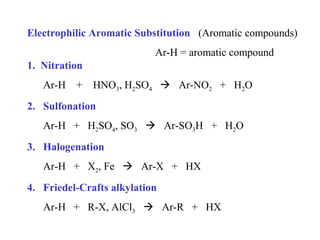
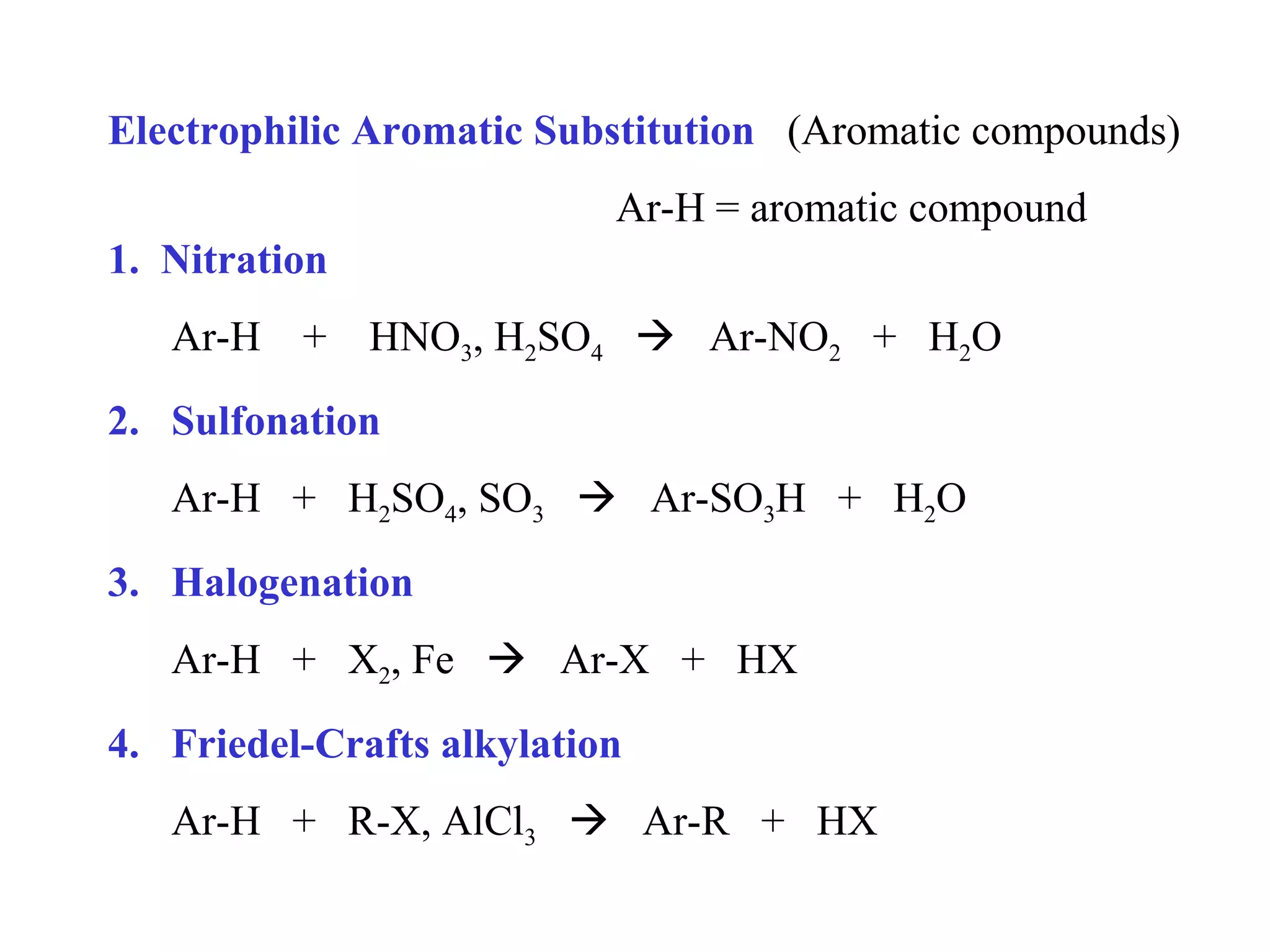
Electrophilic Aromatic Substitution (Aromatic compounds)
Ar-H = aromatic compound
1. Nitration
Ar-H + HNO3, H2SO4  Ar-NO2 + H2O
2. Sulfonation
Ar-H + H2SO4, SO3  Ar-SO3H + H2O
3. Halogenation
Ar-H + X2, Fe  Ar-X + HX
4. Friedel-Crafts alkylation
Ar-H + R-X, AlCl3  Ar-R + HX
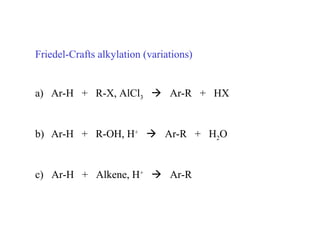
Friedel-Crafts alkylation (variations)
a) Ar-H + R-X, AlCl3  Ar-R + HX
b) Ar-H + R-OH, H+
 Ar-R + H2O
c) Ar-H + Alkene, H+
 Ar-R
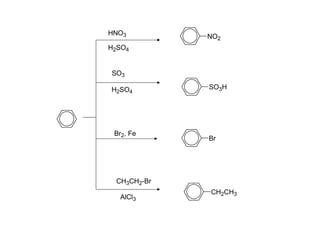
NO2
SO3H
Br
CH2CH3
HNO3
H2SO4
SO3
H2SO4
Br2, Fe
CH3CH2-Br
AlCl3
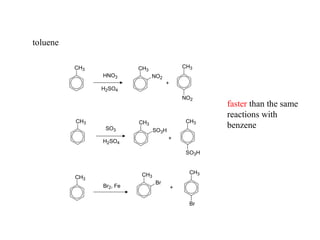
toluene
CH3
CH3
CH3
CH3
CH3
CH3
CH3
CH3
CH3
Br
Br
NO2
NO2
SO3H
SO3H
HNO3
H2SO4
SO3
H2SO4
Br2, Fe
+
+
+
faster than the same
reactions with
benzene
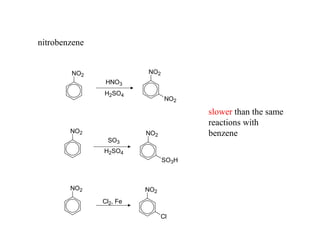
nitrobenzene
NO2
NO2
NO2
NO2
NO2
NO2
NO2
SO3H
Cl
HNO3
H2SO4
H2SO4
SO3
Cl2, Fe
slower than the same
reactions with
benzene
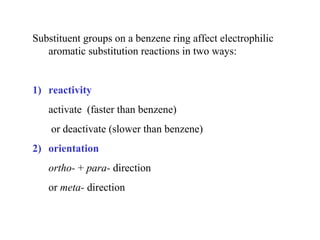
Substituent groups on a benzene ring affect electrophilic
aromatic substitution reactions in two ways:
1) reactivity
activate (faster than benzene)
or deactivate (slower than benzene)
2) orientation
ortho- + para- direction
or meta- direction
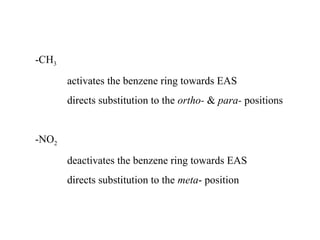
-CH3
activates the benzene ring towards EAS
directs substitution to the ortho- & para- positions
-NO2
deactivates the benzene ring towards EAS
directs substitution to the meta- position
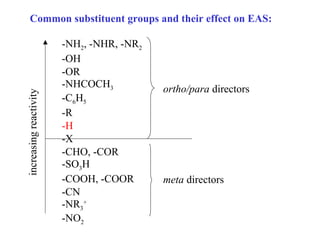
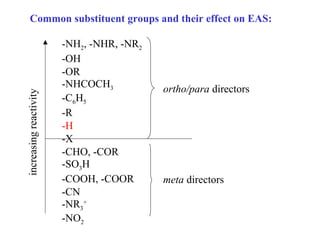
Common substituent groups and their effect on EAS:
-NH2, -NHR, -NR2
-OH
-OR
-NHCOCH3
-C6H5
-R
-H
-X
-CHO, -COR
-SO3H
-COOH, -COOR
-CN
-NR3
+
-NO2
increasingreactivity
ortho/para directors
meta directors
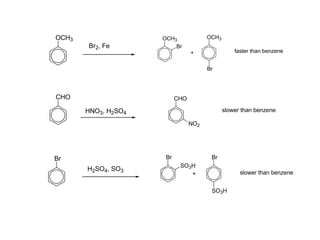
OCH3
CHO
Br
Br2, Fe
HNO3, H2SO4
H2SO4, SO3
OCH3
Br
OCH3
Br
+ faster than benzene
CHO
NO2
slower than benzene
+
Br Br
SO3H
SO3H
slower than benzene
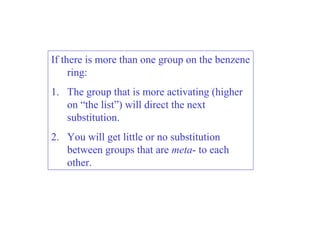
If there is more than one group on the benzene
ring:
1. The group that is more activating (higher
on “the list”) will direct the next
substitution.
2. You will get little or no substitution
between groups that are meta- to each
other.
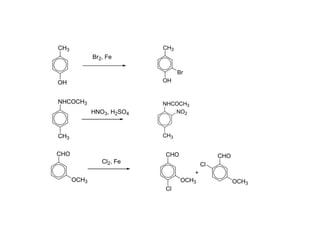
CH3
OH
NHCOCH3
CH3
CHO
OCH3
Br2, Fe
HNO3, H2SO4
Cl2, Fe
CH3
OH
Br
NHCOCH3
CH3
NO2
CHO
OCH3
Cl
CHO
OCH3
Cl
+
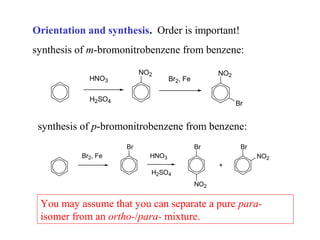
Orientation and synthesis. Order is important!
synthesis of m-bromonitrobenzene from benzene:
NO2
Br
NO2
HNO3
H2SO4
Br2, Fe
synthesis of p-bromonitrobenzene from benzene:
Br Br Br
NO2
NO2
+
Br2, Fe HNO3
H2SO4
You may assume that you can separate a pure para-
isomer from an ortho-/para- mixture.
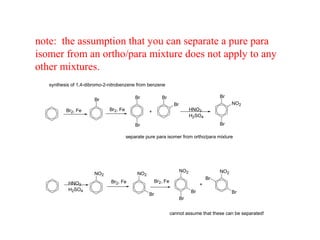
note: the assumption that you can separate a pure para
isomer from an ortho/para mixture does not apply to any
other mixtures.
Br Br
Br
Br
Br
NO2 NO2
Br
NO2
Br
Br
NO2
Br
Br
Br
Br
NO2
+
+
Br2, Fe Br2, Fe
Br2, Fe Br2, FeHNO3
H2SO4
HNO3
H2SO4
synthesis of 1,4-dibromo-2-nitrobenzene from benzene
separate pure para isomer from ortho/para mixture
cannot assume that these can be separated!
CH3
CH3
CH3
COOH
COOH COOH
CH3 COOH
NO2
NO2 NO2
+ ortho-
CH3Br
AlCl3
CH3Br
CH3Br
AlCl3
AlCl3
KMnO4
KMnO4
KMnO4
heat
heat
heat
HNO3
H2SO4
HNO3
H2SO4
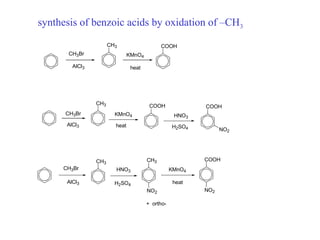
synthesis of benzoic acids by oxidation of –CH3
Links to problem sets on the web involving EAS:
http://chemistry2.csudh.edu/organic/aromatics/reactions.html
Reactivity and sites on monosubstituted benzene
Reaction Sties on disubstituted benzenes
Synthesis of disubstituted benzenes
Synthesis of trisubstituited benzenes
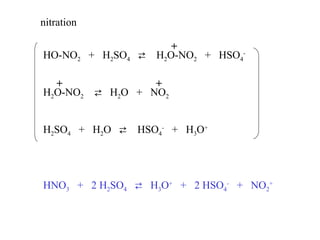
+
HO-NO2 + H2SO4  H2O-NO2 + HSO4
-
+ +
H2O-NO2  H2O + NO2
H2SO4 + H2O  HSO4
-
+ H3O+
HNO3 + 2 H2SO4  H3O+
+ 2 HSO4
-
+ NO2
+
nitration
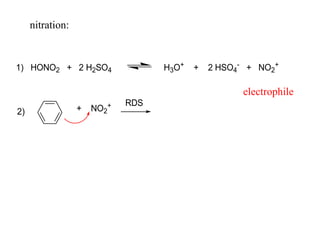
nitration:
1) HONO2 + 2 H2SO4 H3O+
+ 2 HSO4
-
+ NO2
+
2) + NO2
+ RDS
electrophile
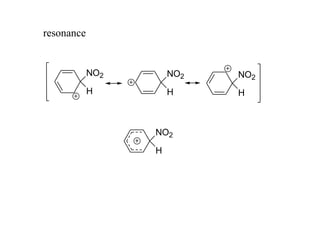
H
NO2
H
NO2
H
NO2
H
NO2
resonance
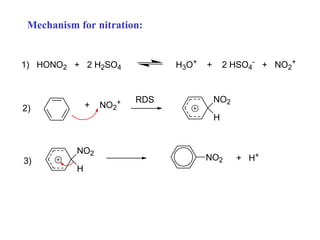
Mechanism for nitration:
1) HONO2 + 2 H2SO4 H3O+
+ 2 HSO4
-
+ NO2
+
2) + NO2
+
H
NO2
3)
RDS
NO2 + H+
H
NO2
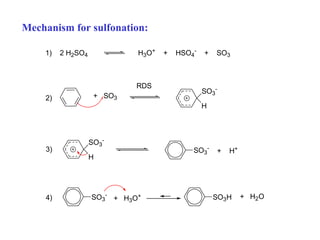
Mechanism for sulfonation:
1) 2 H2SO4 H3O+ + HSO4
- + SO3
2) + SO3
RDS
H
SO3
-
3)
H
SO3
-
SO3
-
+ H+
4) SO3
-
SO3H+ H3O+ + H2O
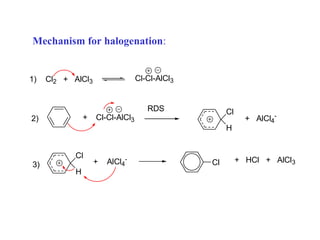
Mechanism for halogenation:
1) Cl2 + AlCl3 Cl-Cl-AlCl3
2) + Cl-Cl-AlCl3
RDS
H
Cl
+ AlCl4
-
3)
H
Cl
+ AlCl4
-
Cl + HCl + AlCl3
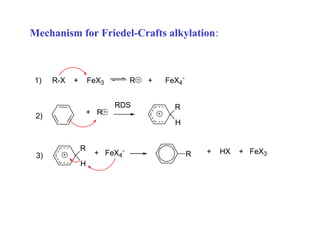
Mechanism for Friedel-Crafts alkylation:
1) R-X + FeX3 R + FeX4
-
2) + R
RDS
3)
H
R
H
R
+ FeX4
-
R + HX + FeX3
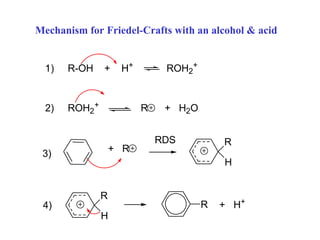
1) R-OH + H+
ROH2
+
3) + R
RDS
4)
H
R
H
R
R
2) ROH2
+ R + H2O
+ H+
Mechanism for Friedel-Crafts with an alcohol & acid
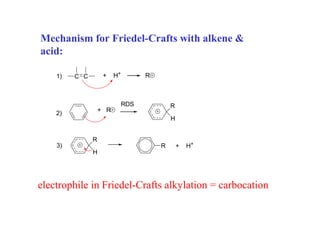
2)
+ R
RDS
3)
H
R
H
R
R
1) C C + H+
R
+ H+
Mechanism for Friedel-Crafts with alkene &
acid:
electrophile in Friedel-Crafts alkylation = carbocation
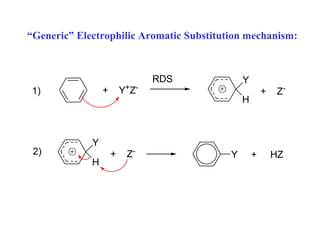
“Generic” Electrophilic Aromatic Substitution mechanism:
1) + Y+Z-
RDS
H
Y
+ Z-
2)
H
Y
+ Z-
Y + HZ
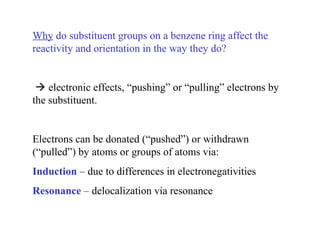
Why do substituent groups on a benzene ring affect the
reactivity and orientation in the way they do?
 electronic effects, “pushing” or “pulling” electrons by
the substituent.
Electrons can be donated (“pushed”) or withdrawn
(“pulled”) by atoms or groups of atoms via:
Induction – due to differences in electronegativities
Resonance – delocalization via resonance
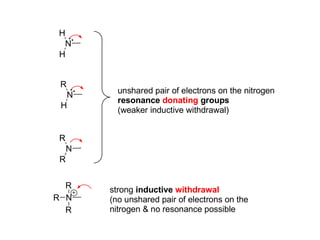
N
H
H
unshared pair of electrons on the nitrogen
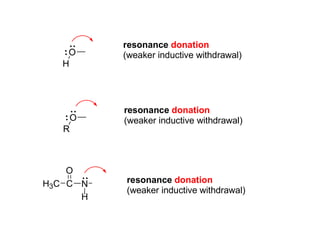
resonance donating groups
(weaker inductive withdrawal)
N
R
R
N
R
H
NR
R
R strong inductive withdrawal
(no unshared pair of electrons on the
nitrogen & no resonance possible
H3C C
O
N
H
resonance donation
(weaker inductive withdrawal)
H
O
resonance donation
(weaker inductive withdrawal)
R
O
resonance donation
(weaker inductive withdrawal)
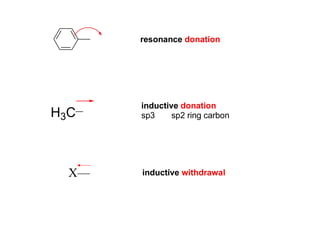
resonance donation
H3C
inductive donation
sp3 sp2 ring carbon
inductive withdrawalX—
H
C
O
HO
C
O
RO
C
O
R
C
O
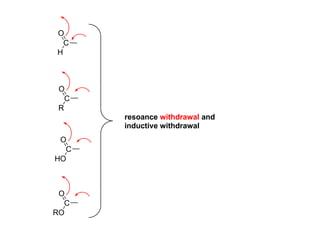
resoance withdrawal and
inductive withdrawal
N
O
O
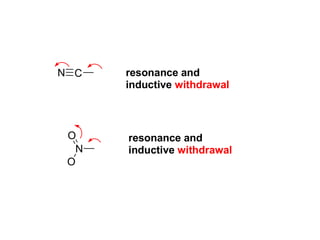
resonance and
inductive withdrawal
resonance and
inductive withdrawal
CN
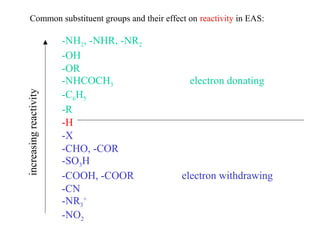
Common substituent groups and their effect on reactivity in EAS:
-NH2, -NHR, -NR2
-OH
-OR
-NHCOCH3 electron donating
-C6H5
-R
-H
-X
-CHO, -COR
-SO3H
-COOH, -COOR electron withdrawing
-CN
-NR3
+
-NO2
increasingreactivity
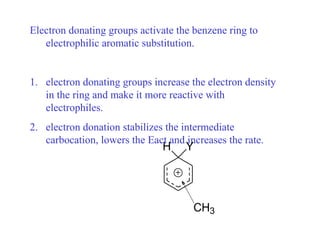
Electron donating groups activate the benzene ring to
electrophilic aromatic substitution.
1. electron donating groups increase the electron density
in the ring and make it more reactive with
electrophiles.
2. electron donation stabilizes the intermediate
carbocation, lowers the Eact and increases the rate.
H Y
CH3
H Y
NO2
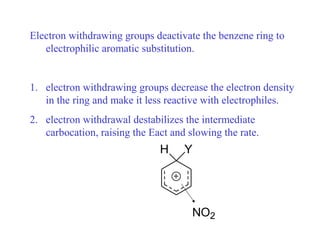
Electron withdrawing groups deactivate the benzene ring to
electrophilic aromatic substitution.
1. electron withdrawing groups decrease the electron density
in the ring and make it less reactive with electrophiles.
2. electron withdrawal destabilizes the intermediate
carbocation, raising the Eact and slowing the rate.
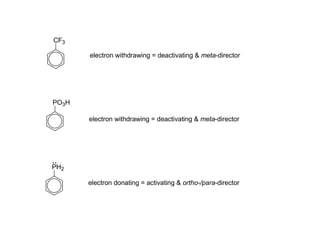
CF3
PH2
PO3H
electron withdrawing = deactivating & meta-director
electron donating = activating & ortho-/para-director
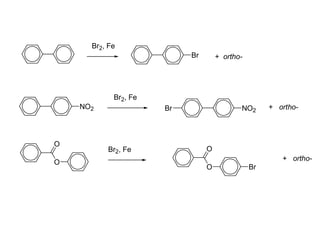
Br2, Fe
Br + ortho-
NO2
Br2, Fe
NO2Br + ortho-
O
O
Br2, Fe
O
O
Br
+ ortho-
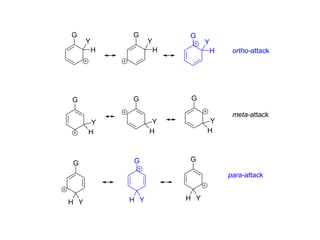
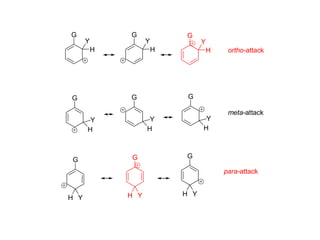
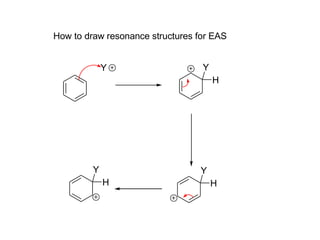
How to draw resonance structures for EAS
Y
H
Y
H
Y
H
Y
G G G
G G G
G G
H H H
Y Y Y
H
Y
H
Y
H
Y
H Y H Y
G
H Y
ortho-attack
meta-attack
para-attack
G
H
Y
G
H Y
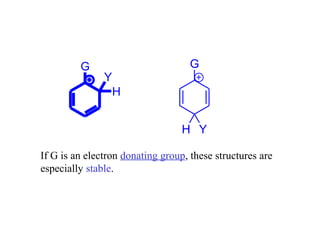
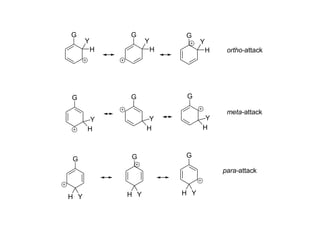
If G is an electron donating group, these structures are
especially stable.
G G G
G G G
G G
H H H
Y Y Y
H
Y
H
Y
H
Y
H Y H Y
G
H Y
ortho-attack
meta-attack
para-attack
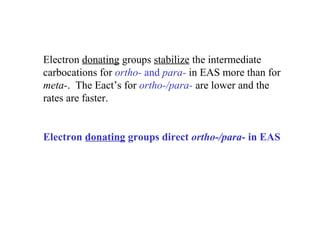
Electron donating groups stabilize the intermediate
carbocations for ortho- and para- in EAS more than for
meta-. The Eact’s for ortho-/para- are lower and the
rates are faster.
Electron donating groups direct ortho-/para- in EAS
G
H
Y
G
H Y
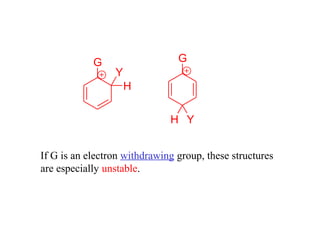
If G is an electron withdrawing group, these structures
are especially unstable.
G G G
G G G
G G
H H H
Y Y Y
H
Y
H
Y
H
Y
H Y H Y
G
H Y
ortho-attack
meta-attack
para-attack
Electron withdrawing groups destabilize the intermediate
carbocations for ortho- and para- in EAS more than for
meta-. The Eact’s for ortho-/para- are higher and the
rates are slower.
Electron withdrawing groups direct meta- in EAS
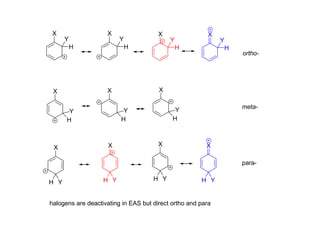
Halogens are electron withdrawing but are ortho/para
directing in EAS.
The halogen atom is unusual in that it is highly
electronegative but also has unshared pairs of electrons
that can be resonance donated to the carbocation.
X X X
X X X
X X
H H H
Y Y Y
H
Y
H
Y
H
Y
H Y H Y
X
H Y
X
H Y
X
H
Y
ortho-
meta-
para-
halogens are deactivating in EAS but direct ortho and para
Common substituent groups and their effect on EAS:
-NH2, -NHR, -NR2
-OH
-OR
-NHCOCH3
-C6H5
-R
-H
-X
-CHO, -COR
-SO3H
-COOH, -COOR
-CN
-NR3
+
-NO2
increasingreactivity
ortho/para directors
meta directors

Suphonation

  • 1.
    Electrophilic Aromatic Substitution(Aromatic compounds) Ar-H = aromatic compound 1. Nitration Ar-H + HNO3, H2SO4  Ar-NO2 + H2O 2. Sulfonation Ar-H + H2SO4, SO3  Ar-SO3H + H2O 3. Halogenation Ar-H + X2, Fe  Ar-X + HX 4. Friedel-Crafts alkylation Ar-H + R-X, AlCl3  Ar-R + HX
  • 2.
    Friedel-Crafts alkylation (variations) a)Ar-H + R-X, AlCl3  Ar-R + HX b) Ar-H + R-OH, H+  Ar-R + H2O c) Ar-H + Alkene, H+  Ar-R
  • 3.
  • 4.
  • 5.
  • 6.
    Substituent groups ona benzene ring affect electrophilic aromatic substitution reactions in two ways: 1) reactivity activate (faster than benzene) or deactivate (slower than benzene) 2) orientation ortho- + para- direction or meta- direction
  • 7.
    -CH3 activates the benzenering towards EAS directs substitution to the ortho- & para- positions -NO2 deactivates the benzene ring towards EAS directs substitution to the meta- position
  • 8.
    Common substituent groupsand their effect on EAS: -NH2, -NHR, -NR2 -OH -OR -NHCOCH3 -C6H5 -R -H -X -CHO, -COR -SO3H -COOH, -COOR -CN -NR3 + -NO2 increasingreactivity ortho/para directors meta directors
  • 9.
    OCH3 CHO Br Br2, Fe HNO3, H2SO4 H2SO4,SO3 OCH3 Br OCH3 Br + faster than benzene CHO NO2 slower than benzene + Br Br SO3H SO3H slower than benzene
  • 10.
    If there ismore than one group on the benzene ring: 1. The group that is more activating (higher on “the list”) will direct the next substitution. 2. You will get little or no substitution between groups that are meta- to each other.
  • 11.
    CH3 OH NHCOCH3 CH3 CHO OCH3 Br2, Fe HNO3, H2SO4 Cl2,Fe CH3 OH Br NHCOCH3 CH3 NO2 CHO OCH3 Cl CHO OCH3 Cl +
  • 12.
    Orientation and synthesis.Order is important! synthesis of m-bromonitrobenzene from benzene: NO2 Br NO2 HNO3 H2SO4 Br2, Fe synthesis of p-bromonitrobenzene from benzene: Br Br Br NO2 NO2 + Br2, Fe HNO3 H2SO4 You may assume that you can separate a pure para- isomer from an ortho-/para- mixture.
  • 13.
    note: the assumptionthat you can separate a pure para isomer from an ortho/para mixture does not apply to any other mixtures. Br Br Br Br Br NO2 NO2 Br NO2 Br Br NO2 Br Br Br Br NO2 + + Br2, Fe Br2, Fe Br2, Fe Br2, FeHNO3 H2SO4 HNO3 H2SO4 synthesis of 1,4-dibromo-2-nitrobenzene from benzene separate pure para isomer from ortho/para mixture cannot assume that these can be separated!
  • 14.
    CH3 CH3 CH3 COOH COOH COOH CH3 COOH NO2 NO2NO2 + ortho- CH3Br AlCl3 CH3Br CH3Br AlCl3 AlCl3 KMnO4 KMnO4 KMnO4 heat heat heat HNO3 H2SO4 HNO3 H2SO4 synthesis of benzoic acids by oxidation of –CH3
  • 15.
    Links to problemsets on the web involving EAS: http://chemistry2.csudh.edu/organic/aromatics/reactions.html Reactivity and sites on monosubstituted benzene Reaction Sties on disubstituted benzenes Synthesis of disubstituted benzenes Synthesis of trisubstituited benzenes
  • 16.
    + HO-NO2 + H2SO4 H2O-NO2 + HSO4 - + + H2O-NO2  H2O + NO2 H2SO4 + H2O  HSO4 - + H3O+ HNO3 + 2 H2SO4  H3O+ + 2 HSO4 - + NO2 + nitration
  • 17.
    nitration: 1) HONO2 +2 H2SO4 H3O+ + 2 HSO4 - + NO2 + 2) + NO2 + RDS electrophile
  • 18.
  • 19.
    Mechanism for nitration: 1)HONO2 + 2 H2SO4 H3O+ + 2 HSO4 - + NO2 + 2) + NO2 + H NO2 3) RDS NO2 + H+ H NO2
  • 20.
    Mechanism for sulfonation: 1)2 H2SO4 H3O+ + HSO4 - + SO3 2) + SO3 RDS H SO3 - 3) H SO3 - SO3 - + H+ 4) SO3 - SO3H+ H3O+ + H2O
  • 21.
    Mechanism for halogenation: 1)Cl2 + AlCl3 Cl-Cl-AlCl3 2) + Cl-Cl-AlCl3 RDS H Cl + AlCl4 - 3) H Cl + AlCl4 - Cl + HCl + AlCl3
  • 22.
    Mechanism for Friedel-Craftsalkylation: 1) R-X + FeX3 R + FeX4 - 2) + R RDS 3) H R H R + FeX4 - R + HX + FeX3
  • 23.
    1) R-OH +H+ ROH2 + 3) + R RDS 4) H R H R R 2) ROH2 + R + H2O + H+ Mechanism for Friedel-Crafts with an alcohol & acid
  • 24.
    2) + R RDS 3) H R H R R 1) CC + H+ R + H+ Mechanism for Friedel-Crafts with alkene & acid: electrophile in Friedel-Crafts alkylation = carbocation
  • 25.
    “Generic” Electrophilic AromaticSubstitution mechanism: 1) + Y+Z- RDS H Y + Z- 2) H Y + Z- Y + HZ
  • 26.
    Why do substituentgroups on a benzene ring affect the reactivity and orientation in the way they do?  electronic effects, “pushing” or “pulling” electrons by the substituent. Electrons can be donated (“pushed”) or withdrawn (“pulled”) by atoms or groups of atoms via: Induction – due to differences in electronegativities Resonance – delocalization via resonance
  • 27.
    N H H unshared pair ofelectrons on the nitrogen resonance donating groups (weaker inductive withdrawal) N R R N R H NR R R strong inductive withdrawal (no unshared pair of electrons on the nitrogen & no resonance possible
  • 28.
    H3C C O N H resonance donation (weakerinductive withdrawal) H O resonance donation (weaker inductive withdrawal) R O resonance donation (weaker inductive withdrawal)
  • 29.
    resonance donation H3C inductive donation sp3sp2 ring carbon inductive withdrawalX—
  • 30.
  • 31.
  • 32.
    Common substituent groupsand their effect on reactivity in EAS: -NH2, -NHR, -NR2 -OH -OR -NHCOCH3 electron donating -C6H5 -R -H -X -CHO, -COR -SO3H -COOH, -COOR electron withdrawing -CN -NR3 + -NO2 increasingreactivity
  • 33.
    Electron donating groupsactivate the benzene ring to electrophilic aromatic substitution. 1. electron donating groups increase the electron density in the ring and make it more reactive with electrophiles. 2. electron donation stabilizes the intermediate carbocation, lowers the Eact and increases the rate. H Y CH3
  • 34.
    H Y NO2 Electron withdrawinggroups deactivate the benzene ring to electrophilic aromatic substitution. 1. electron withdrawing groups decrease the electron density in the ring and make it less reactive with electrophiles. 2. electron withdrawal destabilizes the intermediate carbocation, raising the Eact and slowing the rate.
  • 35.
    CF3 PH2 PO3H electron withdrawing =deactivating & meta-director electron withdrawing = deactivating & meta-director electron donating = activating & ortho-/para-director
  • 36.
    Br2, Fe Br +ortho- NO2 Br2, Fe NO2Br + ortho- O O Br2, Fe O O Br + ortho-
  • 37.
    How to drawresonance structures for EAS Y H Y H Y H Y
  • 38.
    G G G GG G G G H H H Y Y Y H Y H Y H Y H Y H Y G H Y ortho-attack meta-attack para-attack
  • 39.
    G H Y G H Y If Gis an electron donating group, these structures are especially stable.
  • 40.
    G G G GG G G G H H H Y Y Y H Y H Y H Y H Y H Y G H Y ortho-attack meta-attack para-attack
  • 41.
    Electron donating groupsstabilize the intermediate carbocations for ortho- and para- in EAS more than for meta-. The Eact’s for ortho-/para- are lower and the rates are faster. Electron donating groups direct ortho-/para- in EAS
  • 42.
    G H Y G H Y If Gis an electron withdrawing group, these structures are especially unstable.
  • 43.
    G G G GG G G G H H H Y Y Y H Y H Y H Y H Y H Y G H Y ortho-attack meta-attack para-attack
  • 44.
    Electron withdrawing groupsdestabilize the intermediate carbocations for ortho- and para- in EAS more than for meta-. The Eact’s for ortho-/para- are higher and the rates are slower. Electron withdrawing groups direct meta- in EAS
  • 45.
    Halogens are electronwithdrawing but are ortho/para directing in EAS. The halogen atom is unusual in that it is highly electronegative but also has unshared pairs of electrons that can be resonance donated to the carbocation.
  • 46.
    X X X XX X X X H H H Y Y Y H Y H Y H Y H Y H Y X H Y X H Y X H Y ortho- meta- para- halogens are deactivating in EAS but direct ortho and para
  • 47.
    Common substituent groupsand their effect on EAS: -NH2, -NHR, -NR2 -OH -OR -NHCOCH3 -C6H5 -R -H -X -CHO, -COR -SO3H -COOH, -COOR -CN -NR3 + -NO2 increasingreactivity ortho/para directors meta directors