Super Novae Hallmarks
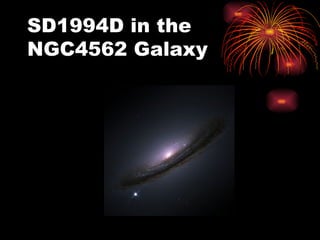
SD1994D in the NGC4562 Galaxy
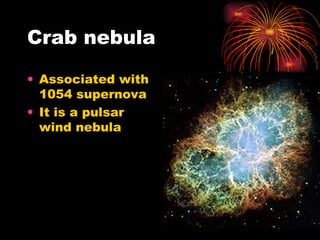
Crab nebula Associated with 1054 supernova It is a pulsar wind nebula
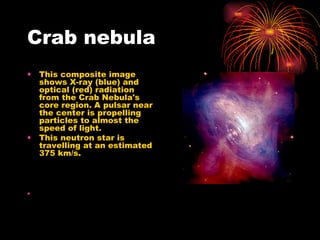
Crab nebula This composite image shows X-ray (blue) and optical (red) radiation from the Crab Nebula's core region. A pulsar near the center is propelling particles to almost the speed of light. This neutron star is travelling at an estimated 375 km/s.
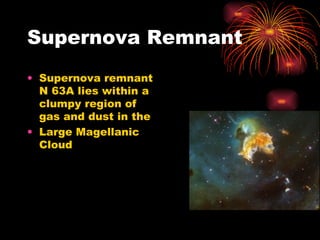
Supernova Remnant Supernova remnant N 63A lies within a clumpy region of gas and dust in the  Large Magellanic Cloud
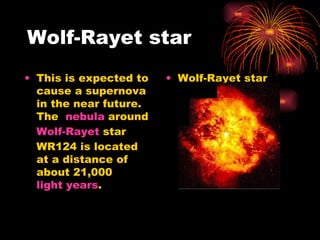
Wolf-Rayet star This is expected to cause a supernova in the near future. The  nebula  around  Wolf- Rayet  star  WR124 is located at a distance of about 21,000  light years . Wolf-Rayet star
A near-earth supernova A  near-Earth supernova  is an explosion resulting from the death of a  star  that occurs close enough to the Earth (roughly fewer than 100  light-years  away) to have noticeable effects on its  biosphere .  Gamma rays  from a supernova induce a  chemical reaction  in the upper  atmosphere , converting molecular  nitrogen  into  nitrogen oxides , depleting the  ozone layer  enough to expose the surface to harmful  solar  and  cosmic radiation . This has been proposed as the cause of the  end Ordovician extinction , which resulted in the death of nearly 60% of the oceanic life on Earth.In 1996, it was theorized that traces of past supernovae might be detectable on Earth in the form of metal isotope signatures in  rock strata . Subsequently,  iron-60  enrichment has been reported in deep-sea rock of the  Pacific Ocean .
Type Ia Supernova Type Ia supernovae are thought to be potentially the most dangerous if they occur close enough to the Earth. Because Type Ia supernovae arise from dim, common  white dwarf  stars, it is likely that a supernova that could affect the Earth will occur unpredictably and take place in a star system that is not well studied. One theory suggests that a Type Ia supernova would have to be closer than a thousand parsecs (3300 light-years) to affect the Earth. The closest known candidate is  IK  Pegasi  (see below). Recent estimates predict that a Type II supernova would have to be closer than eight  parsecs  (26 light-years) to destroy half of the Earth's ozone layer.
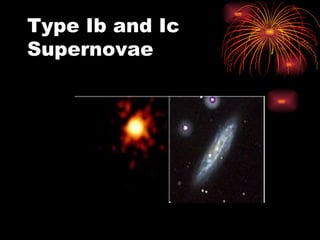
Type Ib and Ic Supernovae
A near-earth supernova A  near-Earth supernova  is an explosion resulting from the death of a  star  that occurs close enough to the Earth (roughly fewer than 100  light-years  away) to have noticeable effects on its  biosphere .  Gamma rays  from a supernova induce a  chemical reaction  in the upper  atmosphere , converting molecular  nitrogen  into  nitrogen oxides , depleting the  ozone layer  enough to expose the surface to harmful  solar  and  cosmic radiation . This has been proposed as the cause of the  end Ordovician extinction , which resulted in the death of nearly 60% of the oceanic life on Earth.In 1996, it was theorized that traces of past supernovae might be detectable on Earth in the form of metal isotope signatures in  rock strata . Subsequently,  iron-60  enrichment has been reported in deep-sea rock of the  Pacific Ocean .

Supernova- Part 1

  • 1.
  • 2.
    SD1994D in theNGC4562 Galaxy
  • 3.
    Crab nebula Associatedwith 1054 supernova It is a pulsar wind nebula
  • 4.
    Crab nebula Thiscomposite image shows X-ray (blue) and optical (red) radiation from the Crab Nebula's core region. A pulsar near the center is propelling particles to almost the speed of light. This neutron star is travelling at an estimated 375 km/s.
  • 5.
    Supernova Remnant Supernovaremnant N 63A lies within a clumpy region of gas and dust in the Large Magellanic Cloud
  • 6.
    Wolf-Rayet star Thisis expected to cause a supernova in the near future. The nebula around Wolf- Rayet star WR124 is located at a distance of about 21,000 light years . Wolf-Rayet star
  • 7.
    A near-earth supernovaA near-Earth supernova is an explosion resulting from the death of a star that occurs close enough to the Earth (roughly fewer than 100  light-years away) to have noticeable effects on its biosphere . Gamma rays from a supernova induce a chemical reaction in the upper atmosphere , converting molecular nitrogen into nitrogen oxides , depleting the ozone layer enough to expose the surface to harmful solar and cosmic radiation . This has been proposed as the cause of the end Ordovician extinction , which resulted in the death of nearly 60% of the oceanic life on Earth.In 1996, it was theorized that traces of past supernovae might be detectable on Earth in the form of metal isotope signatures in rock strata . Subsequently, iron-60 enrichment has been reported in deep-sea rock of the Pacific Ocean .
  • 8.
    Type Ia SupernovaType Ia supernovae are thought to be potentially the most dangerous if they occur close enough to the Earth. Because Type Ia supernovae arise from dim, common white dwarf stars, it is likely that a supernova that could affect the Earth will occur unpredictably and take place in a star system that is not well studied. One theory suggests that a Type Ia supernova would have to be closer than a thousand parsecs (3300 light-years) to affect the Earth. The closest known candidate is IK Pegasi (see below). Recent estimates predict that a Type II supernova would have to be closer than eight parsecs (26 light-years) to destroy half of the Earth's ozone layer.
  • 9.
    Type Ib andIc Supernovae
  • 10.
    A near-earth supernovaA near-Earth supernova is an explosion resulting from the death of a star that occurs close enough to the Earth (roughly fewer than 100  light-years away) to have noticeable effects on its biosphere . Gamma rays from a supernova induce a chemical reaction in the upper atmosphere , converting molecular nitrogen into nitrogen oxides , depleting the ozone layer enough to expose the surface to harmful solar and cosmic radiation . This has been proposed as the cause of the end Ordovician extinction , which resulted in the death of nearly 60% of the oceanic life on Earth.In 1996, it was theorized that traces of past supernovae might be detectable on Earth in the form of metal isotope signatures in rock strata . Subsequently, iron-60 enrichment has been reported in deep-sea rock of the Pacific Ocean .