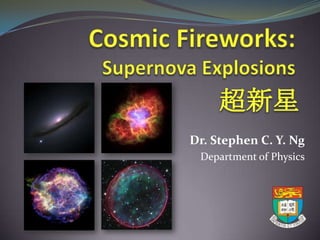
Dr. Stephen C. Y. Ng
Department of Physics
超新星
Outline
 Why study supernova?
 What is a supernova?
 Why does it explode?
 The aftermaths --- Supernova remnants
 Will it destroy the Earth?
Where do they come from?
Mines?
Supernova Explosions!
Gold, Silver & More
Heavy Elements
Building Blocks of Life
Life from Exploding Stars!
Without supernovae to
disperse elements made in
stars, no planets, no life!!
Why Study Supernova?
 They are cool
 most powerful explosions in the Universe
1017J 1044J1,000,000,000,000,000,000,000,000,000 =
Why Study Supernova?
 They are important
 produce heavy elements beyond iron, e.g. gold, silver,…
 recycle materials into space, e.g carbon, oxygen,…
 shock wave triggers new star formation
 They can get you a Nobel prize
 SN Type Ia as standard candles for cosmology
 They are bombs
 shock wave physics
 They are cool
 most powerful explosions in the Universe
What is a Supernova?
 Nova 新星 = new star
Supernova 超新星
 Naming:
 SN 2013A,…, SN2013Z, SN 2013aa,…
SN 2013ab,…, SN 2013ej,…
 Death of a star, most powerful explosion:
 1027 nuclear bombs
 brighter than a galaxy (~1011 stars)
 more energy than the entire
lifetime of a star
SN 1994D
Historical Classification
SN
no H H
Si no Si
He no He
Type Ia Type Ib Type Ic Type II
Physical Classification
Thermonuclear Core Collapse
SN
no H H
Si no Si
He no He
Type Ia Type Ib Type Ic Type II
Why do they explode?
 Stellar evolution
 Core collapse
 Thermonuclear
Life of a Sun-like Star
Protostars
White Dwarf
Planetary
Nebula
Red Giant
Sun-like Star
Star-Forming
Nebula
Life of a Massive Star
Protostars
Black Hole
SUPERNOVA
Red
Supergiant
Massive Star
Star-Forming
Nebula
Neutron Star
self
gravity
Pressure Balance
self
gravity
2,000,000,000x
in 1 second!
Pressure Balance
self
gravity
gas pressure
Pressure Balance
Stellar Alchemy
Life of a Sun-like Star
Protostars
White Dwarf
Planetary
Nebula
Red Giant
Sun-like Star
Star-Forming
Nebula
Massive Stars
Stellar Onion
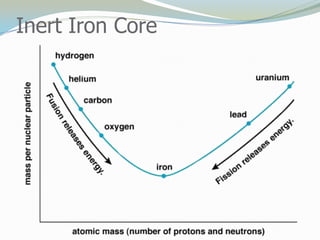
Inert Iron Core
Stellar Onion
not to scale
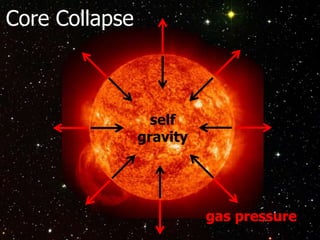
self
gravity
gas pressure
Core Collapse
nuclear force
Core Bounce
Core Bounce
energy: 1046J
99% neutrinos
1% kinetic energy
0.01% visible light
produce heavy
elements
recycle light
elements
triggers new
star formation
Compact Core
Physical Classification
Thermonuclear Core Collapse
SN
no H H
Si no Si
He no He
Type Ia Type Ib Type Ic Type II
How about SN Type Ia?
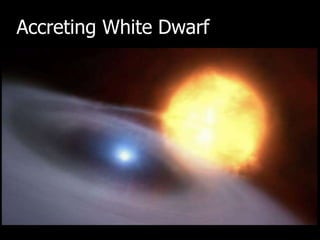
White Dwarf
Main Ingredient: White Dwarf
Mass Transfer
Accreting White Dwarf
Standard Candles
Standard Candles
When can I see a Supernova?
• Expect 1–2/century in our Galaxy, but long overdue:
 Cassiopeia A (~1680AD):
peak magnitude = 6?
too faint to see
 G1.9+0.3 (~1868AD):
not visible on Earth, too
far and obscured
SN 1054
• 1054AD July 4
• Crab Nebula (Messier 1)
Crab Nebula
• Remnant of SN1054
• Harbors the Crab Pulsar
--- most energetic neutron
star found in the Milky Way
Historical Supernovae
Tycho’s SN
•1572AD November
•as bright as Venus
•visible until 1574
SN 1006
•1006AD May 1
•brightest SN observed
•visible for ~18months
Kepler’s SN
•1604AD October 9
•visible in day time
for 3 weeks
Can I See One Now?
• Catch one in the act? Go extragalactic!
• As of today, 6000+ extragalactic SNe observed
Extragalactic SNe
SN 2004et in NGC 6946SN 1994D in NGC 4526
SN 2013ej in M74
Taken here in HKU
SN 1987A
SN 1987A
• 1987 Feb 23, in the Large Magellanic Cloud
• closest (hence brightest) SN observed in 300 yr,
since invention of modern telescope
• ~11 neutrinos detected, 3 hr prior to visible light
• complex environment Milky Way
LMC
SMC
Observations
Australia Telescope Compact Array
Chandra X-ray Observatory
Optical X-ray Radio
Evolution
Expansion
35,000 km/s
4000 km/s
Next Supernova in Our Galaxy
 A major event will be observed by every telescopes
in all wavelengths
 radio, IR, optical, X-ray, -ray,...
 Multimessenger astronomy beyond EM radiation
 neutrino telescopes
 gravitational wave detectors
~100,000 light years across
Artist’s Conception of
our Milky Way Galaxy
Will it destroy the Earth?
location of our
solar system
Nearest candidate (IK Pegasi):
over 150 light years away!
Supernova: within
30 light years
Summary
 Supernovae are important:
 produce everything on Earth
 Explosion mechanisms:
 core collapse of massive stars
 thermonuclear detonations of white dwarfs
 The next supernova?
 we are safe
SNR G292.2-0.5
Triple-ring Structure
Triple Ring Nebula
Morris & Podsiadlowski (2007)

Cosmic Fireworks: Supernova Explosions

Editor's Notes

  • #4 Ever wonder where come from?
  • #5 Ever wonder where come from?
  • #6 Personal connection remnants of a massive star billions yr ago
  • #7 Personal connection remnants of a massive star billions yr ago
  • #20 To understand why explode, energy source, stellar structureThis is our sun, giant ball of H gas hold by gravity, high Temp, what prevents it to collapse is the energy generation pressure
  • #21 To understand why explode, energy source, stellar structureThis is our sun, giant ball of H gas hold by gravity, high Temp, what prevents it to collapse is the energy generation pressure
  • #22 To understand why explode, energy source, stellar structureThis is our sun, giant ball of H gas hold by gravity, high Temp, what prevents it to collapse is the energy generation pressure
  • #23 Simplified pic, sun, < 8M_sun, stop at C
  • #25 Heavy, hot enough temperature, keep going on, until…
  • #26 At the end you’ll get a big onion
  • #27 Largest binding energy, can’t extract energy
  • #30 direct collapse into BH
  • #31 1. Heavy elements produced in neutron rich high temp environment during bounce
  • #32 Iron core, very dense, turn into neutronsIn some cases, further collapse into BH
  • #35 White dwarf,Enough mass ~1.4M_sun, hot enough to ignite thermonuclear reaction suddenly
  • #37 2 theories, accretion / merging of 2 WDignites thermonuclear reaction
  • #40 Always blow up at similar condition once critical mass achieved, so intrinsic brightness similar
  • #41 Always blow up at similar condition once critical mass achieved, so intrinsic brightness similar
  • #44 950yr after explosion, faint, eventually disappear in ISM, 10kyr, 274 known remnants in milky way
  • #45 All visibe by naked eye
  • #46 Really takes off past decade, thx to the survey
  • #47 Too far to study the remnants, expansion, detailed morphology
  • #48 Too far to study the remnants, expansion, detailed morphology
  • #49 progenitor
  • #50 The most famous one is SN1987A, just outside our milky way, but just in our backyard 168k ly
  • #51 My work
  • #53 Hint of deceleration, not surprising, reverse shock takes time
  • #54 Nobody knows when’ll the next SN occur, but for sure, it’ll be a major event, holy grail