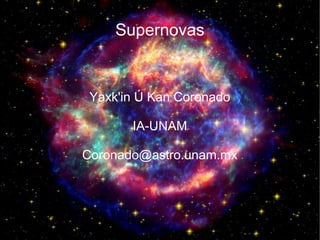
Supernovas

Yaxk'in Ú Kan Coronado
IA-UNAM
Coronado@astro.unam.mx
SUPERNOVA
What is a supernova?
How dangerous are they to life on Earth?
How would the universe be different without
supernovae?
Life of a Butterfly

Caterpillar
Eggs

Pupa

Butterfly

4
Life of a Butterfly

5
Life of a Sun-like Star
Sun-like Star
Protostars

Red Giant

Planetary
Nebula

Star-Forming
Nebula

White Dwarf

6
Life of a Massive Star
Protostars

Massive Star
Red
Supergiant

Star-Forming
Nebula

SUPERNOVA

Neutron Star
Black Hole

7
Death of low-mass star
White Dwarf

White dwarfs are the remaining
cores once fusion stops
Electron degeneracy pressure
supports them against gravity
Cool and grow dimmer over time

Pressure is independent of
Temperature.
A white dwarf can accrete mass
from its companion
Death of median-mass star
Neutron star
●

●

●

Compact and dense
objects compose of
neutrons (10¹⁷ g/cm³)
Over 1.44 M sun
(Chandrasekhar
limit), less to 3 M sun.
Neutron stars and pulsars
●

In 1967 Jocelyn Bell
discovered very
rapid pulses of
radio emmision
coming from a
single point on the
sky.
–

The pulses were
coming from a
spinning
neutron star -a
pulsar.
Pulsar at
center of the
Crab nebula
pulses 30
times per
second
Pulsars
Thought Question

Could there be neutron stars that appear as pulsars to
other civilizations but not to us?
A. Yes
B. No
Thought Question
What happens if the neutron star has more
mass than can be supported by neutron
degeneracy pressure?
1.It will collapse further and become a black
hole
2.It will spin even faster, and fling material out
into space
3.Neutron degeneracy pressure can never be
overcome by gravity
Neutron degeneracy pressure can no longer support a
neutron star against gravity if its mass is > about 3 Msun
Tycho’s supernova of 1572
●

Supernovae
outshine the
whole galaxy!
Two kinds of supernovae
Type I: White dwarf supernova
White dwarf near 1.4 Msun accretes matter from red giant
companion, causing supernova explosion
Type II: Massive star supernova
Massive star builds up 1.4 Msun core and collapses into a
neutron star, gravitational PE released in explosion
light curve shows how luminosity changes with time
r process and s process elements
Nuclear fusion in all stars only produces up to Fe-56
Slow neutron capture (s process) forms up to Bi-209
in low-mass stars
High temps in SN creates elements up to Ca-254
Rapid neutron capture (r process) create neutron-rich
isotopes which decay into more stable neutron-rich
elements
Neutron flux during SN is 1022 neutrons per square
centimeter per second
neutron captures occur much faster than decays
Supernovae and nucleosynthesis of
elements > Fe

Movie
Tarea
●

●
●

●

Explica en cinco renglones ¿Por qué existen
dos tipos de supernovas de acuerdo a las
observaciones? ¿Tienen el mismo o diferente
origen.
Explica como se forma una SN-I A.
Investiga ¿Quienes ganaron el premio nobel en
2011? y ¿Cuál es su aporte en relación a las
SN-I A? ¿Por que usaron estas SN y no otras?
Explica como se generan los elementos más
allá del Fe en una SN.
Tarea Extra:
●
●

Asistir la congreso nacional de astronomía, en
el MUTEC del 29 de Oct. al 1° Nov.
–

Presentar una crónica del evento relatando tres
platicas de 20 min o una plenaria

–

Agregar aparte una opinión de lo que
aprendiste de este evento.

–

Describir en que consistía el poster que más te
gusto.
Gamma Ray Burst (GRB)
Is radiation from supernovae
and GRB sources
dangerous to Earth?

How close would they have to be?
Radiation on Earth
Radioactive sources emit
gamma-rays.
If we are too close to a
radioactive source, like a
chunk of uranium, we
cannot see the radiation, but
it is still harmful to us!
So how far should Earth be
from cosmic radiation
sources to be safe?

34
Death from Exploding Stars?!

.

Artist’s
Conception
of the Milky
Way Galaxy

Location of Solar
System

35
How close would a Supernova
have to be?

.

Location of Solar
System

36
How close would a Supernova
have to be?

.

Location of Solar
System

37
How close would a Supernova
have to be to be dangerous?

.

Supernova:
within 30 light
years

Location of Solar
System

Nearest Supernova
Candidate: over 250 light
years away!

38
How close would a
Gamma-Ray Burst (GRB)
source have to be?
.

Location of Solar
System

39
How close would a
Gamma-Ray Burst (GRB)
source have to be?
.

GRB Danger Zone: within
8,000 light years

Location of Solar
System

40
How close is the nearest
Gamma-Ray Burst (GRB) source ?
Nearest detected GRB source: over
a Billion light years away!
.

Our galaxy is about 100,000 light years across

GRB
Danger
Zone

Location of Solar
System

41
Today we know the
universe is filled with
powerful cosmic
radiation our eyes
cannot see:
• Gamma-rays
• X-Rays
• Fast-moving atomic
particles (“Cosmic Rays”)

Much of which originates from monstrous black holes in
the centers of galaxies and from . . .
42

Supernovas

  • 1.
    Supernovas Yaxk'in Ú KanCoronado IA-UNAM Coronado@astro.unam.mx
  • 2.
    SUPERNOVA What is asupernova? How dangerous are they to life on Earth? How would the universe be different without supernovae?
  • 3.
    Life of aButterfly Caterpillar Eggs Pupa Butterfly 4
  • 4.
    Life of aButterfly 5
  • 5.
    Life of aSun-like Star Sun-like Star Protostars Red Giant Planetary Nebula Star-Forming Nebula White Dwarf 6
  • 6.
    Life of aMassive Star Protostars Massive Star Red Supergiant Star-Forming Nebula SUPERNOVA Neutron Star Black Hole 7
  • 7.
    Death of low-massstar White Dwarf White dwarfs are the remaining cores once fusion stops Electron degeneracy pressure supports them against gravity Cool and grow dimmer over time Pressure is independent of Temperature.
  • 8.
    A white dwarfcan accrete mass from its companion
  • 9.
    Death of median-massstar Neutron star ● ● ● Compact and dense objects compose of neutrons (10¹⁷ g/cm³) Over 1.44 M sun (Chandrasekhar limit), less to 3 M sun.
  • 11.
    Neutron stars andpulsars ● In 1967 Jocelyn Bell discovered very rapid pulses of radio emmision coming from a single point on the sky. – The pulses were coming from a spinning neutron star -a pulsar.
  • 12.
    Pulsar at center ofthe Crab nebula pulses 30 times per second
  • 13.
  • 14.
    Thought Question Could therebe neutron stars that appear as pulsars to other civilizations but not to us? A. Yes B. No
  • 15.
    Thought Question What happensif the neutron star has more mass than can be supported by neutron degeneracy pressure? 1.It will collapse further and become a black hole 2.It will spin even faster, and fling material out into space 3.Neutron degeneracy pressure can never be overcome by gravity
  • 16.
    Neutron degeneracy pressurecan no longer support a neutron star against gravity if its mass is > about 3 Msun
  • 17.
  • 20.
  • 21.
    Two kinds ofsupernovae Type I: White dwarf supernova White dwarf near 1.4 Msun accretes matter from red giant companion, causing supernova explosion Type II: Massive star supernova Massive star builds up 1.4 Msun core and collapses into a neutron star, gravitational PE released in explosion
  • 22.
    light curve showshow luminosity changes with time
  • 25.
    r process ands process elements Nuclear fusion in all stars only produces up to Fe-56 Slow neutron capture (s process) forms up to Bi-209 in low-mass stars High temps in SN creates elements up to Ca-254 Rapid neutron capture (r process) create neutron-rich isotopes which decay into more stable neutron-rich elements Neutron flux during SN is 1022 neutrons per square centimeter per second neutron captures occur much faster than decays
  • 28.
    Supernovae and nucleosynthesisof elements > Fe Movie
  • 29.
    Tarea ● ● ● ● Explica en cincorenglones ¿Por qué existen dos tipos de supernovas de acuerdo a las observaciones? ¿Tienen el mismo o diferente origen. Explica como se forma una SN-I A. Investiga ¿Quienes ganaron el premio nobel en 2011? y ¿Cuál es su aporte en relación a las SN-I A? ¿Por que usaron estas SN y no otras? Explica como se generan los elementos más allá del Fe en una SN.
  • 30.
    Tarea Extra: ● ● Asistir lacongreso nacional de astronomía, en el MUTEC del 29 de Oct. al 1° Nov. – Presentar una crónica del evento relatando tres platicas de 20 min o una plenaria – Agregar aparte una opinión de lo que aprendiste de este evento. – Describir en que consistía el poster que más te gusto.
  • 31.
  • 32.
    Is radiation fromsupernovae and GRB sources dangerous to Earth? How close would they have to be?
  • 33.
    Radiation on Earth Radioactivesources emit gamma-rays. If we are too close to a radioactive source, like a chunk of uranium, we cannot see the radiation, but it is still harmful to us! So how far should Earth be from cosmic radiation sources to be safe? 34
  • 34.
    Death from ExplodingStars?! . Artist’s Conception of the Milky Way Galaxy Location of Solar System 35
  • 35.
    How close woulda Supernova have to be? . Location of Solar System 36
  • 36.
    How close woulda Supernova have to be? . Location of Solar System 37
  • 37.
    How close woulda Supernova have to be to be dangerous? . Supernova: within 30 light years Location of Solar System Nearest Supernova Candidate: over 250 light years away! 38
  • 38.
    How close woulda Gamma-Ray Burst (GRB) source have to be? . Location of Solar System 39
  • 39.
    How close woulda Gamma-Ray Burst (GRB) source have to be? . GRB Danger Zone: within 8,000 light years Location of Solar System 40
  • 40.
    How close isthe nearest Gamma-Ray Burst (GRB) source ? Nearest detected GRB source: over a Billion light years away! . Our galaxy is about 100,000 light years across GRB Danger Zone Location of Solar System 41
  • 41.
    Today we knowthe universe is filled with powerful cosmic radiation our eyes cannot see: • Gamma-rays • X-Rays • Fast-moving atomic particles (“Cosmic Rays”) Much of which originates from monstrous black holes in the centers of galaxies and from . . . 42

Editor's Notes

  • #39 Nearest SN candidate: Spica
  • #43 Image: http://maxim.gsfc.nasa.gov/science.html