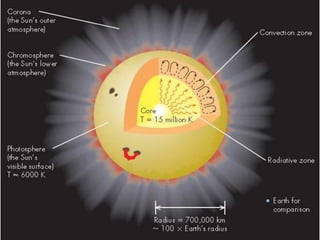
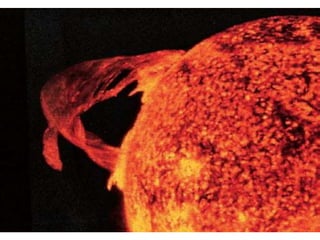
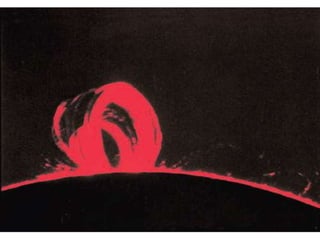
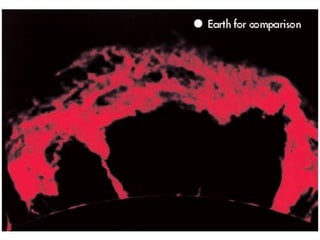
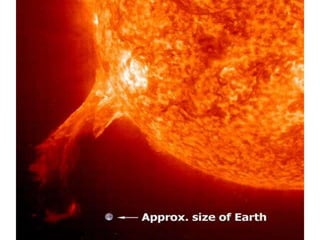
Prominences are huge plumes
of glowing gas that jut from the
lower chromosphere into the
corona
It is an arc of gas that erupts
from the surface of the Sun.
PROMINENCE
Prominences can extend 30,000
miles (50,000 kilometers) or more
above the sun's surface. Upon
reaching this height, they can erupt
for a few minutes to hours and send
large amounts of material racing
through the corona and outward into
space.
Under favorable conditions,
the gas in a prominence may
remain trapped in its magnetic
prison and glow for weeks.
Sunspots also give birth to
solar flares, which are brief but
bright eruptions of hot gas in
the chromosphere.
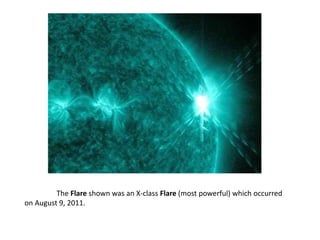
The Flare shown was an X-class Flare (most powerful) which occurred
on August 9, 2011.
Solar flares
were first observed in
1859 by Lord Richard
C. Carrington.
The biggest solar storm
ever recorded was
the Carrington Flare of
1859. It was the first Solar
Flare ever recorded.
One hypothesis suggests that
flares arise when the field near a
sunspot gets twisted by gas
motions.
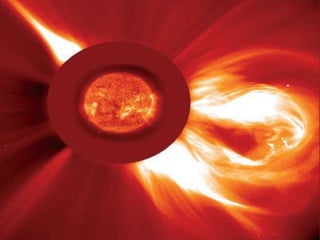
Closely related to flares, but on a
much larger scale, are coronal mass
ejections.
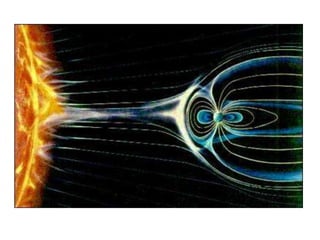
Coronal mass ejections (CMEs) are
bursts of solar material (clouds of plasma
and magnetic fields) that shoot off the
sun's surface.
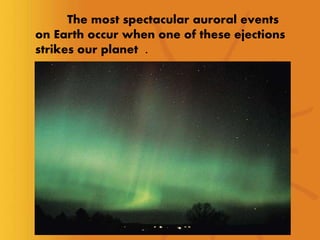
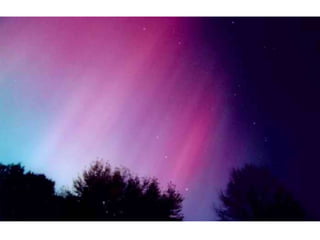
The most spectacular auroral events
on Earth occur when one of these ejections
strikes our planet .
Strong flares and coronal
mass ejections can also disrupt
communications, disable satellites,
and even induce electric currents that
force power grids to shut down.
Prominences and flares

Prominences and flares

  • 2.
    Prominences are hugeplumes of glowing gas that jut from the lower chromosphere into the corona It is an arc of gas that erupts from the surface of the Sun. PROMINENCE
  • 7.
    Prominences can extend30,000 miles (50,000 kilometers) or more above the sun's surface. Upon reaching this height, they can erupt for a few minutes to hours and send large amounts of material racing through the corona and outward into space.
  • 8.
    Under favorable conditions, thegas in a prominence may remain trapped in its magnetic prison and glow for weeks.
  • 9.
    Sunspots also givebirth to solar flares, which are brief but bright eruptions of hot gas in the chromosphere.
  • 11.
    The Flare shownwas an X-class Flare (most powerful) which occurred on August 9, 2011.
  • 12.
    Solar flares were firstobserved in 1859 by Lord Richard C. Carrington.
  • 13.
    The biggest solarstorm ever recorded was the Carrington Flare of 1859. It was the first Solar Flare ever recorded.
  • 14.
    One hypothesis suggeststhat flares arise when the field near a sunspot gets twisted by gas motions.
  • 15.
    Closely related toflares, but on a much larger scale, are coronal mass ejections. Coronal mass ejections (CMEs) are bursts of solar material (clouds of plasma and magnetic fields) that shoot off the sun's surface.
  • 18.
    The most spectacularauroral events on Earth occur when one of these ejections strikes our planet .
  • 21.
    Strong flares andcoronal mass ejections can also disrupt communications, disable satellites, and even induce electric currents that force power grids to shut down.