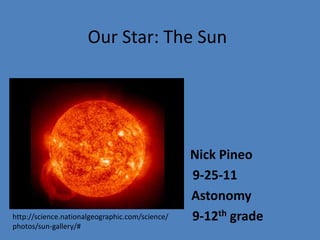
Our Star: The SunNick Pineo	      9-25-11Astonomy		    9-12th gradehttp://science.nationalgeographic.com/science/photos/sun-gallery/#
CharacteristicsMilky Way/Center of Solar SystemHydrogen and HeliumLife – Middle Aged – 5/10 years
Layers InteriorPhotosphereChromosphereCorona
PhotosphereRadiates most of the sunlight we see – “surface”Granules – small, bright markings– about the size of texas.
ChromosphereAbove photosphereThin layer of hot gasesViewed as a red rim around sunSpicules – located on top of the chromosphere – flaming structures. (described as trees sticking out)
CoronaOuter part of sun (atmosphere)Looks like a crown of bright light glowingSolar wind – particles(ionized gases) escaping the corona at high speeds. Ionized referes to the gaining or losing of electrons.
Solar ActivitiesSunspotsProminencesSolar Flares
SunspotsDark spotsSmall (1000 miles) to many times the size of Earth
ProminencesCloudlike structuresLarge amount of gasesLooks like a huge flame coming out of the Sun
Solar FlaresBrief outbursts of energyBrightening of an area of the Sun above the sunspots.
Structure of Sunhttp://whyfiles.org/115sun/3.html
InteriorSource of energy – nuclear fusion – process to fuse particles together to form heavier particles. Hydrogen – Helium Proton-Proton Chain is created through nuclear fusion. Chain reaction converts 4 hydrogen protons into the nucleus of a helium atom. Some mass is converted to energy.
P-P Chain Cont.When hydrogen is converted to helium, this process – Hydrogen burning.The energy that is released from the P-P chain is transmitted through layers of the sun.
What Does the Sun do for Earth?Energy – light – Food – lifeEvents – Good/BadAurorasSolar EclipsesDisruption of Radio/Satellite communications
AurorasEffects from strong solar flares – lights up Earth’s atmosphereNorthern/Southern lights – North/South PoleVaries in shapes, sizes, and colorsAurora  AustralisAurora Borealishttp://www.itsnature.org/travel/wp-content/uploads/2010/10/p6133sv.jpghttp://geology.com/nasa/aurora-borealis.shtml
Solar EclipseEclipse of the sunAlignment between Earth-Moon-SunNew Moon Phase – casts dark shadow on Earthhttp://en.wikipedia.org/wiki/Solar_eclipse
Disruption of Radio/Satellite Communications Solar flares – large outburst of particles can reach Earth – affecting radio and satellite communications. Very rare events
SummarySun has 4 major layersSolar activities may include: prominences, sunspots, and solar flaresNuclear fusion and P-P chainEvents – auroras, solar eclipses, and disruption in radio or satellite communications due to solar flares
Referenceshttp://www.michigan.gov/documents/Earth_HSCE_168206_7.pdfTwelfth Edition Earth Science, Edward J. Tarbuck and Frederick K. Lutgens

The Sun powerpoint