Type Ia Supernovae
A chronological attempt at
determining their progenitor
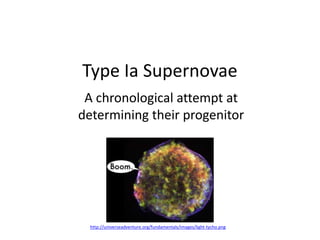
http://universeadventure.org/fundamentals/images/light-tycho.png
Layout
• Introduction:
– What are type Ia supernovae (SNe Ia)?
– Why are they important?
– What is needed?
• Necessary Components:
– Chandrasekhar’s mass limit
– Classical novae
– Recurrent novae
– Super soft X-ray sources
– Single and double degenerate scenarios
– Binary systems
• Trip Through Time (1980’s to current day):
– Lets find out what we know
• Summary:
Introduction
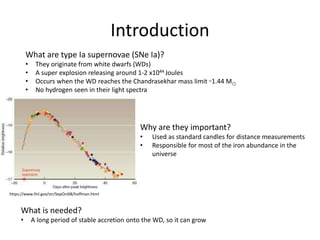
What are type Ia supernovae (SNe Ia)?
• They originate from white dwarfs (WDs)
• A super explosion releasing around 1-2 x1044 Joules
• Occurs when the WD reaches the Chandrasekhar mass limit ~1.44 M⊙
• No hydrogen seen in their light spectra
Why are they important?
• Used as standard candles for distance measurements
• Responsible for most of the iron abundance in the
universe
What is needed?
• A long period of stable accretion onto the WD, so it can grow
https://www.llnl.gov/str/SepOct08/hoffman.html
Necessary Components (1)
Chandrasekhar’s mass limit ~1.44 M⊙:
• Is the maximum mass a white dwarf can have before collapsing
• SNe Ia explodes due to a runaway carbon reaction in the core
Classical and recurrent novae:
• These are caused by thermonuclear runaway reactions on the surface after excessive
hydrogen compression
• Classical novae have been ruled out, due to more mass been removed than accreted
• Recurrent novae lose less mass than it had accreted
Super soft X-ray sources:
• These are very hot (>50 T ⊙) and luminous (>5000 L ⊙) WDs
• Hydrogen burns into helium on the surface immediately leading to no novae
explosions.
http://arxiv.org/pdf/0911.5254v3.pdf
Novae evolution
Necessary Components (2)
Single degenerate scenario (SDS):
• The WD accretes matter from a sub-giant,
main sequence, red giant star or AGB star
Double degenerate scenario (DDS):
• The WD accretes matter from another
WD before colliding
Cataclysmic Variable (CV) [Any star]:
1. Roche lobe is filled, accretion occurs through
the Lagrangian point
Symbiotic Variable (SB) [RG or AGB only]:
1. Roche lobe isn’t filled, accretion occurs only via
strong winds
http://www.daviddarling.info/images/contact_binary.jpg
http://astronomy.swin.edu.au/cms/cpg15x/albums/userpics/typeiaprogenitor1.jpg
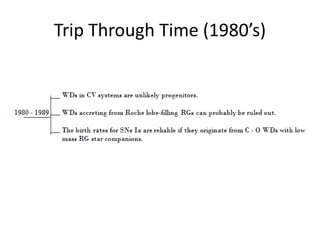
Trip Through Time (1980’s)
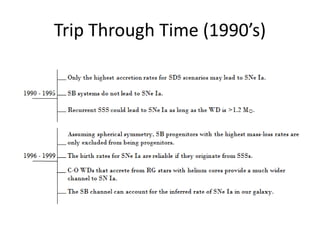
Trip Through Time (1990’s)
Trip Through Time (2000-2009)
Trip Through Time
(2010 to current day)
Summary
In a sentence:
We still have no idea what the progenitor is!
• SSS WDs were favoured up until the beginning of
the century but have now been ruled out
• Recurrent novae are strong contenders, though confusion over
observations of T-Pyx might be an issue
• The double degenerate scenario started off weak pre 2005 but since
then they have become strong contenders due to the effects of
rotation
• Final word:
If we say the progenitor is a combination of both the SDS and
DDS, it would lead to SNe Ia being poor “Standard Candles”!

Type ia supernovae

  • 1.
    Type Ia Supernovae Achronological attempt at determining their progenitor http://universeadventure.org/fundamentals/images/light-tycho.png
  • 2.
    Layout • Introduction: – Whatare type Ia supernovae (SNe Ia)? – Why are they important? – What is needed? • Necessary Components: – Chandrasekhar’s mass limit – Classical novae – Recurrent novae – Super soft X-ray sources – Single and double degenerate scenarios – Binary systems • Trip Through Time (1980’s to current day): – Lets find out what we know • Summary:
  • 3.
    Introduction What are typeIa supernovae (SNe Ia)? • They originate from white dwarfs (WDs) • A super explosion releasing around 1-2 x1044 Joules • Occurs when the WD reaches the Chandrasekhar mass limit ~1.44 M⊙ • No hydrogen seen in their light spectra Why are they important? • Used as standard candles for distance measurements • Responsible for most of the iron abundance in the universe What is needed? • A long period of stable accretion onto the WD, so it can grow https://www.llnl.gov/str/SepOct08/hoffman.html
  • 4.
    Necessary Components (1) Chandrasekhar’smass limit ~1.44 M⊙: • Is the maximum mass a white dwarf can have before collapsing • SNe Ia explodes due to a runaway carbon reaction in the core Classical and recurrent novae: • These are caused by thermonuclear runaway reactions on the surface after excessive hydrogen compression • Classical novae have been ruled out, due to more mass been removed than accreted • Recurrent novae lose less mass than it had accreted Super soft X-ray sources: • These are very hot (>50 T ⊙) and luminous (>5000 L ⊙) WDs • Hydrogen burns into helium on the surface immediately leading to no novae explosions. http://arxiv.org/pdf/0911.5254v3.pdf Novae evolution
  • 5.
    Necessary Components (2) Singledegenerate scenario (SDS): • The WD accretes matter from a sub-giant, main sequence, red giant star or AGB star Double degenerate scenario (DDS): • The WD accretes matter from another WD before colliding Cataclysmic Variable (CV) [Any star]: 1. Roche lobe is filled, accretion occurs through the Lagrangian point Symbiotic Variable (SB) [RG or AGB only]: 1. Roche lobe isn’t filled, accretion occurs only via strong winds http://www.daviddarling.info/images/contact_binary.jpg http://astronomy.swin.edu.au/cms/cpg15x/albums/userpics/typeiaprogenitor1.jpg
  • 6.
  • 7.
  • 8.
    Trip Through Time(2000-2009)
  • 9.
    Trip Through Time (2010to current day)
  • 10.
    Summary In a sentence: Westill have no idea what the progenitor is! • SSS WDs were favoured up until the beginning of the century but have now been ruled out • Recurrent novae are strong contenders, though confusion over observations of T-Pyx might be an issue • The double degenerate scenario started off weak pre 2005 but since then they have become strong contenders due to the effects of rotation • Final word: If we say the progenitor is a combination of both the SDS and DDS, it would lead to SNe Ia being poor “Standard Candles”!