EXPLANATION TEXT
WHY DO AURORAS
HAPPEN
Created by:
Roaliyah XII Science 5
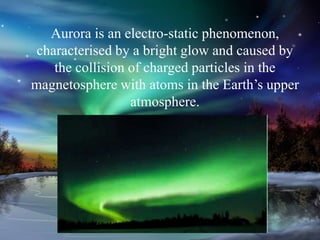
Aurora is an electro-static phenomenon,
characterised by a bright glow and caused by
the collision of charged particles in the
magnetosphere with atoms in the Earth’s upper
atmosphere.
Ultimately, the source lies in the solar wind, a
fast-moving stream of particles constantly
flowing from the Sun that carries the Sun’s
magnetic field out into space. The solar wind,
typically moving at 250 miles (400 kilometers)
per second, flows past Earth’s magnetic field
and molds it into an elongated bubble or
cavity, compressing its sunward side and
stretching its night side far beyond the Moon’s
orbit.
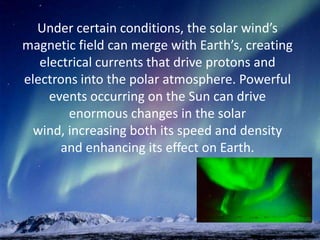
Under certain conditions, the solar wind’s
magnetic field can merge with Earth’s, creating
electrical currents that drive protons and
electrons into the polar atmosphere. Powerful
events occurring on the Sun can drive
enormous changes in the solar
wind, increasing both its speed and density
and enhancing its effect on Earth.
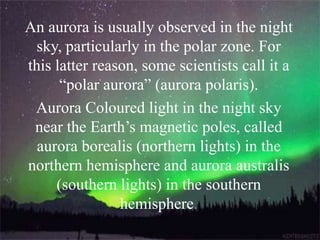
An aurora is usually observed in the night
sky, particularly in the polar zone. For
this latter reason, some scientists call it a
“polar aurora” (aurora polaris).
Aurora Coloured light in the night sky
near the Earth’s magnetic poles, called
aurora borealis (northern lights) in the
northern hemisphere and aurora australis
(southern lights) in the southern
hemisphere.
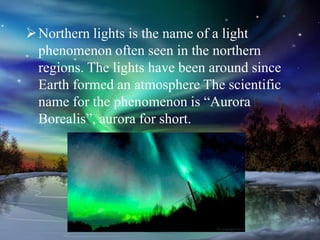
Northern lights is the name of a light
phenomenon often seen in the northern
regions. The lights have been around since
Earth formed an atmosphere The scientific
name for the phenomenon is “Aurora
Borealis”, aurora for short.
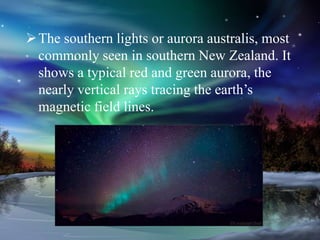
The southern lights or aurora australis, most
commonly seen in southern New Zealand. It
shows a typical red and green aurora, the
nearly vertical rays tracing the earth’s
magnetic field lines.

Explanation Text About Aurora

  • 1.
    EXPLANATION TEXT WHY DOAURORAS HAPPEN Created by: Roaliyah XII Science 5
  • 2.
    Aurora is anelectro-static phenomenon, characterised by a bright glow and caused by the collision of charged particles in the magnetosphere with atoms in the Earth’s upper atmosphere.
  • 3.
    Ultimately, the sourcelies in the solar wind, a fast-moving stream of particles constantly flowing from the Sun that carries the Sun’s magnetic field out into space. The solar wind, typically moving at 250 miles (400 kilometers) per second, flows past Earth’s magnetic field and molds it into an elongated bubble or cavity, compressing its sunward side and stretching its night side far beyond the Moon’s orbit.
  • 4.
    Under certain conditions,the solar wind’s magnetic field can merge with Earth’s, creating electrical currents that drive protons and electrons into the polar atmosphere. Powerful events occurring on the Sun can drive enormous changes in the solar wind, increasing both its speed and density and enhancing its effect on Earth.
  • 5.
    An aurora isusually observed in the night sky, particularly in the polar zone. For this latter reason, some scientists call it a “polar aurora” (aurora polaris). Aurora Coloured light in the night sky near the Earth’s magnetic poles, called aurora borealis (northern lights) in the northern hemisphere and aurora australis (southern lights) in the southern hemisphere.
  • 6.
    Northern lights isthe name of a light phenomenon often seen in the northern regions. The lights have been around since Earth formed an atmosphere The scientific name for the phenomenon is “Aurora Borealis”, aurora for short.
  • 7.
    The southern lightsor aurora australis, most commonly seen in southern New Zealand. It shows a typical red and green aurora, the nearly vertical rays tracing the earth’s magnetic field lines.