© Birla Corporation Limited
Presentation on:-
Earthing & Grounding are the basics to
Safety
PresentedBy-
Vineet Shekhar
2
© Birla Corporation Limited
 What is Earthing in Electrical System.
 Types of Earthing.
 Importance of Earthing
 What is Grounding in Electrical System.
 Objective of Grounding System
 Types of Grounding
 Importance of Grounding
 Key Differences
Content
3
© Birla Corporation Limited
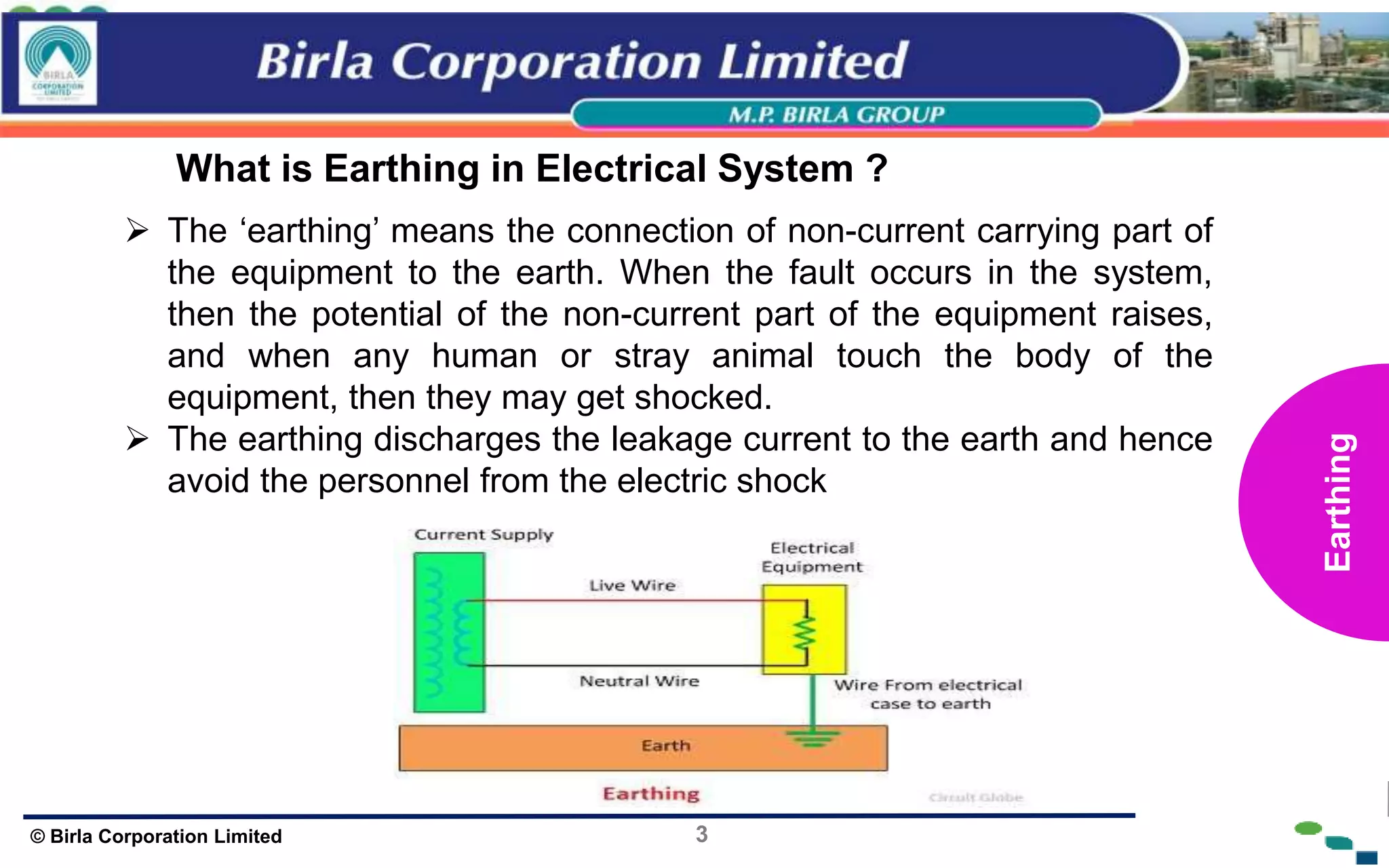
What is Earthing in Electrical System ?
 The ‘earthing’ means the connection of non-current carrying part of
the equipment to the earth. When the fault occurs in the system,
then the potential of the non-current part of the equipment raises,
and when any human or stray animal touch the body of the
equipment, then they may get shocked.
 The earthing discharges the leakage current to the earth and hence
avoid the personnel from the electric shock
Earthing
4
© Birla Corporation Limited
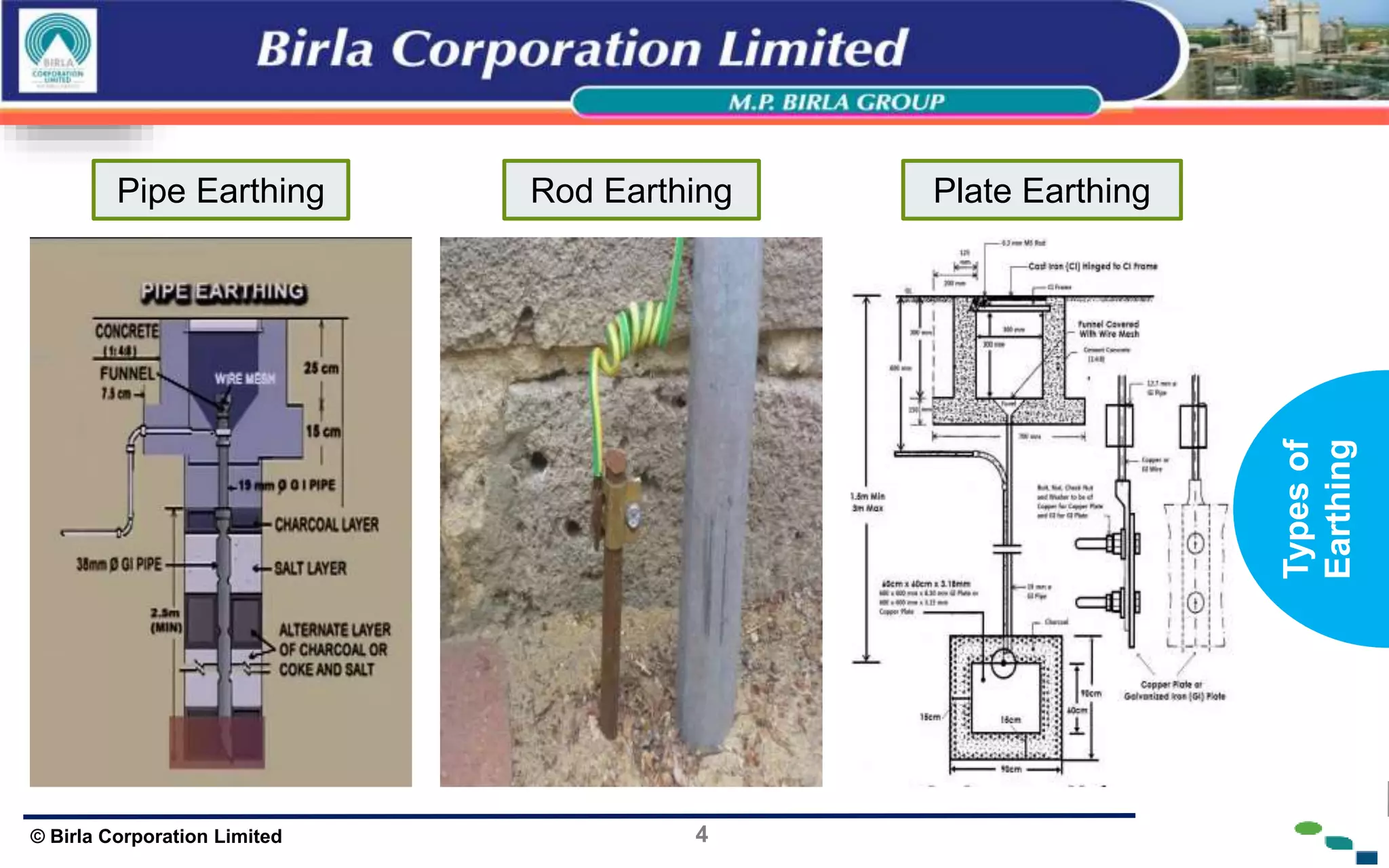
Pipe Earthing Rod Earthing Plate Earthing
Types
of
Earthing
5
© Birla Corporation Limited
Minimizes risk of Electric shock:-,Earthing provides a low resistive
coductive path directly to the earth, which carry any fault or leakage current .
Dissipation of static charge: As the system is perfectly eartheds ,so its
potential is approximately equals to Zero, so it cancelled up the static
charged build up in the conductor.
Protection from power surges:- It protect the system from any voltage
Surge and also from lighting strikes, whenever any lighting strike over
Exposed metal it discharged directly to earth.
For proper functioning of equipment’s: Proper earthing is very important
for the functioning of the devices connected to the system. Mainly protective
devices like ELCB, earth fault relays, etc. needs proper earthing for its
functioning. Because in order to operate all these devices use the reference of
leakage current through the earth line.
Importance
of
Earthing
6
© Birla Corporation Limited
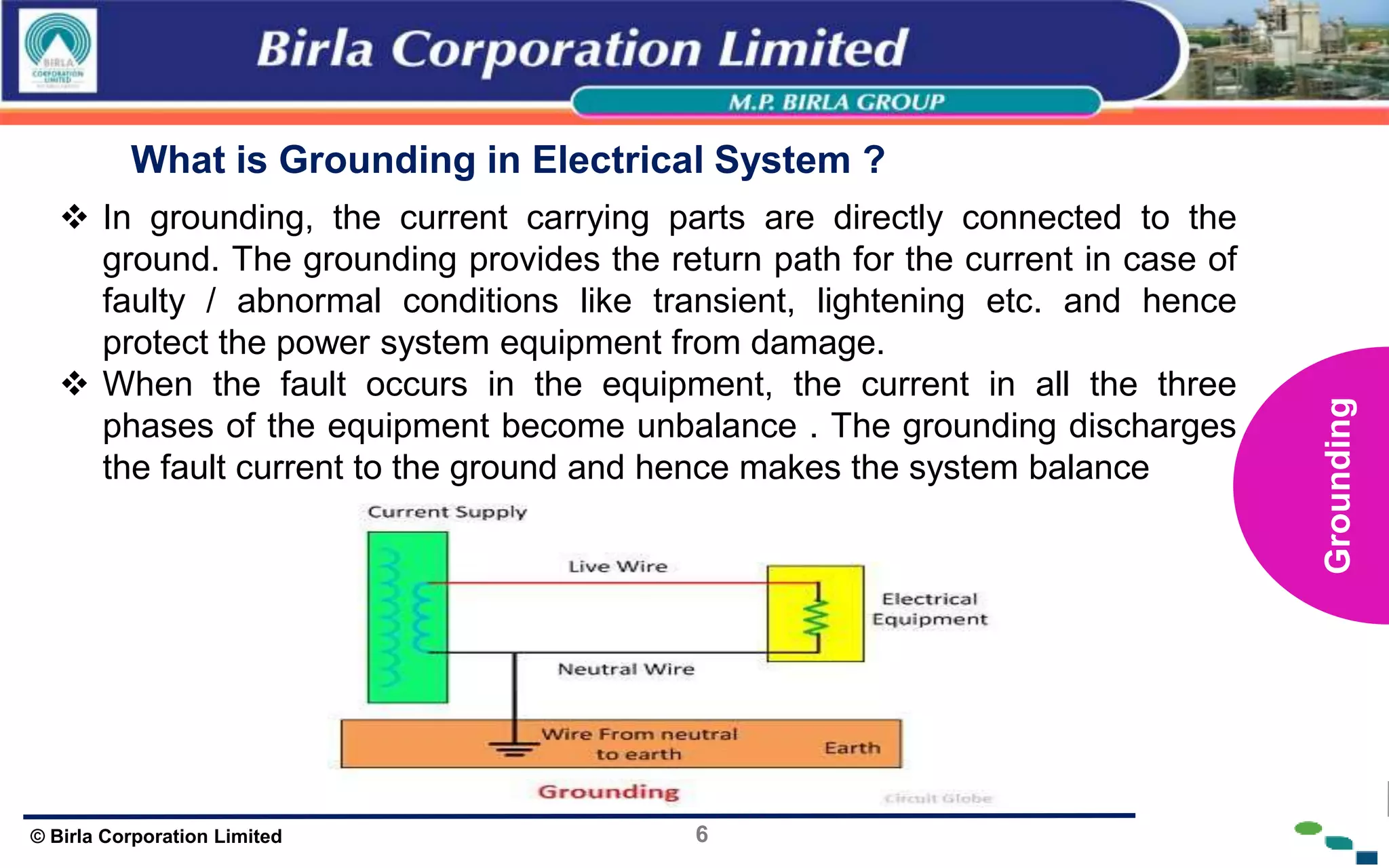
What is Grounding in Electrical System ?
 In grounding, the current carrying parts are directly connected to the
ground. The grounding provides the return path for the current in case of
faulty / abnormal conditions like transient, lightening etc. and hence
protect the power system equipment from damage.
 When the fault occurs in the equipment, the current in all the three
phases of the equipment become unbalance . The grounding discharges
the fault current to the ground and hence makes the system balance
Grounding
7
© Birla Corporation Limited
The objective of a grounding system are:
 To provide safety to personnel during normal and fault conditions by
limiting step and touch potential.
 To assure correct operation of electrical/electronic devices.
 To prevent damage to electrical/electronic apparatus.
 To dissipate lightning strokes.
 To stabilize voltage during transient conditions and to minimize the
probability of flashover during transients.
A safe grounding design has two objectives:
 To provide means to carry electric currents into the earth under
normal and fault conditions without exceeding any operating and
equipment limits or adversely affecting continuity of service.
 To assure that a person in the vicinity of grounded facilities is not
exposed to the danger of critical electric shock.
Objective
8
© Birla Corporation Limited
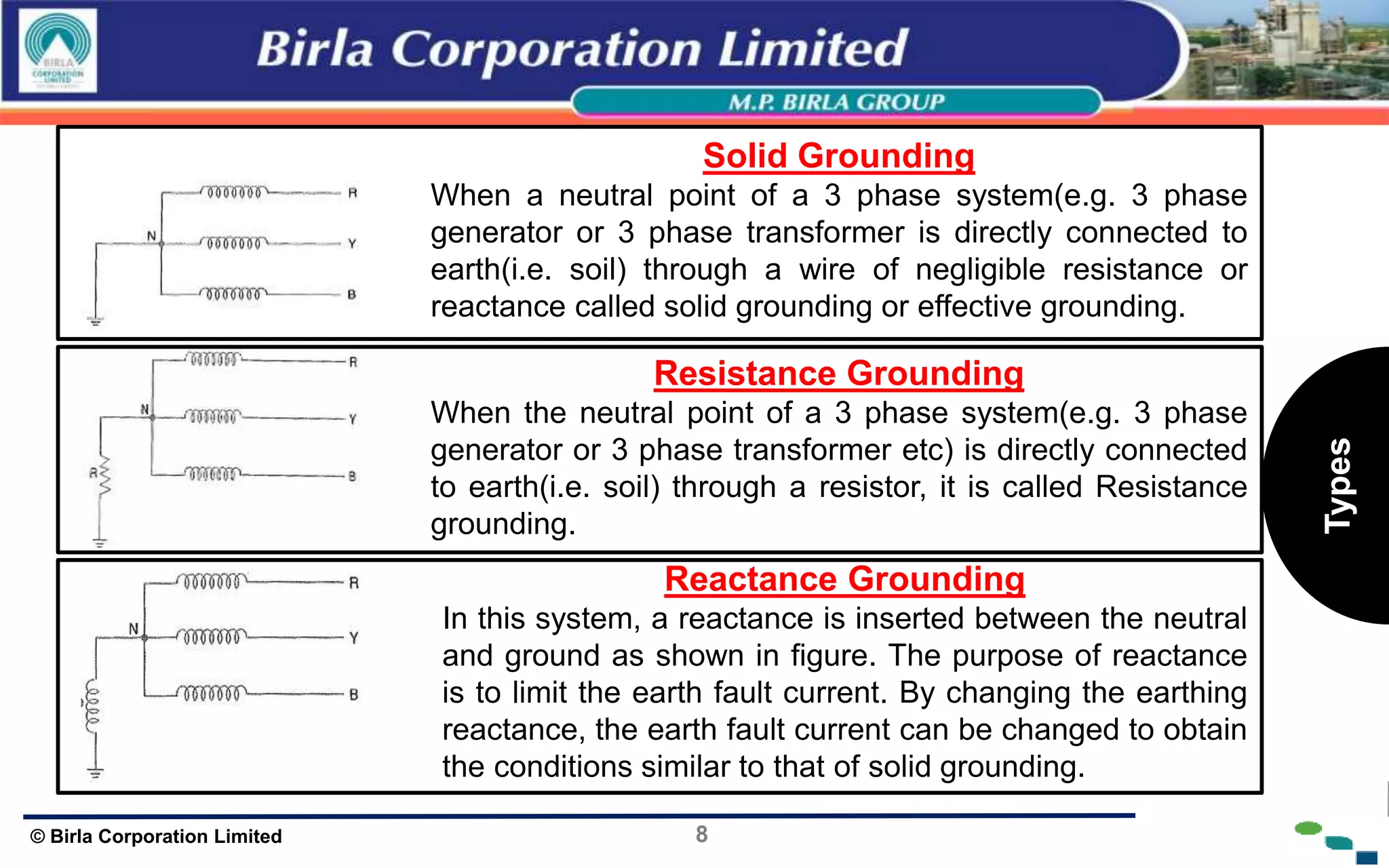
Solid Grounding
When a neutral point of a 3 phase system(e.g. 3 phase
generator or 3 phase transformer is directly connected to
earth(i.e. soil) through a wire of negligible resistance or
reactance called solid grounding or effective grounding.
Resistance Grounding
When the neutral point of a 3 phase system(e.g. 3 phase
generator or 3 phase transformer etc) is directly connected
to earth(i.e. soil) through a resistor, it is called Resistance
grounding.
Reactance Grounding
In this system, a reactance is inserted between the neutral
and ground as shown in figure. The purpose of reactance
is to limit the earth fault current. By changing the earthing
reactance, the earth fault current can be changed to obtain
the conditions similar to that of solid grounding.
Types
9
© Birla Corporation Limited
When the neutral point of a 3-phase system (e.g. 3-phase generator, 3-phase transformer
etc.) is directly connected to earth (i.e. soil) through a wire of negligible resistance and
reactance, it is called Solid Grounding or Effective Grounding.
Advantages of solid grounding :
 The neutral is effectively held at earth potential.
 It becomes easier to protect the system from earth faults which frequently occur
on the When there is an earth fault on any phase of the system, a large fault
current flows between the fault point and the grounded neutral. This permits the
easy operation of earth-fault relay.
Disadvantages of solid grounding :
 Since most of the faults on an overhead system are phase to earth faults, the system
has to bear a large number of severe shocks. This causes the system to become
unstable.
 The solid grounding results in heavy earth fault currents. Since the fault has to be
cleared by the circuit breakers, the heavy earth fault currents may cause the burning of
circuit breaker contacts.
Solid
Grounding
10
© Birla Corporation Limited
In order to limit the magnitude of earth fault current, it is a common practice to connect the
neutral point of a 3-phase system to earth through a resistor. This is called Resistance
Grounding.
When the neutral point of a 3-phase system (e.g. 3-phase generator, 3-phase
transformer etc.) is connected to earth (i.e. soil) through a resistor, it is called
Resistance Grounding.
Advantages of resistance grounding :
 The earth fault current is small due to the presence of earthing resistance.
 It improves the stability of the system.
Disadvantages of resistance grounding
 This system is costlier than the solidly grounded system.
 A large amount of energy is produced in the earthing resistance during earth
faults. Sometimes it becomes difficult to dissipate this energy to atmosphere.
Resistance
Grounding
11
© Birla Corporation Limited
v
The purpose of reactance is to limit the earth fault current By changing
the earthing reactance, the earth fault current can to changed to obtain
the conditions similar to that of solid grounding.
Reactance Grounding
This method is not used these days because of the following
disadvantages:
 In this system, the fault current required to operate the protective device is
higher than that of resistance grounding for the same fault conditions.
 High transient voltages appear under fault conditions.
Reactance
Grounding
12
© Birla Corporation Limited
Protection against electrical overload:- If your system is perfectly
Grounded than excess Fault current will go directly into ground without
damaging the Appliances.
Earth is the best conductor:-One of the reasons why grounding helps
to keep you safe is because the earth is such a great conductor, and
because excess electricity will always take the path of least resistance. By
grounding your electrical system, you are giving it somewhere to go other
than into you – possibly saving your life.
Prevents damage, injury and death :- Without a properly grounded
system your appliances are at higher risk, you are not safe economically
and for your life in case of higher voltage spikes you may get injured or it
may lead to the reason of your death
Importance
of
Grounding
13
© Birla Corporation Limited
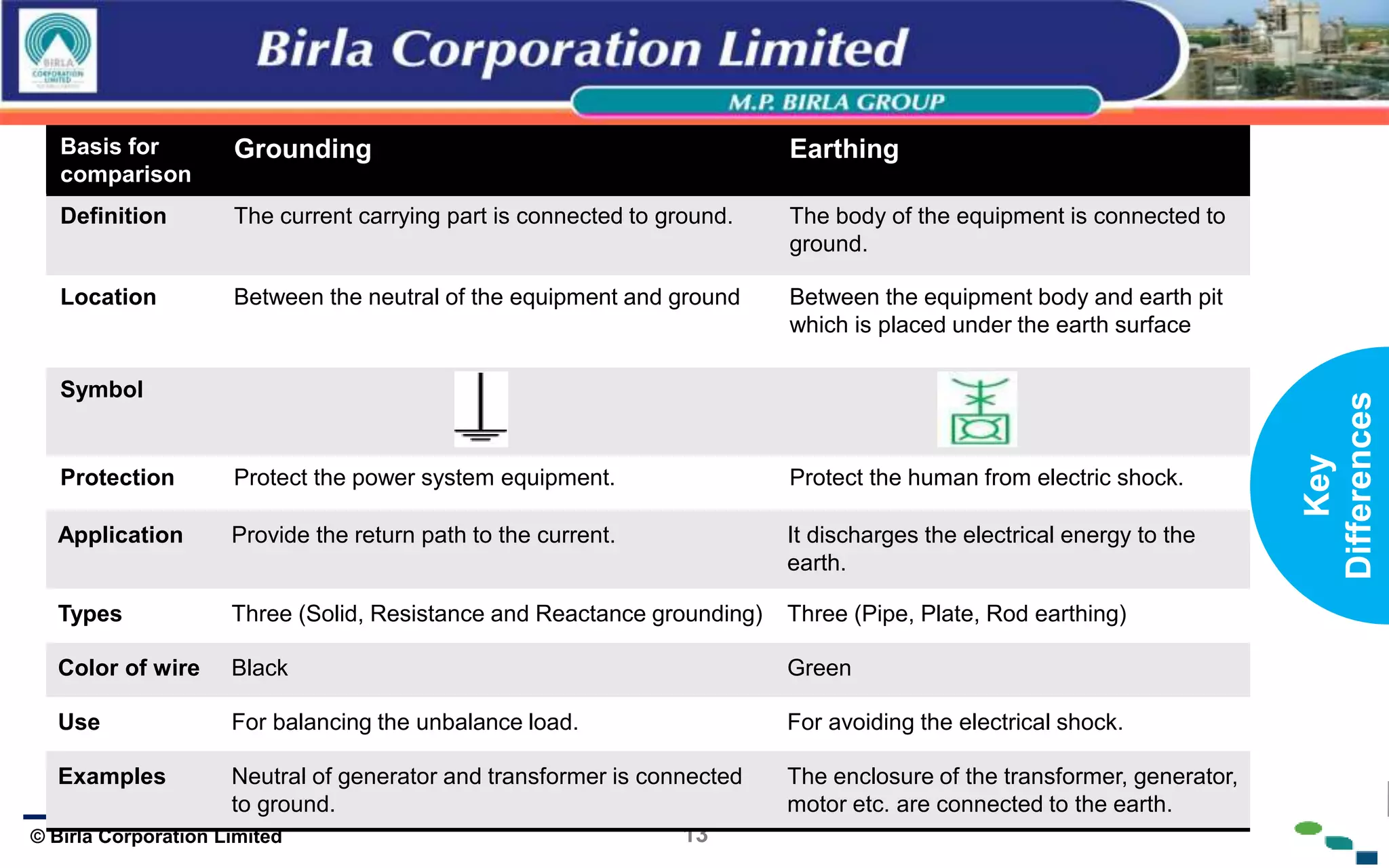
Basis for
comparison
Grounding Earthing
Definition The current carrying part is connected to ground. The body of the equipment is connected to
ground.
Location Between the neutral of the equipment and ground Between the equipment body and earth pit
which is placed under the earth surface
Symbol
Protection Protect the power system equipment. Protect the human from electric shock.
Application Provide the return path to the current. It discharges the electrical energy to the
earth.
Types Three (Solid, Resistance and Reactance grounding) Three (Pipe, Plate, Rod earthing)
Color of wire Black Green
Use For balancing the unbalance load. For avoiding the electrical shock.
Examples Neutral of generator and transformer is connected
to ground.
The enclosure of the transformer, generator,
motor etc. are connected to the earth.
Key
Differences
14
© Birla Corporation Limited

Presentation on Earthing & Grounding

  • 1.
    © Birla CorporationLimited Presentation on:- Earthing & Grounding are the basics to Safety PresentedBy- Vineet Shekhar
  • 2.
    2 © Birla CorporationLimited  What is Earthing in Electrical System.  Types of Earthing.  Importance of Earthing  What is Grounding in Electrical System.  Objective of Grounding System  Types of Grounding  Importance of Grounding  Key Differences Content
  • 3.
    3 © Birla CorporationLimited What is Earthing in Electrical System ?  The ‘earthing’ means the connection of non-current carrying part of the equipment to the earth. When the fault occurs in the system, then the potential of the non-current part of the equipment raises, and when any human or stray animal touch the body of the equipment, then they may get shocked.  The earthing discharges the leakage current to the earth and hence avoid the personnel from the electric shock Earthing
  • 4.
    4 © Birla CorporationLimited Pipe Earthing Rod Earthing Plate Earthing Types of Earthing
  • 5.
    5 © Birla CorporationLimited Minimizes risk of Electric shock:-,Earthing provides a low resistive coductive path directly to the earth, which carry any fault or leakage current . Dissipation of static charge: As the system is perfectly eartheds ,so its potential is approximately equals to Zero, so it cancelled up the static charged build up in the conductor. Protection from power surges:- It protect the system from any voltage Surge and also from lighting strikes, whenever any lighting strike over Exposed metal it discharged directly to earth. For proper functioning of equipment’s: Proper earthing is very important for the functioning of the devices connected to the system. Mainly protective devices like ELCB, earth fault relays, etc. needs proper earthing for its functioning. Because in order to operate all these devices use the reference of leakage current through the earth line. Importance of Earthing
  • 6.
    6 © Birla CorporationLimited What is Grounding in Electrical System ?  In grounding, the current carrying parts are directly connected to the ground. The grounding provides the return path for the current in case of faulty / abnormal conditions like transient, lightening etc. and hence protect the power system equipment from damage.  When the fault occurs in the equipment, the current in all the three phases of the equipment become unbalance . The grounding discharges the fault current to the ground and hence makes the system balance Grounding
  • 7.
    7 © Birla CorporationLimited The objective of a grounding system are:  To provide safety to personnel during normal and fault conditions by limiting step and touch potential.  To assure correct operation of electrical/electronic devices.  To prevent damage to electrical/electronic apparatus.  To dissipate lightning strokes.  To stabilize voltage during transient conditions and to minimize the probability of flashover during transients. A safe grounding design has two objectives:  To provide means to carry electric currents into the earth under normal and fault conditions without exceeding any operating and equipment limits or adversely affecting continuity of service.  To assure that a person in the vicinity of grounded facilities is not exposed to the danger of critical electric shock. Objective
  • 8.
    8 © Birla CorporationLimited Solid Grounding When a neutral point of a 3 phase system(e.g. 3 phase generator or 3 phase transformer is directly connected to earth(i.e. soil) through a wire of negligible resistance or reactance called solid grounding or effective grounding. Resistance Grounding When the neutral point of a 3 phase system(e.g. 3 phase generator or 3 phase transformer etc) is directly connected to earth(i.e. soil) through a resistor, it is called Resistance grounding. Reactance Grounding In this system, a reactance is inserted between the neutral and ground as shown in figure. The purpose of reactance is to limit the earth fault current. By changing the earthing reactance, the earth fault current can be changed to obtain the conditions similar to that of solid grounding. Types
  • 9.
    9 © Birla CorporationLimited When the neutral point of a 3-phase system (e.g. 3-phase generator, 3-phase transformer etc.) is directly connected to earth (i.e. soil) through a wire of negligible resistance and reactance, it is called Solid Grounding or Effective Grounding. Advantages of solid grounding :  The neutral is effectively held at earth potential.  It becomes easier to protect the system from earth faults which frequently occur on the When there is an earth fault on any phase of the system, a large fault current flows between the fault point and the grounded neutral. This permits the easy operation of earth-fault relay. Disadvantages of solid grounding :  Since most of the faults on an overhead system are phase to earth faults, the system has to bear a large number of severe shocks. This causes the system to become unstable.  The solid grounding results in heavy earth fault currents. Since the fault has to be cleared by the circuit breakers, the heavy earth fault currents may cause the burning of circuit breaker contacts. Solid Grounding
  • 10.
    10 © Birla CorporationLimited In order to limit the magnitude of earth fault current, it is a common practice to connect the neutral point of a 3-phase system to earth through a resistor. This is called Resistance Grounding. When the neutral point of a 3-phase system (e.g. 3-phase generator, 3-phase transformer etc.) is connected to earth (i.e. soil) through a resistor, it is called Resistance Grounding. Advantages of resistance grounding :  The earth fault current is small due to the presence of earthing resistance.  It improves the stability of the system. Disadvantages of resistance grounding  This system is costlier than the solidly grounded system.  A large amount of energy is produced in the earthing resistance during earth faults. Sometimes it becomes difficult to dissipate this energy to atmosphere. Resistance Grounding
  • 11.
    11 © Birla CorporationLimited v The purpose of reactance is to limit the earth fault current By changing the earthing reactance, the earth fault current can to changed to obtain the conditions similar to that of solid grounding. Reactance Grounding This method is not used these days because of the following disadvantages:  In this system, the fault current required to operate the protective device is higher than that of resistance grounding for the same fault conditions.  High transient voltages appear under fault conditions. Reactance Grounding
  • 12.
    12 © Birla CorporationLimited Protection against electrical overload:- If your system is perfectly Grounded than excess Fault current will go directly into ground without damaging the Appliances. Earth is the best conductor:-One of the reasons why grounding helps to keep you safe is because the earth is such a great conductor, and because excess electricity will always take the path of least resistance. By grounding your electrical system, you are giving it somewhere to go other than into you – possibly saving your life. Prevents damage, injury and death :- Without a properly grounded system your appliances are at higher risk, you are not safe economically and for your life in case of higher voltage spikes you may get injured or it may lead to the reason of your death Importance of Grounding
  • 13.
    13 © Birla CorporationLimited Basis for comparison Grounding Earthing Definition The current carrying part is connected to ground. The body of the equipment is connected to ground. Location Between the neutral of the equipment and ground Between the equipment body and earth pit which is placed under the earth surface Symbol Protection Protect the power system equipment. Protect the human from electric shock. Application Provide the return path to the current. It discharges the electrical energy to the earth. Types Three (Solid, Resistance and Reactance grounding) Three (Pipe, Plate, Rod earthing) Color of wire Black Green Use For balancing the unbalance load. For avoiding the electrical shock. Examples Neutral of generator and transformer is connected to ground. The enclosure of the transformer, generator, motor etc. are connected to the earth. Key Differences
  • 14.