Super Microbe World
         Teaching Hygiene and Science Through Games


David Farrell
Gameologist
Glasgow Caledonian University
david.farrell@gcu.ac.uk
@unthank
Games in Education
• Games used as motivator (especially boys)
 • extrinsic motivator
    “finish your work and you can play”
 • intrinsic motivator
  • “since they like play, we’ll put learning
      in their games!!”
Problem?


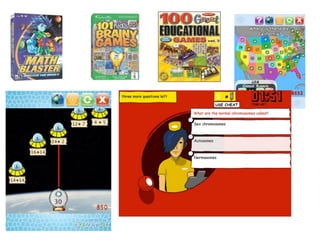
• These products are not particularly
  successful as games or / education
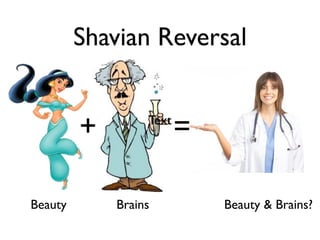
Shavian Reversal


         +        Text
                         =

Beauty       Brains          Beauty & Brains?
Shavian Reversal


         +            =

Beauty       Brains       Beauty & Brains?
Shavian Reversal


  Ugly & Stupid
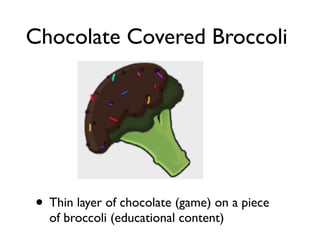
Chocolate Covered Broccoli


• Thin layer of chocolate (game) on a piece
  of broccoli (educational content)
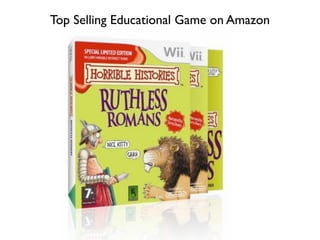
Top Selling Educational Game on Amazon
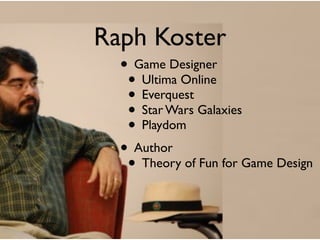
Raph Koster
  • Game Designer
   • Ultima Online
   • Everquest
   • Star Wars Galaxies
   • Playdom
  • Author
   • Theory of Fun for Game Design
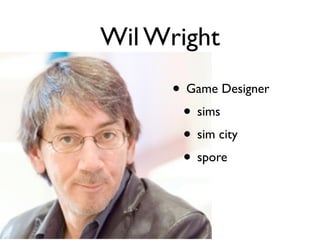
Wil Wright
      • Game Designer
       • sims
       • sim city
       • spore
Will wright @ GDC2010

 • Said that designing games is like building a
   model of the universe. Playing a game is
   like testing a world model and learning
   from how it behaves.
 • like a child playing with water or shapes.
• Neither Raph Koster or Wil Wright are
  educational game developers - but they
  have noticed the potential of games to
  teach through modelling some aspect of
  the world.
Kurt Squire
• Indeed, this kind of learning seems to be
  something that games do particularly well
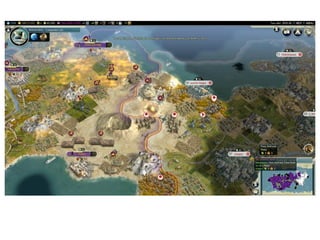
• Kurt Squire’s work with Civilization 3 - just
  by playing scenarios in this commercial
  game, students gained a deep, meaningful
  understanding of history
  • not as a series of facts - but as patterns,
    relationships - as a model of how history
    works
David W Shaffer

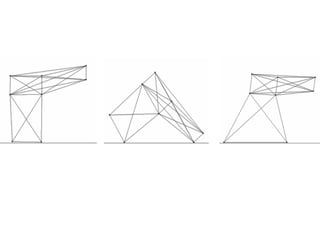
• Similar idea - game models physics.
  (Svarovski & Shaffer, 2006)
• By playing with it, students get a really deep
  understanding of physics.
• Instead of separating the game from the
  learning, it seems that one of the best ways
  to teach through play is to have the game
  model the learning outcomes.
• By playing with a simulation, students can
  attain a deep learning experience.
GM Choccoli

• If games teach what games model, then we
  can design game mechanics that model
  learning outcomes
• by doing that, we can create ‘genetically
  modified broccoli’
  • Broccolate? Choccoli?
• This puts an emphasis on the ‘game’ part of
  educational game design.
• Educational game designers need to
  understand the game development process.
e-Bug
• European Commission project to improve
  microbial education
• Two audiences.
 • 9-12 year olds
 • 13-15 year olds
• Games to be suitable for play in class or at
  home.
Audience Research
• Mix of desk and primary research
 • Amazon for cartoon sales
 • Focus groups with Scottish children for
    further information
• Looking for kinds of games that they enjoy
  that I could see being adapted for e-Bug
Genres (13-15yrs)
• Older children ALL liked shooters and
  sports games (problem!)
• There wasn’t much consensus beyond that.
• I brought in some games for them to play
  and give feedback. They were receptive to
  story based games like Monkey Island and
  Phoenix Wright.
Genres (9yrs)
• Surprisingly, the young pupils were less
  opinionated on what they liked.
• Few owned a console. Most played
  whatever games were on the popular Flash
  portals (Kongregate etc)
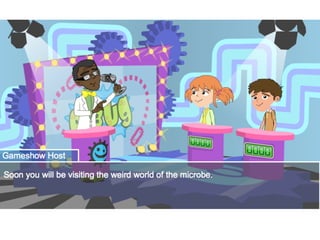
• They liked arcadey, simple games and TV
  quiz games like Millionaire.
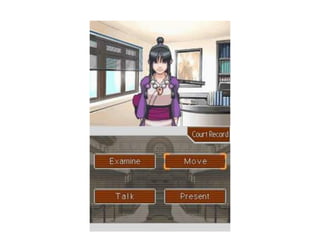
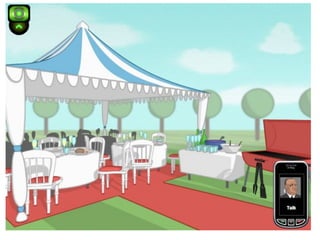
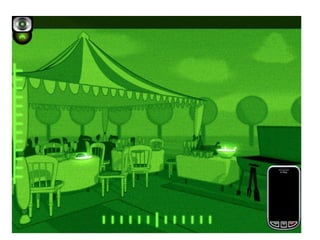
Detective Game

• Narrative / conceptual model based.
• Heavily inspired by the Phoenix Wright: Ace
  Attorney games
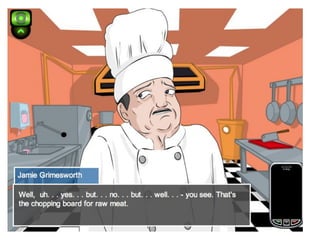
• Players explore locations, looking for clues,
  and speak to characters.
Using Scenarios

• The idea was that each learning outcome
  would be modelled through story.
• The characters in the game would describe
  a mystery and a possible solution.
• The player would use evidence to disprove
  these solutions and in the process would
  learn the science.
For example...


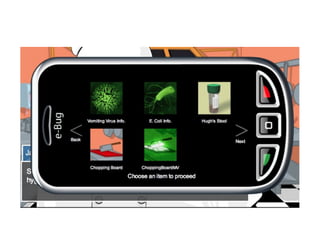
• One learning outcome was:
 • You should use a separate chopping
    board for meat and vegetables.
Another Example


• LO: There are good microbes in the body
  and we should look after them.
• Using dialogue, the player knows that the
  Coach Beveridge character is sick.
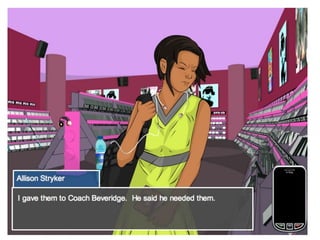
• The player is talking to a girl called Allison
  who tells the player that Coach Beveridge has
  been taking her antibiotic pills.
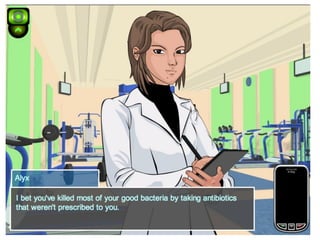
• When the player confronts Coach Beveridge,
  it emerges that he has killed his good bacteria
  and that is why he is sick.
Younger Children
• For researching the younger audience, we
  had decided that:
 • we couldn’t use too much text.
 • we wanted a visual and simple interaction
 • I wanted an interaction that was very
    immediate in its response
Converting LOs to
     Mechanics

• Learning Outcome
 • Some microbes are good for us.
Platform Game Solution
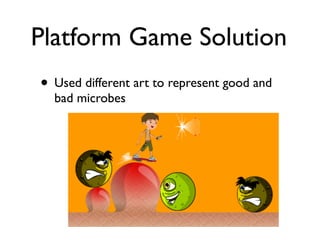
• Used different art to represent good and
  bad microbes
• Contact with bad microbes hurts the player
  whereas good microbes can be stood on to
  jump higher.
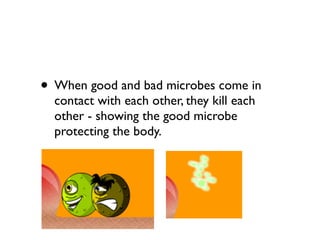
• When good and bad microbes come in
  contact with each other, they kill each
  other - showing the good microbe
  protecting the body.
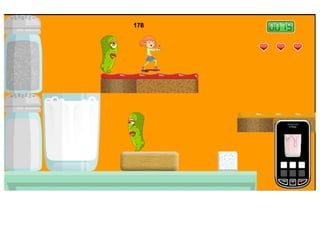
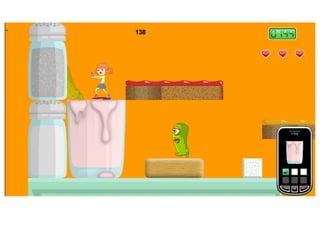
Another Example


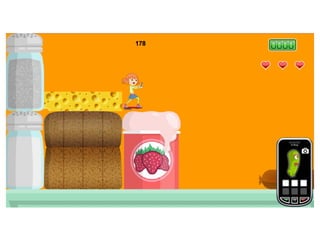
• LO: We use microbes to make foods like
  bread and yogurt.
Some areas that worked
• Enjoyable - why?
 • Platform game - good play-testing throughout
   • levels tweaked to find appropriate difficulty
      level.
   • Didn’t ‘feel like’ an educational game
 • Detective game - good stories / dialogue
  • stories discussed with children before hand
• Teachers liked the games
 • teacher involvement in conceptual stage
    helped ensure their concerns were met
• rolled out to 10 EU countries, more coming
• Some positive knowledge change results
 • in platform game, particular areas very
    successful in short period of time (30
    minutes of play covering multiple LOs)
  • in detective game, some encouraging
    results but not statistically significant -
    too many pupils already aware of correct
    answer - need further study
GM Choccoli Approach
• Mostly successful
• Hard to adapt because each LO has a hard
  coded mechanic
• some of the LOs weren’t successfully
  taught because the mechanic wasn’t evident
  enough
• Can be difficult!
What Next?
• I’m working on games to teach secondary
  school pupils about programming.
• My colleagues are working on a number of
  other interesting project (music, science
  etc)
• We are always looking for schools who
  want to work with us!
For more Information

• www.e-bug.eu
 • (teacher lessons + games)
• david.farrell@gcu.ac.uk
• @unthank

Super Microbe World: Using Games to Teach Science and Hygiene

  • 1.
    Super Microbe World Teaching Hygiene and Science Through Games David Farrell Gameologist Glasgow Caledonian University david.farrell@gcu.ac.uk @unthank
  • 2.
    Games in Education •Games used as motivator (especially boys) • extrinsic motivator “finish your work and you can play” • intrinsic motivator • “since they like play, we’ll put learning in their games!!”
  • 4.
    Problem? • These productsare not particularly successful as games or / education
  • 5.
    Shavian Reversal + Text = Beauty Brains Beauty & Brains?
  • 6.
    Shavian Reversal + = Beauty Brains Beauty & Brains?
  • 7.
    Shavian Reversal Ugly & Stupid
  • 8.
    Chocolate Covered Broccoli •Thin layer of chocolate (game) on a piece of broccoli (educational content)
  • 9.
  • 13.
    Raph Koster • Game Designer • Ultima Online • Everquest • Star Wars Galaxies • Playdom • Author • Theory of Fun for Game Design
  • 16.
    Wil Wright • Game Designer • sims • sim city • spore
  • 17.
    Will wright @GDC2010 • Said that designing games is like building a model of the universe. Playing a game is like testing a world model and learning from how it behaves. • like a child playing with water or shapes.
  • 19.
    • Neither RaphKoster or Wil Wright are educational game developers - but they have noticed the potential of games to teach through modelling some aspect of the world.
  • 20.
    Kurt Squire • Indeed,this kind of learning seems to be something that games do particularly well • Kurt Squire’s work with Civilization 3 - just by playing scenarios in this commercial game, students gained a deep, meaningful understanding of history • not as a series of facts - but as patterns, relationships - as a model of how history works
  • 22.
    David W Shaffer •Similar idea - game models physics. (Svarovski & Shaffer, 2006) • By playing with it, students get a really deep understanding of physics.
  • 24.
    • Instead ofseparating the game from the learning, it seems that one of the best ways to teach through play is to have the game model the learning outcomes. • By playing with a simulation, students can attain a deep learning experience.
  • 25.
    GM Choccoli • Ifgames teach what games model, then we can design game mechanics that model learning outcomes • by doing that, we can create ‘genetically modified broccoli’ • Broccolate? Choccoli?
  • 26.
    • This putsan emphasis on the ‘game’ part of educational game design. • Educational game designers need to understand the game development process.
  • 28.
    e-Bug • European Commissionproject to improve microbial education • Two audiences. • 9-12 year olds • 13-15 year olds • Games to be suitable for play in class or at home.
  • 29.
    Audience Research • Mixof desk and primary research • Amazon for cartoon sales • Focus groups with Scottish children for further information • Looking for kinds of games that they enjoy that I could see being adapted for e-Bug
  • 30.
    Genres (13-15yrs) • Olderchildren ALL liked shooters and sports games (problem!) • There wasn’t much consensus beyond that. • I brought in some games for them to play and give feedback. They were receptive to story based games like Monkey Island and Phoenix Wright.
  • 32.
    Genres (9yrs) • Surprisingly,the young pupils were less opinionated on what they liked. • Few owned a console. Most played whatever games were on the popular Flash portals (Kongregate etc) • They liked arcadey, simple games and TV quiz games like Millionaire.
  • 33.
    Detective Game • Narrative/ conceptual model based. • Heavily inspired by the Phoenix Wright: Ace Attorney games • Players explore locations, looking for clues, and speak to characters.
  • 36.
    Using Scenarios • Theidea was that each learning outcome would be modelled through story. • The characters in the game would describe a mystery and a possible solution. • The player would use evidence to disprove these solutions and in the process would learn the science.
  • 37.
    For example... • Onelearning outcome was: • You should use a separate chopping board for meat and vegetables.
  • 41.
    Another Example • LO:There are good microbes in the body and we should look after them.
  • 43.
    • Using dialogue,the player knows that the Coach Beveridge character is sick. • The player is talking to a girl called Allison who tells the player that Coach Beveridge has been taking her antibiotic pills. • When the player confronts Coach Beveridge, it emerges that he has killed his good bacteria and that is why he is sick.
  • 46.
    Younger Children • Forresearching the younger audience, we had decided that: • we couldn’t use too much text. • we wanted a visual and simple interaction • I wanted an interaction that was very immediate in its response
  • 49.
    Converting LOs to Mechanics • Learning Outcome • Some microbes are good for us.
  • 50.
    Platform Game Solution •Used different art to represent good and bad microbes
  • 51.
    • Contact withbad microbes hurts the player whereas good microbes can be stood on to jump higher.
  • 52.
    • When goodand bad microbes come in contact with each other, they kill each other - showing the good microbe protecting the body.
  • 53.
    Another Example • LO:We use microbes to make foods like bread and yogurt.
  • 56.
    Some areas thatworked • Enjoyable - why? • Platform game - good play-testing throughout • levels tweaked to find appropriate difficulty level. • Didn’t ‘feel like’ an educational game • Detective game - good stories / dialogue • stories discussed with children before hand
  • 57.
    • Teachers likedthe games • teacher involvement in conceptual stage helped ensure their concerns were met • rolled out to 10 EU countries, more coming
  • 59.
    • Some positiveknowledge change results • in platform game, particular areas very successful in short period of time (30 minutes of play covering multiple LOs) • in detective game, some encouraging results but not statistically significant - too many pupils already aware of correct answer - need further study
  • 60.
    GM Choccoli Approach •Mostly successful • Hard to adapt because each LO has a hard coded mechanic • some of the LOs weren’t successfully taught because the mechanic wasn’t evident enough • Can be difficult!
  • 61.
    What Next? • I’mworking on games to teach secondary school pupils about programming. • My colleagues are working on a number of other interesting project (music, science etc) • We are always looking for schools who want to work with us!
  • 62.
    For more Information •www.e-bug.eu • (teacher lessons + games) • david.farrell@gcu.ac.uk • @unthank