

Career Quest
  Behind the Curtain
De-Brief

• Purpose of game

• Learning goals and implementation

• Experiment design and implementation
Affect & SGs
• e-Bug == Cognitive focus + Affective instinct

   • i.e. “I’ll design it to be fun”

• The fun of those games is derived from stealing
  things from games.

   • Platform mechanics

   • Story / comedy

   • scores etc
Affect and e-Bug

• Why is the e-Bug game “fun” for 9-11 year olds?

• Why is ANY game fun?

• Why is anyTHING fun?
SPAM / ARC
• DM spoke of the (S)PAM model of motivation
  (Daniel Pink).

  • Does anyone remember what it is?

• DM spoke of the ARC model of motivation (Deci &
  Ryan).

  • Does anyone remember what it is?
Intrinsic Motivation

• Autonomy (a feeling of having freedom, that your
  choices matter and you can express change)

• Relatedness (a feeling of connection to people, that
  you & what your doing matters to your peers)

• Competence (a feeling that you are good at
  something or are getting better at something)
Support for ARC

• How much people feel supported in Autonomy,
  Relatedness and Competence predicts their
  subjective enjoyment of a task and the extent to
  which they identify with the task.

• People who identify as intrinsically motivated
  perform better and learn / remember more.
ARC & Learning
• Grolnick & Ryan 1987

  • 3 groups of children at school

     • nondirected (asked to read a passage and
       report how interesting.)

     • directed (no mention of test but told instructor
       interested in how much they learn)

     • directed and told about grades
ARC & Learning
• The first two of these groups attempt to give
  autonomy (not DIRECTING behaviour)
• All students tested.
  • Students who were directed performed better on
     rote memorisation than first group.
   • grades group (least autonomous) evidenced
     greatest deterioration of memorised facts after a
     week)
   • grades group also had poorer conceptual
     learning of material than other groups.
ARC & Learning

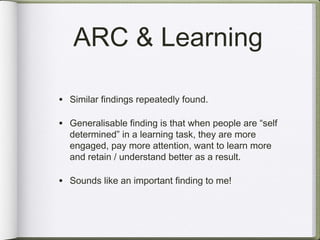
• Similar findings repeatedly found.

• Generalisable finding is that when people are “self
  determined” in a learning task, they are more
  engaged, pay more attention, want to learn more
  and retain / understand better as a result.

• Sounds like an important finding to me!
Games
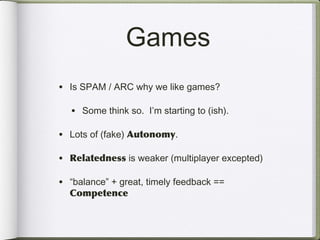
• Is SPAM / ARC why we like games?

  • Some think so. I’m starting to (ish).

• Lots of (fake) Autonomy.

• Relatedness is weaker (multiplayer excepted)

• “balance” + great, timely feedback ==
  Competence
ARC in Games
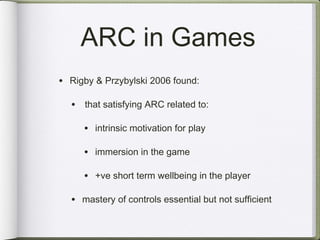
• Rigby & Przybylski 2006 found:

  • that satisfying ARC related to:

     • intrinsic motivation for play

     • immersion in the game

     • +ve short term wellbeing in the player

  • mastery of controls essential but not sufficient
ARC in Games
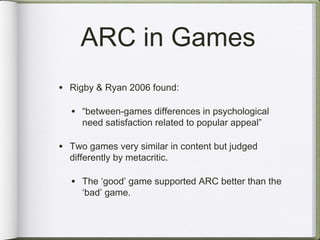
• Rigby & Ryan 2006 found:

  • “between-games differences in psychological
     need satisfaction related to popular appeal”

• Two games very similar in content but judged
  differently by metacritic.

  • The ‘good’ game supported ARC better than the
     ‘bad’ game.
ARC & Games
• Przybylski, Ryan and Rigby 2009 found:

  • Core appeal of violent games was based on
     ARC satisfaction

  • ARC predicted enjoyment, immersion and future
     play. Violent interests / tendencies predicted
     preference for future play - but NOT enjoyment.

• Przybylski 2009 found that post-play aggression
  was not linked to violent content, but rather to low
  ARC support - e.g. frustration from poor mastery
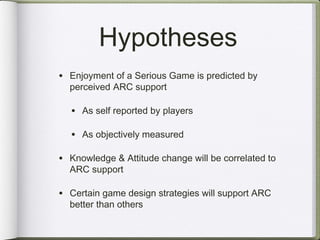
Hypotheses
• Enjoyment of a Serious Game is predicted by
  perceived ARC support

  • As self reported by players

  • As objectively measured

• Knowledge & Attitude change will be correlated to
  ARC support

• Certain game design strategies will support ARC
  better than others
Careers Service
• Students don’t really think about employability until
  after graduation.

• Students think “get my degree then worry about it”

• Students think they have no skills outwith their
  degree and that their P/T work doesn’t matter

• Asked if we could design a game to try to tackle
  these.
Learning Design
• The “Fortnightly Planner” is to raise awareness of
  what is required to manage one’s employability.

• The “Dilemmas” were to make students think about
  employability skills outside of their degree.

• The “Daily Item” was intended to encourage not just
  “playing the game” but taking the content of the
  game into your real world.
Hypotheses
• Enjoyment of a Serious Game is predicted by
  perceived ARC support

  • As self reported by players

  • As objectively measured

• Knowledge & Attitude change will be correlated to
  ARC support

• Certain game design strategies will support ARC
  better than others
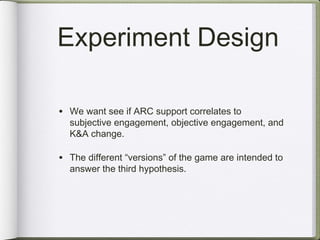
Experiment Design

• We want see if ARC support correlates to
  subjective engagement, objective engagement, and
  K&A change.

• The different “versions” of the game are intended to
  answer the third hypothesis.
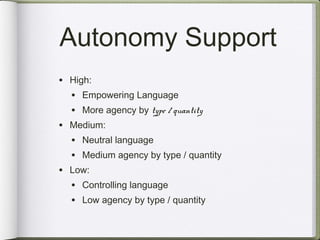
Autonomy Support
• High:
  • Empowering Language
  • More agency by type / quantity
• Medium:
  • Neutral language
  • Medium agency by type / quantity
• Low:
  • Controlling language
  • Low agency by type / quantity
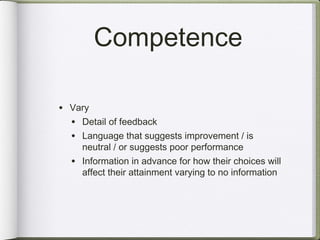
Competence

• Vary
  • Detail of feedback
  • Language that suggests improvement / is
      neutral / or suggests poor performance
  •   Information in advance for how their choices will
      affect their attainment varying to no information
Relatedness

• High group received detailed, personal feedback at
  the start of each week.

• Low group had an avatar we hoped they wouldn’t
  relate to (if also in low Autonomy group)
Demo
Early findings
• K&A wise, I know of some changes to behaviour
  via the “daily task”

   • 12 students signed up for vacancies (1 got a
      game design job ?!?!?!?!)

• At least one student did the “twitter” daily task.

• 6 students got the token from CS - they now know
  where it is!
Early Findings
• Of the NINE “High A, High C” students, only ONE
  chose to answer their own solution to dilemmas.

  • struck me as a bit weird!

• People did not behave as I would have predicted
  SOLELY by their (random) groups

  • one of the most frequent users was a “low
     everything” user.
Results

• Of course, for all but last of the hypotheses it’s
  “perceived” ARC support that matters.

• One objective measure of engagement was daily
  option submissions.
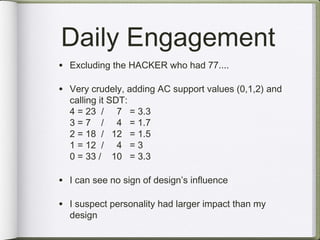
Daily Engagement
• Excluding the HACKER who had 77....

• Very crudely, adding AC support values (0,1,2) and
  calling it SDT:
  4 = 23 / 7 = 3.3
  3 = 7 / 4 = 1.7
  2 = 18 / 12 = 1.5
  1 = 12 / 4 = 3
  0 = 33 / 10 = 3.3

• I can see no sign of design’s influence

• I suspect personality had larger impact than my
  design
This afternoon
• Focus group questions

  • Please think about the game.

  • Think about whether you felt supported in ARC

  • Whether the game mechanics influenced this

  • What you liked /disliked, what you would change
     etc.

Serious games career quest

  • 1.
    Career Quest Behind the Curtain
  • 2.
    De-Brief • Purpose ofgame • Learning goals and implementation • Experiment design and implementation
  • 3.
    Affect & SGs •e-Bug == Cognitive focus + Affective instinct • i.e. “I’ll design it to be fun” • The fun of those games is derived from stealing things from games. • Platform mechanics • Story / comedy • scores etc
  • 4.
    Affect and e-Bug •Why is the e-Bug game “fun” for 9-11 year olds? • Why is ANY game fun? • Why is anyTHING fun?
  • 5.
    SPAM / ARC •DM spoke of the (S)PAM model of motivation (Daniel Pink). • Does anyone remember what it is? • DM spoke of the ARC model of motivation (Deci & Ryan). • Does anyone remember what it is?
  • 6.
    Intrinsic Motivation • Autonomy(a feeling of having freedom, that your choices matter and you can express change) • Relatedness (a feeling of connection to people, that you & what your doing matters to your peers) • Competence (a feeling that you are good at something or are getting better at something)
  • 7.
    Support for ARC •How much people feel supported in Autonomy, Relatedness and Competence predicts their subjective enjoyment of a task and the extent to which they identify with the task. • People who identify as intrinsically motivated perform better and learn / remember more.
  • 8.
    ARC & Learning •Grolnick & Ryan 1987 • 3 groups of children at school • nondirected (asked to read a passage and report how interesting.) • directed (no mention of test but told instructor interested in how much they learn) • directed and told about grades
  • 9.
    ARC & Learning •The first two of these groups attempt to give autonomy (not DIRECTING behaviour) • All students tested. • Students who were directed performed better on rote memorisation than first group. • grades group (least autonomous) evidenced greatest deterioration of memorised facts after a week) • grades group also had poorer conceptual learning of material than other groups.
  • 10.
    ARC & Learning •Similar findings repeatedly found. • Generalisable finding is that when people are “self determined” in a learning task, they are more engaged, pay more attention, want to learn more and retain / understand better as a result. • Sounds like an important finding to me!
  • 11.
    Games • Is SPAM/ ARC why we like games? • Some think so. I’m starting to (ish). • Lots of (fake) Autonomy. • Relatedness is weaker (multiplayer excepted) • “balance” + great, timely feedback == Competence
  • 12.
    ARC in Games •Rigby & Przybylski 2006 found: • that satisfying ARC related to: • intrinsic motivation for play • immersion in the game • +ve short term wellbeing in the player • mastery of controls essential but not sufficient
  • 13.
    ARC in Games •Rigby & Ryan 2006 found: • “between-games differences in psychological need satisfaction related to popular appeal” • Two games very similar in content but judged differently by metacritic. • The ‘good’ game supported ARC better than the ‘bad’ game.
  • 14.
    ARC & Games •Przybylski, Ryan and Rigby 2009 found: • Core appeal of violent games was based on ARC satisfaction • ARC predicted enjoyment, immersion and future play. Violent interests / tendencies predicted preference for future play - but NOT enjoyment. • Przybylski 2009 found that post-play aggression was not linked to violent content, but rather to low ARC support - e.g. frustration from poor mastery
  • 15.
    Hypotheses • Enjoyment ofa Serious Game is predicted by perceived ARC support • As self reported by players • As objectively measured • Knowledge & Attitude change will be correlated to ARC support • Certain game design strategies will support ARC better than others
  • 16.
    Careers Service • Studentsdon’t really think about employability until after graduation. • Students think “get my degree then worry about it” • Students think they have no skills outwith their degree and that their P/T work doesn’t matter • Asked if we could design a game to try to tackle these.
  • 17.
    Learning Design • The“Fortnightly Planner” is to raise awareness of what is required to manage one’s employability. • The “Dilemmas” were to make students think about employability skills outside of their degree. • The “Daily Item” was intended to encourage not just “playing the game” but taking the content of the game into your real world.
  • 18.
    Hypotheses • Enjoyment ofa Serious Game is predicted by perceived ARC support • As self reported by players • As objectively measured • Knowledge & Attitude change will be correlated to ARC support • Certain game design strategies will support ARC better than others
  • 19.
    Experiment Design • Wewant see if ARC support correlates to subjective engagement, objective engagement, and K&A change. • The different “versions” of the game are intended to answer the third hypothesis.
  • 20.
    Autonomy Support • High: • Empowering Language • More agency by type / quantity • Medium: • Neutral language • Medium agency by type / quantity • Low: • Controlling language • Low agency by type / quantity
  • 21.
    Competence • Vary • Detail of feedback • Language that suggests improvement / is neutral / or suggests poor performance • Information in advance for how their choices will affect their attainment varying to no information
  • 22.
    Relatedness • High groupreceived detailed, personal feedback at the start of each week. • Low group had an avatar we hoped they wouldn’t relate to (if also in low Autonomy group)
  • 23.
  • 24.
    Early findings • K&Awise, I know of some changes to behaviour via the “daily task” • 12 students signed up for vacancies (1 got a game design job ?!?!?!?!) • At least one student did the “twitter” daily task. • 6 students got the token from CS - they now know where it is!
  • 25.
    Early Findings • Ofthe NINE “High A, High C” students, only ONE chose to answer their own solution to dilemmas. • struck me as a bit weird! • People did not behave as I would have predicted SOLELY by their (random) groups • one of the most frequent users was a “low everything” user.
  • 26.
    Results • Of course,for all but last of the hypotheses it’s “perceived” ARC support that matters. • One objective measure of engagement was daily option submissions.
  • 27.
    Daily Engagement • Excludingthe HACKER who had 77.... • Very crudely, adding AC support values (0,1,2) and calling it SDT: 4 = 23 / 7 = 3.3 3 = 7 / 4 = 1.7 2 = 18 / 12 = 1.5 1 = 12 / 4 = 3 0 = 33 / 10 = 3.3 • I can see no sign of design’s influence • I suspect personality had larger impact than my design
  • 28.
    This afternoon • Focusgroup questions • Please think about the game. • Think about whether you felt supported in ARC • Whether the game mechanics influenced this • What you liked /disliked, what you would change etc.

Editor's Notes

  • #24 highall 71 (was christopher mcgerr) medall 79 (was ally hay) lowall 45 (was grant mckenna)