2013

Game Design 2
Lecture 15: Revision

http://gcugd2.com

dfarrell@davidlearnsgames.com
Coursework
• I have had three requests for extensions.
• So I’m going to give one to everyone, to be
fair.

• New hand-in time is:
• Friday 13th December
• Noon, M615 (my office)
• If you want to give it sooner, email me.
Game Jam

• Last weekend in January
• Great for portfolio so try to be there!
• There’s a book out with tips etc.
Comments
• On the course blog: gcugd2.com
• If you have 5 minutes, please feed back.
Exam
• Everyone know when it is?
• 10am, Thursday 9th January*

* if this is wrong, it is your responsibility to find the correct details
Questions
• There are SIX questions in the exam, each
worth 10 marks.

• You have to answer FOUR of the six.
• This means that even if you spend 20

minutes reading the paper, you still have 25
minutes per question.
Learning from last year
• Most of my students said the exam was
easy.

• Most of them left early.
• Most of them got around 50%
• People were answering ‘correctly’ - but not
thoroughly.
So what’s in the exam?
• Stuff from the lectures!
• Each lecture has some obviously
examinable content.
Reminder
• Menus
• Text
• UI components
• Interface (paper) Prototyping
• Expert Evaluation
Reminder
• User Evaluation
• Semiotics and Icons
• Immersion though UI (Diegesis)
• Layout & Usability
• Colour
Reminder
• Colour
• Layers and Separation
• Micro and Macro design
Caveat
• Although the exam will be focussing on

material from the lectures, this includes all
handouts.

• So not as simple as memorising the slides
• to get *good* marks, you will have had to
have read the handouts & links
Where to focus?
•

Look at each lecture’s slides.

•
•
•
•

The techniques are important.
The reasons to use them are important
Knowing when and where to use a technique
Knowing the difference between two similar
techniques is important

•
•

e.g layering & separation
Heuristic Evaluation vs Cognitive Walkthrough
Lecture : Menu Flow

• You should be able to write about:
• Why you would plan menu flow?
• What the benefits are of planning in
general?

• What the benefits are of use case

modelling / user stories (37 Signals menu
sketching) and (Fox style) flowcharts?

• The processes you would use to create
satisfying menus
Menu Question
•


Solium Infernum 2 is under development. The
Developer is aware of negative feedback he
received about his menu design in the original
game and has hired you to design the menus.

•


For 5 marks:
	

Describe the processes and techniques you
would use to create menus that are you would use
to make sure that menus in the game are easy to
use and satisfying for the player.
Lecture: Text
• There are design issues in using fonts
• What are these?
• What can you do with a font?
• What is the difference between good use
of fonts and bad use?

• How can text be problematic?
Example Question
• Most games feature text, and yet many
designers fail to take advantage of the
opportunities offered by fonts to
contribute to the design of the game.

• For 8 marks:


 In what ways can font choice
contribute to a game's design
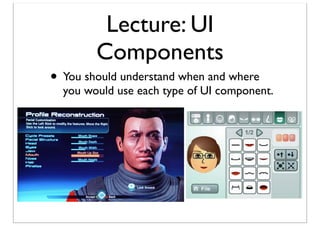
Lecture: UI
Components

• You should understand when and where

you would use each type of UI component.
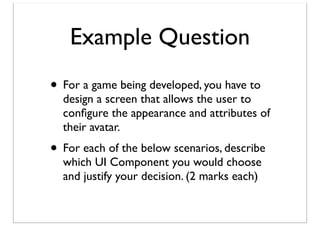
Example Question
• For a game being developed, you have to

design a screen that allows the user to
configure the appearance and attributes of
their avatar.

• For each of the below scenarios, describe
which UI Component you would choose
and justify your decision. (2 marks each)
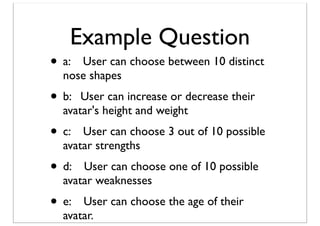
Example Question

• a:

User can choose between 10 distinct
nose shapes

• b:

User can increase or decrease their
avatar's height and weight

• c:

User can choose 3 out of 10 possible
avatar strengths

• d:

User can choose one of 10 possible
avatar weaknesses

• e:

User can choose the age of their
avatar.
Lecture: Prototypes
• Why bother?
• What are your prototyping tools?
• Wireframes / Paper / Digital prototypes
• what are the differences?
• why cascade?
Example Question
• Some game designers don't properly

prototype their UI and as a result, the game
is harder to use than is necessary.

• For 2 marks:


 Explain the benefits of prototyping a
game UI
Example Question
• For 6 marks:


 Describe each of the following, their
benefits, and explain where in the design
process they should be used:

• 	

• 	

• 	


 a: wireframes
	

 b: paper prototypes
	

 c: digital prototypes
Lecture: Expert
Evaluation
• What are benefits & weaknesses of expert
evaluations compared to user evaluations?

• Can you explain why, when, and where you
would want to carry out a Cognitive
Walkthrough or a Heuristic Evaluation of
an interface?
Example Question
• It is often said that a game’s UI should be

tested with members of the target
audience. Sometimes this is not an option
for developers.

• For 3 marks:

Explain how a developer may use Expert
Evaluation techniques in their UI design
process. Include discussion of benefits and
weaknesses.
Example Question
• For 6 marks

Compare and contrast the Expert
Evaluation techniques of Cognitive
Walkthrough and Heuristic Evaluation
Lecture: User Input
• What are benefits and drawbacks to user
evaluations?

• How can you carry out a user evaluation (ask
vs observe)?

• Open Vs Closed Questions - when to use
each / differences / how to write each

• What is card sorting? Why would you use it?
• Open Vs Closed sorting
• How can you analyse card sorts?
Example Questions
• For 3 marks:

Describe how you would use Think Aloud
Protocol to evaluate a user interface.
Comment on the benefits and weaknesses
of the technique.

• Same question for observations / focus
groups
Example Question
• For 4 marks:

Describe the difference between open
and closed questions in a questionnaire and
explain when it would be appropriate to
ask each.
Example Question
• A game under development contains lots of
different types of data.

• For 5 marks:

Explain how a developer could use open
and closed card sorting to help design their
information architecture for this game?
Example Question
• For 2 marks:

How can the results of a card sort inform
the design of menus in a game?

• For 2 marks:

Describe one method of analysing a card
sort.
Lecture:
Semiotics & Icons
• What is semiotics?
• How can an understanding of semiotics
make you a better designer?

• What are the rules for good icon design?
• Can you identify good vs bad and argue
your case?
Example Question
• For 1 mark:

Define semiotics

• For 4 marks:

Describe how an understanding of
semiotics can help a designer communicate
effectively
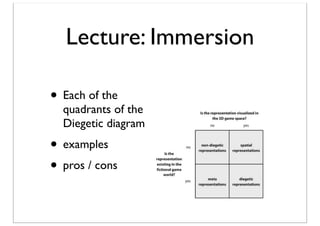
Lecture: Immersion
• Each of the

quadrants of the
Diegetic diagram

• examples
• pros / cons
Example Question
• For 8 marks:

With use of a diagram, define Fagerhold’s
diegetic model of FPS UI and explain each
of his definitions.

• For 2 marks:

Discuss the benefits and weaknesses of
the use of diegesis in game UI
Example Question
• For 6 marks:

What are the rules of good Icon design?
Give examples.
Lecture: Usability
• What are the attributes of a useable
interface?

• What are the human factors that
contribute to usability?

• What techniques can you use to help make
a layout ‘feel’ good.
Example Question
• For 2 mark:

Give Nielsen's definition of Usability.

• For 5 marks:

Give Nielsen's attributes of usability.

• For 2 marks:

Describe Fitt's law and describe how it
can influence a game's UI design.
Example Question
• For 2 marks:

Describe how a designer can use the rule
of thirds or an awareness of the Golden
Ratio in their designs.
Lecture: Colour
• What is colour for? (Tufte’s breakdown)
• do you really understand the different uses for
colour?

• How do we pick a colour scheme?
• What tools can we use?
• What is the reasoning behind these choices?
Example Question
• For 5 marks:


 With examples, describe Tufte's uses of
colour.

• For 5 marks:


 Describe the process that a designer
may go through to choose the colour
scheme for a UI.
Lecture: Layering &
Separation

• There are a number of Data Visualisation
techniques discussed in the lectures.

• What is Layering?
• What is Separation?
• How can you use these techniques?
• Can you think of games where these
techniques are used?
Lecture: Micro / Macro
• Another data visualisation technique
• How does it differ from use of colour?
• How does it differ from use of layering &
separation?

• What are the benefits? What are the
downsides?

• Do you remember the examples?
Example Question
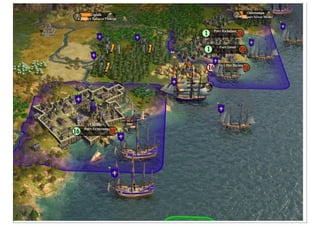
• For 5 marks:

Look at the image and describe which
data visualisation techniques have been
used to communicate with the user.
Example Question
• For 5 marks:

Describe the difference between “Layering
and Separation” and “Micro / Macro” design
techniques.
In general...
• 6 questions from the lectures
• Move from instinctual understanding to
specific and detailed understanding

• Look at the number of marks awarded and
the wording of the question.
Guaranteed Pass
• Take this lecture.
• Take each of the ‘questions’
• answer them thoroughly
• check against the original lectures’ slides
& handouts ‘till you know the material
inside out
Guaranteed Pass cont.
• If you decide to do the above, and write

out an answer to the ‘questions’ above and
if you email me by Thursday noon this week
I’ll email you with good feedback.

• I may be able to do so after Thursday - but
I cannot guarantee this!
Good Luck!

• It’s been a pleasure.

Game design 2 (2013): Lecture 14 - Revision

  • 1.
    2013 Game Design 2 Lecture15: Revision http://gcugd2.com dfarrell@davidlearnsgames.com
  • 2.
    Coursework • I havehad three requests for extensions. • So I’m going to give one to everyone, to be fair. • New hand-in time is: • Friday 13th December • Noon, M615 (my office) • If you want to give it sooner, email me.
  • 3.
    Game Jam • Lastweekend in January • Great for portfolio so try to be there! • There’s a book out with tips etc.
  • 4.
    Comments • On thecourse blog: gcugd2.com • If you have 5 minutes, please feed back.
  • 5.
    Exam • Everyone knowwhen it is? • 10am, Thursday 9th January* * if this is wrong, it is your responsibility to find the correct details
  • 6.
    Questions • There areSIX questions in the exam, each worth 10 marks. • You have to answer FOUR of the six. • This means that even if you spend 20 minutes reading the paper, you still have 25 minutes per question.
  • 7.
    Learning from lastyear • Most of my students said the exam was easy. • Most of them left early. • Most of them got around 50% • People were answering ‘correctly’ - but not thoroughly.
  • 8.
    So what’s inthe exam?
  • 9.
    So what’s inthe exam? • Stuff from the lectures! • Each lecture has some obviously examinable content.
  • 10.
    Reminder • Menus • Text •UI components • Interface (paper) Prototyping • Expert Evaluation
  • 11.
    Reminder • User Evaluation •Semiotics and Icons • Immersion though UI (Diegesis) • Layout & Usability • Colour
  • 12.
    Reminder • Colour • Layersand Separation • Micro and Macro design
  • 13.
    Caveat • Although theexam will be focussing on material from the lectures, this includes all handouts. • So not as simple as memorising the slides • to get *good* marks, you will have had to have read the handouts & links
  • 14.
    Where to focus? • Lookat each lecture’s slides. • • • • The techniques are important. The reasons to use them are important Knowing when and where to use a technique Knowing the difference between two similar techniques is important • • e.g layering & separation Heuristic Evaluation vs Cognitive Walkthrough
  • 15.
    Lecture : MenuFlow • You should be able to write about: • Why you would plan menu flow? • What the benefits are of planning in general? • What the benefits are of use case modelling / user stories (37 Signals menu sketching) and (Fox style) flowcharts? • The processes you would use to create satisfying menus
  • 16.
    Menu Question • Solium Infernum2 is under development. The Developer is aware of negative feedback he received about his menu design in the original game and has hired you to design the menus. • For 5 marks: Describe the processes and techniques you would use to create menus that are you would use to make sure that menus in the game are easy to use and satisfying for the player.
  • 17.
    Lecture: Text • Thereare design issues in using fonts • What are these? • What can you do with a font? • What is the difference between good use of fonts and bad use? • How can text be problematic?
  • 18.
    Example Question • Mostgames feature text, and yet many designers fail to take advantage of the opportunities offered by fonts to contribute to the design of the game. • For 8 marks: In what ways can font choice contribute to a game's design
  • 19.
    Lecture: UI Components • Youshould understand when and where you would use each type of UI component.
  • 20.
    Example Question • Fora game being developed, you have to design a screen that allows the user to configure the appearance and attributes of their avatar. • For each of the below scenarios, describe which UI Component you would choose and justify your decision. (2 marks each)
  • 21.
    Example Question • a: Usercan choose between 10 distinct nose shapes • b: User can increase or decrease their avatar's height and weight • c: User can choose 3 out of 10 possible avatar strengths • d: User can choose one of 10 possible avatar weaknesses • e: User can choose the age of their avatar.
  • 22.
    Lecture: Prototypes • Whybother? • What are your prototyping tools? • Wireframes / Paper / Digital prototypes • what are the differences? • why cascade?
  • 23.
    Example Question • Somegame designers don't properly prototype their UI and as a result, the game is harder to use than is necessary. • For 2 marks: Explain the benefits of prototyping a game UI
  • 24.
    Example Question • For6 marks: Describe each of the following, their benefits, and explain where in the design process they should be used: • • • a: wireframes b: paper prototypes c: digital prototypes
  • 25.
    Lecture: Expert Evaluation • Whatare benefits & weaknesses of expert evaluations compared to user evaluations? • Can you explain why, when, and where you would want to carry out a Cognitive Walkthrough or a Heuristic Evaluation of an interface?
  • 26.
    Example Question • Itis often said that a game’s UI should be tested with members of the target audience. Sometimes this is not an option for developers. • For 3 marks: Explain how a developer may use Expert Evaluation techniques in their UI design process. Include discussion of benefits and weaknesses.
  • 27.
    Example Question • For6 marks Compare and contrast the Expert Evaluation techniques of Cognitive Walkthrough and Heuristic Evaluation
  • 28.
    Lecture: User Input •What are benefits and drawbacks to user evaluations? • How can you carry out a user evaluation (ask vs observe)? • Open Vs Closed Questions - when to use each / differences / how to write each • What is card sorting? Why would you use it? • Open Vs Closed sorting • How can you analyse card sorts?
  • 29.
    Example Questions • For3 marks: Describe how you would use Think Aloud Protocol to evaluate a user interface. Comment on the benefits and weaknesses of the technique. • Same question for observations / focus groups
  • 30.
    Example Question • For4 marks: Describe the difference between open and closed questions in a questionnaire and explain when it would be appropriate to ask each.
  • 31.
    Example Question • Agame under development contains lots of different types of data. • For 5 marks: Explain how a developer could use open and closed card sorting to help design their information architecture for this game?
  • 32.
    Example Question • For2 marks: How can the results of a card sort inform the design of menus in a game? • For 2 marks: Describe one method of analysing a card sort.
  • 33.
    Lecture: Semiotics & Icons •What is semiotics? • How can an understanding of semiotics make you a better designer? • What are the rules for good icon design? • Can you identify good vs bad and argue your case?
  • 34.
    Example Question • For1 mark: Define semiotics • For 4 marks: Describe how an understanding of semiotics can help a designer communicate effectively
  • 35.
    Lecture: Immersion • Eachof the quadrants of the Diegetic diagram • examples • pros / cons
  • 36.
    Example Question • For8 marks: With use of a diagram, define Fagerhold’s diegetic model of FPS UI and explain each of his definitions. • For 2 marks: Discuss the benefits and weaknesses of the use of diegesis in game UI
  • 37.
    Example Question • For6 marks: What are the rules of good Icon design? Give examples.
  • 38.
    Lecture: Usability • Whatare the attributes of a useable interface? • What are the human factors that contribute to usability? • What techniques can you use to help make a layout ‘feel’ good.
  • 39.
    Example Question • For2 mark: Give Nielsen's definition of Usability. • For 5 marks: Give Nielsen's attributes of usability. • For 2 marks: Describe Fitt's law and describe how it can influence a game's UI design.
  • 40.
    Example Question • For2 marks: Describe how a designer can use the rule of thirds or an awareness of the Golden Ratio in their designs.
  • 41.
    Lecture: Colour • Whatis colour for? (Tufte’s breakdown) • do you really understand the different uses for colour? • How do we pick a colour scheme? • What tools can we use? • What is the reasoning behind these choices?
  • 42.
    Example Question • For5 marks: With examples, describe Tufte's uses of colour. • For 5 marks: Describe the process that a designer may go through to choose the colour scheme for a UI.
  • 43.
    Lecture: Layering & Separation •There are a number of Data Visualisation techniques discussed in the lectures. • What is Layering? • What is Separation? • How can you use these techniques? • Can you think of games where these techniques are used?
  • 44.
    Lecture: Micro /Macro • Another data visualisation technique • How does it differ from use of colour? • How does it differ from use of layering & separation? • What are the benefits? What are the downsides? • Do you remember the examples?
  • 45.
    Example Question • For5 marks: Look at the image and describe which data visualisation techniques have been used to communicate with the user.
  • 47.
    Example Question • For5 marks: Describe the difference between “Layering and Separation” and “Micro / Macro” design techniques.
  • 48.
    In general... • 6questions from the lectures • Move from instinctual understanding to specific and detailed understanding • Look at the number of marks awarded and the wording of the question.
  • 49.
    Guaranteed Pass • Takethis lecture. • Take each of the ‘questions’ • answer them thoroughly • check against the original lectures’ slides & handouts ‘till you know the material inside out
  • 50.
    Guaranteed Pass cont. •If you decide to do the above, and write out an answer to the ‘questions’ above and if you email me by Thursday noon this week I’ll email you with good feedback. • I may be able to do so after Thursday - but I cannot guarantee this!
  • 51.
    Good Luck! • It’sbeen a pleasure.