IT’S GONNA BE
<the future soon
Science Fiction, Video Games, and the
Future of Learning
Educator/Gamer
Twitter:
PCSTech
www.edurealms.com
I am a geek.
If the previous slides didn’t clue you in, I’m a geek. I wear it like a badge of honor. There are
a few things I believe about geeks...
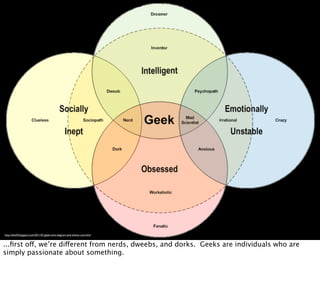
http://altloff.blogspot.com/2011/01/geek-venn-diagram-and-where-i-am.html
...first off, we’re different from nerds, dweebs, and dorks. Geeks are individuals who are
simply passionate about something.
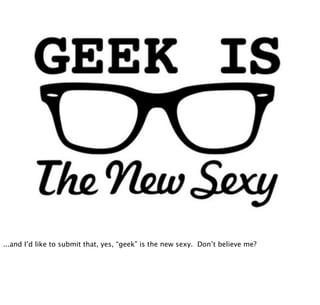
...and I’d like to submit that, yes, “geek” is the new sexy. Don’t believe me?
My “Teacher Glasses”
No, I don’t wear them in public!
So, what do I “geek out” about? Well, there are several things, actually, but a few things close
to the top of the list are video games, science fiction, and yes, learning! In fact, this whole
presentation is about these three things colliding.
One thing that’s very challenging for me is to turn off my “educator switch.” There have been
several instances where while watching a movie or playing a game I’ve had these bizarre,
“Oooh... if I could use THAT in the classroom...” epiphanies. I often encourage educators to
think about the world around them in that mindset. I call it putting on your teacher lenses.
OMG!
Being my geek self, doing my geek things... Looking at life through my teacher glasses has
given me some real OMG moments. And, I want to share a few of my recent ones with you.
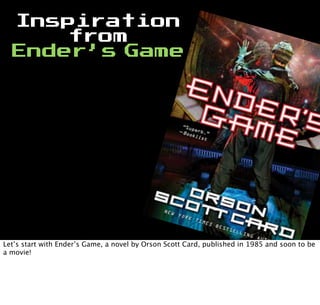
Inspiration
from
Ender’s Game
Let’s start with Ender’s Game, a novel by Orson Scott Card, published in 1985 and soon to be
a movie!
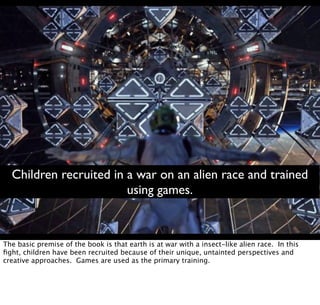
Children recruited in a war on an alien race and trained
using games.
The basic premise of the book is that earth is at war with a insect-like alien race. In this
fight, children have been recruited because of their unique, untainted perspectives and
creative approaches. Games are used as the primary training.
But, we’re already using games for learning!
Yes, but, there are some clear distinctions...
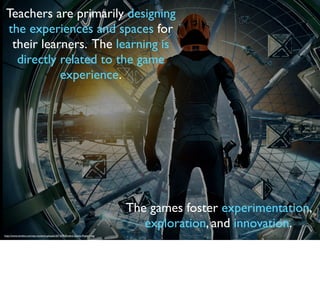
Teachers are primarily designing
the experiences and spaces for
their learners. The learning is
directly related to the game
experience.
The games foster experimentation,
exploration, and innovation.
http://www.nerdist.com/wp-content/uploads/2013/05/Enders-Game-Poster1.jpg
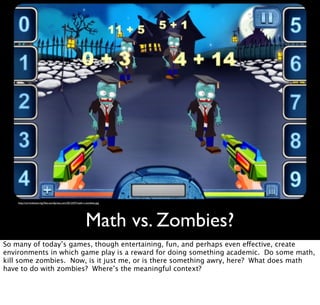
Math vs. Zombies?
http://carnivaltutoring.files.wordpress.com/2012/07/math-v-zombies.jpg
So many of today’s games, though entertaining, fun, and perhaps even effective, create
environments in which game play is a reward for doing something academic. Do some math,
kill some zombies. Now, is it just me, or is there something awry, here? What does math
have to do with zombies? Where’s the meaningful context?
http://www.digitaltrends.com/wp-content/uploads/2013/06/World-War-Z-special-effects-helicopter-41.jpg
Can you imagine a real world scenario like that? Yeah... thought not. Game play within
meaningful context is the key. Also, the best games are the ones that give us those spaces
for experimentation.
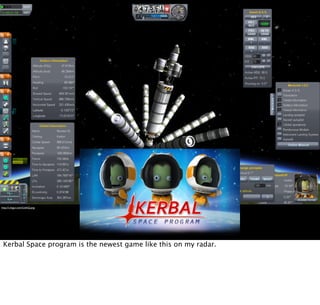
http://i.imgur.com/UofvQ.png
Kerbal Space program is the newest game like this on my radar.
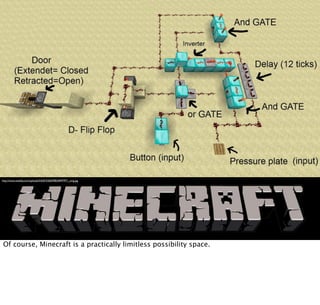
http://www.weebly.com/uploads/5/6/0/3/5603982/8497971_orig.jpg
Of course, Minecraft is a practically limitless possibility space.
Games like Guild Wars 2 and World of Warcraft give us rich environments through which we
can explore literacy and leadership.
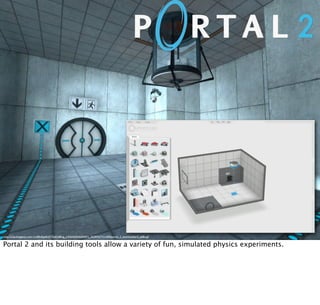
http://2.bp.blogspot.com/-Co00nAgwKdY/TadNdBiog_I/AAAAAAAAAAY/j_2ih3R9q7Y/s1600/portal_2_testchamber4_o68n.gif
Portal 2 and its building tools allow a variety of fun, simulated physics experiments.
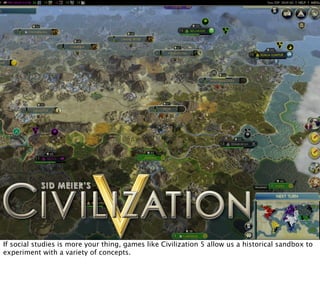
If social studies is more your thing, games like Civilization 5 allow us a historical sandbox to
experiment with a variety of concepts.
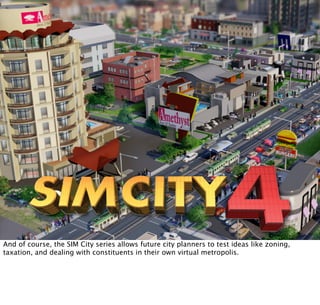
And of course, the SIM City series allows future city planners to test ideas like zoning,
taxation, and dealing with constituents in their own virtual metropolis.
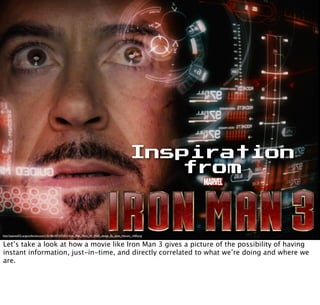
Inspiration
from
http://payload53.cargocollective.com/1/5/186147/3373311/Iron_Man_Mark_VII_HUD_design_By_Jayse_Hansen_1400.png
Let’s take a look at how a movie like Iron Man 3 gives a picture of the possibility of having
instant information, just-in-time, and directly correlated to what we’re doing and where we
are.
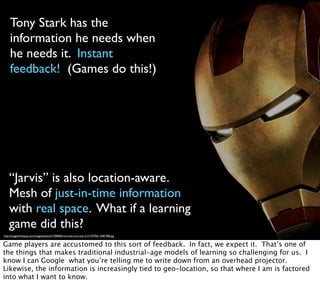
Tony Stark has the
information he needs when
he needs it. Instant
feedback! (Games do this!)
“Jarvis” is also location-aware.
Mesh of just-in-time information
with real space. What if a learning
game did this?
http://images5.fanpop.com/image/photos/31700000/iron-man-iron-man-3-31757925-1440-900.jpg
Game players are accustomed to this sort of feedback. In fact, we expect it. That’s one of
the things that makes traditional industrial-age models of learning so challenging for us. I
know I can Google what you’re telling me to write down from an overhead projector.
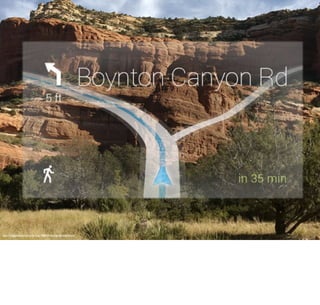
Likewise, the information is increasingly tied to geo-location, so that where I am is factored
into what I want to know.
The future is here, already!
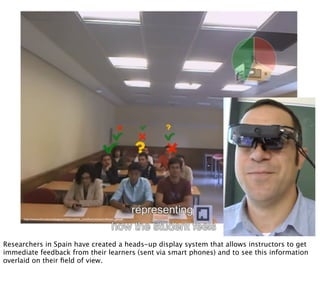
http://www.uc3m.es/portal/page/portal/actualidad_cientifica/noticias/professors_glasses
Researchers in Spain have created a heads-up display system that allows instructors to get
immediate feedback from their learners (sent via smart phones) and to see this information
overlaid on their field of view.
http://techosta.com/wp-content/uploads/2013/07/google-glass-wallpaper-hd.jpg
And you’ve seen Project Glass from Google, right?
http://img.gawkerassets.com/img/18f88a9cnsq5gpng/original.png
Cool tech, but what about the games?
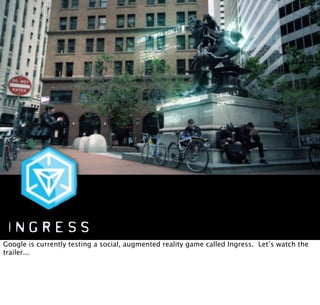
Google is currently testing a social, augmented reality game called Ingress. Let’s watch the
trailer...
https://raw.github.com/jonatkins/ingress-intel-total-conversion/master/screenshots/screen.png
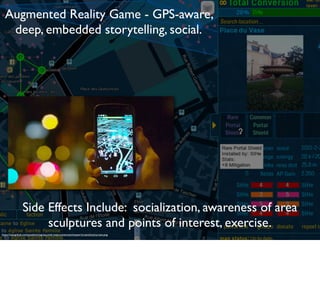
Augmented Reality Game - GPS-aware,
deep, embedded storytelling, social.
Side Effects Include: socialization, awareness of area
sculptures and points of interest, exercise.
Imagine A Field Trip With This!?!
http://langwitches.org/blog/wp-content/uploads/2009/04/fieldtrip.jpg
Can you imagine a tool like this on field trips or creating a similar game at your school?
http://blogs.smithsonianmag.com/ideas/2012/08/augmented-reality-livens-up-museums/
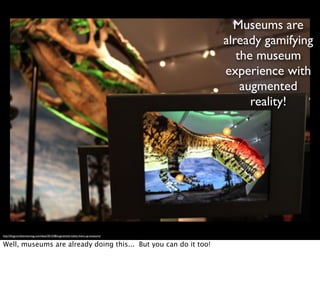
Museums are
already gamifying
the museum
experience with
augmented
reality!
Well, museums are already doing this... But you can do it too!
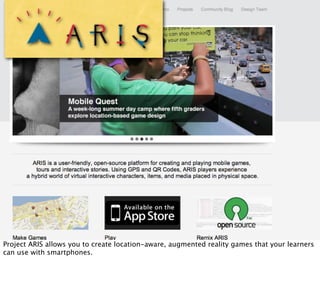
Project ARIS allows you to create location-aware, augmented reality games that your learners
can use with smartphones.
Inspiration
from
Minority
Report
http://www.impawards.com/2002/posters/minority_report_ver4.jpg
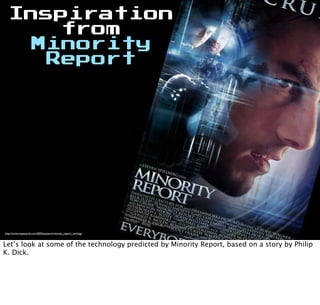
Let’s look at some of the technology predicted by Minority Report, based on a story by Philip
K. Dick.
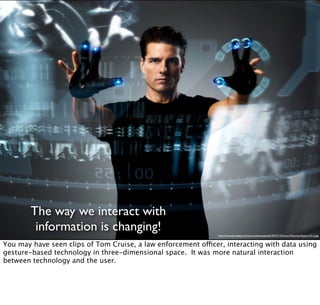
The way we interact with
information is changing! http://www.bitrebels.com/wp-content/uploads/2010/12/Kinect-Minority-Report-UI-2.jpg
You may have seen clips of Tom Cruise, a law enforcement officer, interacting with data using
gesture-based technology in three-dimensional space. It was more natural interaction
between technology and the user.
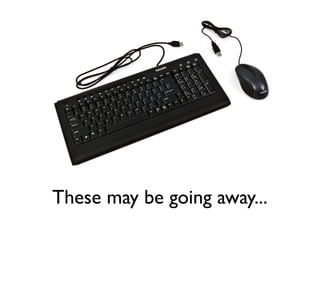
These may be going away...
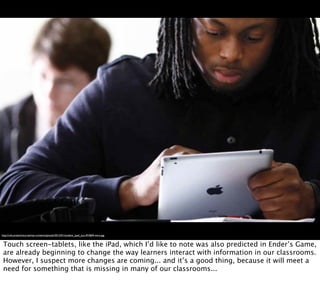
http://cdn.arstechnica.net/wp-content/uploads/2012/01/student_ipad_acu-4f186f4-intro.jpg
Touch screen-tablets, like the iPad, which I’d like to note was also predicted in Ender’s Game,
are already beginning to change the way learners interact with information in our classrooms.
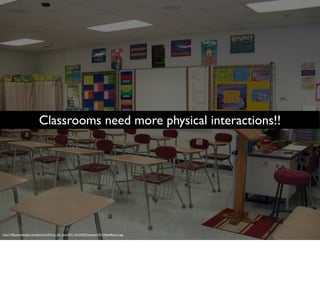
However, I suspect more changes are coming... and it’s a good thing, because it will meet a
need for something that is missing in many of our classrooms...
Classrooms need more physical interactions!!
http://i180.photobucket.com/albums/x103/mrs_hill_ecms/2011-2012%20Classroom/2011SideofRoom1.jpg
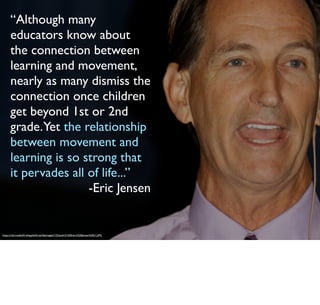
“Although many
educators know about
the connection between
learning and movement,
nearly as many dismiss the
connection once children
get beyond 1st or 2nd
grade.Yet the relationship
between movement and
learning is so strong that
it pervades all of life...”
-Eric Jensen
https://cdn.media34.whipplehill.net/ftpimages/123/push/21505/eric%20Jensen%20(1).JPG
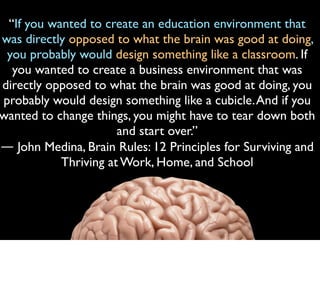
Brain Rules - John Medina
http://zze.st/wp-content/uploads/2010/11/John-Medina-Webcast.jpg
“If you wanted to create an education environment that
was directly opposed to what the brain was good at doing,
you probably would design something like a classroom. If
you wanted to create a business environment that was
directly opposed to what the brain was good at doing, you
probably would design something like a cubicle.And if you
wanted to change things, you might have to tear down both
and start over.”
― John Medina, Brain Rules: 12 Principles for Surviving and
Thriving at Work, Home, and School
Games To The
Rescue!
Here’s a place where the technology predicted by science fiction, is becoming a reality, and
the games that use the technology are meeting a need in creative ways.
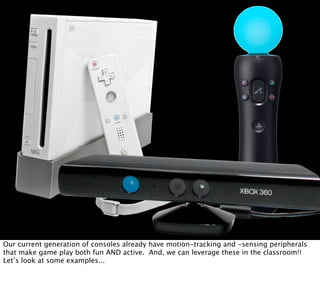
Our current generation of consoles already have motion-tracking and -sensing peripherals
that make game play both fun AND active. And, we can leverage these in the classroom!!
Let’s look at some examples...
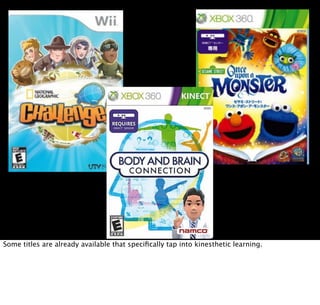
Some titles are already available that specifically tap into kinesthetic learning.
http://cache.gawkerassets.com/assets/images/9/2009/12/endless_ocean2.jpg
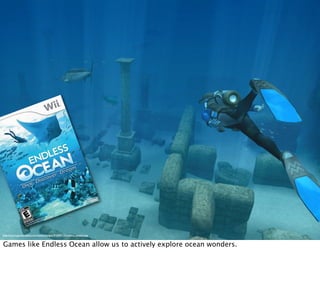
Games like Endless Ocean allow us to actively explore ocean wonders.
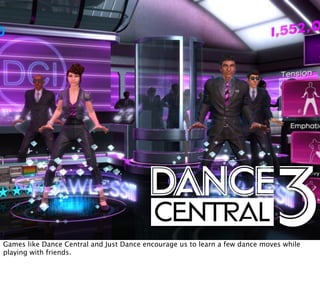
Games like Dance Central and Just Dance encourage us to learn a few dance moves while
playing with friends.
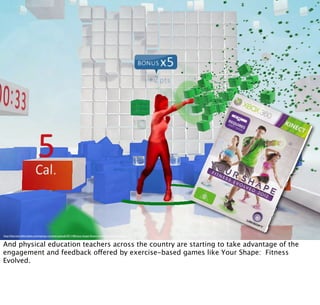
http://thecontrolleronline.com/wp/wp-content/uploads/2011/06/your-shape-fitness-evolved-screenshot-6.jpg
And physical education teachers across the country are starting to take advantage of the
engagement and feedback offered by exercise-based games like Your Shape: Fitness
Evolved.
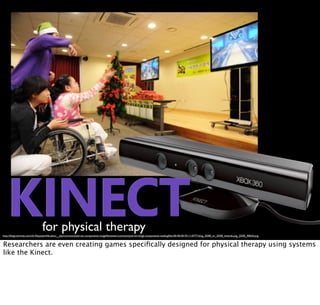
http://blogs.technet.com/cfs-filesystemfile.ashx/__key/communityserver-components-imagefileviewer/communityserver-blogs-components-weblogfiles-00-00-00-93-11/0777.blog_2D00_kr_2D00_kinect6.png_2D00_400x0.png
for physical therapy
Researchers are even creating games specifically designed for physical therapy using systems
like the Kinect.
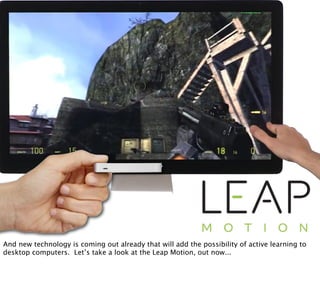
http://www.eyalo.com/wp-content/uploads/2012/10/Leap_Motion_gameplay.jpg http://www.irisclasson.com/wp-content/uploads/2013/05/LeapMotionDevelopment.jpg
And new technology is coming out already that will add the possibility of active learning to
desktop computers. Let’s take a look at the Leap Motion, out now...
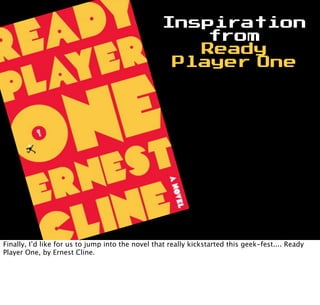
Inspiration
from
Ready
Player One
Finally, I’d like for us to jump into the novel that really kickstarted this geek-fest.... Ready
Player One, by Ernest Cline.
http://wallpaperswa.com/thumbnails/detail/20120824/cyberpunk%20artwork%20virtual%20virtual%20reality%201920x1080%20wallpaper_wallpaperswa.com_21.jpg
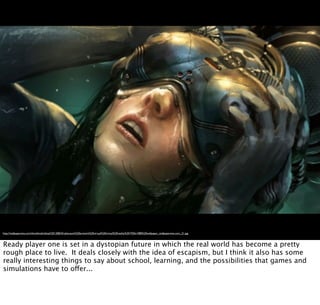
Ready player one is set in a dystopian future in which the real world has become a pretty
rough place to live. It deals closely with the idea of escapism, but I think it also has some
really interesting things to say about school, learning, and the possibilities that games and
simulations have to offer...
http://media.aintitcool.com/coolproduction/ckeditor_assets/pictures/3341/original/1-Artwork-Ready_Player_One-The_Stacks-Pencil.jpg?1315527353
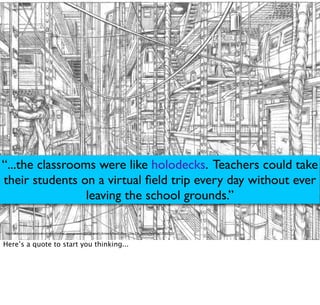
“...the classrooms were like holodecks. Teachers could take
their students on a virtual field trip every day without ever
leaving the school grounds.”
Here’s a quote to start you thinking...
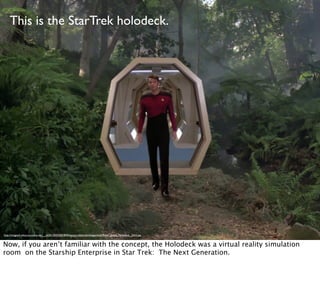
This is the StarTrek holodeck.
http://images4.wikia.nocookie.net/__cb20120425001849/memoryalpha/en/images/e/eb/Riker_Jungle_Holodeck_2364.jpg
Now, if you aren’t familiar with the concept, the Holodeck was a virtual reality simulation
room on the Starship Enterprise in Star Trek: The Next Generation.
http://www.dvdtimes.co.uk/images/MarkBoydell/ancientegyptians1.jpg
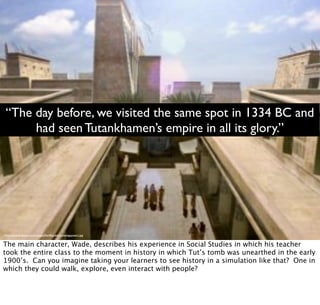
“The day before, we visited the same spot in 1334 BC and
had seen Tutankhamen’s empire in all its glory.”
The main character, Wade, describes his experience in Social Studies in which his teacher
took the entire class to the moment in history in which Tut’s tomb was unearthed in the early
1900’s. Can you imagine taking your learners to see history in a simulation like that? One in
which they could walk, explore, even interact with people?
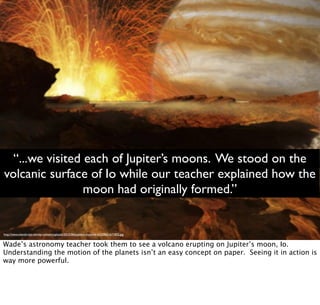
http://www.islandcrisis.net/wp-content/uploads/2012/06/Jupiters-moon-Io-e1339651671832.jpg
“...we visited each of Jupiter’s moons. We stood on the
volcanic surface of Io while our teacher explained how the
moon had originally formed.”
Wade’s astronomy teacher took them to see a volcano erupting on Jupiter’s moon, Io.
Understanding the motion of the planets isn’t an easy concept on paper. Seeing it in action is
way more powerful.
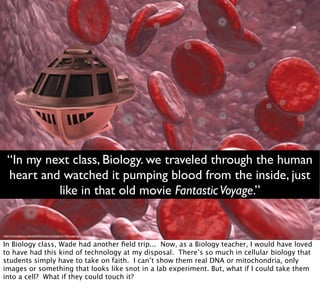
“In my next class, Biology. we traveled through the human
heart and watched it pumping blood from the inside, just
like in that old movie FantasticVoyage.”
http://convergence.ucsb.edu/files/issues/convergence-14/voyage.jpg
In Biology class, Wade had another field trip... Now, as a Biology teacher, I would have loved
to have had this kind of technology at my disposal. There’s so much in cellular biology that
students simply have to take on faith. I can’t show them real DNA or mitochondria, only
images or something that looks like snot in a lab experiment. But, what if I could take them
into a cell? What if they could touch it?
It’s coming sooner than you think...
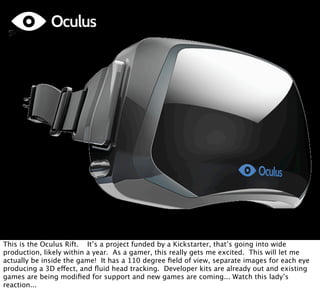
Here’s what really gets me excited.... We are on the verge of this possibility today!
This is the Oculus Rift. It’s a project funded by a Kickstarter, that’s going into wide
production, likely within a year. As a gamer, this really gets me excited. This will let me
actually be inside the game! It has a 110 degree field of view, separate images for each eye
producing a 3D effect, and fluid head tracking. Developer kits are already out and existing
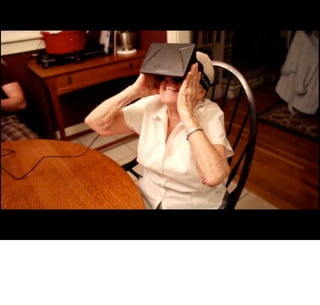
games are being modified for support and new games are coming... Watch this lady’s
reaction...
What if?
One of my favorite questions! What if you had access to this technology for your learners?
What if you could take your kids to ancient Egypt? What if the Egyptian avatars were actually
controlled by other players? What if what started as a field trip erupted into a murder
mystery to find out what or who killed King Tut?
teachers are the
ones that will
carry us into that
future.<
Trust that little voice in
your head that says,
“Wouldn’t it be
interesting if...” And
then do it!
-Duane Michals
Thanks to Jonathan Coulton for writing cool
music for geeks and inspiring the title!
Go Buy His Music!
http://www.jonathancoulton.com

It's Gonna Be The Future Soon: Science Fiction, Video Games, and the Future of Learning