SUPER-CONDUCTOR
Muhammad Hamza
5th Semester
B.Sc. Textile Technology
CONTENTS
University of Agriculture Faisalabad – uaf
Superconductors
Discovery
Properties
Types
Application of
superconductorsAdvantages and
Disadvantages
Limitations
SUPERCONDUCTOR
 A Superconductor is a material that loses all its resistance to the flow of
electric current when it is cooled below a certain temperature called the
critical temperature or transition temperature Tc.
 Examples : Mercury(Hg), Vanadium(V),
Yttrium barium copper oxide(YBCO)
University of Agriculture Faisalabad – uaf
TRANSITION TEMPERATURE
University of Agriculture Faisalabad – uaf
HISTORY
University of Agriculture Faisalabad – uaf
• Superconductivity was first
discovered in 1911 by the
Dutch physicist,Heike
Kammerlingh Onnes.
HISTORY
University of Agriculture Faisalabad – uaf
• Onnes felt that a wire’s resistance would vanish if it is
cooled too much. This suggested that there would be a
steady decrease in electrical resistance, allowing for
better conduction of electricity.
• Onnes passed a current through a pure mercury wire
and measured its resistance as he gradually decreased its
temperature. To his surprise there was little or no
resistance at 4.2 K.
University of Agriculture Faisalabad – uaf
PROPERTIES
• Electrical resistance: Virtually zero electrical resistance.
• Effect of impurities: When impurities are added to superconducting
elements, the superconductivity is not loss but the T c is lowered.
• Effects of pressures and stress: certain materials exhibits
superconductivity on increasing the pressure in superconductors, the
increase in stress results in increase of the T c value
University of Agriculture Faisalabad – uaf
CONTI…..
• Magnetic field effect: If Strong magnetic field applied to a
superconductors below its T C , the superconductors undergoes
a transition from superconducting state to normal state.
University of Agriculture Faisalabad – uaf
MEISSNER EFFECT
• The complete expulsion of all magnetic field by a superconducting material is called
“Meissner effect”
• Magnetic field does not penetrate the sample
• Normal state: T > Tc
• Superconducting state : T < Tc
• The Meissner effect is a distinct characteristics of a superconducting from a normal
perfect conductor. In addition, this effect is exhibited by the superconducting materials
only when the applied field is less then the critical field Hc.
University of Agriculture Faisalabad – uaf
MAGNETIC LEVITATION (MAGLEV)
• Magnetic Levitation or Maglev is the process by which an object is
suspended above another object with no other support but magnetic fields.
• The phenomenon of magnetic levitation is based on Meissner effect.
• The magnetic levitation is brought about by enormous repulsion between
two highly powerful magnetic fields.
University of Agriculture Faisalabad – uaf
MAGNETIC
LEVITATION
University of Agriculture Faisalabad – uaf
TYPES 1 SUPERCONDUCTORS
University of Agriculture Faisalabad – uaf
These superconductors are
called as soft
superconductors.
2. Only one critical magnetic
field exist for these
superconductors.
3. The critical field value is
very low.
4. These superconductors
exhibit perfect and
complete Meissner effect.
5. These materials have
limited technical
applications because of very
low field strength value.
Examples : Pb, Hg, Zn, etc.
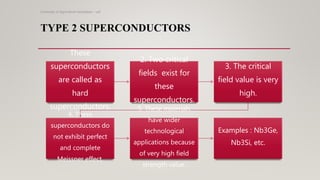
TYPE 2 SUPERCONDUCTORS
University of Agriculture Faisalabad – uaf
These
superconductors
are called as
hard
superconductors.
2. Two critical
fields exist for
these
superconductors.
3. The critical
field value is very
high.
4. These
superconductors do
not exhibit perfect
and complete
Meissner effect.
5. These materials
have wider
technological
applications because
of very high field
strength value.
Examples : Nb3Ge,
Nb3Si, etc.
APPLICATIONS
University of Agriculture Faisalabad – uaf
Maglev train
Magnetic
Resonance
Imaging (MRI)
Superconducting
wire
Rail gun and coil
gun magnets.
Electric motors
and generators
SQUID:
Superconducting
Quantum Interference
Device, it is used in
Particle accelerators
and many other
devices.
APPLICATIONS
University of Agriculture Faisalabad – uaf
ADVANTAGES
University of Agriculture Faisalabad – uaf
Magnetic
levitation
Power & cost
efficient
Reduces the size &
weight of motors,
generators &
supporting
equipments
DISADVANTAGES
University of Agriculture Faisalabad – uaf
Extremely brittle Very low critical temperature Not applicable for consumer
electronics
LIMITATIONS
University of Agriculture Faisalabad – uaf
• The biggest problem of the superconductors is their
‘’COOL’’ nature . Creating a temperature near 0 k is not
a easy job. Cooling arrangements involve a huge cost
which is why superconductors have yet to make a really
big impact on the world, despite being discovered a
century ago.
University of Agriculture Faisalabad – uaf

Super conductor

  • 1.
  • 2.
    CONTENTS University of AgricultureFaisalabad – uaf Superconductors Discovery Properties Types Application of superconductorsAdvantages and Disadvantages Limitations
  • 3.
    SUPERCONDUCTOR  A Superconductoris a material that loses all its resistance to the flow of electric current when it is cooled below a certain temperature called the critical temperature or transition temperature Tc.  Examples : Mercury(Hg), Vanadium(V), Yttrium barium copper oxide(YBCO) University of Agriculture Faisalabad – uaf
  • 4.
    TRANSITION TEMPERATURE University ofAgriculture Faisalabad – uaf
  • 5.
    HISTORY University of AgricultureFaisalabad – uaf • Superconductivity was first discovered in 1911 by the Dutch physicist,Heike Kammerlingh Onnes.
  • 6.
    HISTORY University of AgricultureFaisalabad – uaf • Onnes felt that a wire’s resistance would vanish if it is cooled too much. This suggested that there would be a steady decrease in electrical resistance, allowing for better conduction of electricity. • Onnes passed a current through a pure mercury wire and measured its resistance as he gradually decreased its temperature. To his surprise there was little or no resistance at 4.2 K.
  • 7.
    University of AgricultureFaisalabad – uaf
  • 8.
    PROPERTIES • Electrical resistance:Virtually zero electrical resistance. • Effect of impurities: When impurities are added to superconducting elements, the superconductivity is not loss but the T c is lowered. • Effects of pressures and stress: certain materials exhibits superconductivity on increasing the pressure in superconductors, the increase in stress results in increase of the T c value University of Agriculture Faisalabad – uaf
  • 9.
    CONTI….. • Magnetic fieldeffect: If Strong magnetic field applied to a superconductors below its T C , the superconductors undergoes a transition from superconducting state to normal state. University of Agriculture Faisalabad – uaf
  • 10.
    MEISSNER EFFECT • Thecomplete expulsion of all magnetic field by a superconducting material is called “Meissner effect” • Magnetic field does not penetrate the sample • Normal state: T > Tc • Superconducting state : T < Tc • The Meissner effect is a distinct characteristics of a superconducting from a normal perfect conductor. In addition, this effect is exhibited by the superconducting materials only when the applied field is less then the critical field Hc. University of Agriculture Faisalabad – uaf
  • 11.
    University of AgricultureFaisalabad – uaf
  • 12.
    MAGNETIC LEVITATION (MAGLEV) •Magnetic Levitation or Maglev is the process by which an object is suspended above another object with no other support but magnetic fields. • The phenomenon of magnetic levitation is based on Meissner effect. • The magnetic levitation is brought about by enormous repulsion between two highly powerful magnetic fields. University of Agriculture Faisalabad – uaf
  • 13.
  • 14.
    TYPES 1 SUPERCONDUCTORS Universityof Agriculture Faisalabad – uaf These superconductors are called as soft superconductors. 2. Only one critical magnetic field exist for these superconductors. 3. The critical field value is very low. 4. These superconductors exhibit perfect and complete Meissner effect. 5. These materials have limited technical applications because of very low field strength value. Examples : Pb, Hg, Zn, etc.
  • 15.
    TYPE 2 SUPERCONDUCTORS Universityof Agriculture Faisalabad – uaf These superconductors are called as hard superconductors. 2. Two critical fields exist for these superconductors. 3. The critical field value is very high. 4. These superconductors do not exhibit perfect and complete Meissner effect. 5. These materials have wider technological applications because of very high field strength value. Examples : Nb3Ge, Nb3Si, etc.
  • 16.
    APPLICATIONS University of AgricultureFaisalabad – uaf Maglev train Magnetic Resonance Imaging (MRI) Superconducting wire Rail gun and coil gun magnets. Electric motors and generators SQUID: Superconducting Quantum Interference Device, it is used in Particle accelerators and many other devices.
  • 17.
  • 18.
    ADVANTAGES University of AgricultureFaisalabad – uaf Magnetic levitation Power & cost efficient Reduces the size & weight of motors, generators & supporting equipments
  • 19.
    DISADVANTAGES University of AgricultureFaisalabad – uaf Extremely brittle Very low critical temperature Not applicable for consumer electronics
  • 20.
    LIMITATIONS University of AgricultureFaisalabad – uaf • The biggest problem of the superconductors is their ‘’COOL’’ nature . Creating a temperature near 0 k is not a easy job. Cooling arrangements involve a huge cost which is why superconductors have yet to make a really big impact on the world, despite being discovered a century ago.
  • 21.
    University of AgricultureFaisalabad – uaf