KENAF FIBER
Muhammad Hamza
2016-Ag-7399
5th Semester
B.Sc. Textile Technology
INTRODUCTION
 Kenaf fiber is a natural fiber obtain from kenaf plant .
 Family : Malvaceae
 Botanical name : Hibiscus Cannabinus
 Growing countries are China(44%),India (39%),Indonesia,Malaysia,Bangladesh and
USA etc.
UNIVERSITY OF AGRICULTURE FAISALABAD – UAF
CULTIVATION
 It is sown from May to October.
 Temperature needed from 20-27 degree centigrade.
 Height of plant is 5-6 m .
 Life cycle of kenaf plant is 105-120 days.
UNIVERSITY OF AGRICULTURE FAISALABAD – UAF
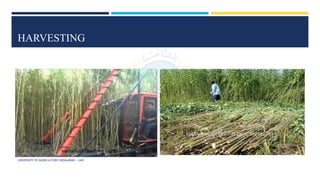
HARVESTING
UNIVERSITY OF AGRICULTURE FAISALABAD – UAF
KENAF FIBER
 Raw kenaf fiber obtained from outer bark.
 Kenaf fiber contains approximately 65.7%
 cellulose, 21.6% lignin and pectin, and other composition. Lignin must be extracted
to separate the fibers
UNIVERSITY OF AGRICULTURE FAISALABAD – UAF
SEPARATION OF KENAF FIBER
 There are two methods to separate the kenaf fibers.
 Mechanical method
 Chemical method
UNIVERSITY OF AGRICULTURE FAISALABAD – UAF
MECHANICAL METHOD
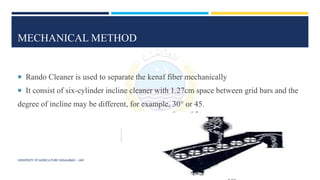
 Rando Cleaner is used to separate the kenaf fiber mechanically
 It consist of six-cylinder incline cleaner with 1.27cm space between grid bars and the
degree of incline may be different, for example, 30° or 45.
UNIVERSITY OF AGRICULTURE FAISALABAD – UAF
CHEMICAL METHOD
 Sulphuric acid is most commonly used in chemical retting to produce bast fibers.
 n this technique, the plant stems are immersed in the chemical over a specific time
period (typically 1 -8 hours) using a ratio of 1 kg of plant to 10 L of water. ...
UNIVERSITY OF AGRICULTURE FAISALABAD – UAF
SPINNING OF KENAF FIBERS
 The procedure for yarns spinning includes several steps.
 The most common processes are opening, carding, drawing and spinning.
 opening: in this process fibers are opened and heavy trash ( such as leaves, seed )is
removed.
 Carding : Carding machines are the most important equipment to form fibrous web.
The output of card is sliver. In carding 99.5% trash is removed.
 drawing and spinning : in this process the sliver is reduced to yarn by drafting and
twisting the fibers .
UNIVERSITY OF AGRICULTURE FAISALABAD – UAF
MERCERIZATION
 Mercerization is the treatment of fabrics or yarns, with an alkali (sodium hydroxide
or liquid ammonia) to increase luster.
 The alkali causes the fiber walls to swell and thus increasing in strength,
luster, and absorbency. Mercerization also enhances dyeability of cellulosic fibers.
 This process may be applied at the yarn or fabric stage.
UNIVERSITY OF AGRICULTURE FAISALABAD – UAF
USES OF KENAF FIBERS
 There are many uses of kenaf fibers.
 The main uses of kenaf fibers are rope, coarse cloth and paper formation.
 packing material; and material that absorbs oil and liquids.
 plastic composites
 Ford and BMW are making the material for the automobile bodies in part from kenaf.
 Kenaf seed oil : The kenaf seed oil is also used for cosmetics,, edible vegetable oil
industrial lubricants and for biofuel production.
UNIVERSITY OF AGRICULTURE FAISALABAD – UAF
REFERENCES
 [1] Cook, J.G. 1960. Handbook of Textile Fibers, Merrow Publishing, Watford, UK, p.20.

 [2] United States Department of Agriculture, Economic and Research Service, Washington, DC. 1993. Industrial uses of agricultural
materials, situation and outlook report. [3] Calamari, T. A., Tao, W., and Goynes, W. R. 1997. A Preliminary Study of Kenaf Fiber
Bundles and Their Composite Cells. Tappi Journal, 80 (8), 149-154.

 [4] Moreau, J. P., Bel-Berger, P., Tao, W. 1995. Mechanical Processing of Kenaf for Nonwovens. Tappi Journal, 78 (2), 96-105.

 [5] Ramaswamy, G.N., Boyd, C.R., Bel-Burger, P. and Kimmel, L.1995. Kenaf/Cotton Blend for Textiles. Family and Consumer
Sciences Research Journal, 24 (2), 180190.

 [6] Ramaswamy, G. N., Ruff, C. G., and Boyd, C. R. 1995. Kenaf/Cotton blends for textiles
UNIVERSITY OF AGRICULTURE FAISALABAD – UAF

Kenaf plant

  • 1.
    KENAF FIBER Muhammad Hamza 2016-Ag-7399 5thSemester B.Sc. Textile Technology
  • 2.
    INTRODUCTION  Kenaf fiberis a natural fiber obtain from kenaf plant .  Family : Malvaceae  Botanical name : Hibiscus Cannabinus  Growing countries are China(44%),India (39%),Indonesia,Malaysia,Bangladesh and USA etc. UNIVERSITY OF AGRICULTURE FAISALABAD – UAF
  • 3.
    CULTIVATION  It issown from May to October.  Temperature needed from 20-27 degree centigrade.  Height of plant is 5-6 m .  Life cycle of kenaf plant is 105-120 days. UNIVERSITY OF AGRICULTURE FAISALABAD – UAF
  • 4.
  • 5.
    KENAF FIBER  Rawkenaf fiber obtained from outer bark.  Kenaf fiber contains approximately 65.7%  cellulose, 21.6% lignin and pectin, and other composition. Lignin must be extracted to separate the fibers UNIVERSITY OF AGRICULTURE FAISALABAD – UAF
  • 6.
    SEPARATION OF KENAFFIBER  There are two methods to separate the kenaf fibers.  Mechanical method  Chemical method UNIVERSITY OF AGRICULTURE FAISALABAD – UAF
  • 7.
    MECHANICAL METHOD  RandoCleaner is used to separate the kenaf fiber mechanically  It consist of six-cylinder incline cleaner with 1.27cm space between grid bars and the degree of incline may be different, for example, 30° or 45. UNIVERSITY OF AGRICULTURE FAISALABAD – UAF
  • 8.
    CHEMICAL METHOD  Sulphuricacid is most commonly used in chemical retting to produce bast fibers.  n this technique, the plant stems are immersed in the chemical over a specific time period (typically 1 -8 hours) using a ratio of 1 kg of plant to 10 L of water. ... UNIVERSITY OF AGRICULTURE FAISALABAD – UAF
  • 9.
    SPINNING OF KENAFFIBERS  The procedure for yarns spinning includes several steps.  The most common processes are opening, carding, drawing and spinning.  opening: in this process fibers are opened and heavy trash ( such as leaves, seed )is removed.  Carding : Carding machines are the most important equipment to form fibrous web. The output of card is sliver. In carding 99.5% trash is removed.  drawing and spinning : in this process the sliver is reduced to yarn by drafting and twisting the fibers . UNIVERSITY OF AGRICULTURE FAISALABAD – UAF
  • 10.
    MERCERIZATION  Mercerization isthe treatment of fabrics or yarns, with an alkali (sodium hydroxide or liquid ammonia) to increase luster.  The alkali causes the fiber walls to swell and thus increasing in strength, luster, and absorbency. Mercerization also enhances dyeability of cellulosic fibers.  This process may be applied at the yarn or fabric stage. UNIVERSITY OF AGRICULTURE FAISALABAD – UAF
  • 11.
    USES OF KENAFFIBERS  There are many uses of kenaf fibers.  The main uses of kenaf fibers are rope, coarse cloth and paper formation.  packing material; and material that absorbs oil and liquids.  plastic composites  Ford and BMW are making the material for the automobile bodies in part from kenaf.  Kenaf seed oil : The kenaf seed oil is also used for cosmetics,, edible vegetable oil industrial lubricants and for biofuel production. UNIVERSITY OF AGRICULTURE FAISALABAD – UAF
  • 12.
    REFERENCES  [1] Cook,J.G. 1960. Handbook of Textile Fibers, Merrow Publishing, Watford, UK, p.20.   [2] United States Department of Agriculture, Economic and Research Service, Washington, DC. 1993. Industrial uses of agricultural materials, situation and outlook report. [3] Calamari, T. A., Tao, W., and Goynes, W. R. 1997. A Preliminary Study of Kenaf Fiber Bundles and Their Composite Cells. Tappi Journal, 80 (8), 149-154.   [4] Moreau, J. P., Bel-Berger, P., Tao, W. 1995. Mechanical Processing of Kenaf for Nonwovens. Tappi Journal, 78 (2), 96-105.   [5] Ramaswamy, G.N., Boyd, C.R., Bel-Burger, P. and Kimmel, L.1995. Kenaf/Cotton Blend for Textiles. Family and Consumer Sciences Research Journal, 24 (2), 180190.   [6] Ramaswamy, G. N., Ruff, C. G., and Boyd, C. R. 1995. Kenaf/Cotton blends for textiles UNIVERSITY OF AGRICULTURE FAISALABAD – UAF
  • 13.
    UNIVERSITY OF AGRICULTUREFAISALABAD – UAF