TTAAPPEERR RROOLLLLEERR 
BBEEAARRIINNGG 
PPrreesseenntteedd BBYY:: 
AAbbhhiisshheekk GGoorraa
 Introduction 
 Types of bearings 
 Tapper roller Bearings 
 Construction 
 Classification 
 Setting Techniques 
 Features 
 Applications 
 Advantages
 Objective of bearing is to provide relative 
positioning and rotational freedom while 
transmitting a load between two parts. 
 It needs a good ssuuppppoorrtt to ensure ssttaabbiilliittyy 
and frictionless rotation. 
 The ssuuppppoorrtt for the shaft is known as 
“bearing”.
 Ball Bearing 
 Taper Roller Bearing 
 Cylindrical Roller Bearing 
 Railway Bearing 
 Large Diameter Bearing
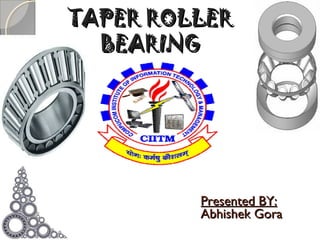
 Tapered roller bearings are bearings that can take 
large axial forces as well as being able to sustain large 
radial forces. 
 Tapered roller bearings are based on the observation 
that cones that meet at a point can roll over each other 
without slipping. 
Tapered Roller bearings are generally separable, which 
means the cone assembly, consisting of the inner ring 
with roller and cage
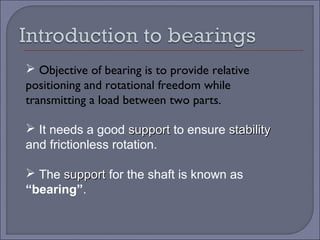
The Taper Roller bearings are 
composed of four elements. 
i.Outer race 
ii.Inner race 
iii.Rolling element 
iv.Cage of retaining ring
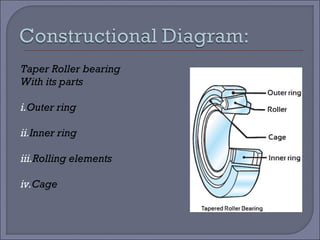
Taper Roller bearing 
With its parts 
i.Outer ring 
ii.Inner ring 
iii.Rolling elements 
iv.Cage
Single Row TRB 
Double Row TRB 
 Four Row TRB 
 Tapered Row TRB
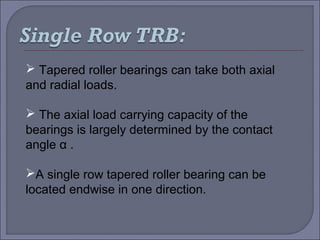
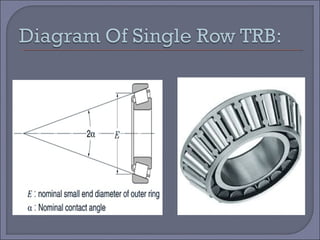
 Tapered roller bearings can take both axial 
and radial loads. 
 The axial load carrying capacity of the 
bearings is largely determined by the contact 
angle α . 
A single row tapered roller bearing can be 
located endwise in one direction.
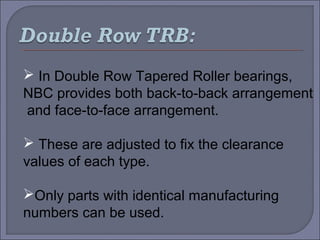
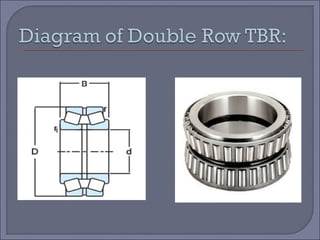
 In Double Row Tapered Roller bearings, 
NBC provides both back-to-back arrangement 
and face-to-face arrangement. 
 These are adjusted to fix the clearance 
values of each type. 
Only parts with identical manufacturing 
numbers can be used.
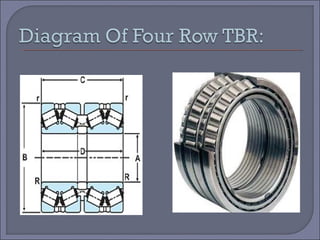
 Four Row Tapered roller bearings are made 
up of two double row inner rings and two double 
row outer rings. 
 These bearings are used for heavy load 
capacity as in the roller necks of rolling mills. 
The life of large bearings is extended by using 
case hardened steel, hollow rollers and pin-type 
cages.
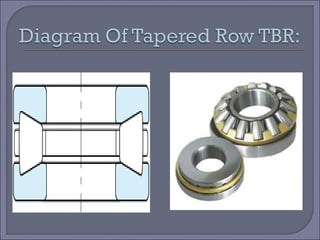
 NBC Tapered Roller Thrust bearings include 
rollers that have conical sections. 
 These bearings are designed primarily to 
support axial loads at contact angles between 30˚ 
and 90˚. 
 These bearing are suited for applications where 
extremely high thrust loads like in crane hooks, 
coal pulverizes etc.
Production-line assembly workers often set bearings 
manually for equipment that is manufactured in low-to 
moderate volume, and where a non-exact and wider-than - 
normal range of end play is acceptable. 
 No special tools, gages, charts, or fixtures are typically 
required. In a truck no driven wheel, for example, manual 
setting consists of tightening an adjusting nut on the end of the 
shaft while rotating the wheel until a slight bind is felt. 
Then the assembler backs off the nut 1/6 to 1/4 turn to the 
nearest locking hole or enough to let the wheel rotate freely. 
The adjusting nut is then locked in position
 High quality through hardened bearing 
steel 
 Optimized, engineered internal 
geometry 
 Highly consistent, reliable, and flexible 
manufacturing 
 Globally interchangeable inch and 
metric designs 
 Available integrated seal
 Heavy duty applications. 
 Agriculture. 
 Construction. 
 Mining equipment. 
 Axle systems. 
 Gear box. 
 Engine motors. 
 Reducers.
 Dimensional Stability. 
 Long Life Even In Contaminated 
Lubricant. 
 Durable Steel Cage. 
 Dimensionally Interchangeable 
With Other Bearing Manufacturers
summer training report on NBC for B.TECH students

summer training report on NBC for B.TECH students

  • 1.
    TTAAPPEERR RROOLLLLEERR BBEEAARRIINNGG PPrreesseenntteedd BBYY:: AAbbhhiisshheekk GGoorraa
  • 2.
     Introduction Types of bearings  Tapper roller Bearings  Construction  Classification  Setting Techniques  Features  Applications  Advantages
  • 3.
     Objective ofbearing is to provide relative positioning and rotational freedom while transmitting a load between two parts.  It needs a good ssuuppppoorrtt to ensure ssttaabbiilliittyy and frictionless rotation.  The ssuuppppoorrtt for the shaft is known as “bearing”.
  • 4.
     Ball Bearing  Taper Roller Bearing  Cylindrical Roller Bearing  Railway Bearing  Large Diameter Bearing
  • 5.
     Tapered rollerbearings are bearings that can take large axial forces as well as being able to sustain large radial forces.  Tapered roller bearings are based on the observation that cones that meet at a point can roll over each other without slipping. Tapered Roller bearings are generally separable, which means the cone assembly, consisting of the inner ring with roller and cage
  • 6.
    The Taper Rollerbearings are composed of four elements. i.Outer race ii.Inner race iii.Rolling element iv.Cage of retaining ring
  • 7.
    Taper Roller bearing With its parts i.Outer ring ii.Inner ring iii.Rolling elements iv.Cage
  • 8.
    Single Row TRB Double Row TRB  Four Row TRB  Tapered Row TRB
  • 9.
     Tapered rollerbearings can take both axial and radial loads.  The axial load carrying capacity of the bearings is largely determined by the contact angle α . A single row tapered roller bearing can be located endwise in one direction.
  • 11.
     In DoubleRow Tapered Roller bearings, NBC provides both back-to-back arrangement and face-to-face arrangement.  These are adjusted to fix the clearance values of each type. Only parts with identical manufacturing numbers can be used.
  • 13.
     Four RowTapered roller bearings are made up of two double row inner rings and two double row outer rings.  These bearings are used for heavy load capacity as in the roller necks of rolling mills. The life of large bearings is extended by using case hardened steel, hollow rollers and pin-type cages.
  • 15.
     NBC TaperedRoller Thrust bearings include rollers that have conical sections.  These bearings are designed primarily to support axial loads at contact angles between 30˚ and 90˚.  These bearing are suited for applications where extremely high thrust loads like in crane hooks, coal pulverizes etc.
  • 17.
    Production-line assembly workersoften set bearings manually for equipment that is manufactured in low-to moderate volume, and where a non-exact and wider-than - normal range of end play is acceptable.  No special tools, gages, charts, or fixtures are typically required. In a truck no driven wheel, for example, manual setting consists of tightening an adjusting nut on the end of the shaft while rotating the wheel until a slight bind is felt. Then the assembler backs off the nut 1/6 to 1/4 turn to the nearest locking hole or enough to let the wheel rotate freely. The adjusting nut is then locked in position
  • 18.
     High qualitythrough hardened bearing steel  Optimized, engineered internal geometry  Highly consistent, reliable, and flexible manufacturing  Globally interchangeable inch and metric designs  Available integrated seal
  • 19.
     Heavy dutyapplications.  Agriculture.  Construction.  Mining equipment.  Axle systems.  Gear box.  Engine motors.  Reducers.
  • 20.
     Dimensional Stability.  Long Life Even In Contaminated Lubricant.  Durable Steel Cage.  Dimensionally Interchangeable With Other Bearing Manufacturers