Submitted By : Submitted To :
Yashwardhan Sahi Mr. Praveen
Kumar
140970104064 HOD
1. Functions of Bearings
2. Classifications of Bearings
3. Rolling and Ball bearings
4. Types of roller and ball bearings
5. Applications of bearings
6. Sliding contact bearing
7. Types of sliding contact bearings
8. Journal Bearings & applications
9. Footsteps or pivot bearings
10. Advantages & Disadvantages
 The main function of a rotating shaft is to transmit
power from one end of the line to the other.
• It needs a good support to ensure stability and
frictionless rotation. The support for the shaft is
known as “bearing”.
 The shaft has a “running fit” in a bearing. All
bearing are provided some lubrication arrangement
to reduced friction between shaft and bearing.
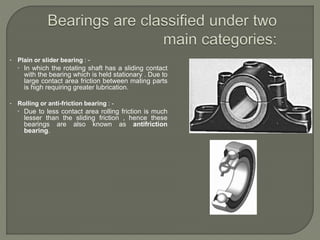
• Plain or slider bearing : -
 In which the rotating shaft has a sliding contact
with the bearing which is held stationary . Due to
large contact area friction between mating parts
is high requiring greater lubrication.
• Rolling or anti-friction bearing : -
 Due to less contact area rolling friction is much
lesser than the sliding friction , hence these
bearings are also known as antifriction
bearing.
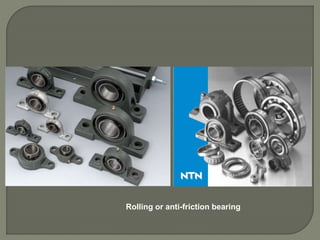
Rolling or anti-friction bearing
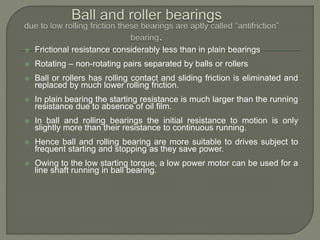
 Frictional resistance considerably less than in plain bearings
 Rotating – non-rotating pairs separated by balls or rollers
 Ball or rollers has rolling contact and sliding friction is eliminated and
replaced by much lower rolling friction.
 In plain bearing the starting resistance is much larger than the running
resistance due to absence of oil film.
 In ball and rolling bearings the initial resistance to motion is only
slightly more than their resistance to continuous running.
 Hence ball and rolling bearing are more suitable to drives subject to
frequent starting and stopping as they save power.
 Owing to the low starting torque, a low power motor can be used for a
line shaft running in ball bearing.
 Single row deep-groove ball bearing:
• Incorporating a deep hardened raceway which makes them
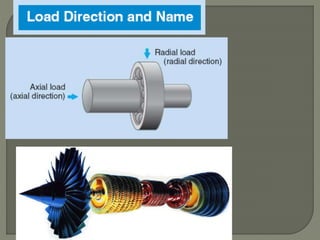
suitable for radial and axial loads in either direction,
provided the radial loads are greater than the axial loads.
 Single row roller bearing:
• Roller bearing have a greater load-carrying capacity than
ball bearing of equivalent size as they make line contact
rather than point contact with their rings.
 Not suitable for axial loading, cheaper to manufacture,
used for heavy and sudden loading, high speed and
continuous service.
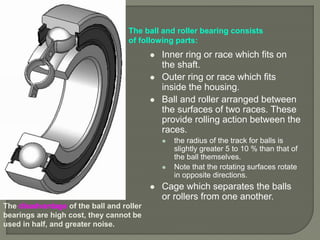
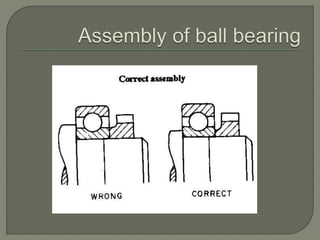
 Inner ring or race which fits on
the shaft.
 Outer ring or race which fits
inside the housing.
 Ball and roller arranged between
the surfaces of two races. These
provide rolling action between the
races.
 the radius of the track for balls is
slightly greater 5 to 10 % than that of
the ball themselves.
 Note that the rotating surfaces rotate
in opposite directions.
 Cage which separates the balls
or rollers from one another.
The disadvantage of the ball and roller
bearings are high cost, they cannot be
used in half, and greater noise.
The ball and roller bearing consists
of following parts:
 Tapered roller bearing (TRB):
• TRB can take both radial and axial loads and used for gear
boxes for heavy trucks, bevel-gear transmission, lathe spindles,
etc.
 Thrust ball bearing:
• It can take only thrust loads.
• Thrust ball bearing are used for heavy axial loads and low
speeds.
 Needle roller bearing:
• It use small diameter of rollers. They are used for radial load at
slow speed and oscillating motion.
 They have the advantage of light weight and occupy small space.
 They are used in aircraft industry, live tail stock centers, bench-drill
spindles, etc.
APPLICATIONS OF ROLLER BEARINGS
 Shafts are generally supported by two
bearings in the radial and axial directions.
 The side that fixes relative movement of the shaft and
housing in the axial direction is called the “fixed side
bearing," and the side that allows
movement is called the "floating side bearing."
 The floating side bearing is needed to absorb
mounting error and avoid stress caused by
expansion and contraction of the shaft due to
temperature change.
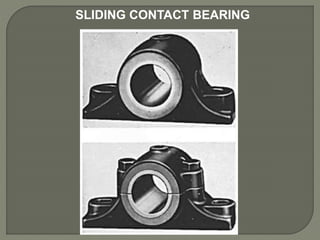
SLIDING CONTACT BEARING
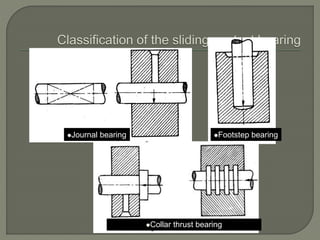
Collar thrust bearing
Footstep bearingJournal bearing
 Journal bearing – in this the bearing pressure is
exerted at right angles to the axis of the axis of the
shaft. The portion of the shaft lying within the
bearing in known as journal. Shaft are generally
made of mild steel.
 Foot step or pivot bearing – in this bearing the
bearing pressure is exerted parallel to the shaft
whose axis is vertical. Note that in this case the
end of the shaft rests within the bearing.
 Thrust bearing – in this bearing supporting
pressure is parallel to the axis of the shaft having
end thrust. Thrust bearing are used in bevel
mountings, propeller drives, turbines, etc. note
here the shaft ,unlike foot-strep bearing passes
through and beyond the bearing.
• Thrust bearings also known as “collar bearing”.
Simple journal or solid bearing
• It is simply a block of cast iron with a hole for the
shaft providing running fit. An oil hole is drilled at
the top for lubrication.
• The main disadvantage of this type of bearing
are
 There is no provision for wear and adjustment on account of
wear.
 The shaft must be passed into the bearing axially, i.e.
endwise.
 Limited load on shaft and speed of shaft is low.
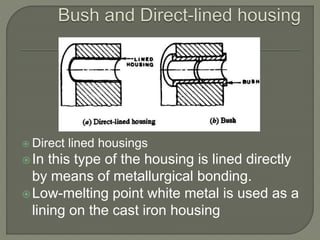
 Direct lined housings
In this type of the housing is lined directly
by means of metallurgical bonding.
Low-melting point white metal is used as a
lining on the cast iron housing
 suitable for supporting a vertical shaft with axial loads.
 In a footstep bearing a gun metal bush having a collar on
top is placed inside the C.I. sole. The end of the shaft
rests on a gun metal disc placed at the bottom in the
bush. The disc is prevented from rotation with the help of
a pin or sung fitted in the sole. The disc act as a thrust
bearing whereas the bush fitted in the casting supports
the shaft in position. The bush can take radial loads, if
any, on the shaft.
 The disadvantage of footstep bearing is that it cannot be
efficiently lubricated and there is unequal wear on the
bottom disc.
 Plain bearing are cheap to produce and have
noiseless operation. They can be easily machined,
occupy small radial space and have vibration
damping properties. Also they can cope with
tapped foreign matter.
 Disadvantages are they require large supply of
lubricating oil, they are suitable only for relative
low temperature and speed; and starting
resistance is much greater than running resistance
due to slow build up of lubricant film around the
bearing surface.
Wikipedia.com
V.B Bhandari
Tata McGrawhill Co.

Bearings

  • 1.
    Submitted By :Submitted To : Yashwardhan Sahi Mr. Praveen Kumar 140970104064 HOD
  • 2.
    1. Functions ofBearings 2. Classifications of Bearings 3. Rolling and Ball bearings 4. Types of roller and ball bearings 5. Applications of bearings 6. Sliding contact bearing 7. Types of sliding contact bearings 8. Journal Bearings & applications 9. Footsteps or pivot bearings 10. Advantages & Disadvantages
  • 4.
     The mainfunction of a rotating shaft is to transmit power from one end of the line to the other. • It needs a good support to ensure stability and frictionless rotation. The support for the shaft is known as “bearing”.  The shaft has a “running fit” in a bearing. All bearing are provided some lubrication arrangement to reduced friction between shaft and bearing.
  • 5.
    • Plain orslider bearing : -  In which the rotating shaft has a sliding contact with the bearing which is held stationary . Due to large contact area friction between mating parts is high requiring greater lubrication. • Rolling or anti-friction bearing : -  Due to less contact area rolling friction is much lesser than the sliding friction , hence these bearings are also known as antifriction bearing.
  • 6.
  • 8.
     Frictional resistanceconsiderably less than in plain bearings  Rotating – non-rotating pairs separated by balls or rollers  Ball or rollers has rolling contact and sliding friction is eliminated and replaced by much lower rolling friction.  In plain bearing the starting resistance is much larger than the running resistance due to absence of oil film.  In ball and rolling bearings the initial resistance to motion is only slightly more than their resistance to continuous running.  Hence ball and rolling bearing are more suitable to drives subject to frequent starting and stopping as they save power.  Owing to the low starting torque, a low power motor can be used for a line shaft running in ball bearing.
  • 9.
     Single rowdeep-groove ball bearing: • Incorporating a deep hardened raceway which makes them suitable for radial and axial loads in either direction, provided the radial loads are greater than the axial loads.  Single row roller bearing: • Roller bearing have a greater load-carrying capacity than ball bearing of equivalent size as they make line contact rather than point contact with their rings.  Not suitable for axial loading, cheaper to manufacture, used for heavy and sudden loading, high speed and continuous service.
  • 10.
     Inner ringor race which fits on the shaft.  Outer ring or race which fits inside the housing.  Ball and roller arranged between the surfaces of two races. These provide rolling action between the races.  the radius of the track for balls is slightly greater 5 to 10 % than that of the ball themselves.  Note that the rotating surfaces rotate in opposite directions.  Cage which separates the balls or rollers from one another. The disadvantage of the ball and roller bearings are high cost, they cannot be used in half, and greater noise. The ball and roller bearing consists of following parts:
  • 11.
     Tapered rollerbearing (TRB): • TRB can take both radial and axial loads and used for gear boxes for heavy trucks, bevel-gear transmission, lathe spindles, etc.  Thrust ball bearing: • It can take only thrust loads. • Thrust ball bearing are used for heavy axial loads and low speeds.  Needle roller bearing: • It use small diameter of rollers. They are used for radial load at slow speed and oscillating motion.  They have the advantage of light weight and occupy small space.  They are used in aircraft industry, live tail stock centers, bench-drill spindles, etc. APPLICATIONS OF ROLLER BEARINGS
  • 12.
     Shafts aregenerally supported by two bearings in the radial and axial directions.  The side that fixes relative movement of the shaft and housing in the axial direction is called the “fixed side bearing," and the side that allows movement is called the "floating side bearing."  The floating side bearing is needed to absorb mounting error and avoid stress caused by expansion and contraction of the shaft due to temperature change.
  • 14.
  • 15.
    Collar thrust bearing FootstepbearingJournal bearing
  • 16.
     Journal bearing– in this the bearing pressure is exerted at right angles to the axis of the axis of the shaft. The portion of the shaft lying within the bearing in known as journal. Shaft are generally made of mild steel.  Foot step or pivot bearing – in this bearing the bearing pressure is exerted parallel to the shaft whose axis is vertical. Note that in this case the end of the shaft rests within the bearing.  Thrust bearing – in this bearing supporting pressure is parallel to the axis of the shaft having end thrust. Thrust bearing are used in bevel mountings, propeller drives, turbines, etc. note here the shaft ,unlike foot-strep bearing passes through and beyond the bearing. • Thrust bearings also known as “collar bearing”.
  • 17.
    Simple journal orsolid bearing • It is simply a block of cast iron with a hole for the shaft providing running fit. An oil hole is drilled at the top for lubrication. • The main disadvantage of this type of bearing are  There is no provision for wear and adjustment on account of wear.  The shaft must be passed into the bearing axially, i.e. endwise.  Limited load on shaft and speed of shaft is low.
  • 18.
     Direct linedhousings In this type of the housing is lined directly by means of metallurgical bonding. Low-melting point white metal is used as a lining on the cast iron housing
  • 19.
     suitable forsupporting a vertical shaft with axial loads.  In a footstep bearing a gun metal bush having a collar on top is placed inside the C.I. sole. The end of the shaft rests on a gun metal disc placed at the bottom in the bush. The disc is prevented from rotation with the help of a pin or sung fitted in the sole. The disc act as a thrust bearing whereas the bush fitted in the casting supports the shaft in position. The bush can take radial loads, if any, on the shaft.  The disadvantage of footstep bearing is that it cannot be efficiently lubricated and there is unequal wear on the bottom disc.
  • 20.
     Plain bearingare cheap to produce and have noiseless operation. They can be easily machined, occupy small radial space and have vibration damping properties. Also they can cope with tapped foreign matter.  Disadvantages are they require large supply of lubricating oil, they are suitable only for relative low temperature and speed; and starting resistance is much greater than running resistance due to slow build up of lubricant film around the bearing surface.
  • 21.