ROLL PASS DESIGN
 IN CONTINUOUS
    BAR MILLS
 Department of Metallurgical
 and Materials Engineering

INDIAN INSTITUTE OF
   TECHNOLOGY
    KHARAGPUR
Basic Terminology

•Two facing grooves form a ‘roll pass’, or simply a
‘pass’.. The distance between the barrels of two rolls is
called the ‘nominal roll gap’, or ‘theoretical roll gap’.

•The ultimate goal of a roll pass design is to ensure the
production of the desired shape of a product with the
appropriate internal structure, defect free surface and
at lowest cost
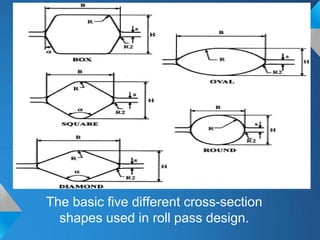
The basic five different cross-section
  shapes used in roll pass design.
Passes & Bars
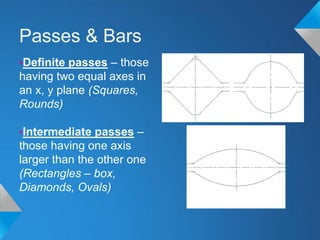
•Definite passes – those
having two equal axes in
an x, y plane (Squares,
Rounds)

•Intermediate passes –
those having one axis
larger than the other one
(Rectangles – box,
Diamonds, Ovals)
Deformation & Sequence
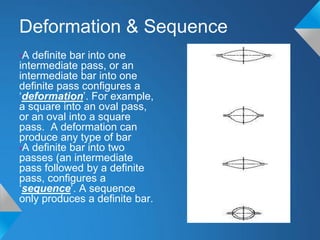
•A definite bar into one
intermediate pass, or an
intermediate bar into one
definite pass configures a
‘deformation’. For example,
a square into an oval pass,
or an oval into a square
pass. A deformation can
produce any type of bar
•A definite bar into two
passes (an intermediate
pass followed by a definite
pass, configures a
‘sequence’. A sequence
only produces a definite bar.
The roll pass design for any product depends
on the following:
• Starting size and Material Grade.
• Mill layout.
• Mill stand sizes.
• Mill motor power.
• Production Requirement.
• Product size and shape.
Typically a pass design calculation has three
parts:

•   Pass design and groove details
•   Pass schedules.
•   Power calculation.
Pass Design and Groove Details: This calculation
gives the following parameters for each pass:

􀂃   Roll groove dimensions.
􀂃   Roll gap.
􀂃   Filled width in pass.
􀂃   Filled area.
􀂃   Area reduction.
􀂃   Bite angle.
Pass Schedules: Pass schedule consists of the
following for each pass:

􀂃   Bar length
􀂃   Rolling speed
􀂃   Rolling time
􀂃   Idle time
􀂃   Loop or tension value between stands
Power Calculation :Power Calculation works out
for each pass:

􀂃   Bar Temperature
􀂃   Rolling load
􀂃   Rolling torque
􀂃   Rolling power
Throughout the mill
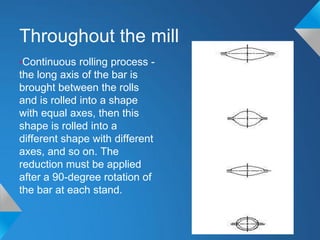
•Continuous rolling process -
the long axis of the bar is
brought between the rolls
and is rolled into a shape
with equal axes, then this
shape is rolled into a
different shape with different
axes, and so on. The
reduction must be applied
after a 90-degree rotation of
the bar at each stand.
Throughout the mill
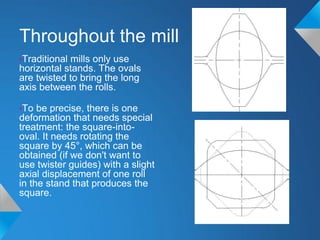
•Traditional mills only use
horizontal stands. The ovals
are twisted to bring the long
axis between the rolls.

•To be precise, there is one
deformation that needs special
treatment: the square-into-
oval. It needs rotating the
square by 45°, which can be
obtained (if we don't want to
use twister guides) with a slight
axial displacement of one roll
in the stand that produces the
square.
The Mills
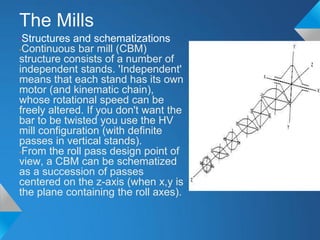
•Structures  and schematizations
•Continuous bar mill (CBM)
structure consists of a number of
independent stands. 'Independent'
means that each stand has its own
motor (and kinematic chain),
whose rotational speed can be
freely altered. If you don't want the
bar to be twisted you use the HV
mill configuration (with definite
passes in vertical stands).
•From the roll pass design point of
view, a CBM can be schematized
as a succession of passes
centered on the z-axis (when x,y is
the plane containing the roll axes).
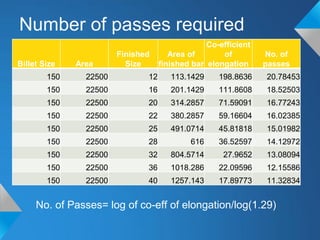
Number of passes required
                                                 Co-efficient
                        Finished       Area of       of         No. of
Billet Size   Area        Size      finished bar elongation     passes
        150     22500          12      113.1429     198.8636    20.78453
        150     22500          16      201.1429     111.8608    18.52503
        150     22500          20      314.2857     71.59091    16.77243
        150     22500          22      380.2857     59.16604    16.02385
        150     22500          25      491.0714     45.81818    15.01982
        150     22500          28           616     36.52597    14.12972
        150     22500          32      804.5714      27.9652    13.08094
        150     22500          36      1018.286     22.09596    12.15586
        150     22500          40      1257.143     17.89773    11.32834


     No. of Passes= log of co-eff of elongation/log(1.29)
Laws of Rolling
•First Law
The purpose of the rolling process is to start from a
    relatively short bar with a large section area, aiming to
    obtain a very long product with a small section area.
    Then, the first law to remember is that the volume (or
    the weight) is a constant: from a 1/2-ton billet you
    will obtain a 1/2-ton coil. Cross sectional area times
    bar length is a constant (this is not strictly true for
    CBMs: some weight will be lost with scale and crop
    ends; but we can afford to neglect that loss.)
Laws of Rolling
•Second Law
There is another, important law to remember: the flow is
    also a constant. Say that the exit bar from stand 1
    has cross sectional area = 3467 sq mm and the
    finished round has cross-sectional area = 113 sq mm
    (hot bar dimensions). If the finished stand delivers at a
    speed of 12 mps, then stand 1 must 'run' at 0.39 mps:
    0.3 x 3467 = 12 x 113. In this case the constant is
    about 1050, i.e., if you know the areas, you can
    immediately calculate the exit speeds. And, you have
    no problems in setting the speed at each stand, as
    each stand has its own independent motor.
Action & Reactions
•When rolling, we can identify one action and two
reactions.
If we focus on a horizontal stand of a continuous mill for
     rounds, we see:
         - that the rolls apply a 'reduction' (vertically);
         - that this reduction produces a wanted 'elongation';
         - that reduction produces a 'spread' (sideways).
Spread
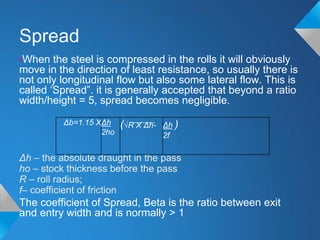
•When the steel is compressed in the rolls it will obviously
move in the direction of least resistance, so usually there is
not only longitudinal flow but also some lateral flow. This is
called ‘Spread”. it is generally accepted that beyond a ratio
width/height = 5, spread becomes negligible.

          Δb=1.15 XΔh    (√R X Δh-   Δh )
                   2ho               2f

Δh – the absolute draught in the pass
ho – stock thickness before the pass
R – roll radius;
f– coefficient of friction
The coefficient of Spread, Beta is the ratio between exit
and entry width and is normally > 1
Reduction and Elongation
      1.Reduction (with a coefficient of reduction Gamma)
           2.Elongation (with a coefficient of elongation
                              Lambda).

•Gamma (defined as ratio between exit and entry height) is
always < 1. If we reduce a 100x10 flat to 8 mm (a 20%
reduction), Gamma=0.8.

•Lambda (defined as ratio between exit and entry length, but
more often as ratio between entry and exit section area) is
always > 1. In the example above (100x10 reduced to 100x8)
Lambda = 1000/800 = 1.25. Note that Beta = 1. (100/100 =1)
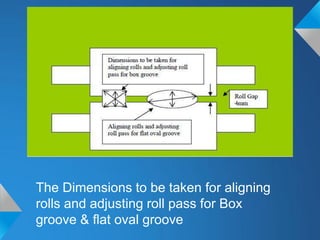
The Dimensions to be taken for aligning
rolls and adjusting roll pass for Box
groove & flat oval groove
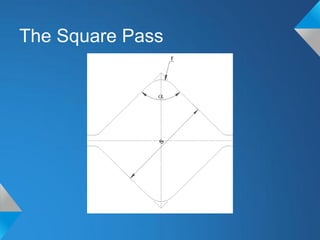
The Square Pass
Important Formulae
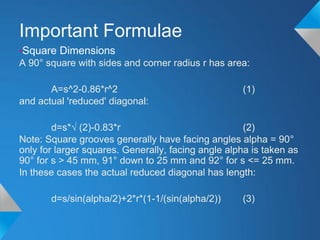
•Square Dimensions
A 90° square with sides and corner radius r has area:

       A=s^2-0.86*r^2                               (1)
and actual 'reduced' diagonal:

        d=s*√ (2)-0.83*r                             (2)
Note: Square grooves generally have facing angles alpha = 90°
only for larger squares. Generally, facing angle alpha is taken as
90° for s > 45 mm, 91° down to 25 mm and 92° for s <= 25 mm.
In these cases the actual reduced diagonal has length:

       d=s/sin(alpha/2)+2*r*(1-1/(sin(alpha/2))     (3)
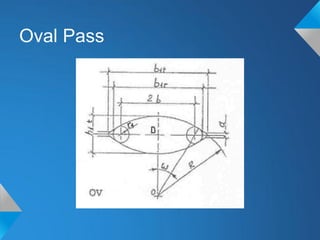
Oval Pass
Important Formulae
•Oval Radius
•An oval pass is made of two circular arcs with facing
concavities. Three dimensions are considered, referring
either to pass or to bar:
     i.   b1t = theoretical oval width (pass, not physically
     measurable)
     ii.  b1r = actual oval width (bar, physically measurable)
     iii. maxw = maximum oval width (pass, physically
     measurable)
Important Formulae
•Oval Radius
To identify oval height, we only need two dimensions:

     i.      h1t = theoretical oval height (pass, physically measurable)
     ii.     h1r = actual oval height (bar, physically measurable)
To draw the oval groove we need to know its radius R. The
formula is:

           R=(b1t^2+h1t^2)/(4*h1t)                       (4)

Now, when gap=0 we have b1t=maxw. This means that if the
oval is identified as maxw x h1t, we can put H=h1t-gap and
calculate

           R=(maxw^2+H^2)/(4*H)                                (5)
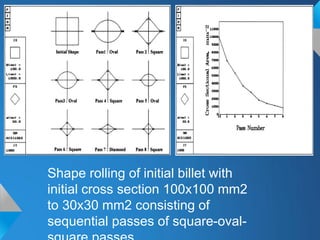
Shape rolling of initial billet with
initial cross section 100x100 mm2
to 30x30 mm2 consisting of
sequential passes of square-oval-
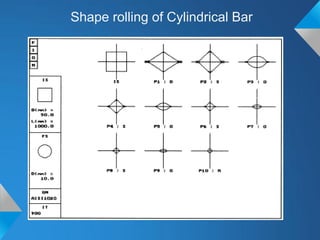
Shape rolling of Cylindrical Bar
Thank You
Let’s share and make
  knowledge free.

Roll pass design in continuous bar mills

  • 1.
    ROLL PASS DESIGN IN CONTINUOUS BAR MILLS Department of Metallurgical and Materials Engineering INDIAN INSTITUTE OF TECHNOLOGY KHARAGPUR
  • 2.
    Basic Terminology •Two facinggrooves form a ‘roll pass’, or simply a ‘pass’.. The distance between the barrels of two rolls is called the ‘nominal roll gap’, or ‘theoretical roll gap’. •The ultimate goal of a roll pass design is to ensure the production of the desired shape of a product with the appropriate internal structure, defect free surface and at lowest cost
  • 3.
    The basic fivedifferent cross-section shapes used in roll pass design.
  • 4.
    Passes & Bars •Definitepasses – those having two equal axes in an x, y plane (Squares, Rounds) •Intermediate passes – those having one axis larger than the other one (Rectangles – box, Diamonds, Ovals)
  • 5.
    Deformation & Sequence •Adefinite bar into one intermediate pass, or an intermediate bar into one definite pass configures a ‘deformation’. For example, a square into an oval pass, or an oval into a square pass. A deformation can produce any type of bar •A definite bar into two passes (an intermediate pass followed by a definite pass, configures a ‘sequence’. A sequence only produces a definite bar.
  • 6.
    The roll passdesign for any product depends on the following: • Starting size and Material Grade. • Mill layout. • Mill stand sizes. • Mill motor power. • Production Requirement. • Product size and shape.
  • 7.
    Typically a passdesign calculation has three parts: • Pass design and groove details • Pass schedules. • Power calculation.
  • 8.
    Pass Design andGroove Details: This calculation gives the following parameters for each pass: 􀂃 Roll groove dimensions. 􀂃 Roll gap. 􀂃 Filled width in pass. 􀂃 Filled area. 􀂃 Area reduction. 􀂃 Bite angle.
  • 9.
    Pass Schedules: Passschedule consists of the following for each pass: 􀂃 Bar length 􀂃 Rolling speed 􀂃 Rolling time 􀂃 Idle time 􀂃 Loop or tension value between stands
  • 10.
    Power Calculation :PowerCalculation works out for each pass: 􀂃 Bar Temperature 􀂃 Rolling load 􀂃 Rolling torque 􀂃 Rolling power
  • 11.
    Throughout the mill •Continuousrolling process - the long axis of the bar is brought between the rolls and is rolled into a shape with equal axes, then this shape is rolled into a different shape with different axes, and so on. The reduction must be applied after a 90-degree rotation of the bar at each stand.
  • 12.
    Throughout the mill •Traditionalmills only use horizontal stands. The ovals are twisted to bring the long axis between the rolls. •To be precise, there is one deformation that needs special treatment: the square-into- oval. It needs rotating the square by 45°, which can be obtained (if we don't want to use twister guides) with a slight axial displacement of one roll in the stand that produces the square.
  • 13.
    The Mills •Structures and schematizations •Continuous bar mill (CBM) structure consists of a number of independent stands. 'Independent' means that each stand has its own motor (and kinematic chain), whose rotational speed can be freely altered. If you don't want the bar to be twisted you use the HV mill configuration (with definite passes in vertical stands). •From the roll pass design point of view, a CBM can be schematized as a succession of passes centered on the z-axis (when x,y is the plane containing the roll axes).
  • 14.
    Number of passesrequired Co-efficient Finished Area of of No. of Billet Size Area Size finished bar elongation passes 150 22500 12 113.1429 198.8636 20.78453 150 22500 16 201.1429 111.8608 18.52503 150 22500 20 314.2857 71.59091 16.77243 150 22500 22 380.2857 59.16604 16.02385 150 22500 25 491.0714 45.81818 15.01982 150 22500 28 616 36.52597 14.12972 150 22500 32 804.5714 27.9652 13.08094 150 22500 36 1018.286 22.09596 12.15586 150 22500 40 1257.143 17.89773 11.32834 No. of Passes= log of co-eff of elongation/log(1.29)
  • 15.
    Laws of Rolling •FirstLaw The purpose of the rolling process is to start from a relatively short bar with a large section area, aiming to obtain a very long product with a small section area. Then, the first law to remember is that the volume (or the weight) is a constant: from a 1/2-ton billet you will obtain a 1/2-ton coil. Cross sectional area times bar length is a constant (this is not strictly true for CBMs: some weight will be lost with scale and crop ends; but we can afford to neglect that loss.)
  • 16.
    Laws of Rolling •SecondLaw There is another, important law to remember: the flow is also a constant. Say that the exit bar from stand 1 has cross sectional area = 3467 sq mm and the finished round has cross-sectional area = 113 sq mm (hot bar dimensions). If the finished stand delivers at a speed of 12 mps, then stand 1 must 'run' at 0.39 mps: 0.3 x 3467 = 12 x 113. In this case the constant is about 1050, i.e., if you know the areas, you can immediately calculate the exit speeds. And, you have no problems in setting the speed at each stand, as each stand has its own independent motor.
  • 17.
    Action & Reactions •Whenrolling, we can identify one action and two reactions. If we focus on a horizontal stand of a continuous mill for rounds, we see: - that the rolls apply a 'reduction' (vertically); - that this reduction produces a wanted 'elongation'; - that reduction produces a 'spread' (sideways).
  • 18.
    Spread •When the steelis compressed in the rolls it will obviously move in the direction of least resistance, so usually there is not only longitudinal flow but also some lateral flow. This is called ‘Spread”. it is generally accepted that beyond a ratio width/height = 5, spread becomes negligible. Δb=1.15 XΔh (√R X Δh- Δh ) 2ho 2f Δh – the absolute draught in the pass ho – stock thickness before the pass R – roll radius; f– coefficient of friction The coefficient of Spread, Beta is the ratio between exit and entry width and is normally > 1
  • 19.
    Reduction and Elongation 1.Reduction (with a coefficient of reduction Gamma) 2.Elongation (with a coefficient of elongation Lambda). •Gamma (defined as ratio between exit and entry height) is always < 1. If we reduce a 100x10 flat to 8 mm (a 20% reduction), Gamma=0.8. •Lambda (defined as ratio between exit and entry length, but more often as ratio between entry and exit section area) is always > 1. In the example above (100x10 reduced to 100x8) Lambda = 1000/800 = 1.25. Note that Beta = 1. (100/100 =1)
  • 20.
    The Dimensions tobe taken for aligning rolls and adjusting roll pass for Box groove & flat oval groove
  • 21.
  • 22.
    Important Formulae •Square Dimensions A90° square with sides and corner radius r has area: A=s^2-0.86*r^2 (1) and actual 'reduced' diagonal: d=s*√ (2)-0.83*r (2) Note: Square grooves generally have facing angles alpha = 90° only for larger squares. Generally, facing angle alpha is taken as 90° for s > 45 mm, 91° down to 25 mm and 92° for s <= 25 mm. In these cases the actual reduced diagonal has length: d=s/sin(alpha/2)+2*r*(1-1/(sin(alpha/2)) (3)
  • 23.
  • 24.
    Important Formulae •Oval Radius •Anoval pass is made of two circular arcs with facing concavities. Three dimensions are considered, referring either to pass or to bar: i. b1t = theoretical oval width (pass, not physically measurable) ii. b1r = actual oval width (bar, physically measurable) iii. maxw = maximum oval width (pass, physically measurable)
  • 25.
    Important Formulae •Oval Radius Toidentify oval height, we only need two dimensions: i. h1t = theoretical oval height (pass, physically measurable) ii. h1r = actual oval height (bar, physically measurable) To draw the oval groove we need to know its radius R. The formula is: R=(b1t^2+h1t^2)/(4*h1t) (4) Now, when gap=0 we have b1t=maxw. This means that if the oval is identified as maxw x h1t, we can put H=h1t-gap and calculate R=(maxw^2+H^2)/(4*H) (5)
  • 26.
    Shape rolling ofinitial billet with initial cross section 100x100 mm2 to 30x30 mm2 consisting of sequential passes of square-oval-
  • 27.
    Shape rolling ofCylindrical Bar
  • 28.
    Thank You Let’s shareand make knowledge free.