A Detailed Lesson Plan in Grade 7
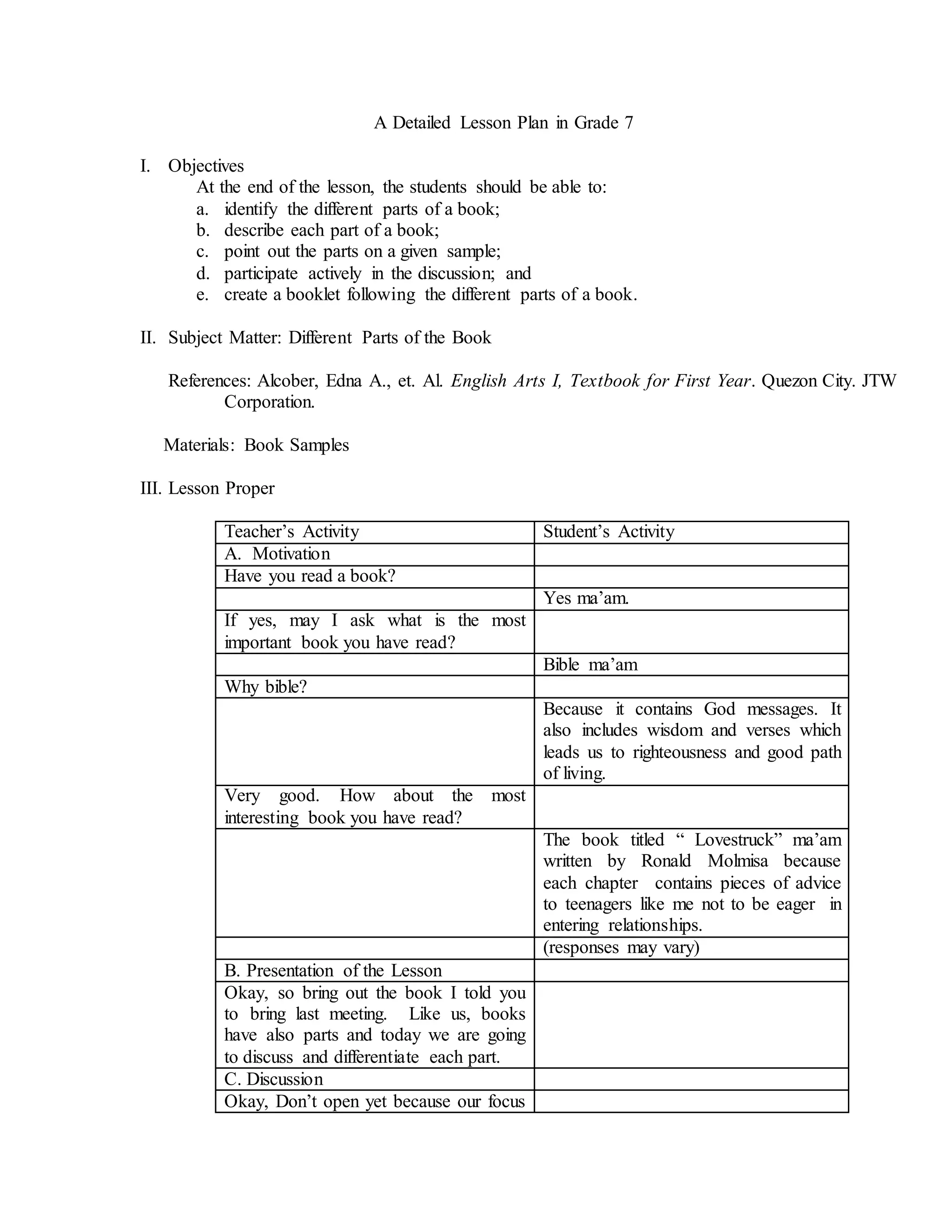
I. Objectives
At the end of the lesson, the students should be able to:
a. identify the different parts of a book;
b. describe each part of a book;
c. point out the parts on a given sample;
d. participate actively in the discussion; and
e. create a booklet following the different parts of a book.
II. Subject Matter: Different Parts of the Book
References: Alcober, Edna A., et. Al. English Arts I, Textbook for First Year. Quezon City. JTW
Corporation.
Materials: Book Samples
III. Lesson Proper
Teacher’s Activity Student’s Activity
A. Motivation
Have you read a book?
Yes ma’am.
If yes, may I ask what is the most
important book you have read?
Bible ma’am
Why bible?
Because it contains God messages. It
also includes wisdom and verses which
leads us to righteousness and good path
of living.
Very good. How about the most
interesting book you have read?
The book titled “ Lovestruck” ma’am
written by Ronald Molmisa because
each chapter contains pieces of advice
to teenagers like me not to be eager in
entering relationships.
(responses may vary)
B. Presentation of the Lesson
Okay, so bring out the book I told you
to bring last meeting. Like us, books
have also parts and today we are going
to discuss and differentiate each part.
C. Discussion
Okay, Don’t open yet because our focus
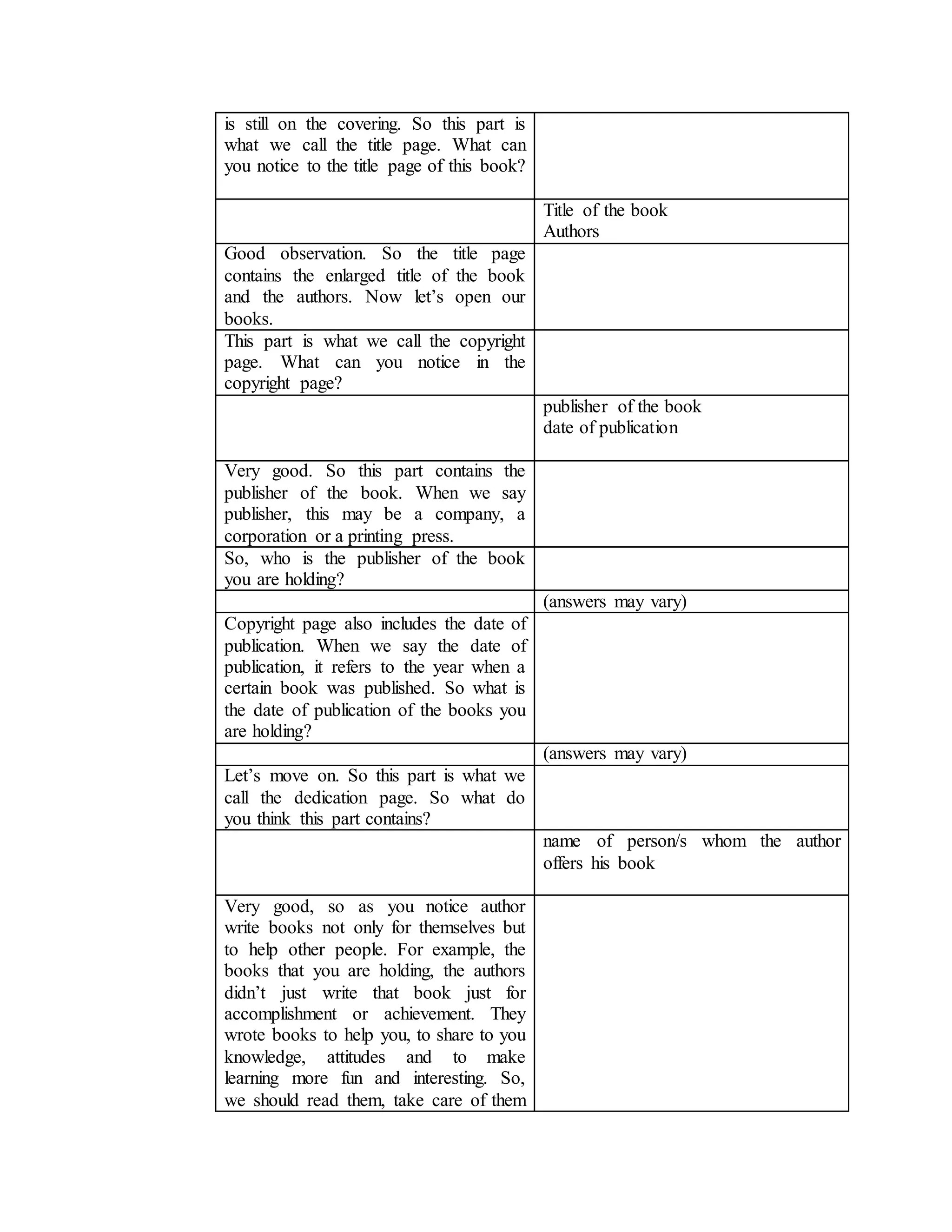
is still on the covering. So this part is
what we call the title page. What can
you notice to the title page of this book?
Title of the book
Authors
Good observation. So the title page
contains the enlarged title of the book
and the authors. Now let’s open our
books.
This part is what we call the copyright
page. What can you notice in the
copyright page?
publisher of the book
date of publication
Very good. So this part contains the
publisher of the book. When we say
publisher, this may be a company, a
corporation or a printing press.
So, who is the publisher of the book
you are holding?
(answers may vary)
Copyright page also includes the date of
publication. When we say the date of
publication, it refers to the year when a
certain book was published. So what is
the date of publication of the books you
are holding?
(answers may vary)
Let’s move on. So this part is what we
call the dedication page. So what do
you think this part contains?
name of person/s whom the author
offers his book
Very good, so as you notice author
write books not only for themselves but
to help other people. For example, the
books that you are holding, the authors
didn’t just write that book just for
accomplishment or achievement. They
wrote books to help you, to share to you
knowledge, attitudes and to make
learning more fun and interesting. So,
we should read them, take care of them
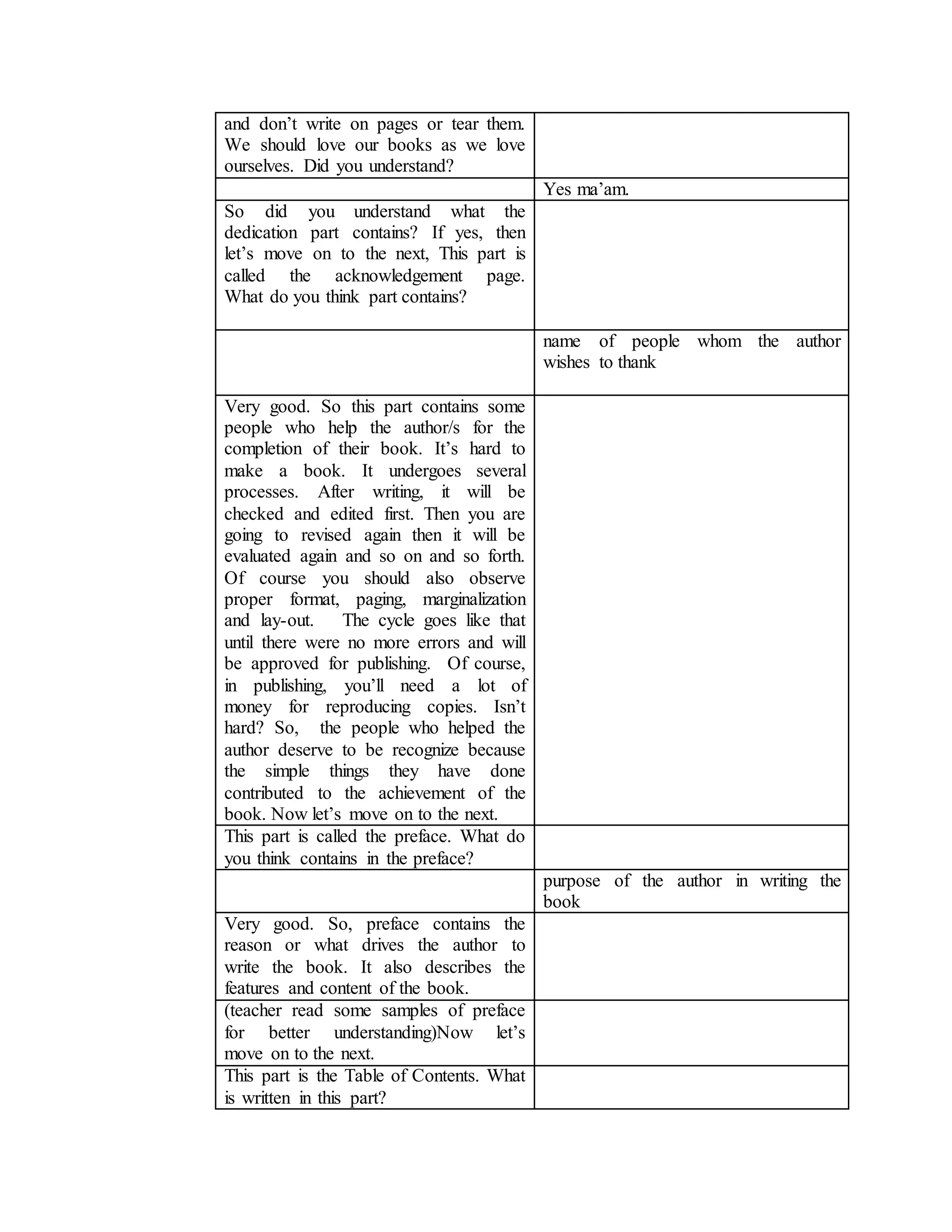
and don’t write on pages or tear them.
We should love our books as we love
ourselves. Did you understand?
Yes ma’am.
So did you understand what the
dedication part contains? If yes, then
let’s move on to the next, This part is
called the acknowledgement page.
What do you think part contains?
name of people whom the author
wishes to thank
Very good. So this part contains some
people who help the author/s for the
completion of their book. It’s hard to
make a book. It undergoes several
processes. After writing, it will be
checked and edited first. Then you are
going to revised again then it will be
evaluated again and so on and so forth.
Of course you should also observe
proper format, paging, marginalization
and lay-out. The cycle goes like that
until there were no more errors and will
be approved for publishing. Of course,
in publishing, you’ll need a lot of
money for reproducing copies. Isn’t
hard? So, the people who helped the
author deserve to be recognize because
the simple things they have done
contributed to the achievement of the
book. Now let’s move on to the next.
This part is called the preface. What do
you think contains in the preface?
purpose of the author in writing the
book
Very good. So, preface contains the
reason or what drives the author to
write the book. It also describes the
features and content of the book.
(teacher read some samples of preface
for better understanding)Now let’s
move on to the next.
This part is the Table of Contents. What
is written in this part?
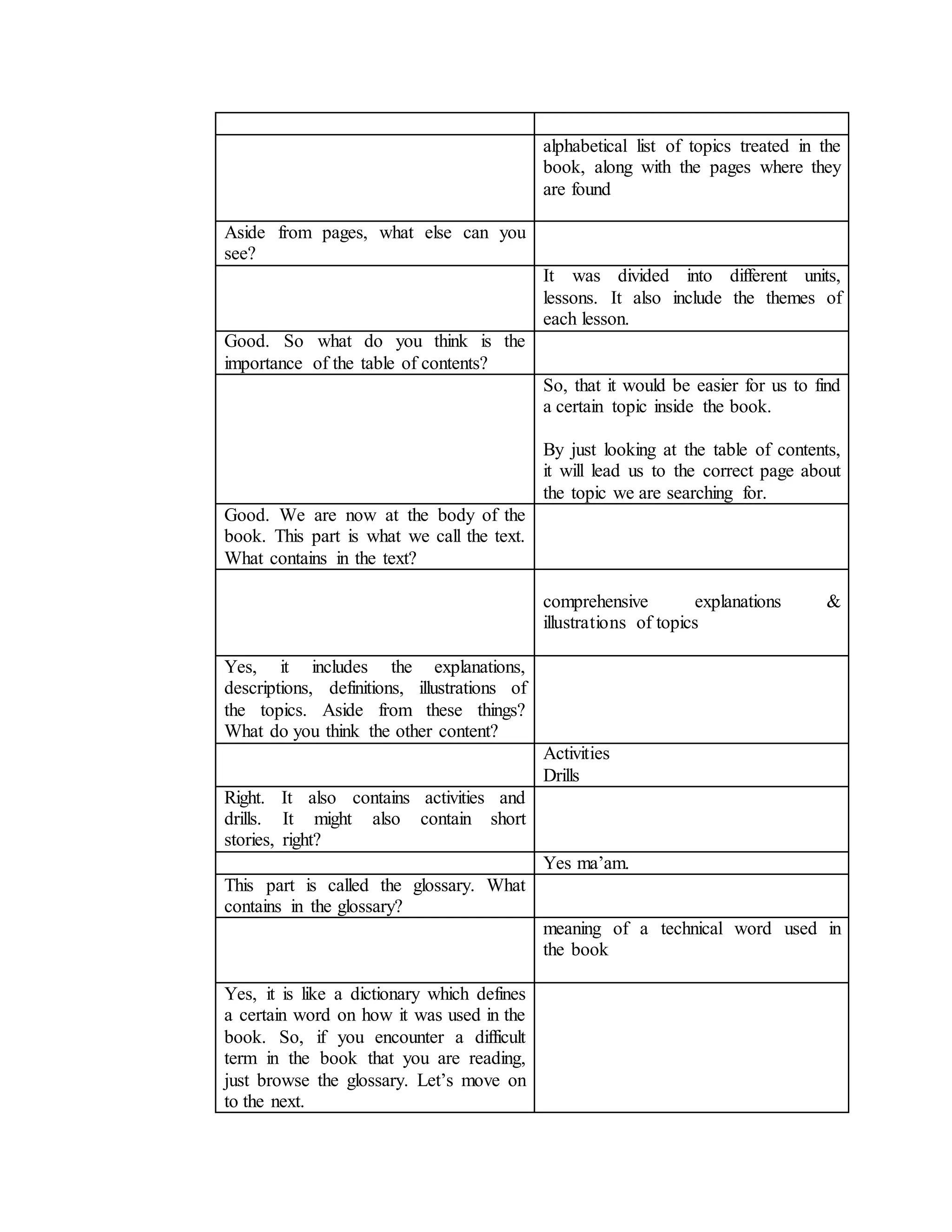
alphabetical list of topics treated in the
book, along with the pages where they
are found
Aside from pages, what else can you
see?
It was divided into different units,
lessons. It also include the themes of
each lesson.
Good. So what do you think is the
importance of the table of contents?
So, that it would be easier for us to find
a certain topic inside the book.
By just looking at the table of contents,
it will lead us to the correct page about
the topic we are searching for.
Good. We are now at the body of the
book. This part is what we call the text.
What contains in the text?
comprehensive explanations &
illustrations of topics
Yes, it includes the explanations,
descriptions, definitions, illustrations of
the topics. Aside from these things?
What do you think the other content?
Activities
Drills
Right. It also contains activities and
drills. It might also contain short
stories, right?
Yes ma’am.
This part is called the glossary. What
contains in the glossary?
meaning of a technical word used in
the book
Yes, it is like a dictionary which defines
a certain word on how it was used in the
book. So, if you encounter a difficult
term in the book that you are reading,
just browse the glossary. Let’s move on
to the next.
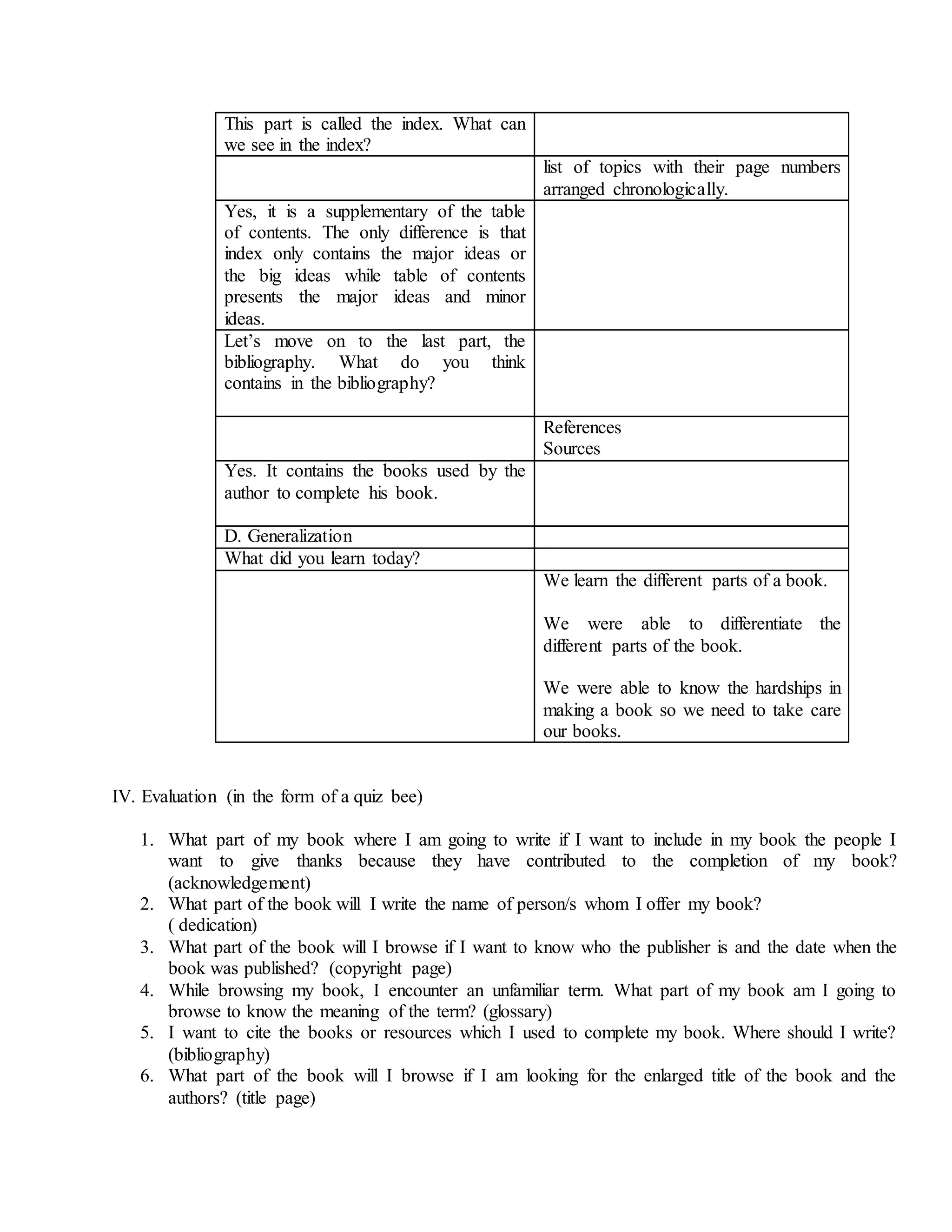
This part is called the index. What can
we see in the index?
list of topics with their page numbers
arranged chronologically.
Yes, it is a supplementary of the table
of contents. The only difference is that
index only contains the major ideas or
the big ideas while table of contents
presents the major ideas and minor
ideas.
Let’s move on to the last part, the
bibliography. What do you think
contains in the bibliography?
References
Sources
Yes. It contains the books used by the
author to complete his book.
D. Generalization
What did you learn today?
We learn the different parts of a book.
We were able to differentiate the
different parts of the book.
We were able to know the hardships in
making a book so we need to take care
our books.
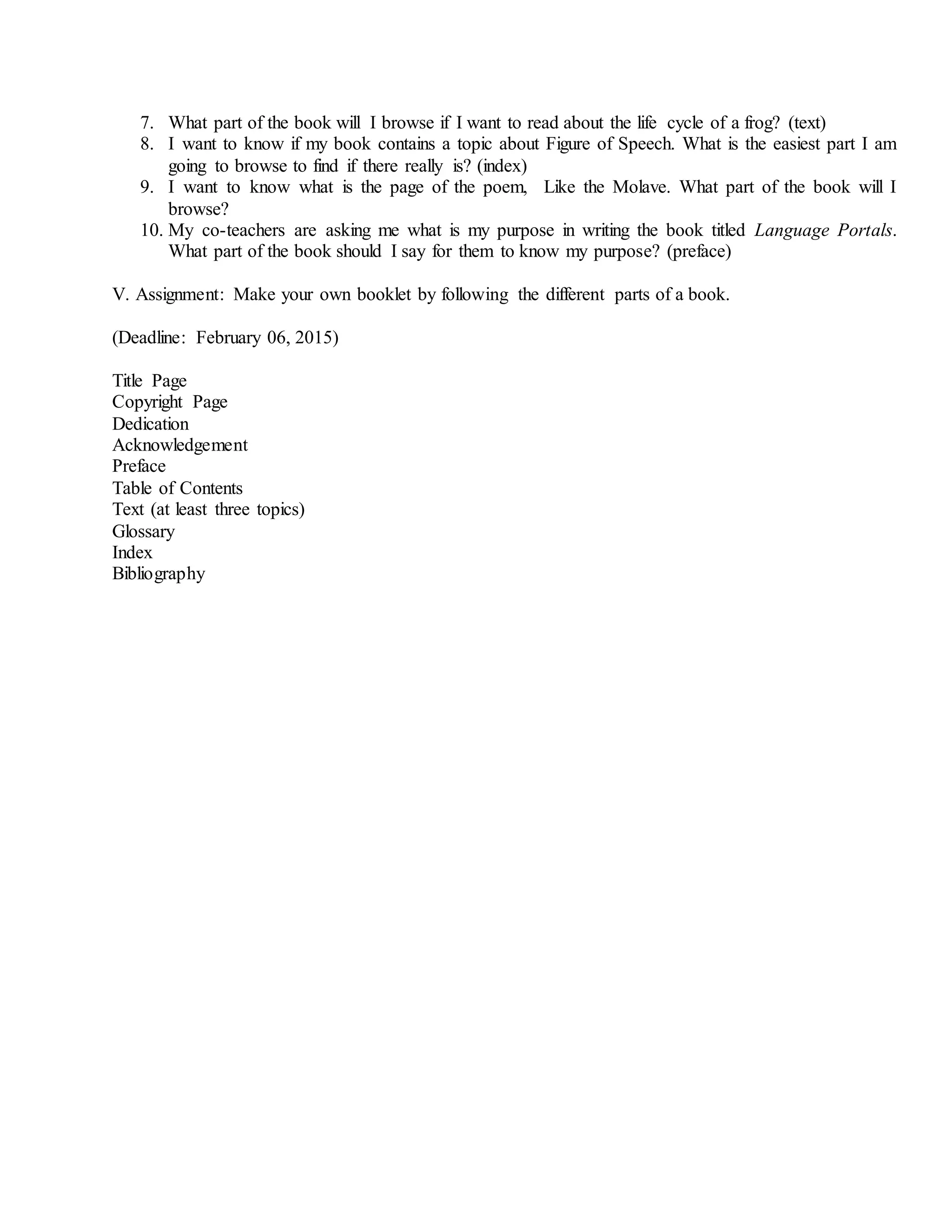
IV. Evaluation (in the form of a quiz bee)
1. What part of my book where I am going to write if I want to include in my book the people I
want to give thanks because they have contributed to the completion of my book?
(acknowledgement)
2. What part of the book will I write the name of person/s whom I offer my book?
( dedication)
3. What part of the book will I browse if I want to know who the publisher is and the date when the
book was published? (copyright page)
4. While browsing my book, I encounter an unfamiliar term. What part of my book am I going to
browse to know the meaning of the term? (glossary)
5. I want to cite the books or resources which I used to complete my book. Where should I write?
(bibliography)
6. What part of the book will I browse if I am looking for the enlarged title of the book and the
authors? (title page)
7. What part of the book will I browse if I want to read about the life cycle of a frog? (text)
8. I want to know if my book contains a topic about Figure of Speech. What is the easiest part I am
going to browse to find if there really is? (index)
9. I want to know what is the page of the poem, Like the Molave. What part of the book will I
browse?
10. My co-teachers are asking me what is my purpose in writing the book titled Language Portals.
What part of the book should I say for them to know my purpose? (preface)
V. Assignment: Make your own booklet by following the different parts of a book.
(Deadline: February 06, 2015)
Title Page
Copyright Page
Dedication
Acknowledgement
Preface
Table of Contents
Text (at least three topics)
Glossary
Index
Bibliography
Republic of the Philippines
DEPARTMENT OF EDUCATION
Region 1
Division of Ilocos Norte
PIDDIG NATIONAL HIGH SCHOOL
Piddig , Ilocos Norte
A Detailed Lesson Plan in English Grade 7
Prepared by:
Love Joy L. Amargo
Student-Teacher
Submitted to:
Mrs. Romanita A. Raquel
Cooperating Teacher
Piddig National High School

Different parts of a book

  • 1.
    A Detailed LessonPlan in Grade 7 I. Objectives At the end of the lesson, the students should be able to: a. identify the different parts of a book; b. describe each part of a book; c. point out the parts on a given sample; d. participate actively in the discussion; and e. create a booklet following the different parts of a book. II. Subject Matter: Different Parts of the Book References: Alcober, Edna A., et. Al. English Arts I, Textbook for First Year. Quezon City. JTW Corporation. Materials: Book Samples III. Lesson Proper Teacher’s Activity Student’s Activity A. Motivation Have you read a book? Yes ma’am. If yes, may I ask what is the most important book you have read? Bible ma’am Why bible? Because it contains God messages. It also includes wisdom and verses which leads us to righteousness and good path of living. Very good. How about the most interesting book you have read? The book titled “ Lovestruck” ma’am written by Ronald Molmisa because each chapter contains pieces of advice to teenagers like me not to be eager in entering relationships. (responses may vary) B. Presentation of the Lesson Okay, so bring out the book I told you to bring last meeting. Like us, books have also parts and today we are going to discuss and differentiate each part. C. Discussion Okay, Don’t open yet because our focus
  • 2.
    is still onthe covering. So this part is what we call the title page. What can you notice to the title page of this book? Title of the book Authors Good observation. So the title page contains the enlarged title of the book and the authors. Now let’s open our books. This part is what we call the copyright page. What can you notice in the copyright page? publisher of the book date of publication Very good. So this part contains the publisher of the book. When we say publisher, this may be a company, a corporation or a printing press. So, who is the publisher of the book you are holding? (answers may vary) Copyright page also includes the date of publication. When we say the date of publication, it refers to the year when a certain book was published. So what is the date of publication of the books you are holding? (answers may vary) Let’s move on. So this part is what we call the dedication page. So what do you think this part contains? name of person/s whom the author offers his book Very good, so as you notice author write books not only for themselves but to help other people. For example, the books that you are holding, the authors didn’t just write that book just for accomplishment or achievement. They wrote books to help you, to share to you knowledge, attitudes and to make learning more fun and interesting. So, we should read them, take care of them
  • 3.
    and don’t writeon pages or tear them. We should love our books as we love ourselves. Did you understand? Yes ma’am. So did you understand what the dedication part contains? If yes, then let’s move on to the next, This part is called the acknowledgement page. What do you think part contains? name of people whom the author wishes to thank Very good. So this part contains some people who help the author/s for the completion of their book. It’s hard to make a book. It undergoes several processes. After writing, it will be checked and edited first. Then you are going to revised again then it will be evaluated again and so on and so forth. Of course you should also observe proper format, paging, marginalization and lay-out. The cycle goes like that until there were no more errors and will be approved for publishing. Of course, in publishing, you’ll need a lot of money for reproducing copies. Isn’t hard? So, the people who helped the author deserve to be recognize because the simple things they have done contributed to the achievement of the book. Now let’s move on to the next. This part is called the preface. What do you think contains in the preface? purpose of the author in writing the book Very good. So, preface contains the reason or what drives the author to write the book. It also describes the features and content of the book. (teacher read some samples of preface for better understanding)Now let’s move on to the next. This part is the Table of Contents. What is written in this part?
  • 4.
    alphabetical list oftopics treated in the book, along with the pages where they are found Aside from pages, what else can you see? It was divided into different units, lessons. It also include the themes of each lesson. Good. So what do you think is the importance of the table of contents? So, that it would be easier for us to find a certain topic inside the book. By just looking at the table of contents, it will lead us to the correct page about the topic we are searching for. Good. We are now at the body of the book. This part is what we call the text. What contains in the text? comprehensive explanations & illustrations of topics Yes, it includes the explanations, descriptions, definitions, illustrations of the topics. Aside from these things? What do you think the other content? Activities Drills Right. It also contains activities and drills. It might also contain short stories, right? Yes ma’am. This part is called the glossary. What contains in the glossary? meaning of a technical word used in the book Yes, it is like a dictionary which defines a certain word on how it was used in the book. So, if you encounter a difficult term in the book that you are reading, just browse the glossary. Let’s move on to the next.
  • 5.
    This part iscalled the index. What can we see in the index? list of topics with their page numbers arranged chronologically. Yes, it is a supplementary of the table of contents. The only difference is that index only contains the major ideas or the big ideas while table of contents presents the major ideas and minor ideas. Let’s move on to the last part, the bibliography. What do you think contains in the bibliography? References Sources Yes. It contains the books used by the author to complete his book. D. Generalization What did you learn today? We learn the different parts of a book. We were able to differentiate the different parts of the book. We were able to know the hardships in making a book so we need to take care our books. IV. Evaluation (in the form of a quiz bee) 1. What part of my book where I am going to write if I want to include in my book the people I want to give thanks because they have contributed to the completion of my book? (acknowledgement) 2. What part of the book will I write the name of person/s whom I offer my book? ( dedication) 3. What part of the book will I browse if I want to know who the publisher is and the date when the book was published? (copyright page) 4. While browsing my book, I encounter an unfamiliar term. What part of my book am I going to browse to know the meaning of the term? (glossary) 5. I want to cite the books or resources which I used to complete my book. Where should I write? (bibliography) 6. What part of the book will I browse if I am looking for the enlarged title of the book and the authors? (title page)
  • 6.
    7. What partof the book will I browse if I want to read about the life cycle of a frog? (text) 8. I want to know if my book contains a topic about Figure of Speech. What is the easiest part I am going to browse to find if there really is? (index) 9. I want to know what is the page of the poem, Like the Molave. What part of the book will I browse? 10. My co-teachers are asking me what is my purpose in writing the book titled Language Portals. What part of the book should I say for them to know my purpose? (preface) V. Assignment: Make your own booklet by following the different parts of a book. (Deadline: February 06, 2015) Title Page Copyright Page Dedication Acknowledgement Preface Table of Contents Text (at least three topics) Glossary Index Bibliography
  • 7.
    Republic of thePhilippines DEPARTMENT OF EDUCATION Region 1 Division of Ilocos Norte PIDDIG NATIONAL HIGH SCHOOL Piddig , Ilocos Norte A Detailed Lesson Plan in English Grade 7 Prepared by: Love Joy L. Amargo Student-Teacher Submitted to: Mrs. Romanita A. Raquel Cooperating Teacher Piddig National High School