RENAISSANCE
AND
REFORMATION
UNIT 7 - 2º bil
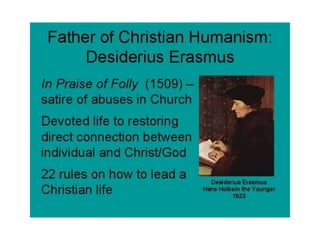
Humanism
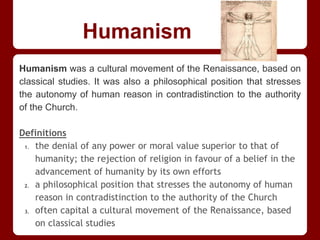
Humanism was a cultural movement of the Renaissance, based on
classical studies. It was also a philosophical position that stresses
the autonomy of human reason in contradistinction to the authority
of the Church.
Definitions
1. the denial of any power or moral value superior to that of
humanity; the rejection of religion in favour of a belief in the
advancement of humanity by its own efforts
2. a philosophical position that stresses the autonomy of human
reason in contradistinction to the authority of the Church
3. often capital a cultural movement of the Renaissance, based
on classical studies
Principles of Humanism
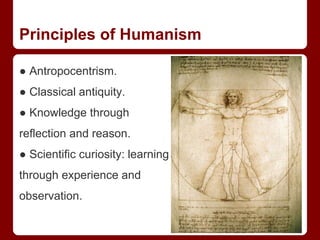
● Antropocentrism.
● Classical antiquity.
● Knowledge through
reflection and reason.
● Scientific curiosity: learning
through experience and
observation.
Science
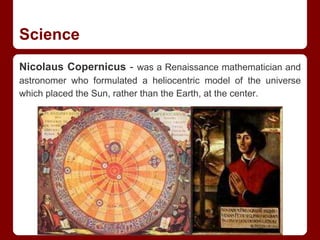
Nicolaus Copernicus - was a Renaissance mathematician and
astronomer who formulated a heliocentric model of the universe
which placed the Sun, rather than the Earth, at the center.
Science
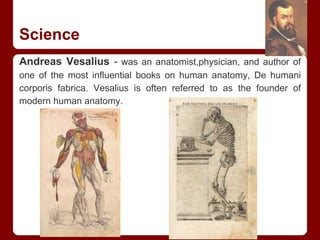
Andreas Vesalius - was an anatomist,physician, and author of
one of the most influential books on human anatomy, De humani
corporis fabrica. Vesalius is often referred to as the founder of
modern human anatomy.
Science
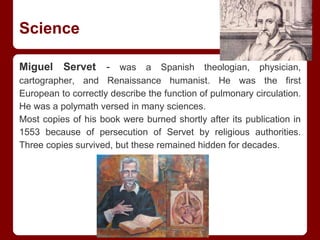
Miguel Servet - was a Spanish theologian, physician,
cartographer, and Renaissance humanist. He was the first
European to correctly describe the function of pulmonary circulation.
He was a polymath versed in many sciences.
Most copies of his book were burned shortly after its publication in
1553 because of persecution of Servet by religious authorities.
Three copies survived, but these remained hidden for decades.
Origin of Humanism
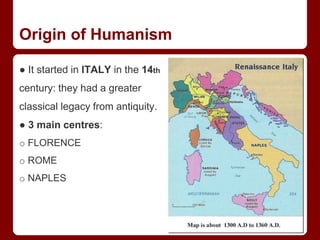
● It started in ITALY in the 14th
century: they had a greater
classical legacy from antiquity.
● 3 main centres:
o FLORENCE
o ROME
o NAPLES
Spread of Humanism
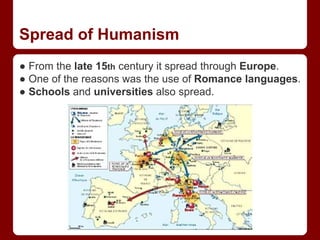
● From the late 15th century it spread through Europe.
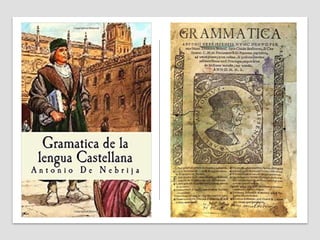
● One of the reasons was the use of Romance languages.
● Schools and universities also spread.
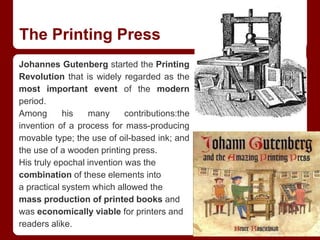
The Printing Press
Johannes Gutenberg started the Printing
Revolution that is widely regarded as the
most important event of the modern
period.
Among his many contributions:the
invention of a process for mass-producing
movable type; the use of oil-based ink; and
the use of a wooden printing press.
His truly epochal invention was the
combination of these elements into
a practical system which allowed the
mass production of printed books and
was economically viable for printers and
readers alike.
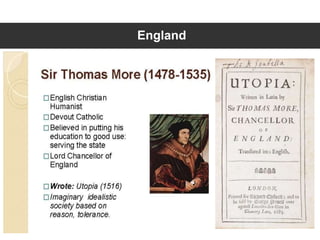
England
What was the Renaissance ?
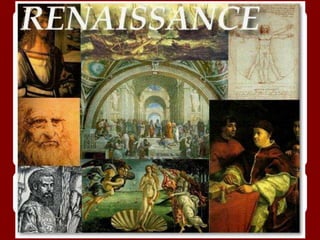
Renaissance was the period of European history marking the
decline of the Middle Ages and the rise of the modern world:
usually considered as beginning in Italy in the 14th century.
With this term we refer to the spirit, culture, art, science, and
thought of this period.
Characteristics of the Renaissance are usually considered to
include intensified classical scholarship, scientific and
geographical discovery, a sense of individual human
potentialities, and the assertion of the active and secular over
the religious and contemplative life.
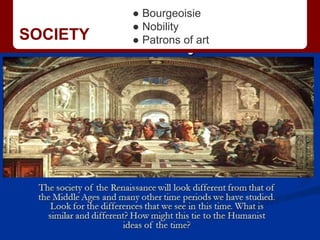
SOCIETY
● Bourgeoisie
● Nobility
● Patrons of art
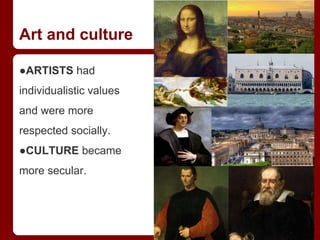
Art and culture
●ARTISTS had
individualistic values
and were more
respected socially.
●CULTURE became
more secular.
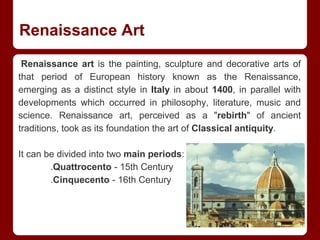
Renaissance Art
Renaissance art is the painting, sculpture and decorative arts of
that period of European history known as the Renaissance,
emerging as a distinct style in Italy in about 1400, in parallel with
developments which occurred in philosophy, literature, music and
science. Renaissance art, perceived as a "rebirth" of ancient
traditions, took as its foundation the art of Classical antiquity.
It can be divided into two main periods:
.Quattrocento - 15th Century
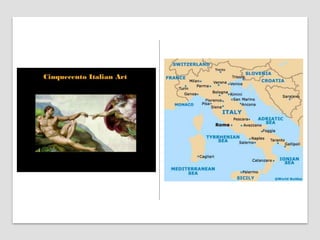
.Cinquecento - 16th Century
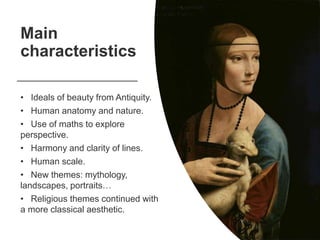
Main
characteristics
• Ideals of beauty from Antiquity.
• Human anatomy and nature.
• Use of maths to explore
perspective.
• Harmony and clarity of lines.
• Human scale.
• New themes: mythology,
landscapes, portraits…
• Religious themes continued with
a more classical aesthetic.
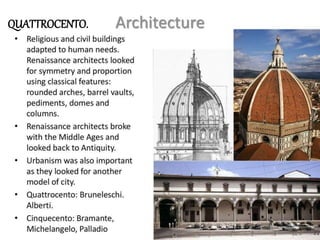
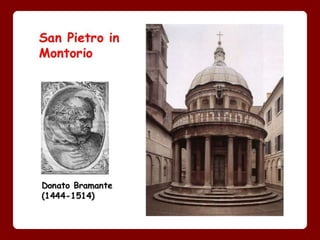
QUATTROCENTO.
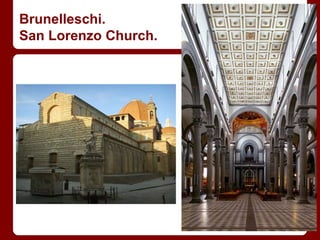
Brunelleschi.
San Lorenzo Church.
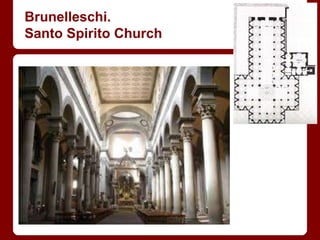
Brunelleschi.
Santo Spirito Church
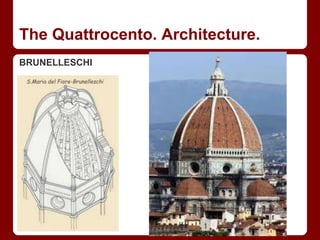
The Quattrocento. Architecture.
BRUNELLESCHI
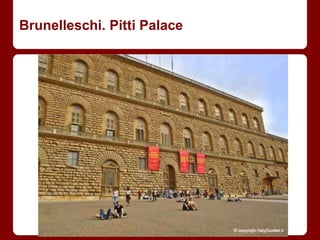
Brunelleschi. Pitti Palace
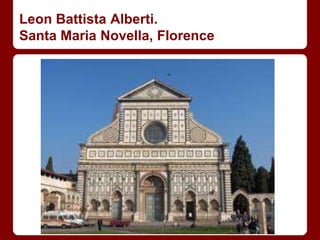
Leon Battista Alberti.
Santa Maria Novella, Florence
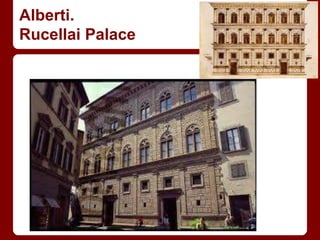
Alberti.
Rucellai Palace
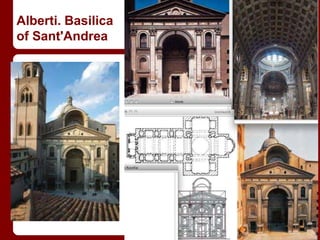
Alberti. Basilica
of Sant'Andrea
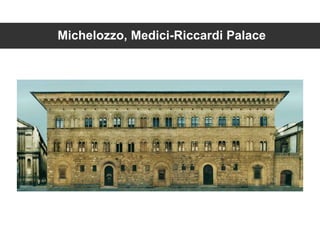
Michelozzo, Medici-Riccardi Palace
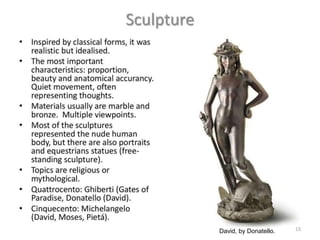
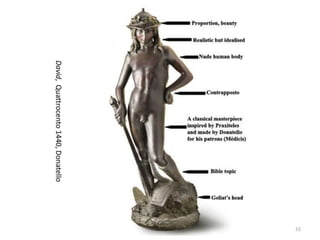
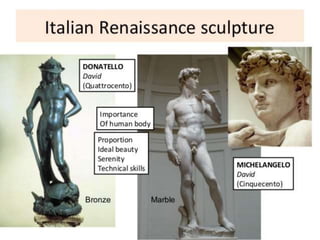
David, by Donatello.
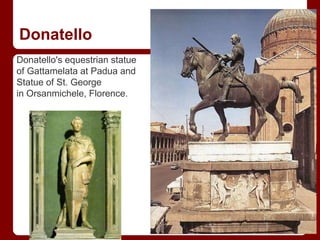
Donatello
Donatello's equestrian statue
of Gattamelata at Padua and
Statue of St. George
in Orsanmichele, Florence.
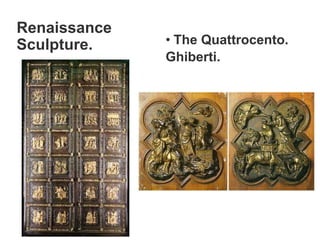
Renaissance
Sculpture. • The Quattrocento.
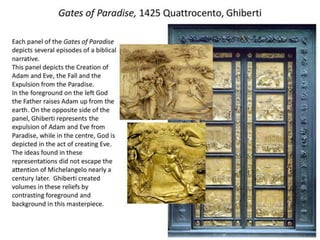
Ghiberti.
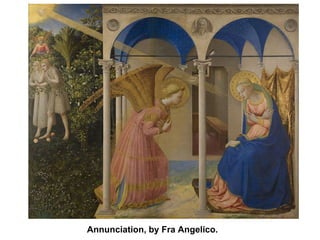
Annunciation, by Fra Angelico.
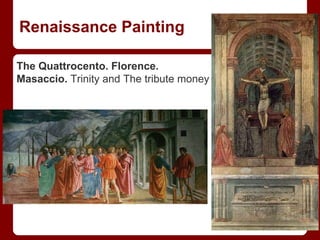
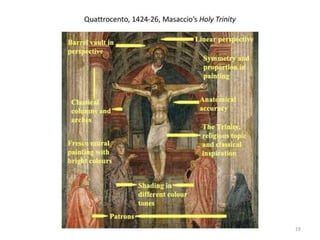
Renaissance Painting
The Quattrocento. Florence.
Masaccio. Trinity and The tribute money
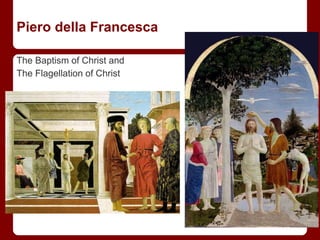
Piero della Francesca
The Baptism of Christ and
The Flagellation of Christ
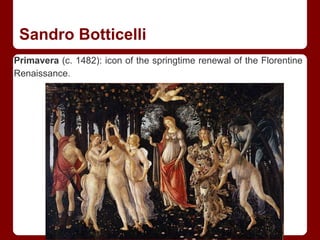
Sandro Botticelli
Primavera (c. 1482): icon of the springtime renewal of the Florentine
Renaissance.
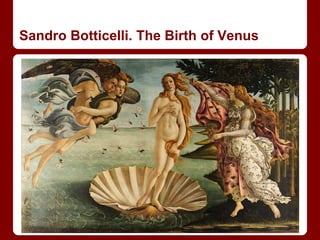
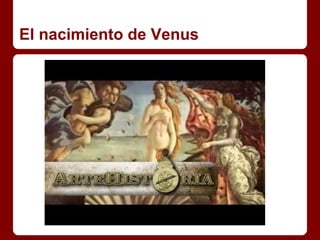
Sandro Botticelli. The Birth of Venus
El nacimiento de Venus
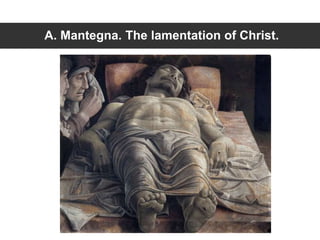
A. Mantegna. The lamentation of Christ.
Architecture
in the
Cinquecento.
Classicism continued.
Buildings became more
austere and monumental (les
decoration more architecture).
Harmony between elements.
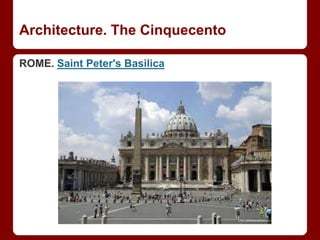
Architecture. The Cinquecento
ROME. Saint Peter's Basilica
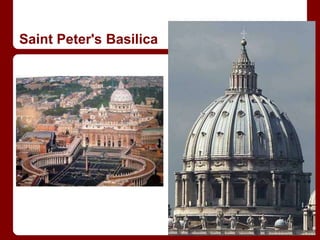
Saint Peter's Basilica
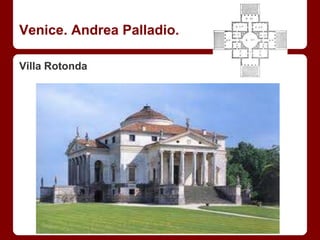
Venice. Andrea Palladio.
Villa Rotonda
• Mastery in perspective and human proportion.
• New techniques to achieve a natural look through light
and colour.
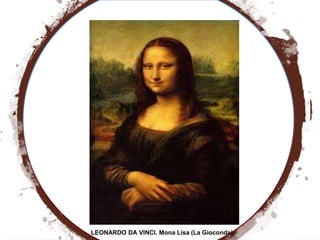
LEONARDO DA VINCI. Mona Lisa (La Gioconda),
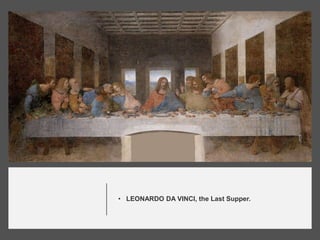
• LEONARDO DA VINCI, the Last Supper.
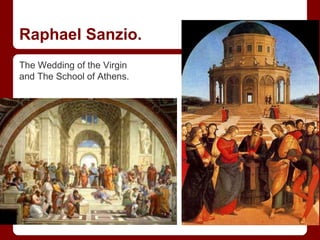
Raphael Sanzio.
The Wedding of the Virgin
and The School of Athens.
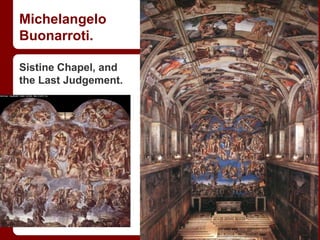
Michelangelo
Buonarroti.
Sistine Chapel, and
the Last Judgement.
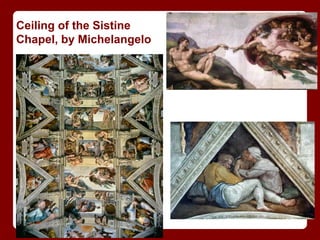
Ceiling of the Sistine
Chapel, by Michelangelo
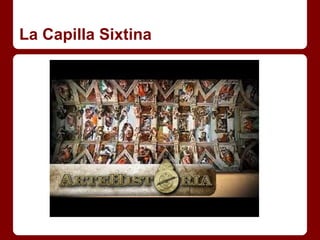
La Capilla Sixtina
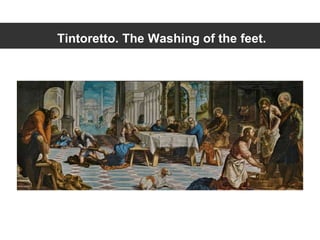
Tintoretto. The Washing of the feet.
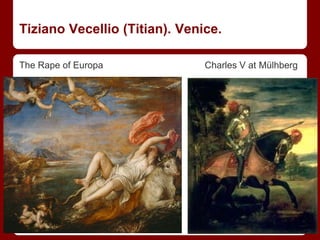
Tiziano Vecellio (Titian). Venice.
The Rape of Europa Charles V at Mülhberg
Italian
Cinquecento.
Sculpture.
• Archeological discoveries from
Ancient Rome inspired Italian
sculptors.
• Importance of human body,
proportion and balance.
• They often represented nudes.
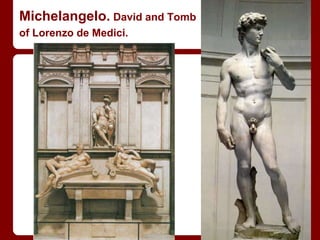
• The main sculptor was
Michelangelo, he evolved during
his career from classical serenity
to expressive and dramatic figures,
anticipating a new style.
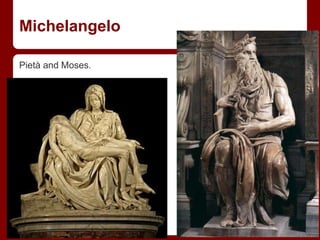
Michelangelo
Pietà and Moses.
Michelangelo. David and Tomb
of Lorenzo de Medici.
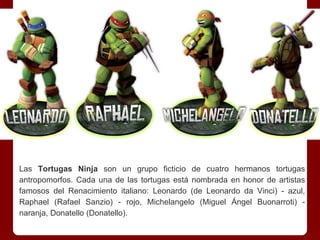
Las Tortugas Ninja son un grupo ficticio de cuatro hermanos tortugas
antropomorfos. Cada una de las tortugas está nombrada en honor de artistas
famosos del Renacimiento italiano: Leonardo (de Leonardo da Vinci) - azul,
Raphael (Rafael Sanzio) - rojo, Michelangelo (Miguel Ángel Buonarroti) -
naranja, Donatello (Donatello).
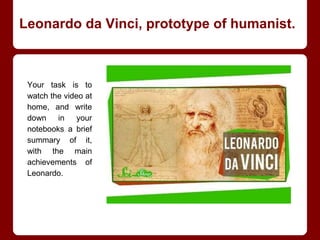
Leonardo da Vinci, prototype of humanist.
Your task is to
watch the video at
home, and write
down in your
notebooks a brief
summary of it,
with the main
achievements of
Leonardo.
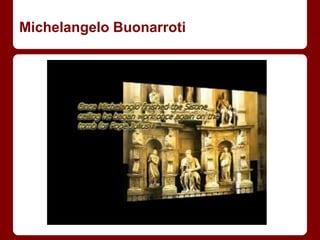
Michelangelo Buonarroti
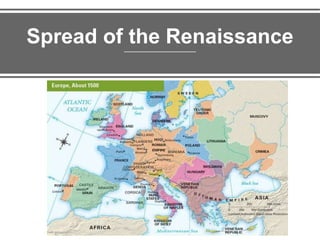
Spread of the Renaissance
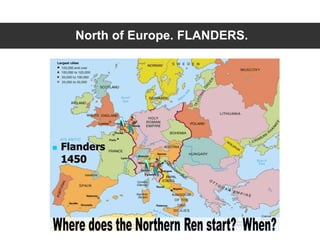
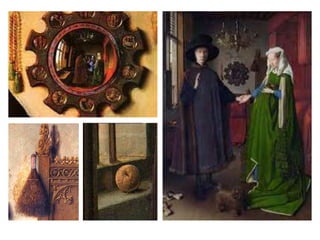
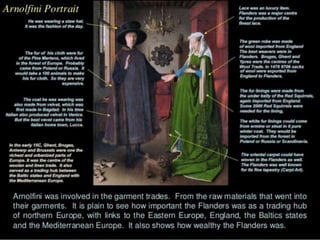
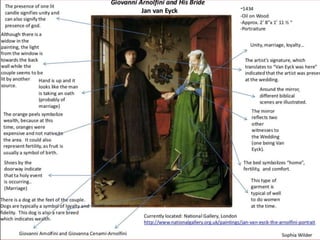
North of Europe. FLANDERS.
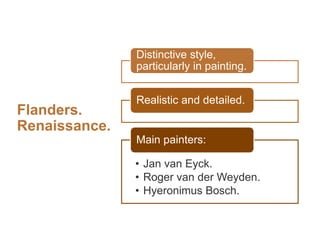
Flanders.
Renaissance.
Distinctive style,
particularly in painting.
Realistic and detailed.
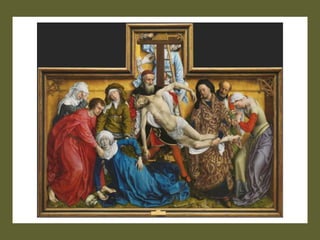
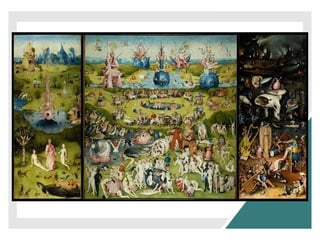
• Jan van Eyck.
• Roger van der Weyden.
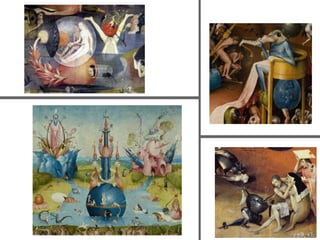
• Hyeronimus Bosch.
Main painters:
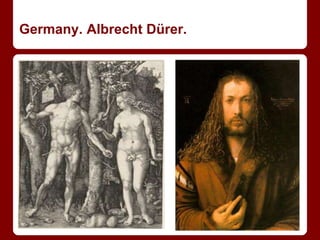
Germany. Albrecht Dürer.
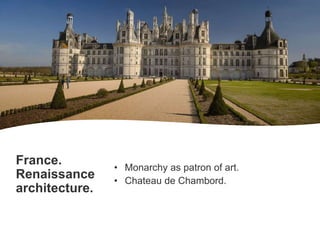
France.
Renaissance
architecture.
• Monarchy as patron of art.
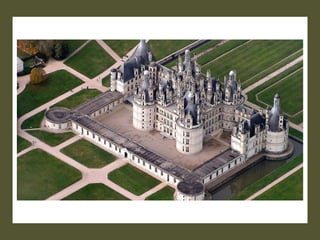
• Chateau de Chambord.
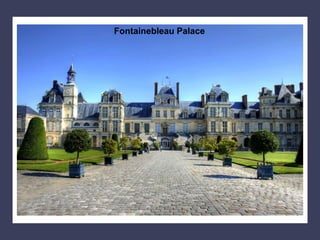
Fontainebleau Palace
Spanish Renaissance
The Gothic style continued to predominate in
Spain until the early 16th Century.
Renaissance in Spain had three possibilities:
the Italian tendency or classical, not very
extended, and the Spanish own styles, which
were two: Herrerian, and Plateresque.
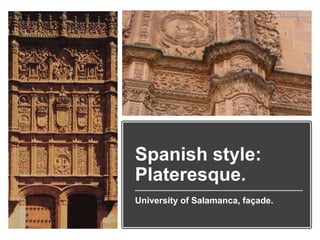
Spanish style:
Plateresque.
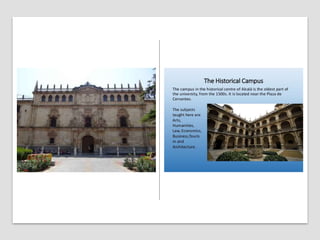
University of Salamanca, façade.
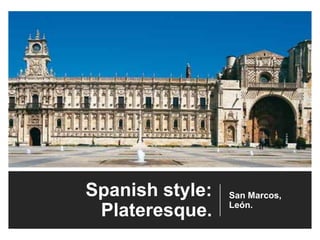
Spanish style:
Plateresque.
San Marcos,
León.
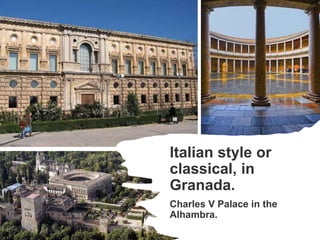
Italian style or
classical, in
Granada.
Charles V Palace in the
Alhambra.
Palacio de Carlos V, Granada
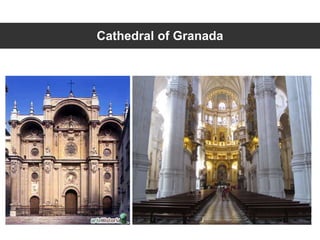
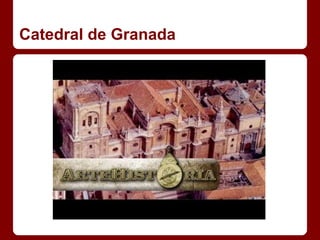
Cathedral of Granada
Catedral de Granada
Spanish style:
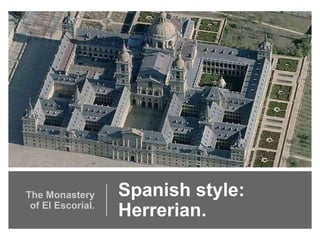
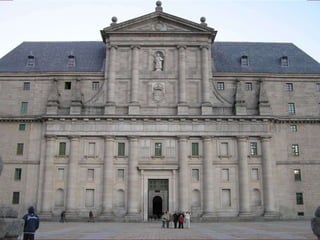
Herrerian.
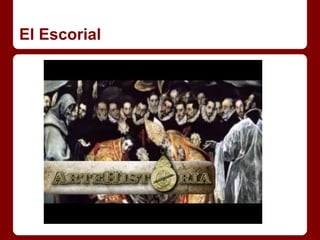
The Monastery
of El Escorial.
El Escorial
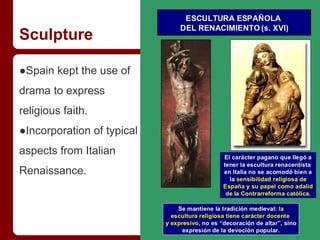
Sculpture
●Spain kept the use of
drama to express
religious faith.
●Incorporation of typical
aspects from Italian
Renaissance.
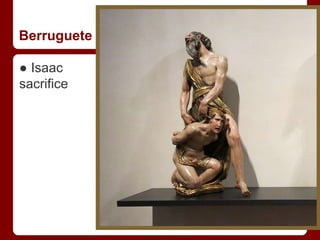
Berruguete
● Isaac
sacrifice
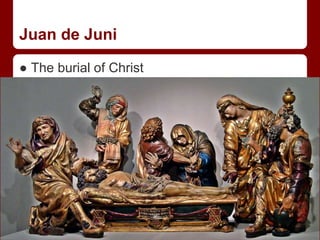
Juan de Juni
● The burial of Christ
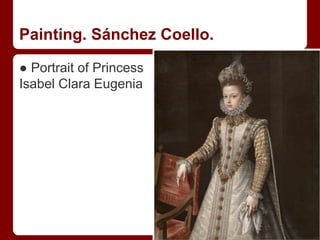
Painting. Sánchez Coello.
● Portrait of Princess
Isabel Clara Eugenia
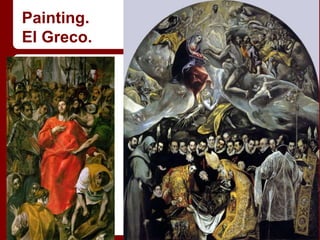
Painting.
El Greco.
El Greco
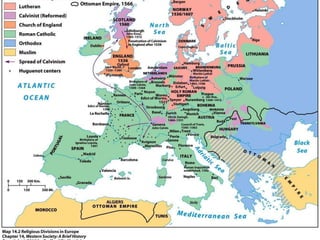
The Reformation
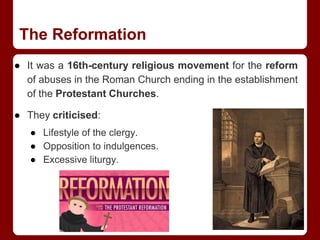
● It was a 16th-century religious movement for the reform
of abuses in the Roman Church ending in the establishment
of the Protestant Churches.
● They criticised:
● Lifestyle of the clergy.
● Opposition to indulgences.
● Excessive liturgy.
The Reformation
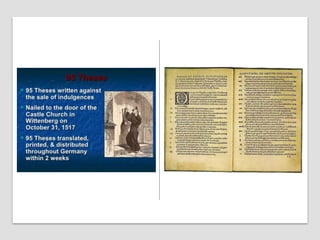
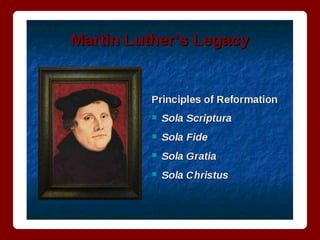
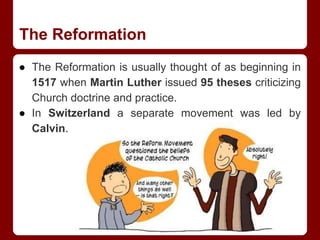
● The Reformation is usually thought of as beginning in
1517 when Martin Luther issued 95 theses criticizing
Church doctrine and practice.
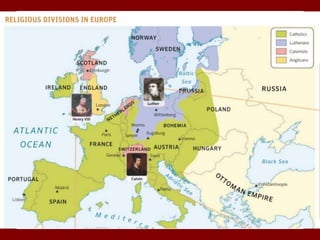
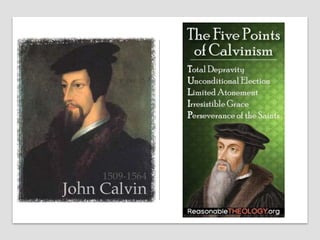
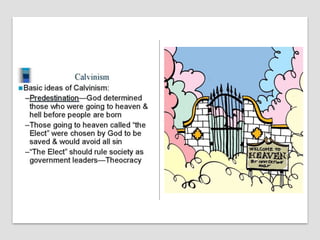
● In Switzerland a separate movement was led by
Calvin.
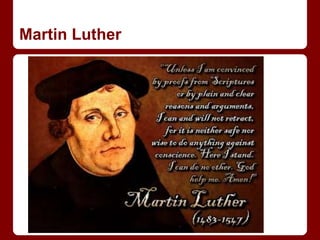
Martin Luther
The Counter-Reformation
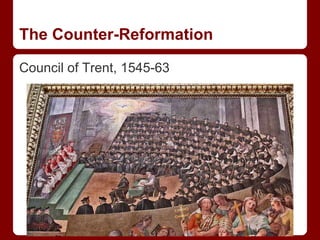
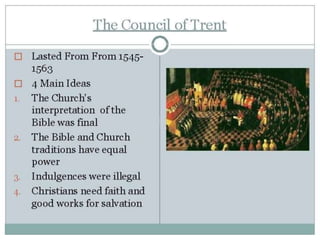
Council of Trent, 1545-63
The Council of Trent: The Catholic Church Survives the
Reformation
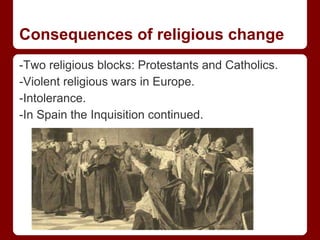
Consequences of religious change
-Two religious blocks: Protestants and Catholics.
-Violent religious wars in Europe.
-Intolerance.
-In Spain the Inquisition continued.
Renaissance Unit 7

Renaissance Unit 7