Summary Ledes
Summary Ledes
• Hard news stories typically use a summary
lede
– This is a “no nonsense” lede
– Just the facts…and fast!
– Uses an “inverted pyramid” to tell the story
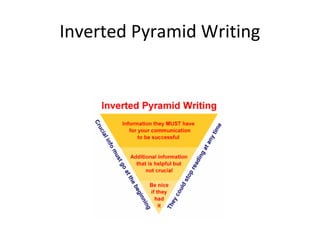
Inverted Pyramid
• An inverted pyramid lead places the essential
information upfront
– This is the opposite of a traditional “storytelling”
approach where one slowly builds the storyline
Inverted Pyramid Writing
Inverted Pyramid
• Many readers will only scan through a story to
get an overview of the topic
• Less important information appears at the end
of the story and is subject to being cut by
editors
Inverted Pyramid
• If a story is written in inverted pyramid
format, the editor can simply trim the story
one paragraph at a time, going from the
bottom up, until the story is the right length.
– The editor can do so confidently, knowing that
even though information is being cut from the
story, it is being cut in ascending order of
importance.
Inverted Pyramid
• Information crucial to the story, the who,
what, where, when, why, and sometimes
how, known as the Five Ws, should appear in
the first three or four sentences.
Guidelines for your Summary Lede
• The following slides offer some guidelines for
constructing your summary lede
– Remember that these guidelines are only here to
give you some direction. Some ledes will defy
these guidelines…
Guidlines for Writing a Lede
• Guideline #1:
• A straight news lede should be a single
paragraph consisting of a single sentence,
should contain no more than 35 words, and
should summarize, at minimum, the most
newsworthy "what," "where" and "when" of
the story.
Example
• "Fire destroyed a house on Main Street early
Monday morning."
– It summarizes the main "what" of the story, which
is that fire destroyed a house.
– It also provides the "where" of the story with the
phrase "on Main Street."
– Finally, it gives the "when" of the story with the
phrase "early Monday morning."
Guidelines for Writing a Lede
• Guideline #2:
• In many cases, the lede's first verb should
express the main "what" of the story and
should be placed among the lede's first seven
words.
Example
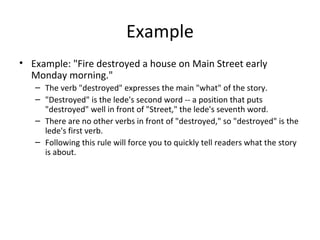
• Example: "Fire destroyed a house on Main Street early
Monday morning."
– The verb "destroyed" expresses the main "what" of the story.
– "Destroyed" is the lede's second word -- a position that puts
"destroyed" well in front of "Street," the lede's seventh word.
– There are no other verbs in front of "destroyed," so "destroyed" is the
lede's first verb.
– Following this rule will force you to quickly tell readers what the story
is about.
Guidelines for Writing a Lede
• Guideline #3:
• The lede's first verb -- the same one that
expresses the main "what" of the story --
should be active voice, not passive voice.
Example
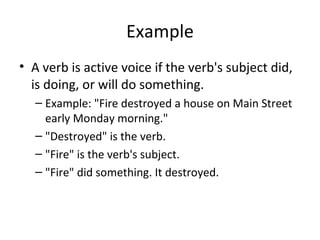
• A verb is active voice if the verb's subject did,
is doing, or will do something.
– Example: "Fire destroyed a house on Main Street
early Monday morning."
– "Destroyed" is the verb.
– "Fire" is the verb's subject.
– "Fire" did something. It destroyed.
Example
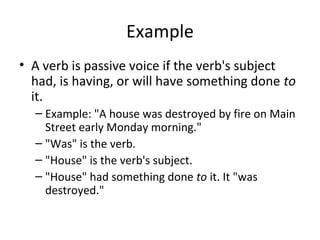
• A verb is passive voice if the verb's subject
had, is having, or will have something done to
it.
– Example: "A house was destroyed by fire on Main
Street early Monday morning."
– "Was" is the verb.
– "House" is the verb's subject.
– "House" had something done to it. It "was
destroyed."
Guidelines for Writing a Lede
• Guideline #4:
• If there's a "who" involved in the story, the
lede should give some indication of who the
"who" is.
Example
• "An elderly Moscow man died Monday when an early
morning fire raged through his Main Street home."
– The "who" is "an elderly Moscow man."
– In this case, the "who" probably isn't someone whose name readers
would recognize.
– As a result, the "who" angle of the lead focuses on what things about
the "who" might make the "who" important to the reader.
• In this case, it's the fact that the man was older and lived in Moscow.
That's called writing a "blind lede."
• The man's name will be given later in the story.
Another Example
• “Moscow Mayor Joe Smith died Monday
when an early morning fire raged through his
Main Street home."
– Smith is the local mayor, and most readers
probably will recognize his name.
– As a result, the lede gives his name.
Guidelines for Writing a Lede
• Guideline #5:
• The lede should summarize the "why" and
"how" of the story, but only if there's room.
• These details will often be described in
subsequent paragraphs
Example
• "An elderly Moscow man died early Monday
morning when fire sparked by faulty wiring
raged through his Main Street home."
– "... fire ... raged through his Main Street home ..."
explains why the man died.
– "... sparked by faulty wiring ..." explains how the
blaze began.
Guidelines for Writing a Lede
• Guideline #6:
• If what's in the lede needs to be attributed,
place the attribution at the end of the lede
Example
• "Faulty wiring most likely sparked the blaze
that claimed the life of an elderly Moscow
man last week, the city's arson investigator
concluded Monday."
– Attribution is simply a reference indicating the
source of some bit of information.
– In this case, the attribution is the phrase, "the
city's arson investigator concluded Monday."
Attribution
• Use attribution if there are assertions that
represent anything other than objective,
indisputable information.
– Example: The arson investigator's assertion that
faulty wiring caused the blaze represents the
investigator's opinion.
– Therefore, the assertion needs to be attributed to
the investigator so readers can decide how
credible the assertion is.
Writing the Lede
• How do you know what aspect of your lede is
most important?
– In other words, should you lead with the “who,”
“what,” “when,” “where” or “why?”
– Which of these details most strongly meets the
definition of news criteria?
– In other words, why is the story interesting or
relevant?
Example
• A fire erupted
• If the fire originated at the home of a
celebrity, then the WHO becomes significant
So what!!!
• Use the “so what” test to help you write your
lede
• Why should a reader care about the story?
Multiple-Element Ledes
• If there are multiple elements that are all
equally significant, then you might use a
multiple-element lede
– To pull this off, you will need to construct a clear,
simple sentence that captures the highlights of
these multiple developments
Multiple-Element Ledes
• Example:
– “A flash fire that swept through a landmark
downtown hotel Saturday killed at least 12
persons, injured 60 more and forced scores of
residents to leap from windows and the roof in
near-zero cold.”
– Note that the verb phrases used within this
sentence are parallel (“killed,” “injured” and
“forced”)
Multiple-Element Ledes
• Use multiple-element ledes sparingly
• Consider breaking the story out into a sidebar
• Editors will often use graphics and sidebars to
visually convey the information

Summary Ledes

  • 1.
  • 2.
    Summary Ledes • Hardnews stories typically use a summary lede – This is a “no nonsense” lede – Just the facts…and fast! – Uses an “inverted pyramid” to tell the story
  • 3.
    Inverted Pyramid • Aninverted pyramid lead places the essential information upfront – This is the opposite of a traditional “storytelling” approach where one slowly builds the storyline
  • 4.
  • 5.
    Inverted Pyramid • Manyreaders will only scan through a story to get an overview of the topic • Less important information appears at the end of the story and is subject to being cut by editors
  • 6.
    Inverted Pyramid • Ifa story is written in inverted pyramid format, the editor can simply trim the story one paragraph at a time, going from the bottom up, until the story is the right length. – The editor can do so confidently, knowing that even though information is being cut from the story, it is being cut in ascending order of importance.
  • 7.
    Inverted Pyramid • Informationcrucial to the story, the who, what, where, when, why, and sometimes how, known as the Five Ws, should appear in the first three or four sentences.
  • 8.
    Guidelines for yourSummary Lede • The following slides offer some guidelines for constructing your summary lede – Remember that these guidelines are only here to give you some direction. Some ledes will defy these guidelines…
  • 9.
    Guidlines for Writinga Lede • Guideline #1: • A straight news lede should be a single paragraph consisting of a single sentence, should contain no more than 35 words, and should summarize, at minimum, the most newsworthy "what," "where" and "when" of the story.
  • 10.
    Example • "Fire destroyeda house on Main Street early Monday morning." – It summarizes the main "what" of the story, which is that fire destroyed a house. – It also provides the "where" of the story with the phrase "on Main Street." – Finally, it gives the "when" of the story with the phrase "early Monday morning."
  • 11.
    Guidelines for Writinga Lede • Guideline #2: • In many cases, the lede's first verb should express the main "what" of the story and should be placed among the lede's first seven words.
  • 12.
    Example • Example: "Firedestroyed a house on Main Street early Monday morning." – The verb "destroyed" expresses the main "what" of the story. – "Destroyed" is the lede's second word -- a position that puts "destroyed" well in front of "Street," the lede's seventh word. – There are no other verbs in front of "destroyed," so "destroyed" is the lede's first verb. – Following this rule will force you to quickly tell readers what the story is about.
  • 13.
    Guidelines for Writinga Lede • Guideline #3: • The lede's first verb -- the same one that expresses the main "what" of the story -- should be active voice, not passive voice.
  • 14.
    Example • A verbis active voice if the verb's subject did, is doing, or will do something. – Example: "Fire destroyed a house on Main Street early Monday morning." – "Destroyed" is the verb. – "Fire" is the verb's subject. – "Fire" did something. It destroyed.
  • 15.
    Example • A verbis passive voice if the verb's subject had, is having, or will have something done to it. – Example: "A house was destroyed by fire on Main Street early Monday morning." – "Was" is the verb. – "House" is the verb's subject. – "House" had something done to it. It "was destroyed."
  • 16.
    Guidelines for Writinga Lede • Guideline #4: • If there's a "who" involved in the story, the lede should give some indication of who the "who" is.
  • 17.
    Example • "An elderlyMoscow man died Monday when an early morning fire raged through his Main Street home." – The "who" is "an elderly Moscow man." – In this case, the "who" probably isn't someone whose name readers would recognize. – As a result, the "who" angle of the lead focuses on what things about the "who" might make the "who" important to the reader. • In this case, it's the fact that the man was older and lived in Moscow. That's called writing a "blind lede." • The man's name will be given later in the story.
  • 18.
    Another Example • “MoscowMayor Joe Smith died Monday when an early morning fire raged through his Main Street home." – Smith is the local mayor, and most readers probably will recognize his name. – As a result, the lede gives his name.
  • 19.
    Guidelines for Writinga Lede • Guideline #5: • The lede should summarize the "why" and "how" of the story, but only if there's room. • These details will often be described in subsequent paragraphs
  • 20.
    Example • "An elderlyMoscow man died early Monday morning when fire sparked by faulty wiring raged through his Main Street home." – "... fire ... raged through his Main Street home ..." explains why the man died. – "... sparked by faulty wiring ..." explains how the blaze began.
  • 21.
    Guidelines for Writinga Lede • Guideline #6: • If what's in the lede needs to be attributed, place the attribution at the end of the lede
  • 22.
    Example • "Faulty wiringmost likely sparked the blaze that claimed the life of an elderly Moscow man last week, the city's arson investigator concluded Monday." – Attribution is simply a reference indicating the source of some bit of information. – In this case, the attribution is the phrase, "the city's arson investigator concluded Monday."
  • 23.
    Attribution • Use attributionif there are assertions that represent anything other than objective, indisputable information. – Example: The arson investigator's assertion that faulty wiring caused the blaze represents the investigator's opinion. – Therefore, the assertion needs to be attributed to the investigator so readers can decide how credible the assertion is.
  • 24.
    Writing the Lede •How do you know what aspect of your lede is most important? – In other words, should you lead with the “who,” “what,” “when,” “where” or “why?” – Which of these details most strongly meets the definition of news criteria? – In other words, why is the story interesting or relevant?
  • 25.
    Example • A fireerupted • If the fire originated at the home of a celebrity, then the WHO becomes significant
  • 26.
    So what!!! • Usethe “so what” test to help you write your lede • Why should a reader care about the story?
  • 27.
    Multiple-Element Ledes • Ifthere are multiple elements that are all equally significant, then you might use a multiple-element lede – To pull this off, you will need to construct a clear, simple sentence that captures the highlights of these multiple developments
  • 28.
    Multiple-Element Ledes • Example: –“A flash fire that swept through a landmark downtown hotel Saturday killed at least 12 persons, injured 60 more and forced scores of residents to leap from windows and the roof in near-zero cold.” – Note that the verb phrases used within this sentence are parallel (“killed,” “injured” and “forced”)
  • 29.
    Multiple-Element Ledes • Usemultiple-element ledes sparingly • Consider breaking the story out into a sidebar • Editors will often use graphics and sidebars to visually convey the information