By Jeanne Acton,UIL & ILPC Journalism Director
and Vicki McCash Brennan, MA, CJE
News Writing
Let’s talk about …
3.
News …
… givesreaders information that
will impact them or interests them
in some way.
“News is anything that's interesting, that relates to
what's happening in the world, what's happening in
areas of the culture that would be of interest to your
audience.”
— Kurt Loder, music journalist, former editor of Rolling Stone
4.
What is alead?
• It’s the first sentence of the
story, the beginning.
• It tells the most important
information and the newest
information.
• It grabs your readers’ attention.
But there’s more …
5.
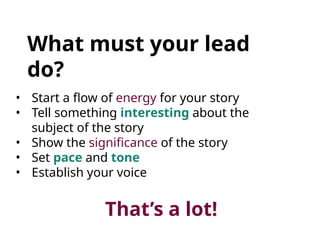
What must yourlead
do?
• Start a flow of energy for your story
• Tell something interesting about the
subject of the story
• Show the significance of the story
• Set pace and tone
• Establish your voice
That’s a lot!
6.
She peeked aroundthe door leading to the 500 Hall.
“Hey,” she whispered, “is Mrs. Solomon looking?” Five
minutes later, the girl with darting eyes would be silently
speed walking towards the black gate, trying to leave school
during C Lunch. [Hillsborough High School]
Freshman Noah Barboza likes to spend his time lifting
at the gym, not lifting textbooks around school. Barboza is
constantly struggling with the pain of carrying his books
around campus on his way to his eight class periods. [Cypress
Bay High School]
At first glance, senior basketball player Myron Dewar
might pass through halls unnoticed. His only striking feature
is his strange, indifferent gaze that seems to hide his past,
his thoughts, his inner turmoil. [Coral Springs High School]
Some great student-written leads …
7.
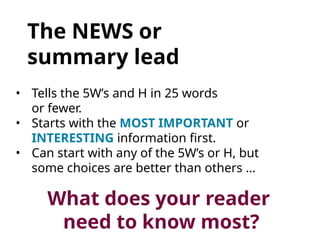
The NEWS or
summarylead
• Tells the 5W’s and H in 25 words
or fewer.
• Starts with the MOST IMPORTANT or
INTERESTING information first.
• Can start with any of the 5W’s or H, but
some choices are better than others …
What does your reader
need to know most?
8.
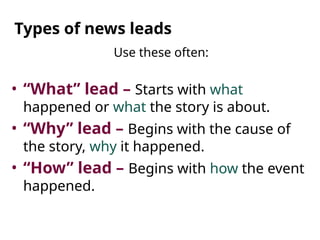
Types of newsleads
Use these often:
• “What” lead – Starts with what
happened or what the story is about.
• “Why” lead – Begins with the cause of
the story, why it happened.
• “How” lead – Begins with how the event
happened.
9.
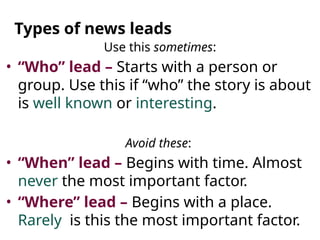
Use this sometimes:
•“Who” lead – Starts with a person or
group. Use this if “who” the story is about
is well known or interesting.
Avoid these:
• “When” lead – Begins with time. Almost
never the most important factor.
• “Where” lead – Begins with a place.
Rarely is this the most important factor.
Types of news leads
10.
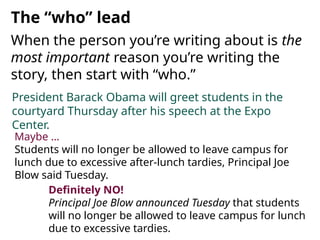
President Barack Obamawill greet students in the
courtyard Thursday after his speech at the Expo
Center.
When the person you’re writing about is the
most important reason you’re writing the
story, then start with “who.”
The “who” lead
Definitely NO!
Principal Joe Blow announced Tuesday that students
will no longer be allowed to leave campus for lunch
due to excessive tardies.
Maybe …
Students will no longer be allowed to leave campus for
lunch due to excessive after-lunch tardies, Principal Joe
Blow said Tuesday.
11.
Yes …
Endurance swimmerDiana Nyad, 64, became the
first person to complete a 110-mile swim from Cuba
to Florida without a shark cage. It took her 53 hours.
Does not need a name to work.
Sometimes identifying the “who” by an
occupation or accomplishment will do it
– as long as the person is interesting
enough to hook your reader.
The “who” lead
12.
Maybe, for ananniversary story ...
Fifty years ago, on Nov. 22, 1963, President John F.
Kennedy was shot and killed in Dallas. It was a defining
moment for the country, one that people older than 55
remember the way most American adults remember Sept.
11.
Definitely no!
On Tuesday Principal Joe Blow announced that students
will no longer be able to leave campus for lunch.
Do not start with the time element. It’s almost
never the most important factor.
The “when” lead
13.
And again: Whyis this type of lead
rarely – almost never – used?
Maybe … but maybe not
In the principal’s office, the senior class dumped 30
pounds of sand to protest the cancellation of the
senior trip to Cancun.
Don’t start with a place, either. It’s almost never
the most important or interesting factor.
Definitely no!
At the school board meeting on Tuesday, Principal Joe
Blow announced that he has ended the off-campus lunch
policy.
The “where” lead
14.
News writers handlethe “where” with a DATELINE,
a city name in all caps before the lead to say
where the story originated.
CATANIA, Italy — More than 800 people were believed to
have drowned in the weekend sinking of a boat packed
with migrants trying to reach Europe, the United Nations
refugee agency said Tuesday.
Datelines are not used on local news stories
where the place is understood. Similarly,
there’s no need for datelines student
newspapers, websites and yearbooks to name
your school. Readers know where you are.
On the topic of “where” …
15.
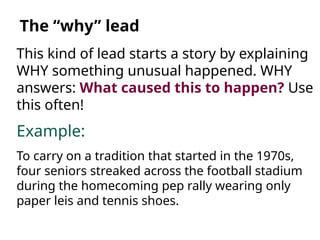
This kind oflead starts a story by explaining
WHY something unusual happened. WHY
answers: What caused this to happen? Use
this often!
Example:
To carry on a tradition that started in the 1970s,
four seniors streaked across the football stadium
during the homecoming pep rally wearing only
paper leis and tennis shoes.
The “why” lead
16.
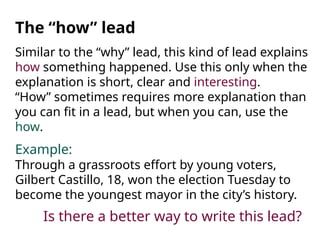
Similar to the“why” lead, this kind of lead explains
how something happened. Use this only when the
explanation is short, clear and interesting.
“How” sometimes requires more explanation than
you can fit in a lead, but when you can, use the
how.
Example:
Through a grassroots effort by young voters,
Gilbert Castillo, 18, won the election Tuesday to
become the youngest mayor in the city’s history.
The “how” lead
Is there a better way to write this lead?
17.
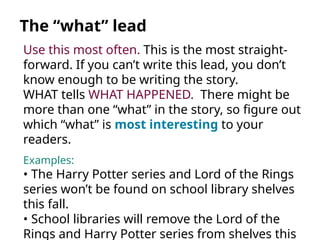
Use this mostoften. This is the most straight-
forward. If you can’t write this lead, you don’t
know enough to be writing the story.
WHAT tells WHAT HAPPENED. There might be
more than one “what” in the story, so figure out
which “what” is most interesting to your
readers.
Examples:
• The Harry Potter series and Lord of the Rings
series won’t be found on school library shelves
this fall.
• School libraries will remove the Lord of the
Rings and Harry Potter series from shelves this
The “what” lead
18.
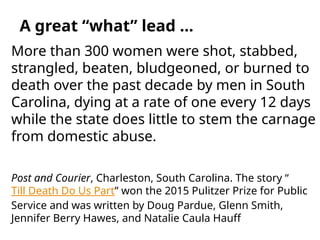
More than 300women were shot, stabbed,
strangled, beaten, bludgeoned, or burned to
death over the past decade by men in South
Carolina, dying at a rate of one every 12 days
while the state does little to stem the carnage
from domestic abuse.
Post and Courier, Charleston, South Carolina. The story “
Till Death Do Us Part” won the 2015 Pulitzer Prize for Public
Service and was written by Doug Pardue, Glenn Smith,
Jennifer Berry Hawes, and Natalie Caula Hauff
A great “what” lead …
19.
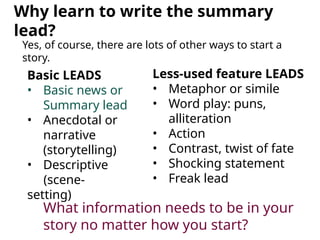
Why learn towrite the summary
lead?
Yes, of course, there are lots of other ways to start a
story.
Basic LEADS
• Basic news or
Summary lead
• Anecdotal or
narrative
(storytelling)
• Descriptive
(scene-
setting)
Less-used feature LEADS
• Metaphor or simile
• Word play: puns,
alliteration
• Action
• Contrast, twist of fate
• Shocking statement
• Freak lead
What information needs to be in your
story no matter how you start?
20.
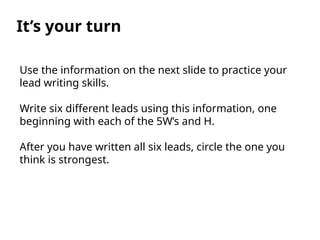
It’s your turn
Usethe information on the next slide to practice your
lead writing skills.
Write six different leads using this information, one
beginning with each of the 5W’s and H.
After you have written all six leads, circle the one you
think is strongest.
21.
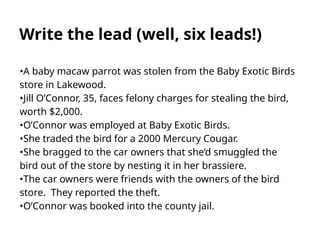
Write the lead(well, six leads!)
•A baby macaw parrot was stolen from the Baby Exotic Birds
store in Lakewood.
•Jill O’Connor, 35, faces felony charges for stealing the bird,
worth $2,000.
•O’Connor was employed at Baby Exotic Birds.
•She traded the bird for a 2000 Mercury Cougar.
•She bragged to the car owners that she’d smuggled the
bird out of the store by nesting it in her brassiere.
•The car owners were friends with the owners of the bird
store. They reported the theft.
•O’Connor was booked into the county jail.
22.
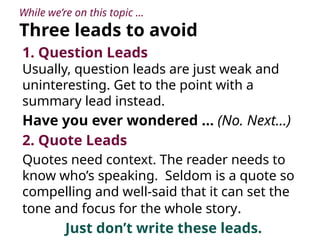
While we’re onthis topic …
Three leads to avoid
1. Question Leads
Usually, question leads are just weak and
uninteresting. Get to the point with a
summary lead instead.
Have you ever wondered … (No. Next…)
2. Quote Leads
Quotes need context. The reader needs to
know who’s speaking. Seldom is a quote so
compelling and well-said that it can set the
tone and focus for the whole story.
Just don’t write these leads.
23.
While we’re onthis topic …
Three leads to avoid
3. Topic Leads
It is not enough to just state the topic of your
story. These are some of the worst leads ever:
On April 25 at the Shockley Community Center,
prom was held.
The school board met Tuesday to discuss
problems with school lunch.
The Bulldogs played the Hurricanes Friday in a
crucial conference game.
With Thanksgiving coming, people are thinking
about food.
Just don’t write these leads.
24.
Every story needsa summary
Regardless of what you are writing about,
the 5W’s and H belong in the story.
If you get in the habit of writing a
summary lead for EVERY STORY, you will
always have the basics covered – even if
you end up with a different kind of lead.
A bonus: Your feature leads will have a
better focus, because they have to lead
into your summary!
25.
Now you knowyou can start your
leads in different ways,
but how do you find the BEST
lead for your story?
Use this four-step
process.
How to write effective news leads
26.
1. Collect allyour facts. REPORTING is key.
• Who: What person or group is this story
about? There might be more than one. List
them all.
• What: What happened? What is the issue,
problem or conflict? Explain it.
• When: Day, date, time
• Where: Be as specific as possible
• Why: Why did this happen? Provide context.
• How: How did it happen? Provide details.
*Adapted from Inside Reporting by Tim Harrower
How to write an effective news lead*
27.
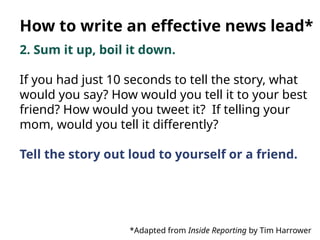
2. Sum itup, boil it down.
If you had just 10 seconds to tell the story, what
would you say? How would you tell it to your best
friend? How would you tweet it? If telling your
mom, would you tell it differently?
Tell the story out loud to yourself or a friend.
*Adapted from Inside Reporting by Tim Harrower
How to write an effective news lead*
28.
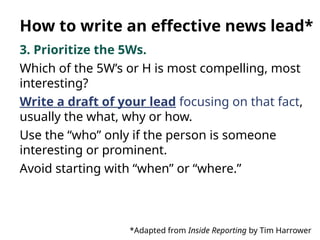
3. Prioritize the5Ws.
Which of the 5W’s or H is most compelling, most
interesting?
Write a draft of your lead focusing on that fact,
usually the what, why or how.
Use the “who” only if the person is someone
interesting or prominent.
Avoid starting with “when” or “where.”
*Adapted from Inside Reporting by Tim Harrower
How to write an effective news lead*
29.
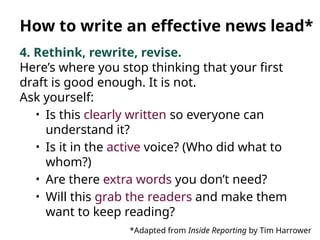
4. Rethink, rewrite,revise.
Here’s where you stop thinking that your first
draft is good enough. It is not.
Ask yourself:
• Is this clearly written so everyone can
understand it?
• Is it in the active voice? (Who did what to
whom?)
• Are there extra words you don’t need?
• Will this grab the readers and make them
want to keep reading?
*Adapted from Inside Reporting by Tim Harrower
How to write an effective news lead*
30.
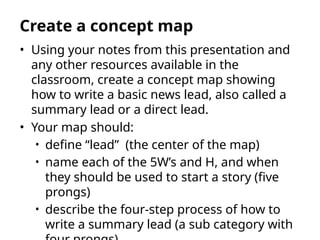
• Using yournotes from this presentation and
any other resources available in the
classroom, create a concept map showing
how to write a basic news lead, also called a
summary lead or a direct lead.
• Your map should:
• define “lead” (the center of the map)
• name each of the 5W’s and H, and when
they should be used to start a story (five
prongs)
• describe the four-step process of how to
write a summary lead (a sub category with
Create a concept map
Editor's Notes
#5 John McPhee calls the lead “a flashlight that shines into the story.”
Inexperienced writers will try to put all five W’s and H into the lead. That makes an overloaded lead.
Editors call those “suitcase” leads – like an over packed suitcase, it bulges with too much stuff.
Others call it “clothesline” lead because it strings bits of info together one after another … avoid this.
#10 Explain that “who” leads don’t necessarily need to use a name. Describing the person as someone the reader can relate to, or with some unique characteristic can work really well.
#11 Who leads work best when the person is the story and the main reason you are writing it is that this person is a CELEBRITY or has PROMINENCE for your readers.
#12 “When” leads can work in anniversary stories, but almost nowhere else. Discourage the use of this lead!
#13 Where something happened usually isn’t the most important element of a story. Also, readers of a particular publication know where they are. What happened, to whom and how or why it happened are almost always more interesting. Even in the second example, the place doesn’t necessarily belong first. This works just as well:The senior class dumped 30 pounds of sand in the principal’s office on Tuesday to protest the cancellation of their senior trip to Cancun.
#14 Teachers: Feel free to update the sample lead with something more timely.
#16 If Gilbert is well-known to students, a who lead might be better. Or even this: A flood of young voters carried senior Gilbert Castillo to become the city’s youngest mayor in history.
#19 No matter what you are writing, you still need the facts: The 5W’s and H. Teachers, please emphasize that every story needs the summary info somewhere, so in some sense, every story needs a summary lead, even if it doesn’t end up being the first paragraph!
#21 Students should use this information to write six different leads, one focused on each of the 5W’s + H. Then they should decide which is strongest and circle it on their paper. Share, discuss, and/or collect.
#22 Have you ever wondered about … is a close cousin to the “Imagine if” lead, which is also a terrible lead.
#23 The problem with topic leads is that they say nothing and don’t really tell you what the story itself is about. The point of a news story – or any story, really – is to tell the readers what happened.
#24 Lesson on types of leads ends here. The next part could be continued before or after students write practice leads. (See “Lead Writing Exercises” slideshow for practice exercises that can be used as bell ringers.)
#25 Lesson on types of leads ends here. The next part could be continued before or after students write practice leads. (See “Lead Writing Exercises” slideshow for practice exercises that can be used as bell ringers.)
#26 Remind students again that when and where are often the least important. Those details need to be there, but students shouldn’t start the story with those elements.
#30 This is a textbook reading strategy … If you also have textbooks in the classroom, ask students to read or refer to the chapters about basic news leads for reinforcement.
![She peeked around the door leading to the 500 Hall.
“Hey,” she whispered, “is Mrs. Solomon looking?” Five
minutes later, the girl with darting eyes would be silently
speed walking towards the black gate, trying to leave school
during C Lunch. [Hillsborough High School]
Freshman Noah Barboza likes to spend his time lifting
at the gym, not lifting textbooks around school. Barboza is
constantly struggling with the pain of carrying his books
around campus on his way to his eight class periods. [Cypress
Bay High School]
At first glance, senior basketball player Myron Dewar
might pass through halls unnoticed. His only striking feature
is his strange, indifferent gaze that seems to hide his past,
his thoughts, his inner turmoil. [Coral Springs High School]
Some great student-written leads …](https://image.slidesharecdn.com/presentation-2-250603105958-d692412a/85/presentation-2-2-basic-lead-writing-pptx-6-320.jpg)