What is News?
News Writing
• informative
• interesting
“… anything that will make people talk.”
— Charles Dana, New York Sun editor
News is
… whatever interests the reader.
Can something be news even if it’s
not important?
News is
… information that’s important
to readers.
Can something be informationand
NOT be news?
News is
News is factual.
• News must be based on facts.
• It must be accurate. Otherwise it is
NOT news. It is opinion.
And one more thing...
“Everyone is entitled to their own
opinion, but not their own facts.”—
Sen. Daniel Patrick Moynihan
“We are recorders and reporters of
the facts – not judges of the
behavior we describe.”
— Alfred C. Kinsey, founder, Institute for Sex Research
Get your facts right.
It’s that simple.
Accuracy
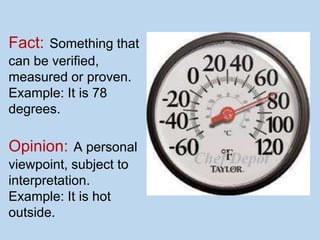
Fact: Something that
can be verified,
measured or proven.
Example: It is 78
degrees.
Opinion: A personal
viewpoint, subject to
interpretation.
Example: It is hot
outside.
•Verify each fact and quote. If you’re in doubt about
anything, check with your sources again.
•Double-check spellings of names, as well as
grade levels and titles. Refer to official documents
listing this information, such as homeroom lists or a
school directory.
•Use Google or YellowBook to double-check the
names of organizations, businesses and places.
•Double-check dates using a calendar.
Tips for accurate reporting
• To be fair in news reporting, you
must report the facts without bias.
• You cannot let your own personal
opinion, your feelings for the subject or
your membership in a club or team
slant your reporting.
Objective reporting
In journalism, “objective” doesn’t refer to what you’re tested on
or what you have to learn today.
Objective means: not influenced by personal
feelings, interpretations, or prejudice; based on
facts; unbiased.
• It is the opposite of “subjective.”
Subjective means: placing excessive emphasis
on one's own moods, attitudes, opinions, etc.;
focused on yourself.
• If you are subjective, you are biased, not fair.
Objective reporting
When you include your own opinion in a story,
it is called editorializing.
• If you report about a pep rally and say that
everyone had a great time, you are editorializing.
You can’t prove that everyone had a great time.
• Report what you saw and heard, not what you
think or feel. Let the readers draw their own
conclusions.
Editorializing
… is not objective reporting!
It’s not fair.
Editorializing
To be fair, you also need
to provide balance in your
coverage.
Balance
• Balance facts with other facts,
opinions with other opinions.
• Cover all sides of an issue.
Did you interview representatives of all
of the people involved in the story?
Balance
Sources – the people who provide
information for news – matter!
• It is essential to interview and quote
the RIGHT sources, the people who are
experts on the topic.
• Go with those in the know.
Balance
Balance means you cover all
perspectives of a story or issue – using
the sources who KNOW the various
positions.
Objectivity means you do not insert
your own thoughts and opinions or quote
one side more than another.
Fairness
• Sometimes two sides are not equal.
• You have to use your best judgment
and knowledge as a reporter to present
the FACTUAL information.
• What if one side is mostly opinion and
the other side supported by facts?
Accuracy
“A newspaper cannot really
congratulate itself on having got
at the facts impartially when it
has quoted at length from two
uninformed idiots on opposing
sides of an issue.”
— A.J. Wiggins, editor and publisher
• interesting
• informative
• factual and accurate
• fair (both objective and balanced)
News is

What is news

  • 1.
  • 2.
    • informative • interesting “…anything that will make people talk.” — Charles Dana, New York Sun editor News is
  • 3.
    … whatever intereststhe reader. Can something be news even if it’s not important? News is
  • 4.
    … information that’simportant to readers. Can something be informationand NOT be news? News is
  • 5.
    News is factual. •News must be based on facts. • It must be accurate. Otherwise it is NOT news. It is opinion. And one more thing...
  • 6.
    “Everyone is entitledto their own opinion, but not their own facts.”— Sen. Daniel Patrick Moynihan “We are recorders and reporters of the facts – not judges of the behavior we describe.” — Alfred C. Kinsey, founder, Institute for Sex Research
  • 7.
    Get your factsright. It’s that simple. Accuracy
  • 8.
    Fact: Something that canbe verified, measured or proven. Example: It is 78 degrees. Opinion: A personal viewpoint, subject to interpretation. Example: It is hot outside.
  • 9.
    •Verify each factand quote. If you’re in doubt about anything, check with your sources again. •Double-check spellings of names, as well as grade levels and titles. Refer to official documents listing this information, such as homeroom lists or a school directory. •Use Google or YellowBook to double-check the names of organizations, businesses and places. •Double-check dates using a calendar. Tips for accurate reporting
  • 10.
    • To befair in news reporting, you must report the facts without bias. • You cannot let your own personal opinion, your feelings for the subject or your membership in a club or team slant your reporting. Objective reporting
  • 11.
    In journalism, “objective”doesn’t refer to what you’re tested on or what you have to learn today. Objective means: not influenced by personal feelings, interpretations, or prejudice; based on facts; unbiased. • It is the opposite of “subjective.” Subjective means: placing excessive emphasis on one's own moods, attitudes, opinions, etc.; focused on yourself. • If you are subjective, you are biased, not fair. Objective reporting
  • 12.
    When you includeyour own opinion in a story, it is called editorializing. • If you report about a pep rally and say that everyone had a great time, you are editorializing. You can’t prove that everyone had a great time. • Report what you saw and heard, not what you think or feel. Let the readers draw their own conclusions. Editorializing
  • 13.
    … is notobjective reporting! It’s not fair. Editorializing
  • 14.
    To be fair,you also need to provide balance in your coverage. Balance
  • 15.
    • Balance factswith other facts, opinions with other opinions. • Cover all sides of an issue. Did you interview representatives of all of the people involved in the story? Balance
  • 16.
    Sources – thepeople who provide information for news – matter! • It is essential to interview and quote the RIGHT sources, the people who are experts on the topic. • Go with those in the know. Balance
  • 17.
    Balance means youcover all perspectives of a story or issue – using the sources who KNOW the various positions. Objectivity means you do not insert your own thoughts and opinions or quote one side more than another. Fairness
  • 18.
    • Sometimes twosides are not equal. • You have to use your best judgment and knowledge as a reporter to present the FACTUAL information. • What if one side is mostly opinion and the other side supported by facts? Accuracy
  • 19.
    “A newspaper cannotreally congratulate itself on having got at the facts impartially when it has quoted at length from two uninformed idiots on opposing sides of an issue.” — A.J. Wiggins, editor and publisher
  • 20.
    • interesting • informative •factual and accurate • fair (both objective and balanced) News is