PARAPHRASING
AND
SUMMARIZING
in
Research Writing
AMNAH
ALBULOUSHI
Learning Goals
● To understand why it is important to learn to
paraphrase and summarize
● To understand when to use paraphrasing,
summarizing and quoting in research writing
● To learn the basic APA style for citing a
paraphrased, quoted or summarized text.
Why paraphrase?
• To simplify an idea that may be more complex in
original source
• To highlight only the most relevant part in the
way you understand it
• To avoid having too many quotes in your
literature review
• To integrate other authors’ ideas more efficiently
in your writing
Paraphrasing
 Paraphrasing is restating—in your own words—
someone else’s ideas. Changing a few words of the
original sentences is NOT paraphrasing.
 You must change both the words and the sentence
structure of the original, without changing the
content.
 Sentences and phrases translated from another
language and incorporated in discussion are also
examples of paraphrase.
Paraphrasing
• Paraphrased passages still require citation
because the ideas came from another source, even
though you are putting them in your own words.
• APA Style guide prescribes that:
o Paraphrased text is cited in-text by mentioning
author’s last name and the year of publication in a
parenthesis at end of the paraphrase.
o The in-text entry is properly referenced in the
reference list.
Why summarize?
• To expand the breadth of your writing by
summarizing the main ideas of several
publications
• To cover a larger body of relevant literature
• To present important ideas in a succinct way to
avoid redundancy
Summarizing
• Summarizing means putting the main idea(s)
into your own words, including only the main
point(s).
• Summaries are significantly shorter than the
original and take a broad overview of the source
material.
• Summarized ideas must also be attributed to the
original source through in-text citation- author’s
last name +year of publication.
Why quote?
• To highlight a particularly striking phrase,
sentence, or passage that strengthens your
argument
• To distance yourself from the original by quoting
it in order to cue readers that the words are not
your own
• To emphasize on a certain idea, phrase or words
in your discussion
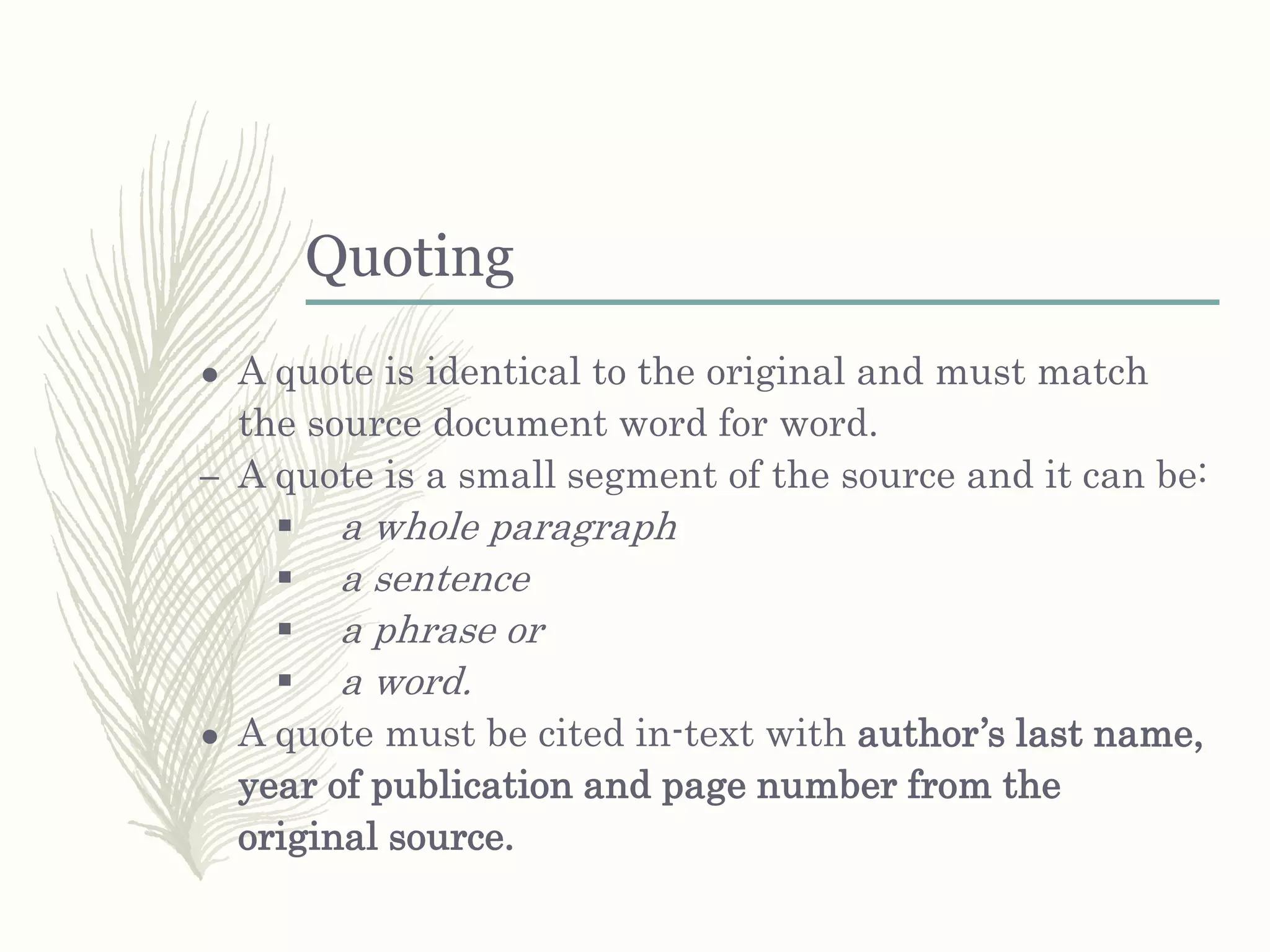
Quoting
● A quote is identical to the original and must match
the source document word for word.
– A quote is a small segment of the source and it can be:
 a whole paragraph
 a sentence
 a phrase or
 a word.
● A quote must be cited in-text with author’s last name,
year of publication and page number from the
original source.

Paraphrasing and Summarizing

  • 1.
  • 2.
    Learning Goals ● Tounderstand why it is important to learn to paraphrase and summarize ● To understand when to use paraphrasing, summarizing and quoting in research writing ● To learn the basic APA style for citing a paraphrased, quoted or summarized text.
  • 3.
    Why paraphrase? • Tosimplify an idea that may be more complex in original source • To highlight only the most relevant part in the way you understand it • To avoid having too many quotes in your literature review • To integrate other authors’ ideas more efficiently in your writing
  • 4.
    Paraphrasing  Paraphrasing isrestating—in your own words— someone else’s ideas. Changing a few words of the original sentences is NOT paraphrasing.  You must change both the words and the sentence structure of the original, without changing the content.  Sentences and phrases translated from another language and incorporated in discussion are also examples of paraphrase.
  • 5.
    Paraphrasing • Paraphrased passagesstill require citation because the ideas came from another source, even though you are putting them in your own words. • APA Style guide prescribes that: o Paraphrased text is cited in-text by mentioning author’s last name and the year of publication in a parenthesis at end of the paraphrase. o The in-text entry is properly referenced in the reference list.
  • 6.
    Why summarize? • Toexpand the breadth of your writing by summarizing the main ideas of several publications • To cover a larger body of relevant literature • To present important ideas in a succinct way to avoid redundancy
  • 7.
    Summarizing • Summarizing meansputting the main idea(s) into your own words, including only the main point(s). • Summaries are significantly shorter than the original and take a broad overview of the source material. • Summarized ideas must also be attributed to the original source through in-text citation- author’s last name +year of publication.
  • 8.
    Why quote? • Tohighlight a particularly striking phrase, sentence, or passage that strengthens your argument • To distance yourself from the original by quoting it in order to cue readers that the words are not your own • To emphasize on a certain idea, phrase or words in your discussion
  • 9.
    Quoting ● A quoteis identical to the original and must match the source document word for word. – A quote is a small segment of the source and it can be:  a whole paragraph  a sentence  a phrase or  a word. ● A quote must be cited in-text with author’s last name, year of publication and page number from the original source.