Types of Writing
PATTERNS OF DEVELOPMENT
1.Narrative Writing
 TELLS A STORY.
 A STORY TOLD FROM ONE’S IMAGINATION IS
FICTIONAL NARRATIVE. A STORY ABOUT
ACTUAL EVENTS IS A NONFICTIONAL
NARRATIVE.
CHARACTERISTICS OF NARRATIVE:
• HAS A CLEAR FOCUS ON THE MAIN POINT
• PRESENTS EVENTS IN A CHRONOLOGICAL OR
TIME ORDER
• HAS A WELL- DEVELOPED PLOT
Characteristics Narrative Writing
• USES SENSORY DETAIL
• USES THE ELEMENTS OF NARRATIVE
• USES EFFECTIVE SENTENCE STRUCTURES
FORMS OF NARRATIVE WRITING
1. FICTION NARRATIVES
- ARE LITERARY TEXTS THAT TELL A STORY
ABOUT IMAGINED PEOPLE, EVENTS, AND IDEAS.
THE DIFFERENT FORMS OF FICTION NARRATIVES
CONTAIN LITERARY ELEMENTS. THEY HAVE WELL
DEVELOPED CONFLICT AND RESOLUTION,
INTERESTING AND
Fiction Narrative
• BELIEVABLE ELEMENTS, AND A RANGE OF
LITERARY STRATEGIES.
FORMS OF FICTION NARRATIVES
A. REALISTIC FICTION
 PORTRAYS INVENTED CHARACTERS AND EVENTS
IN EVERYDAY SITUATIONS.
 THEY OFTEN PRESENTS PROBLEMS THAT MANY
PEOPLE FACE AND SOLUTIONS THEY DEVISE TO
SOLVE THEM.
Fiction Narrative
B. FANTASY STORIES
ARE HIGHLY IMAGINATIVE WRITING THAT
CONTAIN ELEMENTS NOT FOUND IN REAL LIFE.
THEY INVOLVE INVENTED CHARACTERS,
SITUATIONS, AND SOMETIMES INVENTED WORLDS
AND CREATURES.
C. HISTORICAL FICTION
IS ABOUT IMAGINARY PEOPLE LIVING IN
REAL PLACES AND TIMES OF HISTORY. THE MAIN
CHARACTERS ARE USUALLY FICTIONAL PEOPLE
WHO KNOW AND INTERACT WITH FAMOUS PEOPLE
AND
Fiction Narrative
PARTICIPATE IN IMPORTANT HISTORICAL EVENTS.
D. MYSTERY STORIES
PRESENTS UNEXPLAINED OR STRANGE
EVENTS THAT CHARACTERS TRY TO SOLVE. THESE
STORIES ARE OFTEN PACKED FULL OF SUSPENSE
AND SURPRISES.
E. MYTHS
ARE FICTIONAL TALES THAT EXPLAIN THE
ACTIONS OF GODS OR HEROES OR THE ORIGINS OF
THE ELEMENTS OF NATURE. THEY WERE
GENERALLY HANDED DOWN BY WORD OF MOUTH
FOR GENERATIONS.
Fiction NarrativeF. LEGENDS
ARE WIDELY- TOLD STORIES ABOUT THE PAST,
ONE THAT MAY NOT HAVE FOUNDATION IN FACT.
THEY USUALLY CONTAIN FANTASTIC DETAILS SUCH S
INCREDIBLE FEATS OF STRENGTH OR SUPERNATURAL
BEINGS.
G. SCIENCE FICTION
WRITING THAT TELLS ABOUT IMAGINARY
EVENTS THAT INVOLVE SCIENCE OR TECHNOLOGY
H. TALL TALES
TELL LARGER –THAN- LIFE CHARACTERS IN
REAL- LIFE SETTINGS. THE CHARACTERS CAN
PERFORM AMAZING ACTS OF STRENGTH AND
BRAVERY.
Nonfiction Narrative
- STORY ABOUT REAL PEOPLE, EVENTS,
AND IDEAS.
-HAS A WELL- DEVELOPED CONFLICT AND
RESOLUTION, INTERESTING AND BELIEVABLE
CHARACTERS, AND A RANGE OF LITERARY
STRATEGIES SUCH AS DIALOGUE AND
SUSPENSE.
FORMS OF NONFICTION NARRATIVES
A. PERSONAL NARRATIVES(
AUTOBIOGRAPHICAL)
TELL TRUE STORIES ABOUT EVENTS IN A
PERSON’S LIFE.
Nonfiction Narrative
- STORY ABOUT REAL PEOPLE, EVENTS,
AND IDEAS.
-HAS A WELL- DEVELOPED CONFLICT AND
RESOLUTION, INTERESTING AND BELIEVABLE
CHARACTERS, AND A RANGE OF LITERARY
STRATEGIES SUCH AS DIALOGUE AND
SUSPENSE.
FORMS OF NONFICTION NARRATIVES
A. PERSONAL NARRATIVES(
AUTOBIOGRAPHICAL)
TELL TRUE STORIES ABOUT EVENTS IN A
PERSON’S LIFE.
Nonfiction Narrative
B. BIOGRAPHICAL NARRATIVES
-ARE ACCOUNTS OF A PERSON’S LIFE
WRITTEN BY SOMEONE ELSE.
- SHORT OR BOOK LENGTH.
C. DIARY AND JOURNAL ENTRIES
- ARE HIGHLY PERSONAL EXPERIENCES,
THOUGHTS, AND FEELINGS. THE AUDIENCE,
HOWEVER, IS PRIVATE, UNLESS THE WRITER
CHOOSES TO SHARE THE DIARY AND JOURNAL
ENTRIES.
D. BLOGS
ARE ONLINE JOURNALS THAT MAY
INCLUDE
Nonfiction Narrative
AUTOBIOGRAPHICAL NARRATIVES, REFLECTIONS,
OPINIONS, AND OTHER TYPES OF COMMENTS.
E. EYEWITNESS ACCOUNTS
FOCUS ON THE HISTORICAL OR OTHER IMPORTANT
EVENTS. THE WRITER IS THE NARRATOR AND SHARES
HIS/HER THOUGHTS ABOUT THE EVENT.
F. MEMOIRS
ARE ACCOUNTS WRITTEN BY SOMEBODY ABOUT
MEANINGFUL SCENES IN HIS /HER LIFE AND EXPERIENCES
Nonfiction Narrative
G. REFLECTIVE ESSAYS
PRESENT PERSONAL EXPERIENCES THAT GENERALLY
FOCUS ON SHARING OBSERVATIONS AND INSIGHTS THE
WRITER HAD WHILE THINKING ABOUT THIS EXPERIENCES.
2. Descriptive Essay
 Expresses ideas and feelings about real and
imagined people, events, and ideas.
 Uses precise language and sensory
expressions to create vivid images
of the subject being described.
 Using these expressions, the writer attempts
to recreate in the mind of the reader the
picture the writer has in mind.
Forms of Descriptive Essay
A. Travel essay
use sensory words to describe a place.
B. Definition essays
describes the essence of something
abstract or term such as nationalism,
friendship, or love based on an author’s
Emotional experiences. It identifies the scope
Of a concept and marks out its limitations. It
may distinguish a concept from another similar
Forms of Descriptive Essay
Concept but not as much as in
comparison/contrast essay. A definition must be
brief and exact.
Suggested materials in writing a definition
 Etymology of the word
 Evolution of the subject
 Personal definitions of the writer himself or
by professional lexicographers and experts
 Quotations from literature regarding the
subject, where found and or used and by
whom
Forms of Descriptive Essay
Suggested materials in writing a definition
(according to geography, profession, trade,
nationality, or ethnicity)
 Uses and applications
 Comparison and contrast with similar objects
 Materials, ingredients, and composition
3.Expository Writing
 type of writing that intends to communicate
Ideas and information.
 Relies on facts to inform or explain.
 The introductory paragraph presents
a thesis statement which is the main point
to be developed. The body provides facts
about the topic. A variety of sentence structures
and transitions are used in the body. The
concluding paragraph sums up the ideas.
3.Expository Writing
 A type of writing that intends to
communicate ideas and information. It relies
on facts to inform or explain. The introductory
Paragraph presents a thesis statement
Which is the main point to developed.
The body provide facts about the topic.
A variety of sentence structures and transitions
are used in the body. The concluding paragraph
sums up the ideas.
3.Expository Writing
Characteristics:
3.1. contains detailed information and
explanation about a specific topic.
3.2. uses an effective introduction and
conclusion
3.3. has a well-organized structure
3.4. uses a variety of sentence structures and
Transitions
3.5. uses effective and error-free sentence
structures
3.Expository Writing
Forms of Expository Writing
Analytical essay explores a topic by supplying
relevant information in the form of facts,
Examples, reasons and valid inferences.
The introductory paragraph presents a
Thesis statement to support the writer’s
claims.
A. Compare and Contrast
explores similarities and differences
between two or more things for a specific
purpose.
3.Expository Writing
A. Compare and Contrast
 be fair and balanced with the treatment of
the composed or contrasted items.
 Use expressions of comparison and
contrast.
 Compare and contrast your subjects on
important rather than on trivial points.
3.Expository Writing
How to Organize Expository using Compare and
Contrast
• Are the subjects really comparable?
• What can be compared between them?
• What is the most appropriate
Organizational structure to use?
Pattern of organization
1. Point –by-point
The writer may discuss one point of
comparison for both subjects, then goes to the
next point.
3.Expository Writing
Example:
I. Type of curriculum
A. Public high School
B. Private high School
II. Library resources
A. Public high schools
B. Private high schools
III. Sports program
A. Public high schools
B. Private high schools
3.Expository Writing
2. Subject-by-subject
the writer may cover all points of comparison
for one subject and then tell all points of
Comparison for one subject and then all
Points of comparison for the next subject.
Example:
I. Public high schools
A. Type of curriculum
B. Library resources
C. sports program
3.Expository Writing
II. Private high Schools
A. Type of curriculum
B. Library resources
C. Sports program
 Transition words that show comparison
Or contrast
• Like …also
Like a crocodile, an alligator also lives in
marshes.
3.Expository Writing
• Similarly
Similarly, a female alligator lays eggs in the
mud.
• Both
Both crocodiles and alligators eat
small fish.
• On the other hand
Socialism produces a level of equality among
citizens. On the other hand, extreme
capitalism makes the poor get poorer.
3.Expository Writing
• In contrast,
CRT televisions consume more than 100
watts. In contrast, LED televisions consume only
Less than 50 watts.
• While…
While birds have feathers, bats have
fur.
• Unlike…
Unlike other mammals, a platypus lays eggs.
3.Expository Writing
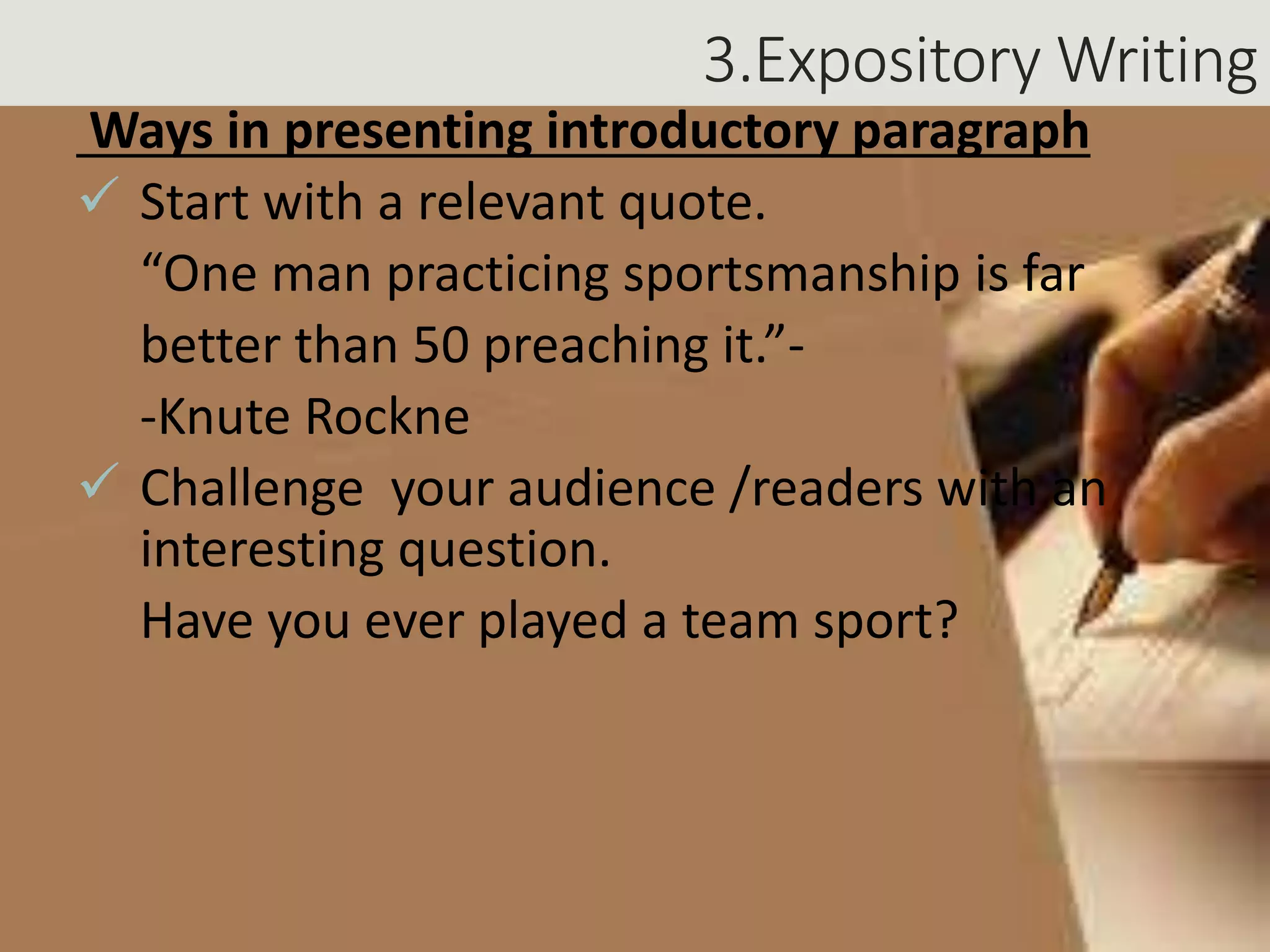
Ways in presenting introductory paragraph
 Start with a relevant quote.
“One man practicing sportsmanship is far
better than 50 preaching it.”-
-Knute Rockne
 Challenge your audience /readers with an
interesting question.
Have you ever played a team sport?
3.Expository Writing
Ways in presenting introductory paragraph
 Offer a hint of what is to follow.
Basketball is probably one of the most
famous sports in the world today.
 Provide important background
information.
Basketball was invented in the United States
in 1891, and it is now one of the most major
sports in the world.
3.Expository Writing
Ways in presenting introductory paragraph
Basketball is a sport of agility and endurance
that develops by hand and eye coordination.
3.Expository Writing
Basketball is one of the most famous
sports in the world today. It is very
entertaining sport and can be played by
anyone. Basketball is known as a
good pastime for many people
but can also be seen as a passion for
many others. While many play the sport,
others follow it as enthusiasts.
3.Expository Writing
Some people even follow players they
idolize for decades. Two of the most
popular basketball players in this
Generation are Lebron James and
Kobe Bryant. Even though James
And Kobe are both professional
basketball starts, they differ in their
opinions about women, preference in
movies, and type of music.
3.Expository Writing
Developing the body of the essay
A. Subject-by-subject organization
B. Point-by-point organization
Ways to conclude an essay
An effective ending helps the reader
reflect on the message of the essay with
new understanding and appreciation.
 Restating the thesis
Original Thesis:
Even though James and Kobe are both
professional basketball stars, they differ in their
3.Expository Writing
opinions about women, preference in movies,
and type of music.
Restatement of thesis:
Lebron and Bryant may be the top two
players in the league today, but they are
so different when it comes to views on
women, movie choices, and song genre.
 Highlighting one or more key supporting
points
Basketball is not only about physical strength
but also about mental toughness.
3.Expository Writing
 Providing a final analysis or reflection
At the end of the day, people should realize that
the benefits of engaging in a sport outweigh the
hardships in keeping one.
 Helping the reader appreciate the
significance of the information
After all, playing basketball is one of the
most effective ways for one to keep a healthy
Body and a sharp mind.
3.Expository Writing
B. Cause- and – Effect Essay
 The writer looks for a cause, evaluates it, and
determines its validity. The writer also
analyzes effect by separating it and
relating it to consequences.
 One’s analysis of cause should contain
explanations that appeal to logic and reason.
3.Expository Writing
B. Cause- and – Effect Essay
Three Categories of Causation:
1. There is contributory cause which helps an
event happen but cannot make happen by
itself.
example:
Poverty as contributory factor in violent
crimes.
2. A necessary cause is one that must be present
but cannot cause the event by itself.
3.Expository Writing
Example:
If a ship collides with an iceberg, it can be
contributory to the sinking of the ship but it
alone does not necessarily cause the ship’s
sinking.
3. A sufficient cause is one that can produce
a given effect.
example:
A person drops dead after eating durian
candies contaminated with botulism toxin.
3.Expository Writing
C. Classification Essay
a writer organizes a subject into
categories and explains the category into which
item falls.
a writer breaks down a concept,
Idea, a process, or a thing into major parts of
categories.
3.Expository Writing
D. Problem- Solution essay
presents a problem and then offers
solutions to that problem.
E. Newspaper and Magazine Articles
offer information about news and
events. They are typically factual and do
not include the writer’s opinions.
4. Persuasive Writing
 aims to convince the reader to adopt an
opinion or a course of action. A strong
persuasive text is logically organized nd
clearly describes the issue.
 aims to influence the attitudes or
Actions of a specific audience on specific issues.
4. Persuasive Writing
Characteristics:
 Has a clear thesis on an issue
 Uses sound reasoning
 Uses powerful language
 Presents detailed and relevant evidences
and references
 Presents alternatives and counter arguments
 Use clear organization
 Provides a clear conclusion
 Uses effective and error- free sentence
structure

Types of writing

  • 1.
  • 2.
    1.Narrative Writing  TELLSA STORY.  A STORY TOLD FROM ONE’S IMAGINATION IS FICTIONAL NARRATIVE. A STORY ABOUT ACTUAL EVENTS IS A NONFICTIONAL NARRATIVE. CHARACTERISTICS OF NARRATIVE: • HAS A CLEAR FOCUS ON THE MAIN POINT • PRESENTS EVENTS IN A CHRONOLOGICAL OR TIME ORDER • HAS A WELL- DEVELOPED PLOT
  • 3.
    Characteristics Narrative Writing •USES SENSORY DETAIL • USES THE ELEMENTS OF NARRATIVE • USES EFFECTIVE SENTENCE STRUCTURES FORMS OF NARRATIVE WRITING 1. FICTION NARRATIVES - ARE LITERARY TEXTS THAT TELL A STORY ABOUT IMAGINED PEOPLE, EVENTS, AND IDEAS. THE DIFFERENT FORMS OF FICTION NARRATIVES CONTAIN LITERARY ELEMENTS. THEY HAVE WELL DEVELOPED CONFLICT AND RESOLUTION, INTERESTING AND
  • 4.
    Fiction Narrative • BELIEVABLEELEMENTS, AND A RANGE OF LITERARY STRATEGIES. FORMS OF FICTION NARRATIVES A. REALISTIC FICTION  PORTRAYS INVENTED CHARACTERS AND EVENTS IN EVERYDAY SITUATIONS.  THEY OFTEN PRESENTS PROBLEMS THAT MANY PEOPLE FACE AND SOLUTIONS THEY DEVISE TO SOLVE THEM.
  • 5.
    Fiction Narrative B. FANTASYSTORIES ARE HIGHLY IMAGINATIVE WRITING THAT CONTAIN ELEMENTS NOT FOUND IN REAL LIFE. THEY INVOLVE INVENTED CHARACTERS, SITUATIONS, AND SOMETIMES INVENTED WORLDS AND CREATURES. C. HISTORICAL FICTION IS ABOUT IMAGINARY PEOPLE LIVING IN REAL PLACES AND TIMES OF HISTORY. THE MAIN CHARACTERS ARE USUALLY FICTIONAL PEOPLE WHO KNOW AND INTERACT WITH FAMOUS PEOPLE AND
  • 6.
    Fiction Narrative PARTICIPATE INIMPORTANT HISTORICAL EVENTS. D. MYSTERY STORIES PRESENTS UNEXPLAINED OR STRANGE EVENTS THAT CHARACTERS TRY TO SOLVE. THESE STORIES ARE OFTEN PACKED FULL OF SUSPENSE AND SURPRISES. E. MYTHS ARE FICTIONAL TALES THAT EXPLAIN THE ACTIONS OF GODS OR HEROES OR THE ORIGINS OF THE ELEMENTS OF NATURE. THEY WERE GENERALLY HANDED DOWN BY WORD OF MOUTH FOR GENERATIONS.
  • 7.
    Fiction NarrativeF. LEGENDS AREWIDELY- TOLD STORIES ABOUT THE PAST, ONE THAT MAY NOT HAVE FOUNDATION IN FACT. THEY USUALLY CONTAIN FANTASTIC DETAILS SUCH S INCREDIBLE FEATS OF STRENGTH OR SUPERNATURAL BEINGS. G. SCIENCE FICTION WRITING THAT TELLS ABOUT IMAGINARY EVENTS THAT INVOLVE SCIENCE OR TECHNOLOGY H. TALL TALES TELL LARGER –THAN- LIFE CHARACTERS IN REAL- LIFE SETTINGS. THE CHARACTERS CAN PERFORM AMAZING ACTS OF STRENGTH AND BRAVERY.
  • 8.
    Nonfiction Narrative - STORYABOUT REAL PEOPLE, EVENTS, AND IDEAS. -HAS A WELL- DEVELOPED CONFLICT AND RESOLUTION, INTERESTING AND BELIEVABLE CHARACTERS, AND A RANGE OF LITERARY STRATEGIES SUCH AS DIALOGUE AND SUSPENSE. FORMS OF NONFICTION NARRATIVES A. PERSONAL NARRATIVES( AUTOBIOGRAPHICAL) TELL TRUE STORIES ABOUT EVENTS IN A PERSON’S LIFE.
  • 9.
    Nonfiction Narrative - STORYABOUT REAL PEOPLE, EVENTS, AND IDEAS. -HAS A WELL- DEVELOPED CONFLICT AND RESOLUTION, INTERESTING AND BELIEVABLE CHARACTERS, AND A RANGE OF LITERARY STRATEGIES SUCH AS DIALOGUE AND SUSPENSE. FORMS OF NONFICTION NARRATIVES A. PERSONAL NARRATIVES( AUTOBIOGRAPHICAL) TELL TRUE STORIES ABOUT EVENTS IN A PERSON’S LIFE.
  • 10.
    Nonfiction Narrative B. BIOGRAPHICALNARRATIVES -ARE ACCOUNTS OF A PERSON’S LIFE WRITTEN BY SOMEONE ELSE. - SHORT OR BOOK LENGTH. C. DIARY AND JOURNAL ENTRIES - ARE HIGHLY PERSONAL EXPERIENCES, THOUGHTS, AND FEELINGS. THE AUDIENCE, HOWEVER, IS PRIVATE, UNLESS THE WRITER CHOOSES TO SHARE THE DIARY AND JOURNAL ENTRIES. D. BLOGS ARE ONLINE JOURNALS THAT MAY INCLUDE
  • 11.
    Nonfiction Narrative AUTOBIOGRAPHICAL NARRATIVES,REFLECTIONS, OPINIONS, AND OTHER TYPES OF COMMENTS. E. EYEWITNESS ACCOUNTS FOCUS ON THE HISTORICAL OR OTHER IMPORTANT EVENTS. THE WRITER IS THE NARRATOR AND SHARES HIS/HER THOUGHTS ABOUT THE EVENT. F. MEMOIRS ARE ACCOUNTS WRITTEN BY SOMEBODY ABOUT MEANINGFUL SCENES IN HIS /HER LIFE AND EXPERIENCES
  • 12.
    Nonfiction Narrative G. REFLECTIVEESSAYS PRESENT PERSONAL EXPERIENCES THAT GENERALLY FOCUS ON SHARING OBSERVATIONS AND INSIGHTS THE WRITER HAD WHILE THINKING ABOUT THIS EXPERIENCES.
  • 13.
    2. Descriptive Essay Expresses ideas and feelings about real and imagined people, events, and ideas.  Uses precise language and sensory expressions to create vivid images of the subject being described.  Using these expressions, the writer attempts to recreate in the mind of the reader the picture the writer has in mind.
  • 14.
    Forms of DescriptiveEssay A. Travel essay use sensory words to describe a place. B. Definition essays describes the essence of something abstract or term such as nationalism, friendship, or love based on an author’s Emotional experiences. It identifies the scope Of a concept and marks out its limitations. It may distinguish a concept from another similar
  • 15.
    Forms of DescriptiveEssay Concept but not as much as in comparison/contrast essay. A definition must be brief and exact. Suggested materials in writing a definition  Etymology of the word  Evolution of the subject  Personal definitions of the writer himself or by professional lexicographers and experts  Quotations from literature regarding the subject, where found and or used and by whom
  • 16.
    Forms of DescriptiveEssay Suggested materials in writing a definition (according to geography, profession, trade, nationality, or ethnicity)  Uses and applications  Comparison and contrast with similar objects  Materials, ingredients, and composition
  • 17.
    3.Expository Writing  typeof writing that intends to communicate Ideas and information.  Relies on facts to inform or explain.  The introductory paragraph presents a thesis statement which is the main point to be developed. The body provides facts about the topic. A variety of sentence structures and transitions are used in the body. The concluding paragraph sums up the ideas.
  • 18.
    3.Expository Writing  Atype of writing that intends to communicate ideas and information. It relies on facts to inform or explain. The introductory Paragraph presents a thesis statement Which is the main point to developed. The body provide facts about the topic. A variety of sentence structures and transitions are used in the body. The concluding paragraph sums up the ideas.
  • 19.
    3.Expository Writing Characteristics: 3.1. containsdetailed information and explanation about a specific topic. 3.2. uses an effective introduction and conclusion 3.3. has a well-organized structure 3.4. uses a variety of sentence structures and Transitions 3.5. uses effective and error-free sentence structures
  • 20.
    3.Expository Writing Forms ofExpository Writing Analytical essay explores a topic by supplying relevant information in the form of facts, Examples, reasons and valid inferences. The introductory paragraph presents a Thesis statement to support the writer’s claims. A. Compare and Contrast explores similarities and differences between two or more things for a specific purpose.
  • 21.
    3.Expository Writing A. Compareand Contrast  be fair and balanced with the treatment of the composed or contrasted items.  Use expressions of comparison and contrast.  Compare and contrast your subjects on important rather than on trivial points.
  • 22.
    3.Expository Writing How toOrganize Expository using Compare and Contrast • Are the subjects really comparable? • What can be compared between them? • What is the most appropriate Organizational structure to use? Pattern of organization 1. Point –by-point The writer may discuss one point of comparison for both subjects, then goes to the next point.
  • 23.
    3.Expository Writing Example: I. Typeof curriculum A. Public high School B. Private high School II. Library resources A. Public high schools B. Private high schools III. Sports program A. Public high schools B. Private high schools
  • 24.
    3.Expository Writing 2. Subject-by-subject thewriter may cover all points of comparison for one subject and then tell all points of Comparison for one subject and then all Points of comparison for the next subject. Example: I. Public high schools A. Type of curriculum B. Library resources C. sports program
  • 25.
    3.Expository Writing II. Privatehigh Schools A. Type of curriculum B. Library resources C. Sports program  Transition words that show comparison Or contrast • Like …also Like a crocodile, an alligator also lives in marshes.
  • 26.
    3.Expository Writing • Similarly Similarly,a female alligator lays eggs in the mud. • Both Both crocodiles and alligators eat small fish. • On the other hand Socialism produces a level of equality among citizens. On the other hand, extreme capitalism makes the poor get poorer.
  • 27.
    3.Expository Writing • Incontrast, CRT televisions consume more than 100 watts. In contrast, LED televisions consume only Less than 50 watts. • While… While birds have feathers, bats have fur. • Unlike… Unlike other mammals, a platypus lays eggs.
  • 28.
    3.Expository Writing Ways inpresenting introductory paragraph  Start with a relevant quote. “One man practicing sportsmanship is far better than 50 preaching it.”- -Knute Rockne  Challenge your audience /readers with an interesting question. Have you ever played a team sport?
  • 29.
    3.Expository Writing Ways inpresenting introductory paragraph  Offer a hint of what is to follow. Basketball is probably one of the most famous sports in the world today.  Provide important background information. Basketball was invented in the United States in 1891, and it is now one of the most major sports in the world.
  • 30.
    3.Expository Writing Ways inpresenting introductory paragraph Basketball is a sport of agility and endurance that develops by hand and eye coordination.
  • 31.
    3.Expository Writing Basketball isone of the most famous sports in the world today. It is very entertaining sport and can be played by anyone. Basketball is known as a good pastime for many people but can also be seen as a passion for many others. While many play the sport, others follow it as enthusiasts.
  • 32.
    3.Expository Writing Some peopleeven follow players they idolize for decades. Two of the most popular basketball players in this Generation are Lebron James and Kobe Bryant. Even though James And Kobe are both professional basketball starts, they differ in their opinions about women, preference in movies, and type of music.
  • 33.
    3.Expository Writing Developing thebody of the essay A. Subject-by-subject organization B. Point-by-point organization Ways to conclude an essay An effective ending helps the reader reflect on the message of the essay with new understanding and appreciation.  Restating the thesis Original Thesis: Even though James and Kobe are both professional basketball stars, they differ in their
  • 34.
    3.Expository Writing opinions aboutwomen, preference in movies, and type of music. Restatement of thesis: Lebron and Bryant may be the top two players in the league today, but they are so different when it comes to views on women, movie choices, and song genre.  Highlighting one or more key supporting points Basketball is not only about physical strength but also about mental toughness.
  • 35.
    3.Expository Writing  Providinga final analysis or reflection At the end of the day, people should realize that the benefits of engaging in a sport outweigh the hardships in keeping one.  Helping the reader appreciate the significance of the information After all, playing basketball is one of the most effective ways for one to keep a healthy Body and a sharp mind.
  • 36.
    3.Expository Writing B. Cause-and – Effect Essay  The writer looks for a cause, evaluates it, and determines its validity. The writer also analyzes effect by separating it and relating it to consequences.  One’s analysis of cause should contain explanations that appeal to logic and reason.
  • 37.
    3.Expository Writing B. Cause-and – Effect Essay Three Categories of Causation: 1. There is contributory cause which helps an event happen but cannot make happen by itself. example: Poverty as contributory factor in violent crimes. 2. A necessary cause is one that must be present but cannot cause the event by itself.
  • 38.
    3.Expository Writing Example: If aship collides with an iceberg, it can be contributory to the sinking of the ship but it alone does not necessarily cause the ship’s sinking. 3. A sufficient cause is one that can produce a given effect. example: A person drops dead after eating durian candies contaminated with botulism toxin.
  • 39.
    3.Expository Writing C. ClassificationEssay a writer organizes a subject into categories and explains the category into which item falls. a writer breaks down a concept, Idea, a process, or a thing into major parts of categories.
  • 40.
    3.Expository Writing D. Problem-Solution essay presents a problem and then offers solutions to that problem. E. Newspaper and Magazine Articles offer information about news and events. They are typically factual and do not include the writer’s opinions.
  • 41.
    4. Persuasive Writing aims to convince the reader to adopt an opinion or a course of action. A strong persuasive text is logically organized nd clearly describes the issue.  aims to influence the attitudes or Actions of a specific audience on specific issues.
  • 42.
    4. Persuasive Writing Characteristics: Has a clear thesis on an issue  Uses sound reasoning  Uses powerful language  Presents detailed and relevant evidences and references  Presents alternatives and counter arguments  Use clear organization  Provides a clear conclusion  Uses effective and error- free sentence structure