SULPHONAMIDES
ANTIBIOTICS.
DR LINUS WAFULA ,JKUAT.
JUNE 2021
SULPHONAMIDES.
• HISTORY: Sulfonamides (U.S) : Sulphonamides (U.K)
• History Gerhard Domagk 1935- developed sulfa from the prod
drug azo dye, Prontosil (used to treat streptococcal infection in
mice.
• He got Nobel Prize for medicine in 1939).
DR WAF JUNE 2021 2
GENERAL FEATURES.
• Defined as “SULFA-related group of antibiotics, that are
derived from sulphanilamide, which are able to prevent the
multiplication of bacteria”
• Mainly, they are derivatives of PRONTOSIL RED (A dye) •
Inactive in nature • Becomes active in-vivo……
DR WAF JUNE 2021 3
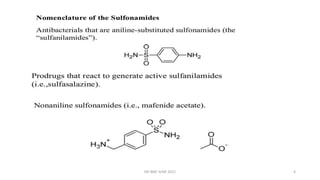
DR WAF JUNE 2021 4
Chemistry
• White crystalline powder, insoluble in water, soluble in alkaline
PH
● Sodium salts are soluble in water
● Weak organic acids.
● Pka 4.99 to 8.56 (used to indicate the strength of an acid)
● Parenteral preparations are alkaline- care should be taken
while administration through iv route to prevent perivascular
damage I/m and S/C preparations should be properly buffered.
● Sulfacetamide- neutral preparation for ophthalmic use.
DR WAF JUNE 2021 5
CLASSIFICATION OF
SULPHONAMIDES:
• BASED ON SITE OF ACTION:
• 1. For general infections: - Sulphanilamide - Sulphadiazine -
Sulphamethoxazole - Sulphadoxine - Sulphapyridine -
Sulphamethocine - Sulphathiazole
• 2. For intestinal infections: - Pthalyl Sulphathiazole - Succinyl
Sulphathiazole - Sulphasalazine
• 3. For Dermatitis: - Dapsone - Solapsone
DR WAF JUNE 2021 6
• 4. For local infections: - Sulphacetamide sodium - Mafenide
sodium - Silver Sulphadiazine
• 5. For UTI (Urinary Tract Infections): - Sulphadiazine -
Sulphacetamide sodium
DR WAF JUNE 2021 7
Based on duration of action.
• Short acting sulfonamides (4-8 hours) - Sulfadiazine
● Intermediate acting sulfonamides (8-12 hours)-
Sulfamethoxazole, Sulfamoxole
● Long acting sulfonamide (approx 7 days)- Sulfadoxine,
sulfamethopyrazine
● Special purpose sulfonamide- Sulfacetamide sod,
sulfasalazine, mafenide, silver sulfadiazine ( Burns)
DR WAF JUNE 2021 8
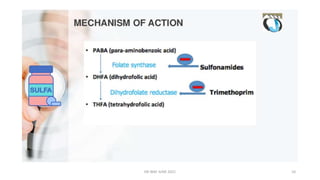
Mode Of Action.
• Under normal conditions (in bacteria): Pteridine combines with
PABA (Para-amino benzoic acid) in the presence of enzyme
Dihydropteroate synthetase which forms Dihydropteroic acid (a)
• Glutamate gets added to (a) and forms DHFA (dihydro folic acid)
DHFA, in the presence of Dihydrofolate reductase enzyme gets
converted to THFA (Tetrahydrofolic acid) THFA forms Thymidylic
acid DNA and genetic bases (purine, pyrimidine, thymidine etc. )
are formed
• Sulphonamides block the enzyme Dihydropteroate synthetase
thus Pteridine cannot combine with PABA Thus Dihydropteroic acid
is not formed
DR WAF JUNE 2021 9
DR WAF JUNE 2021 10
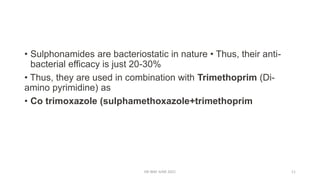
• Sulphonamides are bacteriostatic in nature • Thus, their anti-
bacterial efficacy is just 20-30%
• Thus, they are used in combination with Trimethoprim (Di-
amino pyrimidine) as
• Co trimoxazole (sulphamethoxazole+trimethoprim
DR WAF JUNE 2021 11
ANTI-BACTERIAL SPECTRUM OF
SULPHONAMIDES:
• Sulphonamides are primarily Bacteriostatic against Gram
positive and Gram negative organisms
• Organisms that are sensitive to sulphonamides include:
- Streptococcus pyogenes
– Calymmobacterium granulomatis
- Haemophilus influenzae
- Vibrio cholera
- Staphylococcus aureus
- Meningococci - E.coli - Toxoplasma - Shigella - Actinomyces…
DR WAF JUNE 2021 12
SULPHONAMIDE RESISTANCE:
• Organisms that are resistant to sulphonamides include: -
Staphylococcus aureus - E.Coli - Meningococci - Streptococcus
viridans - Gonococci - Anaerobes • Mechanisms of resistance
include:
• 1. Production of increased amounts of PABA
• 2. Mutants contain folate synthase enzyme shows less affinity
for sulphonamides
• 3. Bacteria adopt alternative pathway for folate metabolism
• Usually Cross resistance is observed for microbes within
sulphonamides.
DR WAF JUNE 2021 13
ADVERSE DRUG REACTIONS OF
SULPHONAMIDES:
• Nausea
• Vomiting
• Epigastric pain
• Crystalluria
• Hypersensitivity reactions: - Urticaria - Drug fever - Rashes
• Photosensitivity
• Stevens-Johnson syndrome
DR WAF JUNE 2021 14
PHARMCOKINETICS.
●Rapid and complete absorption from GIT
● Widely distributed, cross BBB & placenta
● Metabolism in liver, non-microsomal, acetylation at N4
● Glomerular filtration, less soluble in acidic urine --> crystalluria (
take plenty of water to aid in elimination)
● Contraindicated in near term females and neonates
DR WAF JUNE 2021 15
PRINCIPLES TO BE FOLLOWED IN
SULPHONAMIDE
• Start therapy at early stage of infection
● Ineffective in chronic cases
● In severe infection administer by iv route
● Administer adequate quantity of drinking water during therapy
● Alkalinisation of urine prevents crystalluria
● Treatment should not exceed seven days
● If no favourable response within four to five days, discontinue the
therapy
● Treatment continued 48 hours after remission to prevent recurrence
for some cases
● Immune response of the host should be well maintained
DR WAF JUNE 2021 16
Drug interaction.
• PABA antagonizes sulfonamides
● Calcium and antacids inhibits absorption
● Pus and tissue debris - rich in thymidine and purines so
bacterial requirement of FA is less.
● Synergistic with diaminopyrimidines - Trimethoprim,
ormethoprim,
● Sulfonamides + chlortetracycline act as Growth promoter
prevent clostridial ET.
DR WAF JUNE 2021 17
CO-TRIMOXAZOLE. (Septrin)
• Introduction:
• Cotrimoxazole is the combination of two drugs i.e. Sulphamethoxazole and
Trimethoprim
• Co-trimoxazole mixture contains 5 parts of sulphamethoxazole and 1 part of
trimethoprim.
• These two drugs produce overtly similar effects; will sometimes produce
increased effects when used concurrently.
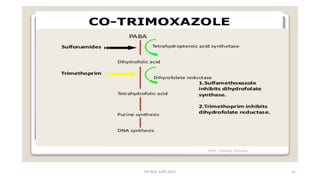
• Sulphonamides block the biosynthesis of folic acid from p-amino benzoic acid.
• Trimethoprim inhibits the enzyme folate reductase and blocks the conversion of
folic acid to tetrahydofolic acid (THF).
• THF is the form required for coenzyme synthesis.
• Combination of Sulphamethoxazole and Trimethoprim by synergism produces
bactericidal effect
DR WAF JUNE 2021 18
COTRIMOXAZOLE/TRIMETHOPRIM
• Eg.Trimethoprim, ormetoprim,Pyrimethamine
● Weak organic bases, Pka7.6 accumulate in acidic urine, milk and
ruminal fluid
● Trimethoprim- poorly soluble in water
● Fixed dose combination of sulfamethoxazole + trimethoprim(Co-
trimoxazole)
● Readily absorbed after oral administration except in ruminants –
trapped and undergo microbial degradation.
● 30 % to 60% protein bound, widely distributed in tissues including
prostate. Partly metabolized in liver and excreted in urine by
glomerular filtration and tubular secretion.
DR WAF JUNE 2021 19
MECHANISM OF ACTION.
• Selectively inhibits bacterial dihydrofolate reductase
• Wide distribution, crosses BBB & placenta
• Partly metabolized in liver excreted in urine
• DOSE of co- trimoxazole: •20 mg (trimethoprim) + 100 mg
(sulphamethoxazole) : paediatric tablet bd.
• •160 mg (trimethoprim) + 800 mg (sulphamethoxazole): for
adults, bid
DR WAF JUNE 2021 20
DR WAF JUNE 2021 21
CO-TRIMOXAZOLE
Use:
1. It is as anti microbial agent.
2. It is mainly used in treatment of;
Urinary tract infection
Upper and Lower respiratory infection (URTI and LRTI)
Skin and wound infections
Septicemias
DR WAF JUNE 2021 22
SULPHADOXINE,
SULPHAMETHOPYRAZINE:
• Ultra-long acting compounds (Due to increased plasma protein
binding, and slow renal excretion)
• - Half-life: 5-9 days
• - Uses: Above drugs + PYRIMETHAMINE ( Fansidar &
Metakelvin)
• treatment of Plasmodium falciparum associated malaria
• . Pne-umocystis jiroveci pneumonia in AIDS patients
• c. Toxoplasmosis
• ADRs: serious cutaneous reactions thus not much used…
DR WAF JUNE 2021 23
SILVER SULPHADIAZINE:
• Active against most bacteria and fungi
• - Anti-microbial action is attributed to slow release of SILVER ions…
• - USES:
• 1. Preventing infection of burnt surfaces
• 2. Chronic ulcers
• ADR:
• 1. Itching
• 2. Burning sensation
• - DOSE: 1% cream
DR WAF JUNE 2021 24
DDS (DIAMINO-DIPHENYL
SULFONE):Dapsone.
- USES: 1. Leprosy 2. Nocardiosis
- DOSE: 100 mg daily
- ADRs: 1. Peripheral neuropathy
2. Anemia…………………………
DR WAF JUNE 2021 25
CONTRAINDICATIONS FOR
SULPHONAMIDES.
• Blood dyscrasias
• Don’t use in Glucose-6-phosphate dehydrogenase individuals
haemolysis can occur
• Hypersensitivity
• Intestinal or urinary tract obstruction
• Porphyrias
• Vitamin.K deficiency
• Thyrotoxicosis
DR WAF JUNE 2021 26
• THANK YOU.
DR WAF JUNE 2021 27

Sulphonamides and Trimethoprime

  • 1.
  • 2.
    SULPHONAMIDES. • HISTORY: Sulfonamides(U.S) : Sulphonamides (U.K) • History Gerhard Domagk 1935- developed sulfa from the prod drug azo dye, Prontosil (used to treat streptococcal infection in mice. • He got Nobel Prize for medicine in 1939). DR WAF JUNE 2021 2
  • 3.
    GENERAL FEATURES. • Definedas “SULFA-related group of antibiotics, that are derived from sulphanilamide, which are able to prevent the multiplication of bacteria” • Mainly, they are derivatives of PRONTOSIL RED (A dye) • Inactive in nature • Becomes active in-vivo…… DR WAF JUNE 2021 3
  • 4.
  • 5.
    Chemistry • White crystallinepowder, insoluble in water, soluble in alkaline PH ● Sodium salts are soluble in water ● Weak organic acids. ● Pka 4.99 to 8.56 (used to indicate the strength of an acid) ● Parenteral preparations are alkaline- care should be taken while administration through iv route to prevent perivascular damage I/m and S/C preparations should be properly buffered. ● Sulfacetamide- neutral preparation for ophthalmic use. DR WAF JUNE 2021 5
  • 6.
    CLASSIFICATION OF SULPHONAMIDES: • BASEDON SITE OF ACTION: • 1. For general infections: - Sulphanilamide - Sulphadiazine - Sulphamethoxazole - Sulphadoxine - Sulphapyridine - Sulphamethocine - Sulphathiazole • 2. For intestinal infections: - Pthalyl Sulphathiazole - Succinyl Sulphathiazole - Sulphasalazine • 3. For Dermatitis: - Dapsone - Solapsone DR WAF JUNE 2021 6
  • 7.
    • 4. Forlocal infections: - Sulphacetamide sodium - Mafenide sodium - Silver Sulphadiazine • 5. For UTI (Urinary Tract Infections): - Sulphadiazine - Sulphacetamide sodium DR WAF JUNE 2021 7
  • 8.
    Based on durationof action. • Short acting sulfonamides (4-8 hours) - Sulfadiazine ● Intermediate acting sulfonamides (8-12 hours)- Sulfamethoxazole, Sulfamoxole ● Long acting sulfonamide (approx 7 days)- Sulfadoxine, sulfamethopyrazine ● Special purpose sulfonamide- Sulfacetamide sod, sulfasalazine, mafenide, silver sulfadiazine ( Burns) DR WAF JUNE 2021 8
  • 9.
    Mode Of Action. •Under normal conditions (in bacteria): Pteridine combines with PABA (Para-amino benzoic acid) in the presence of enzyme Dihydropteroate synthetase which forms Dihydropteroic acid (a) • Glutamate gets added to (a) and forms DHFA (dihydro folic acid) DHFA, in the presence of Dihydrofolate reductase enzyme gets converted to THFA (Tetrahydrofolic acid) THFA forms Thymidylic acid DNA and genetic bases (purine, pyrimidine, thymidine etc. ) are formed • Sulphonamides block the enzyme Dihydropteroate synthetase thus Pteridine cannot combine with PABA Thus Dihydropteroic acid is not formed DR WAF JUNE 2021 9
  • 10.
    DR WAF JUNE2021 10
  • 11.
    • Sulphonamides arebacteriostatic in nature • Thus, their anti- bacterial efficacy is just 20-30% • Thus, they are used in combination with Trimethoprim (Di- amino pyrimidine) as • Co trimoxazole (sulphamethoxazole+trimethoprim DR WAF JUNE 2021 11
  • 12.
    ANTI-BACTERIAL SPECTRUM OF SULPHONAMIDES: •Sulphonamides are primarily Bacteriostatic against Gram positive and Gram negative organisms • Organisms that are sensitive to sulphonamides include: - Streptococcus pyogenes – Calymmobacterium granulomatis - Haemophilus influenzae - Vibrio cholera - Staphylococcus aureus - Meningococci - E.coli - Toxoplasma - Shigella - Actinomyces… DR WAF JUNE 2021 12
  • 13.
    SULPHONAMIDE RESISTANCE: • Organismsthat are resistant to sulphonamides include: - Staphylococcus aureus - E.Coli - Meningococci - Streptococcus viridans - Gonococci - Anaerobes • Mechanisms of resistance include: • 1. Production of increased amounts of PABA • 2. Mutants contain folate synthase enzyme shows less affinity for sulphonamides • 3. Bacteria adopt alternative pathway for folate metabolism • Usually Cross resistance is observed for microbes within sulphonamides. DR WAF JUNE 2021 13
  • 14.
    ADVERSE DRUG REACTIONSOF SULPHONAMIDES: • Nausea • Vomiting • Epigastric pain • Crystalluria • Hypersensitivity reactions: - Urticaria - Drug fever - Rashes • Photosensitivity • Stevens-Johnson syndrome DR WAF JUNE 2021 14
  • 15.
    PHARMCOKINETICS. ●Rapid and completeabsorption from GIT ● Widely distributed, cross BBB & placenta ● Metabolism in liver, non-microsomal, acetylation at N4 ● Glomerular filtration, less soluble in acidic urine --> crystalluria ( take plenty of water to aid in elimination) ● Contraindicated in near term females and neonates DR WAF JUNE 2021 15
  • 16.
    PRINCIPLES TO BEFOLLOWED IN SULPHONAMIDE • Start therapy at early stage of infection ● Ineffective in chronic cases ● In severe infection administer by iv route ● Administer adequate quantity of drinking water during therapy ● Alkalinisation of urine prevents crystalluria ● Treatment should not exceed seven days ● If no favourable response within four to five days, discontinue the therapy ● Treatment continued 48 hours after remission to prevent recurrence for some cases ● Immune response of the host should be well maintained DR WAF JUNE 2021 16
  • 17.
    Drug interaction. • PABAantagonizes sulfonamides ● Calcium and antacids inhibits absorption ● Pus and tissue debris - rich in thymidine and purines so bacterial requirement of FA is less. ● Synergistic with diaminopyrimidines - Trimethoprim, ormethoprim, ● Sulfonamides + chlortetracycline act as Growth promoter prevent clostridial ET. DR WAF JUNE 2021 17
  • 18.
    CO-TRIMOXAZOLE. (Septrin) • Introduction: •Cotrimoxazole is the combination of two drugs i.e. Sulphamethoxazole and Trimethoprim • Co-trimoxazole mixture contains 5 parts of sulphamethoxazole and 1 part of trimethoprim. • These two drugs produce overtly similar effects; will sometimes produce increased effects when used concurrently. • Sulphonamides block the biosynthesis of folic acid from p-amino benzoic acid. • Trimethoprim inhibits the enzyme folate reductase and blocks the conversion of folic acid to tetrahydofolic acid (THF). • THF is the form required for coenzyme synthesis. • Combination of Sulphamethoxazole and Trimethoprim by synergism produces bactericidal effect DR WAF JUNE 2021 18
  • 19.
    COTRIMOXAZOLE/TRIMETHOPRIM • Eg.Trimethoprim, ormetoprim,Pyrimethamine ●Weak organic bases, Pka7.6 accumulate in acidic urine, milk and ruminal fluid ● Trimethoprim- poorly soluble in water ● Fixed dose combination of sulfamethoxazole + trimethoprim(Co- trimoxazole) ● Readily absorbed after oral administration except in ruminants – trapped and undergo microbial degradation. ● 30 % to 60% protein bound, widely distributed in tissues including prostate. Partly metabolized in liver and excreted in urine by glomerular filtration and tubular secretion. DR WAF JUNE 2021 19
  • 20.
    MECHANISM OF ACTION. •Selectively inhibits bacterial dihydrofolate reductase • Wide distribution, crosses BBB & placenta • Partly metabolized in liver excreted in urine • DOSE of co- trimoxazole: •20 mg (trimethoprim) + 100 mg (sulphamethoxazole) : paediatric tablet bd. • •160 mg (trimethoprim) + 800 mg (sulphamethoxazole): for adults, bid DR WAF JUNE 2021 20
  • 21.
    DR WAF JUNE2021 21
  • 22.
    CO-TRIMOXAZOLE Use: 1. It isas anti microbial agent. 2. It is mainly used in treatment of; Urinary tract infection Upper and Lower respiratory infection (URTI and LRTI) Skin and wound infections Septicemias DR WAF JUNE 2021 22
  • 23.
    SULPHADOXINE, SULPHAMETHOPYRAZINE: • Ultra-long actingcompounds (Due to increased plasma protein binding, and slow renal excretion) • - Half-life: 5-9 days • - Uses: Above drugs + PYRIMETHAMINE ( Fansidar & Metakelvin) • treatment of Plasmodium falciparum associated malaria • . Pne-umocystis jiroveci pneumonia in AIDS patients • c. Toxoplasmosis • ADRs: serious cutaneous reactions thus not much used… DR WAF JUNE 2021 23
  • 24.
    SILVER SULPHADIAZINE: • Activeagainst most bacteria and fungi • - Anti-microbial action is attributed to slow release of SILVER ions… • - USES: • 1. Preventing infection of burnt surfaces • 2. Chronic ulcers • ADR: • 1. Itching • 2. Burning sensation • - DOSE: 1% cream DR WAF JUNE 2021 24
  • 25.
    DDS (DIAMINO-DIPHENYL SULFONE):Dapsone. - USES:1. Leprosy 2. Nocardiosis - DOSE: 100 mg daily - ADRs: 1. Peripheral neuropathy 2. Anemia………………………… DR WAF JUNE 2021 25
  • 26.
    CONTRAINDICATIONS FOR SULPHONAMIDES. • Blooddyscrasias • Don’t use in Glucose-6-phosphate dehydrogenase individuals haemolysis can occur • Hypersensitivity • Intestinal or urinary tract obstruction • Porphyrias • Vitamin.K deficiency • Thyrotoxicosis DR WAF JUNE 2021 26
  • 27.
    • THANK YOU. DRWAF JUNE 2021 27