CONTENTS:-
1.INTRODUCTION.
2.CLASSIFICATION.
3.MECHANISM OF ACTIONS.
5.PHARMACOKINETICS/METABOLISM.
7.USES.
8.ADVERSE EFFECTS.
BY:-
MALLADI.ABHIRAM
B.PHARMACY.
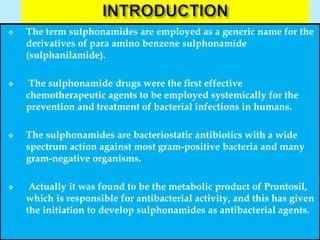
 The term sulphonamides are employed as a generic name for the
derivatives of para amino benzene sulphonamide
(sulphanilamide).
 The sulphonamide drugs were the first effective
chemotherapeutic agents to be employed systemically for the
prevention and treatment of bacterial infections in humans.
 The sulphonamides are bacteriostatic antibiotics with a wide
spectrum action against most gram-positive bacteria and many
gram-negative organisms.
 Actually it was found to be the metabolic product of Prontosil,
which is responsible for antibacterial activity, and this has given
the initiation to develop sulphonamides as antibacterial agents.
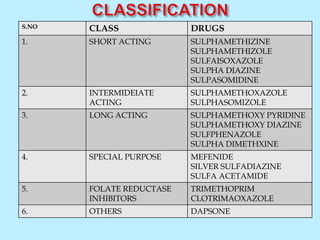
S.NO CLASS DRUGS
1. SHORT ACTING SULPHAMETHIZINE
SULPHAMETHIZOLE
SULFAISOXAZOLE
SULPHA DIAZINE
SULPASOMIDINE
2. INTERMIDEIATE
ACTING
SULPHAMETHOXAZOLE
SULPHASOMIZOLE
3. LONG ACTING SULPHAMETHOXY PYRIDINE
SULPHAMETHOXY DIAZINE
SULFPHENAZOLE
SULPHA DIMETHXINE
4. SPECIAL PURPOSE MEFENIDE
SILVER SULFADIAZINE
SULFA ACETAMIDE
5. FOLATE REDUCTASE
INHIBITORS
TRIMETHOPRIM
CLOTRIMAOXAZOLE
6. OTHERS DAPSONE
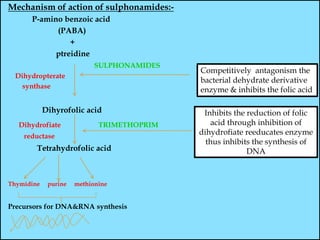
Mechanism of action of sulphonamides:-
P-amino benzoic acid
(PABA)
+
ptreidine
SULPHONAMIDES
Dihydropterate
synthase
Dihyrofolic acid
Dihydrofiate TRIMETHOPRIM d
reductase
Tetrahydrofolic acid
Thymidine purine methionine
Precursors for DNA&RNA synthesis
Competitively antagonism the
bacterial dehydrate derivative
enzyme & inhibits the folic acid
Inhibits the reduction of folic
acid through inhibition of
dihydrofiate reeducates enzyme
thus inhibits the synthesis of
DNA
PHARMACOKINETICS:-
It is the prototype of the general purpose sulfonamides that is rapidly
absorbed orally&rapidly excreted in urine.
Plasma protein binding is 50% and it is 20-40% acetylated.
The acetylated derivatives is less soluble in urine,crystalluria is likely.
It has good penetrability in brain & CSF.
It was the preferred compound for MENINGITIES.
Dose :-0.5g QID to 2g TDS.
SULFADIAZINE 0.45g tab.
SULPHADIAZINE
SULFAMETHOXAZOLE
PHARMACOKINETICS :-
It has slower oral absorption and urinary excretion
resulting in intermidiate duration of action t1/2 in adults
averages 10hrs.
It is the preferred compound for combining with
trimethoprim because the t1/2 of both is similar.
However a high fraction is acetylated, which is relatively
insoluble so that crystalluria can occur.
Dose : 1g BD for 2 days, then 0.5g BD.
GANTANOL 0.5g tab.
SULFAMETHOPYRAZINE
PHARMACOKINETICS :-
These are ultra strong acting compounds action lasting >1 week
because of high plasma protein binding and slow renal excretion t1/2
is about 5-9 days .
They attain low plasma concentration and are not suitable for
treatment of acute phylogenic infections
But, they are used in combination with pyrimethamine in the
treatment of malaria .
Large scale use of combination for prophylaxis of malaria is not
recommended .
SULFACETAMIDE
PHARMACOKINETICS :-
It is a highly soluble compound yielding neutral solution which
is only mildly irritating to the eye in concentrations upto 30%
 It is used typical sulfonamides, because( –CH 2-) bridge
separates the benzene ring and the amino group.
It is used only topically which inhibits a variety of gram +ve &
gram –ve bacteria.
In contrast to typical sulfonamides, it is active in the presence of
pus and against the Pseudomonas, clostridia which are not
inhibited by typical sulfonamides.
It has been mainly employed for burn dressing to prevent
infection, but not to treat already infected cases.
COTRIMOXAZOLE
PHARMACOKINETICS :-
The fixed dose combination of trimethoprim and
Sulphamethoxazole is called cotrimaxozole.
Sulphamethoxazole was selected for combining with
trimethoprim because both have nearly the same t/ (approx hr)
Trimethoprim adquately crosses the BBB and placenta , while
Sulphamethoxazole has a poorer entry.
Moreover treimethoprim is more rapidly absorbed than
Sulphamethoxazole.
Trimethoprim is 40% plasma protein bounded while
Sulphamethoxazole is 65% bound.
Treimethoprim is partly metabolizes in liver and excreted in
urine.
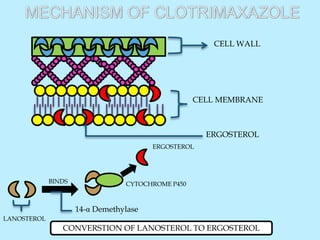
CELL WALL
CELL MEMBRANE
ERGOSTEROL
ERGOSTEROL
LANOSTEROL
CYTOCHROME P450
CONVERSTION OF LANOSTEROL TO ERGOSTEROL
14-α Demethylase
BINDS
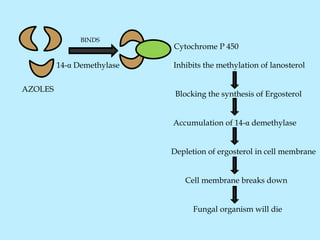
iInhibits the methylation of lanosterol
Blocking the synthesis of Ergosterol
Accumulation of 14-α demethylase
Depletion of ergosterol in cell membrane
Cell membrane breaks down
Fungal organism will die
Cytochrome P 450
14-α Demethylase
BINDS
AZOLES
USES :-
Systemic use of sulfonamides alone is rare now.
Thought they can be employed for suppressive therapy of
chronic urinary tract infections.
Combined with trimethoprim Sulphamethoxazole is used
for many bacterial infections ,P. jioveci and nocardiosis.
Ocular sulfacetamide sod. (10-30%) is a cheap alternative
in trachoma/ inclusion conjuctivities, though additional
systemic azithromycin or tetracycline therapy is equired for
eradication of the disease.
Topical silver sulfadiazine or mafenide are used for
preventing infection on burn surfaces.
ADVERSE EFFECTS :-
 Nausea,vomiting and epigastric pain.
Crystalluria is dose related ,but infrequent.
Hypersensitivity reactions occur in 2-5% patients. These
are mostly forms of rashes drug fever.
Hepatitis, unrelated to dose, in 0.1% patients.
Topical use of sulphinamides is not allowed , risk of
contact sensitization . However ocular use is permitted.
Hemolysis can occur in G-6PD deficient individuals with
high doses of sulfonamides .
THANK
YOU
REFERENCE :-
K.D TRIPATI

Sulphonamides

  • 1.
  • 2.
     The termsulphonamides are employed as a generic name for the derivatives of para amino benzene sulphonamide (sulphanilamide).  The sulphonamide drugs were the first effective chemotherapeutic agents to be employed systemically for the prevention and treatment of bacterial infections in humans.  The sulphonamides are bacteriostatic antibiotics with a wide spectrum action against most gram-positive bacteria and many gram-negative organisms.  Actually it was found to be the metabolic product of Prontosil, which is responsible for antibacterial activity, and this has given the initiation to develop sulphonamides as antibacterial agents.
  • 3.
    S.NO CLASS DRUGS 1.SHORT ACTING SULPHAMETHIZINE SULPHAMETHIZOLE SULFAISOXAZOLE SULPHA DIAZINE SULPASOMIDINE 2. INTERMIDEIATE ACTING SULPHAMETHOXAZOLE SULPHASOMIZOLE 3. LONG ACTING SULPHAMETHOXY PYRIDINE SULPHAMETHOXY DIAZINE SULFPHENAZOLE SULPHA DIMETHXINE 4. SPECIAL PURPOSE MEFENIDE SILVER SULFADIAZINE SULFA ACETAMIDE 5. FOLATE REDUCTASE INHIBITORS TRIMETHOPRIM CLOTRIMAOXAZOLE 6. OTHERS DAPSONE
  • 4.
    Mechanism of actionof sulphonamides:- P-amino benzoic acid (PABA) + ptreidine SULPHONAMIDES Dihydropterate synthase Dihyrofolic acid Dihydrofiate TRIMETHOPRIM d reductase Tetrahydrofolic acid Thymidine purine methionine Precursors for DNA&RNA synthesis Competitively antagonism the bacterial dehydrate derivative enzyme & inhibits the folic acid Inhibits the reduction of folic acid through inhibition of dihydrofiate reeducates enzyme thus inhibits the synthesis of DNA
  • 5.
    PHARMACOKINETICS:- It is theprototype of the general purpose sulfonamides that is rapidly absorbed orally&rapidly excreted in urine. Plasma protein binding is 50% and it is 20-40% acetylated. The acetylated derivatives is less soluble in urine,crystalluria is likely. It has good penetrability in brain & CSF. It was the preferred compound for MENINGITIES. Dose :-0.5g QID to 2g TDS. SULFADIAZINE 0.45g tab. SULPHADIAZINE
  • 6.
    SULFAMETHOXAZOLE PHARMACOKINETICS :- It hasslower oral absorption and urinary excretion resulting in intermidiate duration of action t1/2 in adults averages 10hrs. It is the preferred compound for combining with trimethoprim because the t1/2 of both is similar. However a high fraction is acetylated, which is relatively insoluble so that crystalluria can occur. Dose : 1g BD for 2 days, then 0.5g BD. GANTANOL 0.5g tab.
  • 7.
    SULFAMETHOPYRAZINE PHARMACOKINETICS :- These areultra strong acting compounds action lasting >1 week because of high plasma protein binding and slow renal excretion t1/2 is about 5-9 days . They attain low plasma concentration and are not suitable for treatment of acute phylogenic infections But, they are used in combination with pyrimethamine in the treatment of malaria . Large scale use of combination for prophylaxis of malaria is not recommended .
  • 8.
    SULFACETAMIDE PHARMACOKINETICS :- It isa highly soluble compound yielding neutral solution which is only mildly irritating to the eye in concentrations upto 30%  It is used typical sulfonamides, because( –CH 2-) bridge separates the benzene ring and the amino group. It is used only topically which inhibits a variety of gram +ve & gram –ve bacteria. In contrast to typical sulfonamides, it is active in the presence of pus and against the Pseudomonas, clostridia which are not inhibited by typical sulfonamides. It has been mainly employed for burn dressing to prevent infection, but not to treat already infected cases.
  • 9.
    COTRIMOXAZOLE PHARMACOKINETICS :- The fixeddose combination of trimethoprim and Sulphamethoxazole is called cotrimaxozole. Sulphamethoxazole was selected for combining with trimethoprim because both have nearly the same t/ (approx hr) Trimethoprim adquately crosses the BBB and placenta , while Sulphamethoxazole has a poorer entry. Moreover treimethoprim is more rapidly absorbed than Sulphamethoxazole. Trimethoprim is 40% plasma protein bounded while Sulphamethoxazole is 65% bound. Treimethoprim is partly metabolizes in liver and excreted in urine.
  • 10.
    CELL WALL CELL MEMBRANE ERGOSTEROL ERGOSTEROL LANOSTEROL CYTOCHROMEP450 CONVERSTION OF LANOSTEROL TO ERGOSTEROL 14-α Demethylase BINDS
  • 11.
    iInhibits the methylationof lanosterol Blocking the synthesis of Ergosterol Accumulation of 14-α demethylase Depletion of ergosterol in cell membrane Cell membrane breaks down Fungal organism will die Cytochrome P 450 14-α Demethylase BINDS AZOLES
  • 12.
    USES :- Systemic useof sulfonamides alone is rare now. Thought they can be employed for suppressive therapy of chronic urinary tract infections. Combined with trimethoprim Sulphamethoxazole is used for many bacterial infections ,P. jioveci and nocardiosis. Ocular sulfacetamide sod. (10-30%) is a cheap alternative in trachoma/ inclusion conjuctivities, though additional systemic azithromycin or tetracycline therapy is equired for eradication of the disease. Topical silver sulfadiazine or mafenide are used for preventing infection on burn surfaces.
  • 13.
    ADVERSE EFFECTS :- Nausea,vomiting and epigastric pain. Crystalluria is dose related ,but infrequent. Hypersensitivity reactions occur in 2-5% patients. These are mostly forms of rashes drug fever. Hepatitis, unrelated to dose, in 0.1% patients. Topical use of sulphinamides is not allowed , risk of contact sensitization . However ocular use is permitted. Hemolysis can occur in G-6PD deficient individuals with high doses of sulfonamides .
  • 14.