

COMMUNITY LANGUAGE
LEARNING
Introduction
CLL represents the use of Counseling-Learning
theory to teach language.
In humanistic psychology, Curran found that
person often feel threatened by a new learning
situation or fear that they will appear foolish.
A way to deal with the fears of students is for
teachers to become language counselors.
CLL advises teachers to take their students as
“whole person.”
T – S Relationship
I. ROLE
Teacher’s Role : a counsellor
Student’s Role : a client
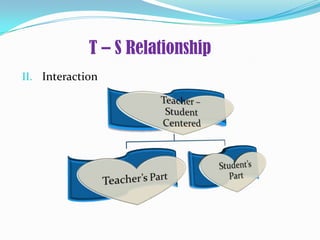
II. Interaction
T – S Relationship
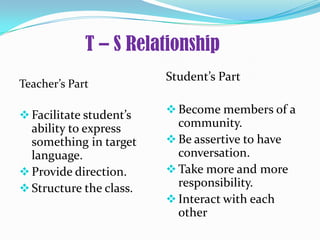
Teacher’s Part
 Facilitate student’s
ability to express
something in target
language.
 Provide direction.
 Structure the class.
Student’s Part
 Become members of a
community.
 Be assertive to have
conversation.
 Take more and more
responsibility.
 Interact with each
other
T – S Relationship
GOALS
Teachers want their students to learn how to use
the target language communicatively.
They want their students to learn about their own
learning.
They want their students to learn how to learn from
one another.
The Techniques of the CLL
Method
Tape recording student conversation
This technique used to record student produce
language as well as give the opportunity for
community learning to come about.
Transcription
Students make the transcription of their conversation
that have been recorded.
The Techniques of the CLL Method
Reflection on Experience
The teacher give the students the opportunity to reflect
on how they feel about the language Learning
experience. Themselves as learners, and their
relationship with one another.
Reflective Listening
The students relax and listen to their own voices speaking
the target language on the tape.
The Techniques of the CLL Method
 Small Group Task
Small groups might be asked to make new
sentences with the words on the
transcript. Then, groups shared the
sentences they made with the rest of the
class.
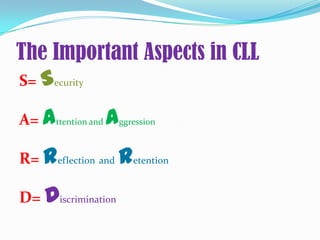
The Important Aspects in CLL
S= Security
A= Attention and Aggression
R= Reflection and Retention
D= Discrimination
The Important Aspects in CLL
Security
 Non-threatening learning environment
Attention and Aggression
 Ability to attend to many factors in learning so the
students don’t lose the learning.
 Actively involved in the learning experience.
The Important Aspects in CLL
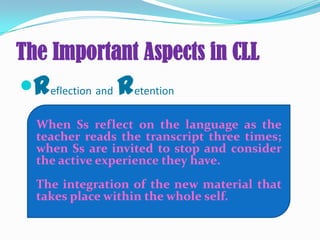
Reflection and Retention
When Ss reflect on the language as the
teacher reads the transcript three times;
when Ss are invited to stop and consider
the active experience they have.
The integration of the new material that
takes place within the whole self.
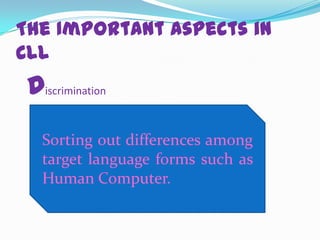
The Important Aspects in
CLL
Discrimination
Sorting out differences among
target language forms such as
Human Computer.
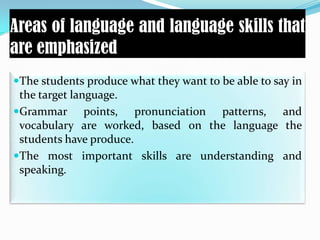
Areas of language and language skills that
are emphasized
The students produce what they want to be able to say in
the target language.
Grammar points, pronunciation patterns, and
vocabulary are worked, based on the language the
students have produce.
The most important skills are understanding and
speaking.
How does the teacher respond to student
errors?
Teachers should tell it in a non-
threatening way. Teacher repeat correctly
what the student has said incorrectly.
Advantages
 Nonthreatening
 Student independence.
 Emphasizes the humanistic side, and not
merely its linguistic dimension
Disadvantages
 Teacher poor
translator?
 The teachers may not
have special training to
attempt counselling.
CONCLUSION
Learning is persons: whole-person
language takes place best in a relationship
of trust, support, and cooperation between
teacher and students and among students.
CLL places unusual demands on language
teacher. They must be highly proficient and
familiar to the role of counselor. So,
special training in CLL technique is usually
required.

Community language learning

  • 1.
  • 2.
    Introduction CLL represents theuse of Counseling-Learning theory to teach language. In humanistic psychology, Curran found that person often feel threatened by a new learning situation or fear that they will appear foolish. A way to deal with the fears of students is for teachers to become language counselors. CLL advises teachers to take their students as “whole person.”
  • 3.
    T – SRelationship I. ROLE Teacher’s Role : a counsellor Student’s Role : a client
  • 4.
    II. Interaction T –S Relationship
  • 5.
    Teacher’s Part  Facilitatestudent’s ability to express something in target language.  Provide direction.  Structure the class. Student’s Part  Become members of a community.  Be assertive to have conversation.  Take more and more responsibility.  Interact with each other T – S Relationship
  • 6.
    GOALS Teachers want theirstudents to learn how to use the target language communicatively. They want their students to learn about their own learning. They want their students to learn how to learn from one another.
  • 7.
    The Techniques ofthe CLL Method Tape recording student conversation This technique used to record student produce language as well as give the opportunity for community learning to come about. Transcription Students make the transcription of their conversation that have been recorded.
  • 8.
    The Techniques ofthe CLL Method Reflection on Experience The teacher give the students the opportunity to reflect on how they feel about the language Learning experience. Themselves as learners, and their relationship with one another. Reflective Listening The students relax and listen to their own voices speaking the target language on the tape.
  • 9.
    The Techniques ofthe CLL Method  Small Group Task Small groups might be asked to make new sentences with the words on the transcript. Then, groups shared the sentences they made with the rest of the class.
  • 10.
    The Important Aspectsin CLL S= Security A= Attention and Aggression R= Reflection and Retention D= Discrimination
  • 11.
    The Important Aspectsin CLL Security  Non-threatening learning environment Attention and Aggression  Ability to attend to many factors in learning so the students don’t lose the learning.  Actively involved in the learning experience.
  • 12.
    The Important Aspectsin CLL Reflection and Retention When Ss reflect on the language as the teacher reads the transcript three times; when Ss are invited to stop and consider the active experience they have. The integration of the new material that takes place within the whole self.
  • 13.
    The Important Aspectsin CLL Discrimination Sorting out differences among target language forms such as Human Computer.
  • 14.
    Areas of languageand language skills that are emphasized The students produce what they want to be able to say in the target language. Grammar points, pronunciation patterns, and vocabulary are worked, based on the language the students have produce. The most important skills are understanding and speaking.
  • 15.
    How does theteacher respond to student errors? Teachers should tell it in a non- threatening way. Teacher repeat correctly what the student has said incorrectly.
  • 16.
    Advantages  Nonthreatening  Studentindependence.  Emphasizes the humanistic side, and not merely its linguistic dimension
  • 17.
    Disadvantages  Teacher poor translator? The teachers may not have special training to attempt counselling.
  • 18.
    CONCLUSION Learning is persons:whole-person language takes place best in a relationship of trust, support, and cooperation between teacher and students and among students. CLL places unusual demands on language teacher. They must be highly proficient and familiar to the role of counselor. So, special training in CLL technique is usually required.