1
ADIGRAT UNIVERSITY
COLLEGE OF ENGINEERING AND TECHNOLOGY
DEPARTMENT OFCHEMICAL ENGINEERING
PROCESS INDUSTRIES II
CHAPTER -TWO
THE TECHNOLOGY OF SUGAR PROCESSING
By : Mengsteab N.
2
Outline
Introduction to sugar cane
Raw materials and its accessories
Process description
Utilization of sugar by- products
3
Introduction
Sources of Sugar
 Sugar naturally exists as syrup in two main sources :
Sugar cane.........70% world sugar production
Sugar beet..........30% world sugar production
• All sweet materials contain sugar;but what matters is the %
content of sucrose
• Raw material acceptence criteria = f(% sucrose content)
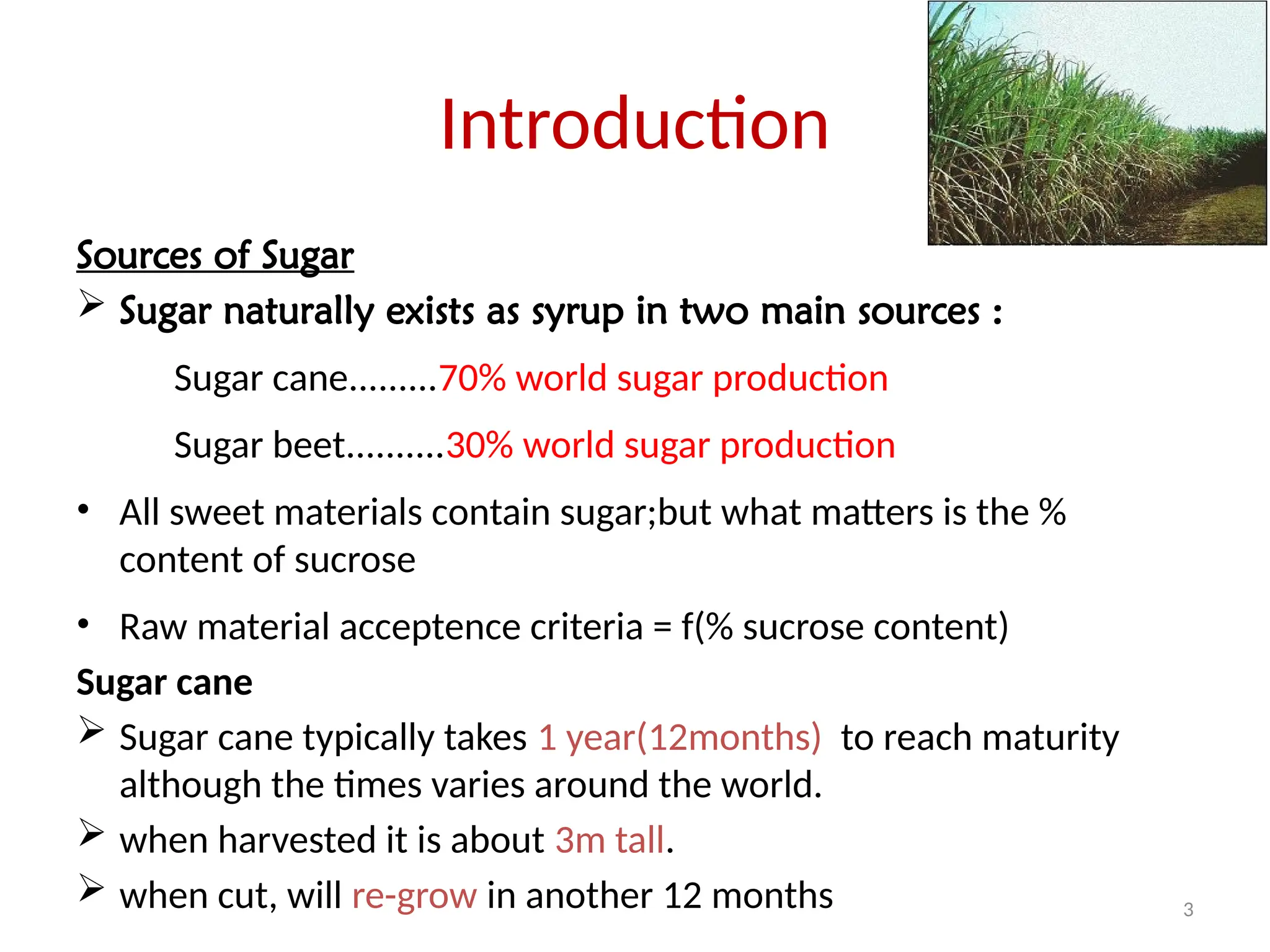
Sugar cane
 Sugar cane typically takes 1 year(12months) to reach maturity
although the times varies around the world.
 when harvested it is about 3m tall.
 when cut, will re-grow in another 12 months
4
 The process whereby cane plants make sugars is photosynthesis.
12 CO2 + 11 H2 O + energy = C12 H22 O11 + 12 O2
Sugar Cane composition
 Sucrose is not homogenously distributed in the cane
• The bottom parts of the millable cane contain more sucrose than the
top
• The sucrose concentration increase to the center of the cane
Table :-Sugar cane composition
Water……………..70- 75%
Sucrose ..................10- 15%
Fibre ……………..10-16%
Reducing sugars… 0.5-2%
Other organics……0.5-1%
in organics………..0.5-0.8%
5
Sugar Production from sugar cane
Raw materials and its accessories
• The raw materials used in the every sugar factory is sugar
cane.However there are accessories material used for different
purposes
• For instance Sulphur dioxide-used in clarification process to make
- rapid settling of juice
- fast boiling of massecuite
- fast crystalization of sucrose
- market improvement of suger colour
- better elimination of phosphates and waxes
6
• Lime(CaO)-also used during clarification to;
 neuterilize the free organic acids present in a juice
 for the pricipitation of colouring matters
• Water-used for
 Imbibition(process in which water is applied to the crushed cane
to enhance the extraction of the juice at the next mill)
 Steam generation
 Sugar wash . . .etc
7
Process Description of sugar Production
Major unit operations
1. Cane harvesting
2. Cane preparation
3. Juice extraction/milling
4. Juice Screening
5. Juice Heating
6. Juice clarification
7. Juice Settling
8. Filtration
9. Evaporation
10. Crystallization
11. Centrifugation
12. Drying
8
1. Cane harvesting
Cane cutting method
• Hand cutting
• Mechanical cutting
1. Hand Cutting:
 Undoubtedly, hand cut cane is better suited for factory processing than
mechanically harvested cane
 Because a hand cut cane is cleaner and its purities are higher since in
general cane is cut lower to the ground by hand than by machine
 The highest sugar content is known to be in the lowest part of the cane
stalk, the poorest part being the top.
9
2. Mechanical Cutting:
 Mechanically cutting and loading is a faster process.
 The main problem with machine handling of cane is usually damage to
the field, harming future cane crop
 particularly this occurs when harvesting is done during the rainy season
in which damage to the next years cane can be appreciable.
Attention: When the cane is cut, rapid deterioration of the
sugar begins
 Therefore, unlike sugar beets, sugarcane can’t be stored
for latter processing without excessive deterioration of the
sucrose content.
 Thus it has to be processed as soon as possible after
harvesting (24 hr)
10
2.Cane preparation
 A size reduction operation
 The purpose of this operation is to creat optimun condition for
maximum juice extraction
Cane preparation section tasks:
1. Washing
2. Disintegration of cane stalk
3. Iron removal
The preparation of the cane is accomplished by several ways.
 By revolving cane knives that cut the cane into chips but extracts no
juice.
 By shredders that tears the cane into shreds, but extract no juice.
11
 Preparation of the cane has three main objectives.
 To increase capacity by increase of bulk density of the feed.
 To assist extraction at the mills by breaking down the structure of
the cane.
 To render the juice more readily available for the action of
Imbibition by breaking and opening cane cells.
12
3.Juice extraction/milling
The purpose of this unit operation is to extract maximum juice as
much as possible.
 There are two different systems of extracting the sugar containing
juice from the cane. Such methods of extraction are: -
a. By means of pressure in a number of mills provided with three
rollers through which the cane is forced
b. By means of diffusion, extracting juice by applying heat and
immersion in water and squeezing of the bagasse
13
• For the grinding, or milling, of the crushed cane, multiple sets of
three-roller mills are most commonly used although some mills
consist of four, five, or six rollers in multiple sets
• Conveyors transport the crushed cane from one mill to the next.
• Imbibition is the process in which water or juice is applied to the
crushed cane to enhance the extraction of the juice at the next mill
• The crushed cane exiting the last mill is called bagasse.
Why Imbibition?
 Even when bagasse is subjected to high and repeated pressure,
it never gives up all the juice which it contains
 Thus Imbibition is done to enhance the extraction of the juice
at the next mill
14
Milling Diagram
15
Mill house
Pre.cane
Bagasse
Mixed juice
Imbibition water
Mixed juice = cane - bagasse + imbibitions water
16
The main factors affecting mill efficiency are:
Degree of cane preparation
Mill set clearance (pressure)
Number of mills in the tandem
 imbibitions water percentage
17
Several important aspects to extraction
The extraction is actually conducted as a counter-
current process using fresh hot water at one end
being pumped in the opposite direction to the
cane.
 The more water that is used, the more sugar is
extracted but the more dilute the mixed juice is
and hence the more energy that is required to
evaporate the juice.
Optimization is required on imbibition water vs
evaportor load
18
4.Juice Screening
• Mixed juice from the milling tandem contains a large amount
of cane fiber that falls out with the juice between the rollers of
the mills.
• The process in which the fiber is separated from the juice is
called juice screening.
Juice Screening Equipments
• A stationary and vibrating or rotating wire mesh screen.
• An inclined wedge-wire screen
• A rubber-lined Dorr clone (cyclone) system
19
5.Juice Heating
• Juice heating is excited in a number of vessels called juice heaters or preheaters.
• The main purpose of such heating is the following.
 Due to application of heat to the Juice, certain organic constituents like proteins are
coagulated
 Heat destroys microorganisms and enzymes preventing loss of sucrose by microbiological
activity
 Heat accelerates the reaction rate between the juice acids and the lime, which will be
subsequently added
types of Juice Heaters
There are two main types of heaters.
• The Plate Heat Exchangers
• A Shell and Tube Type (Vertical and Horizontal)
20
6.Juice clarification
• In juice clarification process the elimination of non-sugars has to
be done in such a way that
• Inorganic non-sugars are removed and not produced afresh when
the clarifying agents are used
• If agents are not used under proper condition, color and ash are
produced afresh
• Neither sucrose nor reducing sugars are destroyed in considerable
quantity
21
• The main objects of cane juice clarification are:-
 To separate soluble and insoluble matter that can precipitate
 To reduce color and turbidity of the juice
 To produce clear juice of correct pH (7.0)
 To kill or inactivate microorganisms in the juice by heat treatment
Methods of Juice Clarification
• Depending on the type of final product to be produced, there are
different methods of juice clarification
 Carbonation process
 Defecation Process
 Sulfitation Process
22
Carbonation Process: The main clarifying agents in the carbonation
process are lime and CO2 gas. The process consists of precipitating
calcium carbonate.
Ca (OH)2 + CO2 → CaCO3 + H2O
• The precipitate (Calcium Carbonate) adsorbs coloring matter and
gums
• It is easily filterable. The raw juice is heated to a temperature 50 –
55 0
C and pumped into the carbonation tank where lime is added
and mixed thoroughly.
• The juice is neutralized with CO2 gas
23
Defecation Process:
 Clarification by heat and lime is known as a simple defecation
process. Sufficient lime is added to neutralize the organic acids
present in the juice, after which the temperature is raised 98 0
C
(boiling point).
 The treatment causes formation of heavy precipitate of complex
composition.
 The flocculent precipitate carries with it most of the finely
suspended material of the juice that has escaped mechanical
screening.
24
Sulfitation Process:
• In the sulfitation system clarification is done by heat lime and sulphur
dioxide gas
• The mixed juice is heated to 75 0
C, more lime slurry is added to the raw
juice and the excess of lime is neutralized by SO2 gas.
• The process is called after the name of the acid used for neutralization of
excess lime “sulphitation”
• The treated juice is heated to 98 0
C and separation of flocculated non-
sugars takes place in a continuous settler.
• From the settler the clear juice continues in the process and the underflow
mud is a filtered on continuous drum filter and the filtrate is recycled to
the measured raw juice
25
7.Juice Settling
 When the juice has undergone the desired treatment - simple
defecation and sulphitation - it must be allowed to settle in order
to separate the clear juice from the precipitate formed in the body
of the juice. This settling is effected in continuous decanters or
clarifiers.
 In the clarifier, the suspended solids are allowed to settle out from the juice
 The main factor controlling settling is the difference in density
between the material to be settled and the liquid in which it is
mixed.
 The juice flows upward at a velocity low enough to allow the precipitate to settle
 Obviously, for effective separation, the settling rate must be faster than all of the
up-flow streams of juice so that net direction of particle movement is downward
26
8.filtration
• The clarification process separates the juices treated into two
layers or two parts:
(a) The clear juice, which rises to the surface
(b) The mud, which collects at the bottom. The clear juice goes to
manufacture, that is, in general, direct to the evaporators. The
mud has first to be filtered, in order to separate from the juice the
suspended matter which it contains, with the insoluble salts
formed and the fine bagasse entrained with them.
The typical and most widely used filter is continuous rotary vacuum
filter,
27
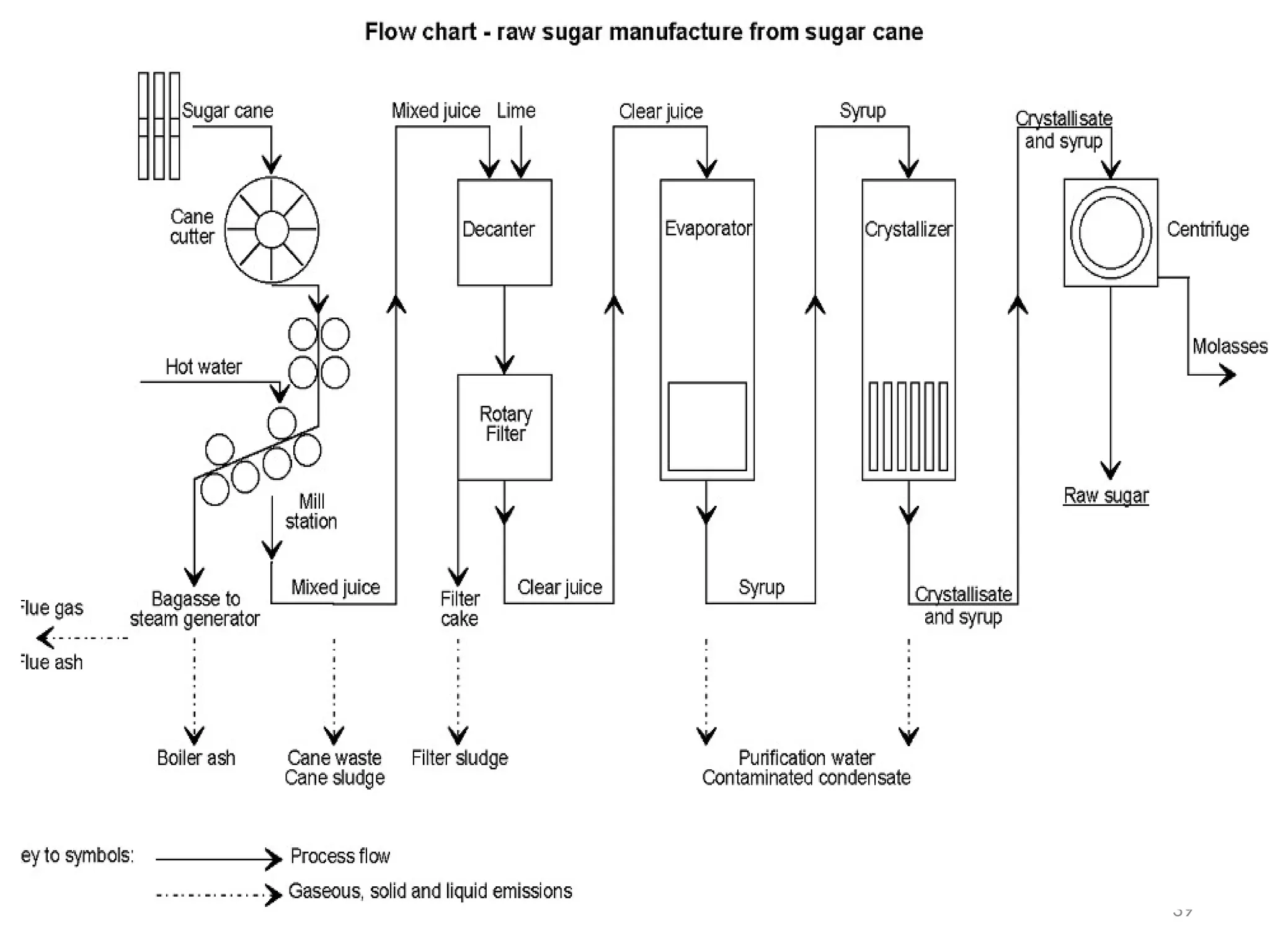
9.Evaporation
 The evaporation process is the process of concentration of the solids
in juice with removed of the water, without substantial changes in the
composition or character of the solids in the solution.
 The clear juice contains about 83 to 85% water, the remaining
portion being represented by the sugar and impurities known as non
sugar components.
• The clarified juice is concentrated to syrup by boiling off excess
water in a series of connected vessels called multiple effect
evaporator. Under automatically controlled conditions in the
evaporator station, each subsequent vessel operates under decreasing
pressure with the last one being under almost a total vacuum. After
this step the syrup is ready to go to the high-vacuum boiling pans.
The syrup concentrated 60-65 degree brix.
28
 Evaporation in open pots over a fire had already been
abandoned and evaporation of juice by heating with steam
had been commenced
 Steam is used for heating juice to evaporate the water which it
contains.
 With steam at 1100
C, pressure 0.4 Kg/Cm2
juice at
atmospheric pressure may be heated and evaporated
29
30
10.Crystallization
Concentration of the syrup from the evaporator is continued in
vacuum pans. Very small seed crystals are introduced to the
concentrating syrup and these begin to grow in size. When the
crystals reach the required size, the mixture of crystals and syrup is
discharged from the pan.
 The process is with the aim of completing the formation of crystals
and forcing further exhaustion of the mother liquor
31
11.Centrifugal Separation
• The final stage of the process of sugar making has now been
peached.
• The sugar crystals mixed with the mother liquor has been obtained.
• What remains is to separate them by the centrifugal force in proper
marketable form.
• Such separation is known as curing, purging by a centrifugal
machine
32
12.Sugar dryer
• The sugar leaving the centrifugals is hot at 60 – 700
C and moist 0.5 –
1.5% moisture and as such it can't be bagged for sale.
• Sugar drying is done by using hot air.
• Rotary-drum Dryers is the most widely used dryer. In general it is
cylindrical, and set at a slope of about 5° to the horizontal, which
facilitates the movement of the sugar from end to end of the drum,
being repeatedly lifted and dropped through the countercurrent air flow.
• The drum is often arranged to act as both dryer and cooler, the cold air
entering at the lower end and leaving near the middle of the drum,
where the hot air is introduced.
33
Sieving and Grading of Sugars
• The sugar obtained after drying and cooling consists of a mixture of
heterogeneous crystals and needs to be well sieved and graded
before it is marketed.
• The sieving is done through sifters which are of the following.
 Rotary Type
 Magnetic or Vibrating Type
34
Utilization of Sugar processing By-products
Besides sugar, sugar processing from sugarcane generates the following by
products;
1. Bagasse
2. Molasses
3. Filter cake
1.Bagasse
1. As fuel in boiler-house for generating steam and electricity
Maximize economy of energy consumption and saving as much
Bagasse as possible
Bagasse ash uses as fertilizer due to its potassium and phosphate
content
The ash can also uses for glass manufacturing since it contain silica
2.Paper and Pulp Manufacturing
35
2. Molasses
Ethanol (C2H5OH) production
Obtained through molasses fermentation
3. Filter Cake
serves as a good fertilizer in the fields since it contains
most of inorganic salts like sulfites, phosphates precipitated
during juice clarification
Moreover composted filter mud adds humus to the soil
36
Reasons for utilization of sugar by-
products
To use the biomass generated in sugar processing
for solving energy crisis and raw material shortage
Environmental protection
Conversion of by-products into useful chemicals
and products will impart greater financial stability
to the main industry.
37
COMMON NOMENCLATURE IN
sugar production
• Cane; Raw material fed to the milling station
• Imbibition water; Water added in the exhaust section
for washing out and recovering most of the sucrose in
cane. Common numbers are 20 to 35 % on cane.
• Absolute juice; total weight of cane minus the weight
of present fiber. A common relation between both is
86 to 14 % on cane.
• Fiber; The lignocellulosic structure giving strength to
the cane to keep itself erected. Common values are 12
to 14 % on cane.
38
• Mixed juice; Juice coming off the milling station and
going into the purification station. The weight of mixed
juice produced per unit time, is quite similar to that of
cane ground per same unit time, in many healthy
installations .
• Bagasse; Is the lignocellulosic residue left from cane
after the juice extraction in the milling station. Most of
its components are fiber, between 45 and 47 % on wet
bagasse, and moisture , between 49 and 51 % on wet
bagasse. From 2 % to 4 % may be soluble solids, mainly
sucrose .
Fundamental Equation of milling is:
Cane + Imbibition Water = Mixed Juice +Bagasse.
39

sugar production process course one .pptx

  • 1.
    1 ADIGRAT UNIVERSITY COLLEGE OFENGINEERING AND TECHNOLOGY DEPARTMENT OFCHEMICAL ENGINEERING PROCESS INDUSTRIES II CHAPTER -TWO THE TECHNOLOGY OF SUGAR PROCESSING By : Mengsteab N.
  • 2.
    2 Outline Introduction to sugarcane Raw materials and its accessories Process description Utilization of sugar by- products
  • 3.
    3 Introduction Sources of Sugar Sugar naturally exists as syrup in two main sources : Sugar cane.........70% world sugar production Sugar beet..........30% world sugar production • All sweet materials contain sugar;but what matters is the % content of sucrose • Raw material acceptence criteria = f(% sucrose content) Sugar cane  Sugar cane typically takes 1 year(12months) to reach maturity although the times varies around the world.  when harvested it is about 3m tall.  when cut, will re-grow in another 12 months
  • 4.
    4  The processwhereby cane plants make sugars is photosynthesis. 12 CO2 + 11 H2 O + energy = C12 H22 O11 + 12 O2 Sugar Cane composition  Sucrose is not homogenously distributed in the cane • The bottom parts of the millable cane contain more sucrose than the top • The sucrose concentration increase to the center of the cane Table :-Sugar cane composition Water……………..70- 75% Sucrose ..................10- 15% Fibre ……………..10-16% Reducing sugars… 0.5-2% Other organics……0.5-1% in organics………..0.5-0.8%
  • 5.
    5 Sugar Production fromsugar cane Raw materials and its accessories • The raw materials used in the every sugar factory is sugar cane.However there are accessories material used for different purposes • For instance Sulphur dioxide-used in clarification process to make - rapid settling of juice - fast boiling of massecuite - fast crystalization of sucrose - market improvement of suger colour - better elimination of phosphates and waxes
  • 6.
    6 • Lime(CaO)-also usedduring clarification to;  neuterilize the free organic acids present in a juice  for the pricipitation of colouring matters • Water-used for  Imbibition(process in which water is applied to the crushed cane to enhance the extraction of the juice at the next mill)  Steam generation  Sugar wash . . .etc
  • 7.
    7 Process Description ofsugar Production Major unit operations 1. Cane harvesting 2. Cane preparation 3. Juice extraction/milling 4. Juice Screening 5. Juice Heating 6. Juice clarification 7. Juice Settling 8. Filtration 9. Evaporation 10. Crystallization 11. Centrifugation 12. Drying
  • 8.
    8 1. Cane harvesting Canecutting method • Hand cutting • Mechanical cutting 1. Hand Cutting:  Undoubtedly, hand cut cane is better suited for factory processing than mechanically harvested cane  Because a hand cut cane is cleaner and its purities are higher since in general cane is cut lower to the ground by hand than by machine  The highest sugar content is known to be in the lowest part of the cane stalk, the poorest part being the top.
  • 9.
    9 2. Mechanical Cutting: Mechanically cutting and loading is a faster process.  The main problem with machine handling of cane is usually damage to the field, harming future cane crop  particularly this occurs when harvesting is done during the rainy season in which damage to the next years cane can be appreciable. Attention: When the cane is cut, rapid deterioration of the sugar begins  Therefore, unlike sugar beets, sugarcane can’t be stored for latter processing without excessive deterioration of the sucrose content.  Thus it has to be processed as soon as possible after harvesting (24 hr)
  • 10.
    10 2.Cane preparation  Asize reduction operation  The purpose of this operation is to creat optimun condition for maximum juice extraction Cane preparation section tasks: 1. Washing 2. Disintegration of cane stalk 3. Iron removal The preparation of the cane is accomplished by several ways.  By revolving cane knives that cut the cane into chips but extracts no juice.  By shredders that tears the cane into shreds, but extract no juice.
  • 11.
    11  Preparation ofthe cane has three main objectives.  To increase capacity by increase of bulk density of the feed.  To assist extraction at the mills by breaking down the structure of the cane.  To render the juice more readily available for the action of Imbibition by breaking and opening cane cells.
  • 12.
    12 3.Juice extraction/milling The purposeof this unit operation is to extract maximum juice as much as possible.  There are two different systems of extracting the sugar containing juice from the cane. Such methods of extraction are: - a. By means of pressure in a number of mills provided with three rollers through which the cane is forced b. By means of diffusion, extracting juice by applying heat and immersion in water and squeezing of the bagasse
  • 13.
    13 • For thegrinding, or milling, of the crushed cane, multiple sets of three-roller mills are most commonly used although some mills consist of four, five, or six rollers in multiple sets • Conveyors transport the crushed cane from one mill to the next. • Imbibition is the process in which water or juice is applied to the crushed cane to enhance the extraction of the juice at the next mill • The crushed cane exiting the last mill is called bagasse. Why Imbibition?  Even when bagasse is subjected to high and repeated pressure, it never gives up all the juice which it contains  Thus Imbibition is done to enhance the extraction of the juice at the next mill
  • 14.
  • 15.
    15 Mill house Pre.cane Bagasse Mixed juice Imbibitionwater Mixed juice = cane - bagasse + imbibitions water
  • 16.
    16 The main factorsaffecting mill efficiency are: Degree of cane preparation Mill set clearance (pressure) Number of mills in the tandem  imbibitions water percentage
  • 17.
    17 Several important aspectsto extraction The extraction is actually conducted as a counter- current process using fresh hot water at one end being pumped in the opposite direction to the cane.  The more water that is used, the more sugar is extracted but the more dilute the mixed juice is and hence the more energy that is required to evaporate the juice. Optimization is required on imbibition water vs evaportor load
  • 18.
    18 4.Juice Screening • Mixedjuice from the milling tandem contains a large amount of cane fiber that falls out with the juice between the rollers of the mills. • The process in which the fiber is separated from the juice is called juice screening. Juice Screening Equipments • A stationary and vibrating or rotating wire mesh screen. • An inclined wedge-wire screen • A rubber-lined Dorr clone (cyclone) system
  • 19.
    19 5.Juice Heating • Juiceheating is excited in a number of vessels called juice heaters or preheaters. • The main purpose of such heating is the following.  Due to application of heat to the Juice, certain organic constituents like proteins are coagulated  Heat destroys microorganisms and enzymes preventing loss of sucrose by microbiological activity  Heat accelerates the reaction rate between the juice acids and the lime, which will be subsequently added types of Juice Heaters There are two main types of heaters. • The Plate Heat Exchangers • A Shell and Tube Type (Vertical and Horizontal)
  • 20.
    20 6.Juice clarification • Injuice clarification process the elimination of non-sugars has to be done in such a way that • Inorganic non-sugars are removed and not produced afresh when the clarifying agents are used • If agents are not used under proper condition, color and ash are produced afresh • Neither sucrose nor reducing sugars are destroyed in considerable quantity
  • 21.
    21 • The mainobjects of cane juice clarification are:-  To separate soluble and insoluble matter that can precipitate  To reduce color and turbidity of the juice  To produce clear juice of correct pH (7.0)  To kill or inactivate microorganisms in the juice by heat treatment Methods of Juice Clarification • Depending on the type of final product to be produced, there are different methods of juice clarification  Carbonation process  Defecation Process  Sulfitation Process
  • 22.
    22 Carbonation Process: Themain clarifying agents in the carbonation process are lime and CO2 gas. The process consists of precipitating calcium carbonate. Ca (OH)2 + CO2 → CaCO3 + H2O • The precipitate (Calcium Carbonate) adsorbs coloring matter and gums • It is easily filterable. The raw juice is heated to a temperature 50 – 55 0 C and pumped into the carbonation tank where lime is added and mixed thoroughly. • The juice is neutralized with CO2 gas
  • 23.
    23 Defecation Process:  Clarificationby heat and lime is known as a simple defecation process. Sufficient lime is added to neutralize the organic acids present in the juice, after which the temperature is raised 98 0 C (boiling point).  The treatment causes formation of heavy precipitate of complex composition.  The flocculent precipitate carries with it most of the finely suspended material of the juice that has escaped mechanical screening.
  • 24.
    24 Sulfitation Process: • Inthe sulfitation system clarification is done by heat lime and sulphur dioxide gas • The mixed juice is heated to 75 0 C, more lime slurry is added to the raw juice and the excess of lime is neutralized by SO2 gas. • The process is called after the name of the acid used for neutralization of excess lime “sulphitation” • The treated juice is heated to 98 0 C and separation of flocculated non- sugars takes place in a continuous settler. • From the settler the clear juice continues in the process and the underflow mud is a filtered on continuous drum filter and the filtrate is recycled to the measured raw juice
  • 25.
    25 7.Juice Settling  Whenthe juice has undergone the desired treatment - simple defecation and sulphitation - it must be allowed to settle in order to separate the clear juice from the precipitate formed in the body of the juice. This settling is effected in continuous decanters or clarifiers.  In the clarifier, the suspended solids are allowed to settle out from the juice  The main factor controlling settling is the difference in density between the material to be settled and the liquid in which it is mixed.  The juice flows upward at a velocity low enough to allow the precipitate to settle  Obviously, for effective separation, the settling rate must be faster than all of the up-flow streams of juice so that net direction of particle movement is downward
  • 26.
    26 8.filtration • The clarificationprocess separates the juices treated into two layers or two parts: (a) The clear juice, which rises to the surface (b) The mud, which collects at the bottom. The clear juice goes to manufacture, that is, in general, direct to the evaporators. The mud has first to be filtered, in order to separate from the juice the suspended matter which it contains, with the insoluble salts formed and the fine bagasse entrained with them. The typical and most widely used filter is continuous rotary vacuum filter,
  • 27.
    27 9.Evaporation  The evaporationprocess is the process of concentration of the solids in juice with removed of the water, without substantial changes in the composition or character of the solids in the solution.  The clear juice contains about 83 to 85% water, the remaining portion being represented by the sugar and impurities known as non sugar components. • The clarified juice is concentrated to syrup by boiling off excess water in a series of connected vessels called multiple effect evaporator. Under automatically controlled conditions in the evaporator station, each subsequent vessel operates under decreasing pressure with the last one being under almost a total vacuum. After this step the syrup is ready to go to the high-vacuum boiling pans. The syrup concentrated 60-65 degree brix.
  • 28.
    28  Evaporation inopen pots over a fire had already been abandoned and evaporation of juice by heating with steam had been commenced  Steam is used for heating juice to evaporate the water which it contains.  With steam at 1100 C, pressure 0.4 Kg/Cm2 juice at atmospheric pressure may be heated and evaporated
  • 29.
  • 30.
    30 10.Crystallization Concentration of thesyrup from the evaporator is continued in vacuum pans. Very small seed crystals are introduced to the concentrating syrup and these begin to grow in size. When the crystals reach the required size, the mixture of crystals and syrup is discharged from the pan.  The process is with the aim of completing the formation of crystals and forcing further exhaustion of the mother liquor
  • 31.
    31 11.Centrifugal Separation • Thefinal stage of the process of sugar making has now been peached. • The sugar crystals mixed with the mother liquor has been obtained. • What remains is to separate them by the centrifugal force in proper marketable form. • Such separation is known as curing, purging by a centrifugal machine
  • 32.
    32 12.Sugar dryer • Thesugar leaving the centrifugals is hot at 60 – 700 C and moist 0.5 – 1.5% moisture and as such it can't be bagged for sale. • Sugar drying is done by using hot air. • Rotary-drum Dryers is the most widely used dryer. In general it is cylindrical, and set at a slope of about 5° to the horizontal, which facilitates the movement of the sugar from end to end of the drum, being repeatedly lifted and dropped through the countercurrent air flow. • The drum is often arranged to act as both dryer and cooler, the cold air entering at the lower end and leaving near the middle of the drum, where the hot air is introduced.
  • 33.
    33 Sieving and Gradingof Sugars • The sugar obtained after drying and cooling consists of a mixture of heterogeneous crystals and needs to be well sieved and graded before it is marketed. • The sieving is done through sifters which are of the following.  Rotary Type  Magnetic or Vibrating Type
  • 34.
    34 Utilization of Sugarprocessing By-products Besides sugar, sugar processing from sugarcane generates the following by products; 1. Bagasse 2. Molasses 3. Filter cake 1.Bagasse 1. As fuel in boiler-house for generating steam and electricity Maximize economy of energy consumption and saving as much Bagasse as possible Bagasse ash uses as fertilizer due to its potassium and phosphate content The ash can also uses for glass manufacturing since it contain silica 2.Paper and Pulp Manufacturing
  • 35.
    35 2. Molasses Ethanol (C2H5OH)production Obtained through molasses fermentation 3. Filter Cake serves as a good fertilizer in the fields since it contains most of inorganic salts like sulfites, phosphates precipitated during juice clarification Moreover composted filter mud adds humus to the soil
  • 36.
    36 Reasons for utilizationof sugar by- products To use the biomass generated in sugar processing for solving energy crisis and raw material shortage Environmental protection Conversion of by-products into useful chemicals and products will impart greater financial stability to the main industry.
  • 37.
    37 COMMON NOMENCLATURE IN sugarproduction • Cane; Raw material fed to the milling station • Imbibition water; Water added in the exhaust section for washing out and recovering most of the sucrose in cane. Common numbers are 20 to 35 % on cane. • Absolute juice; total weight of cane minus the weight of present fiber. A common relation between both is 86 to 14 % on cane. • Fiber; The lignocellulosic structure giving strength to the cane to keep itself erected. Common values are 12 to 14 % on cane.
  • 38.
    38 • Mixed juice;Juice coming off the milling station and going into the purification station. The weight of mixed juice produced per unit time, is quite similar to that of cane ground per same unit time, in many healthy installations . • Bagasse; Is the lignocellulosic residue left from cane after the juice extraction in the milling station. Most of its components are fiber, between 45 and 47 % on wet bagasse, and moisture , between 49 and 51 % on wet bagasse. From 2 % to 4 % may be soluble solids, mainly sucrose . Fundamental Equation of milling is: Cane + Imbibition Water = Mixed Juice +Bagasse.
  • 39.