ALITAME
MOKSHA CHIB
13FET1003
Artificial Sweetener
1
WHAT IS ALITAME ?
 Alitame is a non-nutritive, artificial, intensive sweetener.
 Unlike Aspartame, it is a protein and a dipeptide.
 It has been allotted the E number 956.
 Used as low calorie sweetener as it gives the same taste as table
sugar but without any calories.
 Chemical name : L-α-Aspartyl-N-(2,2,4,4-tetramethyl-3-
thietanyl)-D-alaninamide, hydrated
 Chemical formula : C14H25N3O4S · 2.5 H2O
ALITAME2
STRUCTURE
 Alitame is a dipeptide of L-Aspartic acid & D-Alanine. Attached
to alanine is a amine (2,2,4,4 tetramethylthietanyl amine).
 It was developed by Pfizer in the early 1980s and is currently
marketed in some countries under the brand name Aclame.
 It was synthesized after the accidental discovery of Aspartame.
ALITAME3
IUPAC Name:
(3S)-3-amino-4-[ [(1R)-
1-methyl-2-oxo-2-
[(2,2,4,4-tetramethyl-3-
thietanyl)amino]ethyl]a
mino]-4-oxobutanoic
acid
L – Aspartic D- Alanine Amide
STRUCTURE
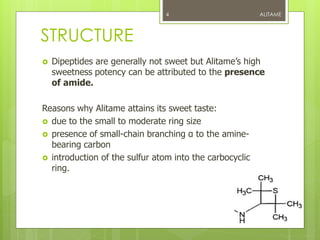
 Dipeptides are generally not sweet but Alitame’s high
sweetness potency can be attributed to the presence
of amide.
Reasons why Alitame attains its sweet taste:
 due to the small to moderate ring size
 presence of small-chain branching α to the amine-
bearing carbon
 introduction of the sulfur atom into the carbocyclic
ring.
ALITAME4
PREPARATION
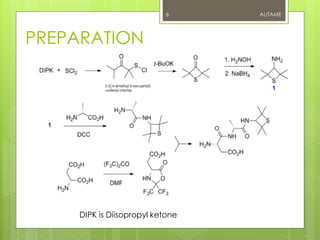
 Alitame is prepared by a multistep synthesis involving
the reaction between two intermediates, (S)-[2,5-
dioxo-(4-thiazolidine)] acetic acid and (R)-2-amino-N-
(2,2,4,4-tetramethyl-3-thietanyl) propanamide.
 The final product is isolated and purified through
crystallization of an alitame-4-methylbenzenesulfonic
acid molecules, followed by additional purification
steps, and finally recrystallization from water.
ALITAME5
PREPARATION
ALITAME6
DIPK is Diisopropyl ketone
ORGANOLEPTIC PROPERTIES
 Alitame is a crystalline, odourless, non hygroscopic powder.
 It is about 2000 times sweeter than Sucrose & about 10 times
sweeter than Aspartame.
 The sweetness of Alitame is of a high quality, sucrose-like, without
accompanying any bitter or metallic notes. Its sweet taste develops
rapidly in the mouth and lingers for sometime.
 Alitame has been found to exhibit synergy when combined with
both Acesulfame K and Cyclamate. High-quality blends with
other sweeteners including saccharin are also effective.
ALITAME7
SOLUBILITY
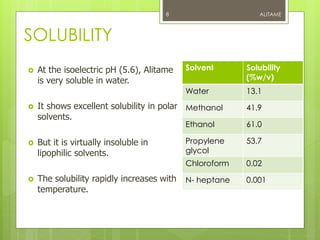
 At the isoelectric pH (5.6), Alitame
is very soluble in water.
 It shows excellent solubility in polar
solvents.
 But it is virtually insoluble in
lipophilic solvents.
 The solubility rapidly increases with
temperature.
ALITAME8
Solvent Solubility
(%w/v)
Water 13.1
Methanol 41.9
Ethanol 61.0
Propylene
glycol
53.7
Chloroform 0.02
N- heptane 0.001
DECOMPOSITION PATHWAYS
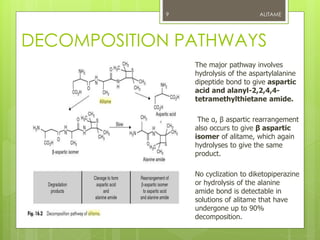
 The major pathway involves
hydrolysis of the aspartylalanine
dipeptide bond to give aspartic
acid and alanyl-2,2,4,4-
tetramethylthietane amide.
 The α, β aspartic rearrangement
also occurs to give β aspartic
isomer of alitame, which again
hydrolyses to give the same
product.
 No cyclization to diketopiperazine
or hydrolysis of the alanine
amide bond is detectable in
solutions of alitame that have
undergone up to 90%
decomposition.
ALITAME9
STABILITY
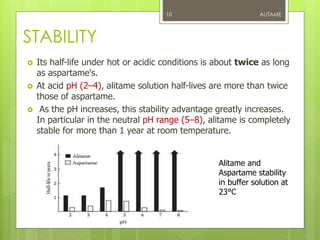
 Its half-life under hot or acidic conditions is about twice as long
as aspartame's.
 At acid pH (2–4), alitame solution half-lives are more than twice
those of aspartame.
 As the pH increases, this stability advantage greatly increases.
In particular in the neutral pH range (5–8), alitame is completely
stable for more than 1 year at room temperature.
ALITAME10
Alitame and
Aspartame stability
in buffer solution at
23°C
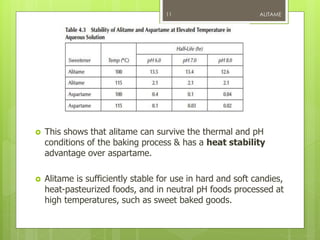
 This shows that alitame can survive the thermal and pH
conditions of the baking process & has a heat stability
advantage over aspartame.
 Alitame is sufficiently stable for use in hard and soft candies,
heat-pasteurized foods, and in neutral pH foods processed at
high temperatures, such as sweet baked goods.
ALITAME11
COMPATIBILITY
 The compatibility of alitame with a given recipe will depend on
the actual ingredients present and the thermal and pH exposure
involved in the manufacturing process.
Reaction with reducing sugars
 High levels of reducing sugars, such as glucose and lactose, may
react with alitame in heated liquid or semi liquid systems, such
as baked goods, to form Maillard reaction products.
 Similar reactions are shown by flavour aldehydes at high levels.
ALITAME12
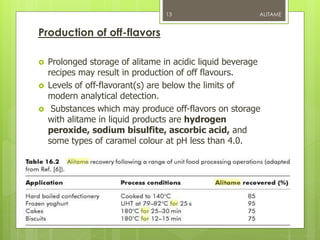
Production of off-flavors
 Prolonged storage of alitame in acidic liquid beverage
recipes may result in production of off flavours.
 Levels of off-flavorant(s) are below the limits of
modern analytical detection.
 Substances which may produce off-flavors on storage
with alitame in liquid products are hydrogen
peroxide, sodium bisulfite, ascorbic acid, and
some types of caramel colour at pH less than 4.0.
ALITAME13
METABOLISM
 Alitame is well absorbed after oral administration to the mouse,
rat, dog, or man.
 Most of an oral dose (77%–96%) is excreted in urine as a
mixture of metabolites. The remainder (7%–22%) is excreted in
the faeces, primarily as unchanged alitame.
 The maximum calorific value given by alitame is 1.4kcal/ gram.
 Alitame is metabolized to aspartic acid which is used in amino
acid metabolism, making alitame caloric.
ALITAME14
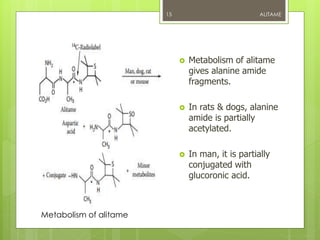
 Metabolism of alitame
gives alanine amide
fragments.
 In rats & dogs, alanine
amide is partially
acetylated.
 In man, it is partially
conjugated with
glucoronic acid.
ALITAME15
Metabolism of alitame
INCORPORATION IN FOODS
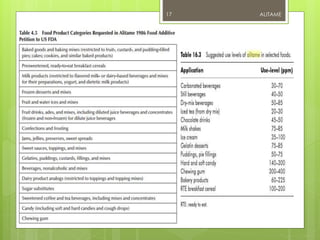
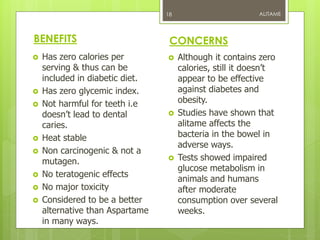
 Alitame is used in a wide range of foods and beverages,
including bakery wares, water-based flavored drinks, dairy-based
drinks, cream, edible ices, jams, confectionery.
 Being a low calorie sweetener, it is incorporated in diabetic
foods.
 Alitame is used in the rolling compound of chewing gums from
0.01% - 20%.
 Due to high thermal stability, it finds many more applications in
bakery products and in dairy based products which undergo
pasteurization (UHT) during processing.
ALITAME16
ALITAME17
BENEFITS
 Has zero calories per
serving & thus can be
included in diabetic diet.
 Has zero glycemic index.
 Not harmful for teeth i.e
doesn’t lead to dental
caries.
 Heat stable
 Non carcinogenic & not a
mutagen.
 No teratogenic effects
 No major toxicity
 Considered to be a better
alternative than Aspartame
in many ways.
CONCERNS
 Although it contains zero
calories, still it doesn’t
appear to be effective
against diabetes and
obesity.
 Studies have shown that
alitame affects the
bacteria in the bowel in
adverse ways.
 Tests showed impaired
glucose metabolism in
animals and humans
after moderate
consumption over several
weeks.
ALITAME18
SAFETY
 Non carcinogenic, teratogenic, embryogenic and mutagenic.
 Unlike aspartame, alitame does not contain phenylalanine, and can
therefore be used by people with phenylketonuria (PKU).
 Considered to have no or very low toxicological effects in either
rats or humans.
 In 1996, JECFA set an acceptable ADI of 1mg/kg bw/day.
 In the 59th meeting occurring in JUNE 2002, JECFA postponed
making ADI or other toxicological recommendations about alitame
until findings of a 90 day tolerance study were made available.
 In the FDA petition, the estimated daily intake as a sole sweetener
in all products is 0.34mg/kg bw/day.
 The level at which no observable adverse effects occurred in
animals was 100mg/kg.
ALITAME19
REGULATORY STATUS
 In 1986 a Food Additive Petition was submitted to the US FDA
requesting broad clearance for alitame (Federal Register 1986).
 The petition requested approval of alitame as a sweetener and
flavoring in specified foods in amounts necessary to achieve the
intended effect and in accordance with good manufacturing
practice.
 Alitame was approved for use in food and beverages in Australia
(1993); in Mexico (1994); in New Zealand (1994); in People’s
Republic of China (1994); in Indonesia (1995); in Colombia
(1996), and in Chile (1997).
ALITAME20
REFERENCES
 Alternative Sweeteners, 4th edition by Lyn O’ Brien Nabors.
 Sweeteners and Sugar Alternatives in Food Technology by
Helen Mitchell
 Ellis, J. W. (1995). "Overview of Sweeteners". Journal of
Chemical Education 72 (8)
 "Notice of withdrawal of petition: docket No. FDA-1986-F-0277
(formerly docket No. 1986F-0364)"(pdf). Food and Drug
Administration.
 FAO org page- JECFA Additives
ALITAME21
THANK YOU !
ALITAME22

Alitame

  • 1.
  • 2.
    WHAT IS ALITAME?  Alitame is a non-nutritive, artificial, intensive sweetener.  Unlike Aspartame, it is a protein and a dipeptide.  It has been allotted the E number 956.  Used as low calorie sweetener as it gives the same taste as table sugar but without any calories.  Chemical name : L-α-Aspartyl-N-(2,2,4,4-tetramethyl-3- thietanyl)-D-alaninamide, hydrated  Chemical formula : C14H25N3O4S · 2.5 H2O ALITAME2
  • 3.
    STRUCTURE  Alitame isa dipeptide of L-Aspartic acid & D-Alanine. Attached to alanine is a amine (2,2,4,4 tetramethylthietanyl amine).  It was developed by Pfizer in the early 1980s and is currently marketed in some countries under the brand name Aclame.  It was synthesized after the accidental discovery of Aspartame. ALITAME3 IUPAC Name: (3S)-3-amino-4-[ [(1R)- 1-methyl-2-oxo-2- [(2,2,4,4-tetramethyl-3- thietanyl)amino]ethyl]a mino]-4-oxobutanoic acid L – Aspartic D- Alanine Amide
  • 4.
    STRUCTURE  Dipeptides aregenerally not sweet but Alitame’s high sweetness potency can be attributed to the presence of amide. Reasons why Alitame attains its sweet taste:  due to the small to moderate ring size  presence of small-chain branching α to the amine- bearing carbon  introduction of the sulfur atom into the carbocyclic ring. ALITAME4
  • 5.
    PREPARATION  Alitame isprepared by a multistep synthesis involving the reaction between two intermediates, (S)-[2,5- dioxo-(4-thiazolidine)] acetic acid and (R)-2-amino-N- (2,2,4,4-tetramethyl-3-thietanyl) propanamide.  The final product is isolated and purified through crystallization of an alitame-4-methylbenzenesulfonic acid molecules, followed by additional purification steps, and finally recrystallization from water. ALITAME5
  • 6.
  • 7.
    ORGANOLEPTIC PROPERTIES  Alitameis a crystalline, odourless, non hygroscopic powder.  It is about 2000 times sweeter than Sucrose & about 10 times sweeter than Aspartame.  The sweetness of Alitame is of a high quality, sucrose-like, without accompanying any bitter or metallic notes. Its sweet taste develops rapidly in the mouth and lingers for sometime.  Alitame has been found to exhibit synergy when combined with both Acesulfame K and Cyclamate. High-quality blends with other sweeteners including saccharin are also effective. ALITAME7
  • 8.
    SOLUBILITY  At theisoelectric pH (5.6), Alitame is very soluble in water.  It shows excellent solubility in polar solvents.  But it is virtually insoluble in lipophilic solvents.  The solubility rapidly increases with temperature. ALITAME8 Solvent Solubility (%w/v) Water 13.1 Methanol 41.9 Ethanol 61.0 Propylene glycol 53.7 Chloroform 0.02 N- heptane 0.001
  • 9.
    DECOMPOSITION PATHWAYS  Themajor pathway involves hydrolysis of the aspartylalanine dipeptide bond to give aspartic acid and alanyl-2,2,4,4- tetramethylthietane amide.  The α, β aspartic rearrangement also occurs to give β aspartic isomer of alitame, which again hydrolyses to give the same product.  No cyclization to diketopiperazine or hydrolysis of the alanine amide bond is detectable in solutions of alitame that have undergone up to 90% decomposition. ALITAME9
  • 10.
    STABILITY  Its half-lifeunder hot or acidic conditions is about twice as long as aspartame's.  At acid pH (2–4), alitame solution half-lives are more than twice those of aspartame.  As the pH increases, this stability advantage greatly increases. In particular in the neutral pH range (5–8), alitame is completely stable for more than 1 year at room temperature. ALITAME10 Alitame and Aspartame stability in buffer solution at 23°C
  • 11.
     This showsthat alitame can survive the thermal and pH conditions of the baking process & has a heat stability advantage over aspartame.  Alitame is sufficiently stable for use in hard and soft candies, heat-pasteurized foods, and in neutral pH foods processed at high temperatures, such as sweet baked goods. ALITAME11
  • 12.
    COMPATIBILITY  The compatibilityof alitame with a given recipe will depend on the actual ingredients present and the thermal and pH exposure involved in the manufacturing process. Reaction with reducing sugars  High levels of reducing sugars, such as glucose and lactose, may react with alitame in heated liquid or semi liquid systems, such as baked goods, to form Maillard reaction products.  Similar reactions are shown by flavour aldehydes at high levels. ALITAME12
  • 13.
    Production of off-flavors Prolonged storage of alitame in acidic liquid beverage recipes may result in production of off flavours.  Levels of off-flavorant(s) are below the limits of modern analytical detection.  Substances which may produce off-flavors on storage with alitame in liquid products are hydrogen peroxide, sodium bisulfite, ascorbic acid, and some types of caramel colour at pH less than 4.0. ALITAME13
  • 14.
    METABOLISM  Alitame iswell absorbed after oral administration to the mouse, rat, dog, or man.  Most of an oral dose (77%–96%) is excreted in urine as a mixture of metabolites. The remainder (7%–22%) is excreted in the faeces, primarily as unchanged alitame.  The maximum calorific value given by alitame is 1.4kcal/ gram.  Alitame is metabolized to aspartic acid which is used in amino acid metabolism, making alitame caloric. ALITAME14
  • 15.
     Metabolism ofalitame gives alanine amide fragments.  In rats & dogs, alanine amide is partially acetylated.  In man, it is partially conjugated with glucoronic acid. ALITAME15 Metabolism of alitame
  • 16.
    INCORPORATION IN FOODS Alitame is used in a wide range of foods and beverages, including bakery wares, water-based flavored drinks, dairy-based drinks, cream, edible ices, jams, confectionery.  Being a low calorie sweetener, it is incorporated in diabetic foods.  Alitame is used in the rolling compound of chewing gums from 0.01% - 20%.  Due to high thermal stability, it finds many more applications in bakery products and in dairy based products which undergo pasteurization (UHT) during processing. ALITAME16
  • 17.
  • 18.
    BENEFITS  Has zerocalories per serving & thus can be included in diabetic diet.  Has zero glycemic index.  Not harmful for teeth i.e doesn’t lead to dental caries.  Heat stable  Non carcinogenic & not a mutagen.  No teratogenic effects  No major toxicity  Considered to be a better alternative than Aspartame in many ways. CONCERNS  Although it contains zero calories, still it doesn’t appear to be effective against diabetes and obesity.  Studies have shown that alitame affects the bacteria in the bowel in adverse ways.  Tests showed impaired glucose metabolism in animals and humans after moderate consumption over several weeks. ALITAME18
  • 19.
    SAFETY  Non carcinogenic,teratogenic, embryogenic and mutagenic.  Unlike aspartame, alitame does not contain phenylalanine, and can therefore be used by people with phenylketonuria (PKU).  Considered to have no or very low toxicological effects in either rats or humans.  In 1996, JECFA set an acceptable ADI of 1mg/kg bw/day.  In the 59th meeting occurring in JUNE 2002, JECFA postponed making ADI or other toxicological recommendations about alitame until findings of a 90 day tolerance study were made available.  In the FDA petition, the estimated daily intake as a sole sweetener in all products is 0.34mg/kg bw/day.  The level at which no observable adverse effects occurred in animals was 100mg/kg. ALITAME19
  • 20.
    REGULATORY STATUS  In1986 a Food Additive Petition was submitted to the US FDA requesting broad clearance for alitame (Federal Register 1986).  The petition requested approval of alitame as a sweetener and flavoring in specified foods in amounts necessary to achieve the intended effect and in accordance with good manufacturing practice.  Alitame was approved for use in food and beverages in Australia (1993); in Mexico (1994); in New Zealand (1994); in People’s Republic of China (1994); in Indonesia (1995); in Colombia (1996), and in Chile (1997). ALITAME20
  • 21.
    REFERENCES  Alternative Sweeteners,4th edition by Lyn O’ Brien Nabors.  Sweeteners and Sugar Alternatives in Food Technology by Helen Mitchell  Ellis, J. W. (1995). "Overview of Sweeteners". Journal of Chemical Education 72 (8)  "Notice of withdrawal of petition: docket No. FDA-1986-F-0277 (formerly docket No. 1986F-0364)"(pdf). Food and Drug Administration.  FAO org page- JECFA Additives ALITAME21
  • 22.