@SrExecAdvisor
Beth Miller, CMC
Succession Planning
Ensuring Continuity of Leadership and Expertise
@SrExecAdvisor
Agenda
Why Succession Planning?
Preparing for the Plan
The Process
Assessing and Developing Talent
Creating and Implementing
Next Steps
@SrExecAdvisor
Succession Planning
@SrExecAdvisor
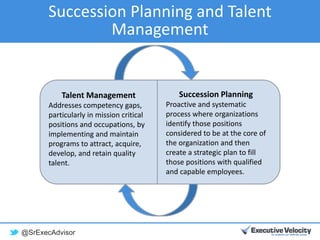
Succession Planning and Talent
Management
Succession Planning
Proactive and systematic
process where organizations
identify those positions
considered to be at the core of
the organization and then
create a strategic plan to fill
those positions with qualified
and capable employees.
Talent Management
Addresses competency gaps,
particularly in mission critical
positions and occupations, by
implementing and maintain
programs to attract, acquire,
develop, and retain quality
talent.
@SrExecAdvisor
Succession Plan
A systematic approach to ensuring continuity
of leadership, knowledge, and expertise
within an organization by developing
employees and recruiting new talent to meet
the future needs of the organization.
@SrExecAdvisor
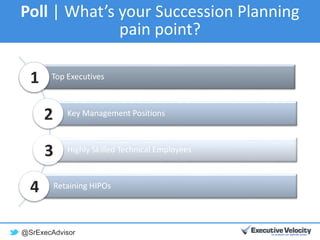
Top Executives
Key Management Positions
Highly Skilled Technical Employees
Retaining HIPOs
1
2
3
4
Poll | What’s your Succession Planning
pain point?
@SrExecAdvisor
Why a Succession Plan?
@SrExecAdvisor
Why a Succession Plan?
• CEOs and corporate boards rate succession planning as the third most
important issue, after financial results and strategic planning (Korn
Ferry Survey)
• Organizational success depends on having the right people in the right
positions at the right times to achieve goals and objectives.
• It is part of your risk management strategy for unexpected turnover
• Succession plans create a roadmap for developing others to take on
new responsibilities when change occurs internally or externally.
• Engages high potentials and increases retention rates of top
performers.
@SrExecAdvisor
Common Myths
• Exit planning and succession planning are done
concurrently
• Succession planning is a single occurrence
• Succession planning is a single-person process
• Successors have to be ready now
• External candidates are more qualified
• No need to look externally, you have what you
need internally
@SrExecAdvisor
Models of Succession Plans
@SrExecAdvisor
Succession Plan Models
• The “Hope” Model
• The “Nominal” Model
• The ”Robust” Model
@SrExecAdvisor
“Hope” Model
Wait until a vacancy occurs and HOPE there
is someone suitable to recruit into the
position.
- Can take up to 12 months for an external
hire becomes fully productive depending on
position
- Up to 30% failure rate
@SrExecAdvisor
“Nominal” Model
• Identify 1-2 people who can step into each of the key
roles at short notice if required
• Low cost, quick fill
• Candidates may not be suited for next step
• Little development of successors
@SrExecAdvisor
“Robust” Model
• Identify a group of talent that all have potential to be
promoted to various levels (High Potential Pool)
• Assess abilities attitude, skills and identify development
needs
• Develop the group of High Potentials which improves current
performance, motivates and engages them to prepare for
next step.
• Strategic, long term view of talent
• Leadership Pipeline ready for the unexpected, risk
management
@SrExecAdvisor
Robust Model for Succession Planning
@SrExecAdvisor
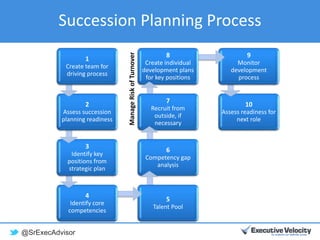
Succession Planning Process
1
Create team for
driving process
2
Assess succession
planning readiness
3
Identify key
positions from
strategic plan
4
Identify core
competencies
5
Talent Pool
6
Competency gap
analysis
7
Recruit from
outside, if
necessary
8
Create individual
development plans
for key positions
9
Monitor
development
process
10
Assess readiness for
next role
ManageRiskofTurnover
@SrExecAdvisor
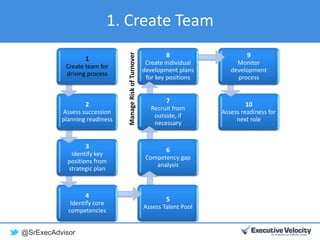
1. Create Team
1
Create team for
driving process
2
Assess succession
planning readiness
3
Identify key
positions from
strategic plan
4
Identify core
competencies
5
Assess Talent Pool
6
Competency gap
analysis
7
Recruit from
outside, if
necessary
8
Create individual
development plans
for key positions
9
Monitor
development
process
10
Assess readiness for
next role
ManageRiskofTurnover
@SrExecAdvisor
Who should be part of Succession
Planning Process?
• C Suite
• Managers
• Supervisors
• Human Resources
• Talent Management
@SrExecAdvisor
Are you Ready for Succession
Planning?
@SrExecAdvisor
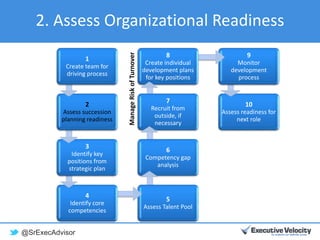
2. Assess Organizational Readiness
1
Create team for
driving process
2
Assess succession
planning readiness
3
Identify key
positions from
strategic plan
4
Identify core
competencies
5
Assess Talent Pool
6
Competency gap
analysis
7
Recruit from
outside, if
necessary
8
Create individual
development plans
for key positions
9
Monitor
development
process
10
Assess readiness for
next role
ManageRiskofTurnover
@SrExecAdvisor
Assessing Readiness
• Organizational Infrastructure
• Organizational Key Roles
• Competency Model
• Assessment Process for High Potentials
• Development Process
• Support of Succession Plan
@SrExecAdvisor
Exercise
@SrExecAdvisor
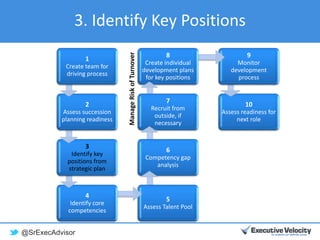
3. Identify Key Positions
1
Create team for
driving process
2
Assess succession
planning readiness
3
Identify key
positions from
strategic plan
4
Identify core
competencies
5
Assess Talent Pool
6
Competency gap
analysis
7
Recruit from
outside, if
necessary
8
Create individual
development plans
for key positions
9
Monitor
development
process
10
Assess readiness for
next role
ManageRiskofTurnover
@SrExecAdvisor
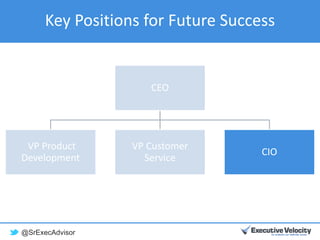
Key Positions for Future Success
• Review Strategic Plan and identify those
positions that will be critical to success
• Positions currently filled
• New Positions
@SrExecAdvisor
Key Positions for Future Success
CEO
VP Product
Development
VP Customer
Service
CIO
@SrExecAdvisor
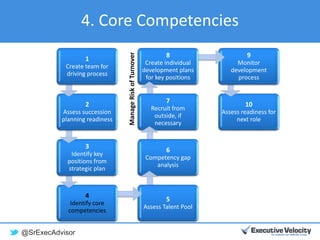
4. Core Competencies
1
Create team for
driving process
2
Assess succession
planning readiness
3
Identify key
positions from
strategic plan
4
Identify core
competencies
5
Assess Talent Pool
6
Competency gap
analysis
7
Recruit from
outside, if
necessary
8
Create individual
development plans
for key positions
9
Monitor
development
process
10
Assess readiness for
next role
ManageRiskofTurnover
@SrExecAdvisor
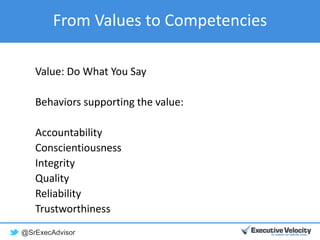
From Values to Competencies
Value: Do What You Say
Behaviors supporting the value:
Accountability
Conscientiousness
Integrity
Quality
Reliability
Trustworthiness
@SrExecAdvisor
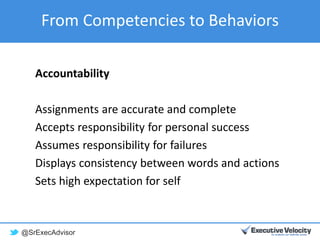
From Competencies to Behaviors
Accountability
Assignments are accurate and complete
Accepts responsibility for personal success
Assumes responsibility for failures
Displays consistency between words and actions
Sets high expectation for self
@SrExecAdvisor
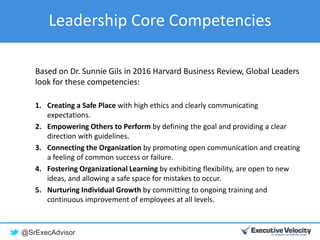
Leadership Core Competencies
Based on Dr. Sunnie Gils in 2016 Harvard Business Review, Global Leaders
look for these competencies:
1. Creating a Safe Place with high ethics and clearly communicating
expectations.
2. Empowering Others to Perform by defining the goal and providing a clear
direction with guidelines.
3. Connecting the Organization by promoting open communication and creating
a feeling of common success or failure.
4. Fostering Organizational Learning by exhibiting flexibility, are open to new
ideas, and allowing a safe space for mistakes to occur.
5. Nurturing Individual Growth by committing to ongoing training and
continuous improvement of employees at all levels.
@SrExecAdvisor
How capable is your talent?
@SrExecAdvisor
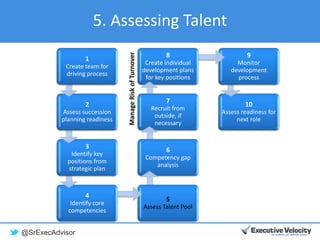
5. Assessing Talent
1
Create team for
driving process
2
Assess succession
planning readiness
3
Identify key
positions from
strategic plan
4
Identify core
competencies
5
Assess Talent Pool
6
Competency gap
analysis
7
Recruit from
outside, if
necessary
8
Create individual
development plans
for key positions
9
Monitor
development
process
10
Assess readiness for
next role
ManageRiskofTurnover
@SrExecAdvisor
Potential vs Performance
@SrExecAdvisor
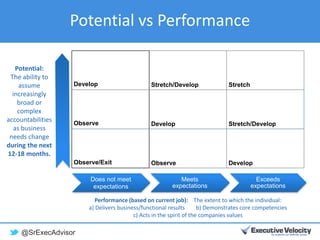
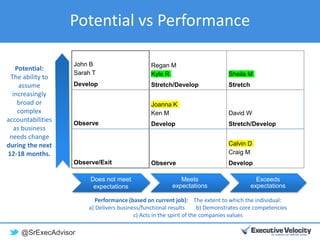
Potential vs Performance
Develop Stretch/Develop Stretch
Observe Develop Stretch/Develop
Observe/Exit Observe Develop
Does not meet
expectations
Meets
expectations
Exceeds
expectations
Potential:
The ability to
assume
increasingly
broad or
complex
accountabilities
as business
needs change
during the next
12-18 months.
Performance (based on current job): The extent to which the individual:
a) Delivers business/functional results b) Demonstrates core competencies
c) Acts in the spirit of the companies values
@SrExecAdvisor
Identifying Potential
• Have a mutual understanding of potential in the
organization
• Address biases and prejudices
• Cast a wide net at lower levels in the organization
• Allow for self nomination
@SrExecAdvisor
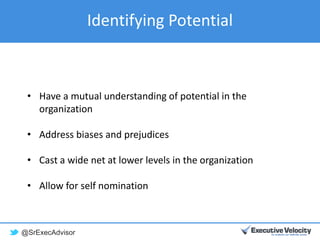
Identifying Potential
@SrExecAdvisor
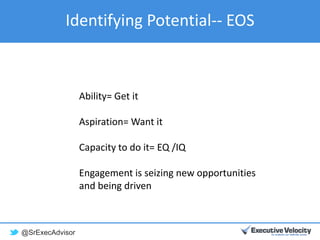
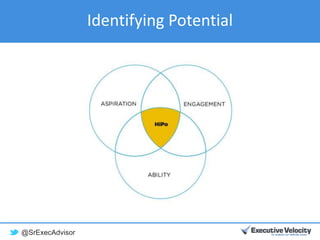
Identifying Potential-- EOS
Ability= Get it
Aspiration= Want it
Capacity to do it= EQ /IQ
Engagement is seizing new opportunities
and being driven
@SrExecAdvisor
Exercise
@SrExecAdvisor
360 Assessments
• Provides feedback from multiple raters
• Multiple raters decrease performance feedback bias and
provide a more balanced view of performance
• Increases self awareness:
– Uncovers blindspots
– Leverages strengths
• Used as a benchmark in an employee’s development plan
and/or coaching NOT as part of performance reviews
@SrExecAdvisor
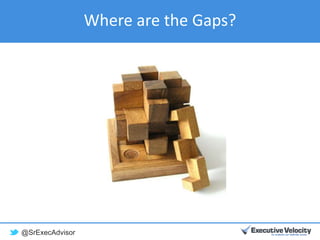
Where are the Gaps?
@SrExecAdvisor
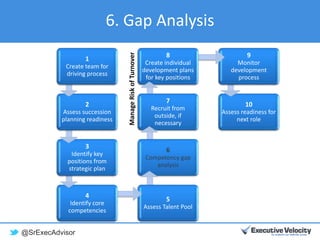
6. Gap Analysis
1
Create team for
driving process
2
Assess succession
planning readiness
3
Identify key
positions from
strategic plan
4
Identify core
competencies
5
Assess Talent Pool
6
Competency gap
analysis
7
Recruit from
outside, if
necessary
8
Create individual
development plans
for key positions
9
Monitor
development
process
10
Assess readiness for
next role
ManageRiskofTurnover
@SrExecAdvisor
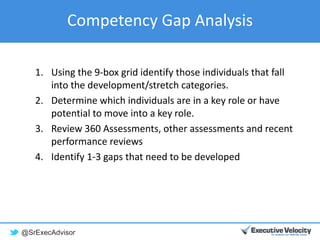
Competency Gap Analysis
1. Using the 9-box grid identify those individuals that fall
into the development/stretch categories.
2. Determine which individuals are in a key role or have
potential to move into a key role.
3. Review 360 Assessments, other assessments and recent
performance reviews
4. Identify 1-3 gaps that need to be developed
@SrExecAdvisor
Potential vs Performance
John B
Sarah T
Develop
Regan M
Kyle R
Stretch/Develop
Sheila M
Stretch
Observe
Joanna K
Ken M
Develop
David W
Stretch/Develop
Observe/Exit Observe
Calvin D
Craig M
Develop
Does not meet
expectations
Meets
expectations
Exceeds
expectations
Potential:
The ability to
assume
increasingly
broad or
complex
accountabilities
as business
needs change
during the next
12-18 months.
Performance (based on current job): The extent to which the individual:
a) Delivers business/functional results b) Demonstrates core competencies
c) Acts in the spirit of the companies values
@SrExecAdvisor
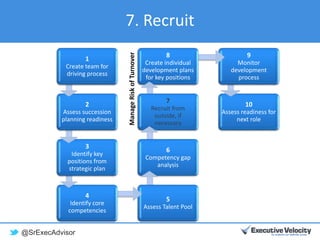
7. Recruit
1
Create team for
driving process
2
Assess succession
planning readiness
3
Identify key
positions from
strategic plan
4
Identify core
competencies
5
Assess Talent Pool
6
Competency gap
analysis
7
Recruit from
outside, if
necessary
8
Create individual
development plans
for key positions
9
Monitor
development
process
10
Assess readiness for
next role
ManageRiskofTurnover
@SrExecAdvisor
How do you Fill the Gaps?
@SrExecAdvisor
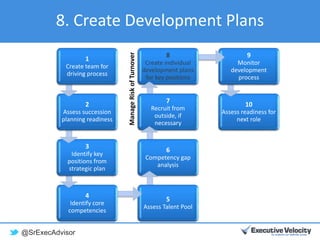
8. Create Development Plans
1
Create team for
driving process
2
Assess succession
planning readiness
3
Identify key
positions from
strategic plan
4
Identify core
competencies
5
Assess Talent Pool
6
Competency gap
analysis
7
Recruit from
outside, if
necessary
8
Create individual
development plans
for key positions
9
Monitor
development
process
10
Assess readiness for
next role
ManageRiskofTurnover
@SrExecAdvisor
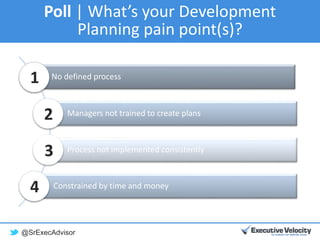
No defined process
Managers not trained to create plans
Process not implemented consistently
Constrained by time and money
1
2
3
4
Poll | What’s your Development
Planning pain point(s)?
@SrExecAdvisor
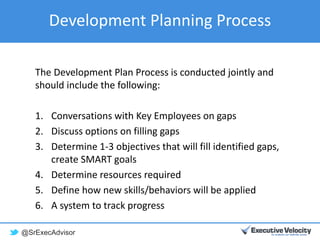
Development Planning Process
The Development Plan Process is conducted jointly and
should include the following:
1. Conversations with Key Employees on gaps
2. Discuss options on filling gaps
3. Determine 1-3 objectives that will fill identified gaps,
create SMART goals
4. Determine resources required
5. Define how new skills/behaviors will be applied
6. A system to track progress
@SrExecAdvisor
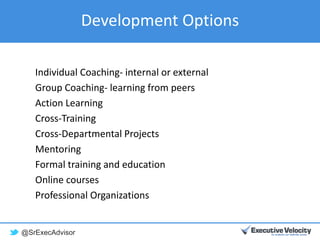
Development Options
Individual Coaching- internal or external
Group Coaching- learning from peers
Action Learning
Cross-Training
Cross-Departmental Projects
Mentoring
Formal training and education
Online courses
Professional Organizations
@SrExecAdvisor
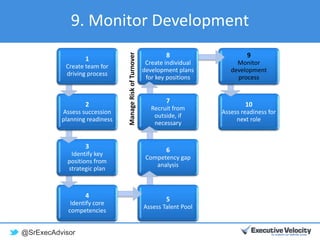
9. Monitor Development
1
Create team for
driving process
2
Assess succession
planning readiness
3
Identify key
positions from
strategic plan
4
Identify core
competencies
5
Assess Talent Pool
6
Competency gap
analysis
7
Recruit from
outside, if
necessary
8
Create individual
development plans
for key positions
9
Monitor
development
process
10
Assess readiness for
next role
ManageRiskofTurnover
@SrExecAdvisor
EOS Quarterly Conversations
What’s Working
What’s Not Working
**Development Updates**
@SrExecAdvisor
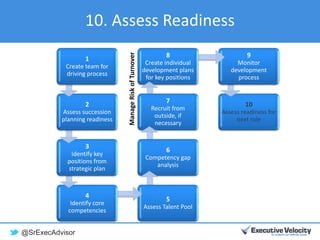
10. Assess Readiness
1
Create team for
driving process
2
Assess succession
planning readiness
3
Identify key
positions from
strategic plan
4
Identify core
competencies
5
Assess Talent Pool
6
Competency gap
analysis
7
Recruit from
outside, if
necessary
8
Create individual
development plans
for key positions
9
Monitor
development
process
10
Assess readiness for
next role
ManageRiskofTurnover
@SrExecAdvisor
Rapid Recall
@SrExecAdvisor
7 Steps to Succession Planning Success
1. Identify your Succession Planning Team
2. Have each team member complete the Succession Planning Assessment
3. Address the low hanging fruit first.
4. Identify key positions to support your strategic plan
5. Use the 9 Box Grid to evaluate employees in the key positions first and then
evaluate all other employees to identify high potentials
6. Create development plans to prepare for future roles and responsibilities
7. Review development progress on a quarterly basis and succession plan annually
@SrExecAdvisor
Bench Strength|
Robert Barner(2006)
Executive Velocity
Website, Resources
Core Leadership Competencies
Organizational Succession
Planning| www.executive-
velocity.com/downloads-
login/
Resources | Books & Articles
@SrExecAdvisor
Beth Miller
beth.miller@executive-velocity.com
404.451.3726
www.betharmknechtmiller.com

Succession planning workshop

  • 1.
    @SrExecAdvisor Beth Miller, CMC SuccessionPlanning Ensuring Continuity of Leadership and Expertise
  • 2.
    @SrExecAdvisor Agenda Why Succession Planning? Preparingfor the Plan The Process Assessing and Developing Talent Creating and Implementing Next Steps
  • 3.
  • 4.
    @SrExecAdvisor Succession Planning andTalent Management Succession Planning Proactive and systematic process where organizations identify those positions considered to be at the core of the organization and then create a strategic plan to fill those positions with qualified and capable employees. Talent Management Addresses competency gaps, particularly in mission critical positions and occupations, by implementing and maintain programs to attract, acquire, develop, and retain quality talent.
  • 5.
    @SrExecAdvisor Succession Plan A systematicapproach to ensuring continuity of leadership, knowledge, and expertise within an organization by developing employees and recruiting new talent to meet the future needs of the organization.
  • 6.
    @SrExecAdvisor Top Executives Key ManagementPositions Highly Skilled Technical Employees Retaining HIPOs 1 2 3 4 Poll | What’s your Succession Planning pain point?
  • 7.
  • 8.
    @SrExecAdvisor Why a SuccessionPlan? • CEOs and corporate boards rate succession planning as the third most important issue, after financial results and strategic planning (Korn Ferry Survey) • Organizational success depends on having the right people in the right positions at the right times to achieve goals and objectives. • It is part of your risk management strategy for unexpected turnover • Succession plans create a roadmap for developing others to take on new responsibilities when change occurs internally or externally. • Engages high potentials and increases retention rates of top performers.
  • 9.
    @SrExecAdvisor Common Myths • Exitplanning and succession planning are done concurrently • Succession planning is a single occurrence • Succession planning is a single-person process • Successors have to be ready now • External candidates are more qualified • No need to look externally, you have what you need internally
  • 10.
  • 11.
    @SrExecAdvisor Succession Plan Models •The “Hope” Model • The “Nominal” Model • The ”Robust” Model
  • 12.
    @SrExecAdvisor “Hope” Model Wait untila vacancy occurs and HOPE there is someone suitable to recruit into the position. - Can take up to 12 months for an external hire becomes fully productive depending on position - Up to 30% failure rate
  • 13.
    @SrExecAdvisor “Nominal” Model • Identify1-2 people who can step into each of the key roles at short notice if required • Low cost, quick fill • Candidates may not be suited for next step • Little development of successors
  • 14.
    @SrExecAdvisor “Robust” Model • Identifya group of talent that all have potential to be promoted to various levels (High Potential Pool) • Assess abilities attitude, skills and identify development needs • Develop the group of High Potentials which improves current performance, motivates and engages them to prepare for next step. • Strategic, long term view of talent • Leadership Pipeline ready for the unexpected, risk management
  • 15.
  • 16.
    @SrExecAdvisor Succession Planning Process 1 Createteam for driving process 2 Assess succession planning readiness 3 Identify key positions from strategic plan 4 Identify core competencies 5 Talent Pool 6 Competency gap analysis 7 Recruit from outside, if necessary 8 Create individual development plans for key positions 9 Monitor development process 10 Assess readiness for next role ManageRiskofTurnover
  • 17.
    @SrExecAdvisor 1. Create Team 1 Createteam for driving process 2 Assess succession planning readiness 3 Identify key positions from strategic plan 4 Identify core competencies 5 Assess Talent Pool 6 Competency gap analysis 7 Recruit from outside, if necessary 8 Create individual development plans for key positions 9 Monitor development process 10 Assess readiness for next role ManageRiskofTurnover
  • 18.
    @SrExecAdvisor Who should bepart of Succession Planning Process? • C Suite • Managers • Supervisors • Human Resources • Talent Management
  • 19.
    @SrExecAdvisor Are you Readyfor Succession Planning?
  • 20.
    @SrExecAdvisor 2. Assess OrganizationalReadiness 1 Create team for driving process 2 Assess succession planning readiness 3 Identify key positions from strategic plan 4 Identify core competencies 5 Assess Talent Pool 6 Competency gap analysis 7 Recruit from outside, if necessary 8 Create individual development plans for key positions 9 Monitor development process 10 Assess readiness for next role ManageRiskofTurnover
  • 21.
    @SrExecAdvisor Assessing Readiness • OrganizationalInfrastructure • Organizational Key Roles • Competency Model • Assessment Process for High Potentials • Development Process • Support of Succession Plan
  • 22.
  • 23.
    @SrExecAdvisor 3. Identify KeyPositions 1 Create team for driving process 2 Assess succession planning readiness 3 Identify key positions from strategic plan 4 Identify core competencies 5 Assess Talent Pool 6 Competency gap analysis 7 Recruit from outside, if necessary 8 Create individual development plans for key positions 9 Monitor development process 10 Assess readiness for next role ManageRiskofTurnover
  • 24.
    @SrExecAdvisor Key Positions forFuture Success • Review Strategic Plan and identify those positions that will be critical to success • Positions currently filled • New Positions
  • 25.
    @SrExecAdvisor Key Positions forFuture Success CEO VP Product Development VP Customer Service CIO
  • 26.
    @SrExecAdvisor 4. Core Competencies 1 Createteam for driving process 2 Assess succession planning readiness 3 Identify key positions from strategic plan 4 Identify core competencies 5 Assess Talent Pool 6 Competency gap analysis 7 Recruit from outside, if necessary 8 Create individual development plans for key positions 9 Monitor development process 10 Assess readiness for next role ManageRiskofTurnover
  • 27.
    @SrExecAdvisor From Values toCompetencies Value: Do What You Say Behaviors supporting the value: Accountability Conscientiousness Integrity Quality Reliability Trustworthiness
  • 28.
    @SrExecAdvisor From Competencies toBehaviors Accountability Assignments are accurate and complete Accepts responsibility for personal success Assumes responsibility for failures Displays consistency between words and actions Sets high expectation for self
  • 29.
    @SrExecAdvisor Leadership Core Competencies Basedon Dr. Sunnie Gils in 2016 Harvard Business Review, Global Leaders look for these competencies: 1. Creating a Safe Place with high ethics and clearly communicating expectations. 2. Empowering Others to Perform by defining the goal and providing a clear direction with guidelines. 3. Connecting the Organization by promoting open communication and creating a feeling of common success or failure. 4. Fostering Organizational Learning by exhibiting flexibility, are open to new ideas, and allowing a safe space for mistakes to occur. 5. Nurturing Individual Growth by committing to ongoing training and continuous improvement of employees at all levels.
  • 30.
  • 31.
    @SrExecAdvisor 5. Assessing Talent 1 Createteam for driving process 2 Assess succession planning readiness 3 Identify key positions from strategic plan 4 Identify core competencies 5 Assess Talent Pool 6 Competency gap analysis 7 Recruit from outside, if necessary 8 Create individual development plans for key positions 9 Monitor development process 10 Assess readiness for next role ManageRiskofTurnover
  • 32.
  • 33.
    @SrExecAdvisor Potential vs Performance DevelopStretch/Develop Stretch Observe Develop Stretch/Develop Observe/Exit Observe Develop Does not meet expectations Meets expectations Exceeds expectations Potential: The ability to assume increasingly broad or complex accountabilities as business needs change during the next 12-18 months. Performance (based on current job): The extent to which the individual: a) Delivers business/functional results b) Demonstrates core competencies c) Acts in the spirit of the companies values
  • 34.
    @SrExecAdvisor Identifying Potential • Havea mutual understanding of potential in the organization • Address biases and prejudices • Cast a wide net at lower levels in the organization • Allow for self nomination
  • 35.
  • 36.
    @SrExecAdvisor Identifying Potential-- EOS Ability=Get it Aspiration= Want it Capacity to do it= EQ /IQ Engagement is seizing new opportunities and being driven
  • 37.
  • 38.
    @SrExecAdvisor 360 Assessments • Providesfeedback from multiple raters • Multiple raters decrease performance feedback bias and provide a more balanced view of performance • Increases self awareness: – Uncovers blindspots – Leverages strengths • Used as a benchmark in an employee’s development plan and/or coaching NOT as part of performance reviews
  • 39.
  • 40.
    @SrExecAdvisor 6. Gap Analysis 1 Createteam for driving process 2 Assess succession planning readiness 3 Identify key positions from strategic plan 4 Identify core competencies 5 Assess Talent Pool 6 Competency gap analysis 7 Recruit from outside, if necessary 8 Create individual development plans for key positions 9 Monitor development process 10 Assess readiness for next role ManageRiskofTurnover
  • 41.
    @SrExecAdvisor Competency Gap Analysis 1.Using the 9-box grid identify those individuals that fall into the development/stretch categories. 2. Determine which individuals are in a key role or have potential to move into a key role. 3. Review 360 Assessments, other assessments and recent performance reviews 4. Identify 1-3 gaps that need to be developed
  • 42.
    @SrExecAdvisor Potential vs Performance JohnB Sarah T Develop Regan M Kyle R Stretch/Develop Sheila M Stretch Observe Joanna K Ken M Develop David W Stretch/Develop Observe/Exit Observe Calvin D Craig M Develop Does not meet expectations Meets expectations Exceeds expectations Potential: The ability to assume increasingly broad or complex accountabilities as business needs change during the next 12-18 months. Performance (based on current job): The extent to which the individual: a) Delivers business/functional results b) Demonstrates core competencies c) Acts in the spirit of the companies values
  • 43.
    @SrExecAdvisor 7. Recruit 1 Create teamfor driving process 2 Assess succession planning readiness 3 Identify key positions from strategic plan 4 Identify core competencies 5 Assess Talent Pool 6 Competency gap analysis 7 Recruit from outside, if necessary 8 Create individual development plans for key positions 9 Monitor development process 10 Assess readiness for next role ManageRiskofTurnover
  • 44.
  • 45.
    @SrExecAdvisor 8. Create DevelopmentPlans 1 Create team for driving process 2 Assess succession planning readiness 3 Identify key positions from strategic plan 4 Identify core competencies 5 Assess Talent Pool 6 Competency gap analysis 7 Recruit from outside, if necessary 8 Create individual development plans for key positions 9 Monitor development process 10 Assess readiness for next role ManageRiskofTurnover
  • 46.
    @SrExecAdvisor No defined process Managersnot trained to create plans Process not implemented consistently Constrained by time and money 1 2 3 4 Poll | What’s your Development Planning pain point(s)?
  • 47.
    @SrExecAdvisor Development Planning Process TheDevelopment Plan Process is conducted jointly and should include the following: 1. Conversations with Key Employees on gaps 2. Discuss options on filling gaps 3. Determine 1-3 objectives that will fill identified gaps, create SMART goals 4. Determine resources required 5. Define how new skills/behaviors will be applied 6. A system to track progress
  • 48.
    @SrExecAdvisor Development Options Individual Coaching-internal or external Group Coaching- learning from peers Action Learning Cross-Training Cross-Departmental Projects Mentoring Formal training and education Online courses Professional Organizations
  • 49.
    @SrExecAdvisor 9. Monitor Development 1 Createteam for driving process 2 Assess succession planning readiness 3 Identify key positions from strategic plan 4 Identify core competencies 5 Assess Talent Pool 6 Competency gap analysis 7 Recruit from outside, if necessary 8 Create individual development plans for key positions 9 Monitor development process 10 Assess readiness for next role ManageRiskofTurnover
  • 50.
    @SrExecAdvisor EOS Quarterly Conversations What’sWorking What’s Not Working **Development Updates**
  • 51.
    @SrExecAdvisor 10. Assess Readiness 1 Createteam for driving process 2 Assess succession planning readiness 3 Identify key positions from strategic plan 4 Identify core competencies 5 Assess Talent Pool 6 Competency gap analysis 7 Recruit from outside, if necessary 8 Create individual development plans for key positions 9 Monitor development process 10 Assess readiness for next role ManageRiskofTurnover
  • 52.
  • 53.
    @SrExecAdvisor 7 Steps toSuccession Planning Success 1. Identify your Succession Planning Team 2. Have each team member complete the Succession Planning Assessment 3. Address the low hanging fruit first. 4. Identify key positions to support your strategic plan 5. Use the 9 Box Grid to evaluate employees in the key positions first and then evaluate all other employees to identify high potentials 6. Create development plans to prepare for future roles and responsibilities 7. Review development progress on a quarterly basis and succession plan annually
  • 54.
    @SrExecAdvisor Bench Strength| Robert Barner(2006) ExecutiveVelocity Website, Resources Core Leadership Competencies Organizational Succession Planning| www.executive- velocity.com/downloads- login/ Resources | Books & Articles
  • 55.

Editor's Notes

  • #8 What percent of your employees will retire in the next 5-7 years? What percent of employees are looking for another job?
  • #23 Succession Planning Exercise ---infrastructure and development process self evaluate Group Discussion How many rated all 8 statements a 3 or 4? 6 or more rated 3 or 4? What evidence is missing? Several areas of management training
  • #27 Review your values, People Analyzer from EOS…what behaviors support those values? Determine additional competencies unique to positions
  • #29 Get a volunteer to do this exercise with one of their values A comprehensive list of over 50 leadership competencies …get card and I will send…. great tool for hiring as well
  • #34 What boxes would be your biggest risks? Why develop someone with low potential? Development vs Job Shift HANDOUT OF TALENT REVIEW, to use effectively you need clear job descriptions, core competencies and success metrics
  • #36 Future Focused
  • #37 Today Focused
  • #38 9 Box Grid template- plot one key employee Who identified a single contributor? What biases may be impacting your assessment? How does your definition of potential differ from others on your team? Group Discussion
  • #39 CEB report just 1 out of 6 high performance employees display attributes that indicate potential 360 Assessments are generally used to measure
  • #42 Who does this work? Should be a group effort to decrease bias.
  • #43 Green Key role Yellow Potential Key Role
  • #44 Start early and be creative about sourcing, use CertiPay as an example
  • #48 How many of you have a defined development planning process that all managers are trained to deliver? *Training and Development Methods and Techniques to fill GAPS Action Learning
  • #50 EOS Quarterly Conversations- What’s working and not working
  • #54 NEED A SUCCESSION PLAN TEMPLATE