APPLE Inc.   “THINK DIFFERENT” PRESENTED BY: ROHIT CHANDRA SIMRANJEET SINGH  RAJAN MITTAL  PARMEET SINGH MANVIR SINGH LMT School Of Management PRESENTED TO: Prof. R.K. DE
CONTENTS HISTORY COMPETITIVE ENVIRONMENT GROWTH CHANGES AT THE HELM DECLINE OF APPLE APPLE’s STRATEGY CORE COMPETENCIES SWOT CONCLUSION
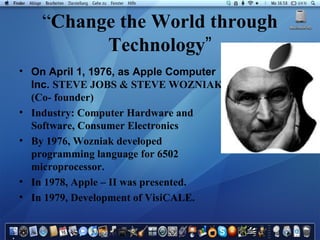
“ Change the World through Technology ” On April 1, 1976, as Apple Computer Inc.  STEVE JOBS & STEVE WOZNIAK (Co- founder) Industry: Computer Hardware and Software, Consumer Electronics By 1976, Wozniak developed programming language for 6502 microprocessor. In 1978, Apple – II was presented. In 1979, Development of VisiCALE.
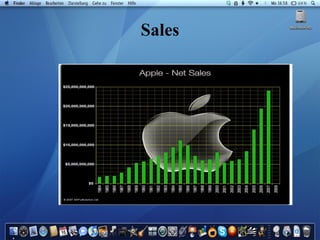
Sales
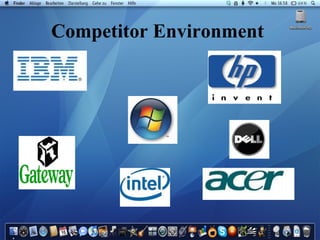
Competitor Environment  High Competition Share of Dell and HP Microsoft and Intel-Leaders of Software CE Industry- Sony, Nokia, Samsung, Cisco, Motorola
Competitor Environment
GROWTH In1980, 25000 Apple II was sold & largest stock offering. In 1982, Huge infrastructure of retail & touch $1B. Focus on dealers. Launched program “Kids Can’t Wait”. New computer models II-e & LISA GUI , interface between People & Machine.
CHANGES AT HELM In 1983 , growing invincibly & production demands was high. They move to STEWARDSHIP MANAGEMENT STYLE. John Sculley was elected president & CEO in 1983. In 1985 , Jobs ousted from the board. Reestablished Apple as pioneer in GUI. Unique features for PC & captured the attention of users.
APPLE UNDER SCULLEY   Macintosh less expensive than LISA. IN 1985, departure of Jobs & Wozniak. IBM forceful enter into PC market & apple demand was depressed. Reengineering the organization in 1986. Vision was to target office computing. Sales were $1.96B to $5.3B in 1989.
IBM  clones, led to slow down of market share growth. Apple was decentralized in 1988. Separate division for product development & manufacturing  Change in organizational structure cause problems between marketing and R&D. Process improvement initiatives Smart manufacturing and geared the company to a market pull then technology push.
DECLINE OF APPLE   Refused to license its OS to other computer manufacturer. Technology proprietary and exploit it only in its own products. Microsoft with windows, diffuses its technology by putting on IBM PC. Finally realized its mistake of superior technology. In 1991, participate in IBM/Motorola/Apple consortium.
Contd. Five distinct initiatives: Better integration with IBM compatibles New family of Reduced instruction set computers (RISCs) Open system environment known  as AIX. Multimedia joint venture Next generation of OS software based on object oriented programming.
Contd.. Aim was to break Intel & Microsoft strong hold on PC market.  In 1993, Michael Spindler took over as CEO & aggressive actions was taken. Cost cutting measures: Laying off 2500 workers. Freezing executive salaries Canning some projects Reducing R&D by $100M a  year.
Contd. In 1996, Gilbert Amelio, replaced Spindler as CEO. Second Quarter loss was $740M. In 1997, stock fell to 12 year low Jobs was brought back as an advisor. He declined as CEO & remain CEO at PIXAR , a new hi-tech venture.
Apple employs a Product Differentiation Drawbacks as a result of their strategy include: Not appealing to Price Conscious Consumers  Risk of Imitation by Competitors Risk of Change in Customer Taste Apple’s Strategy
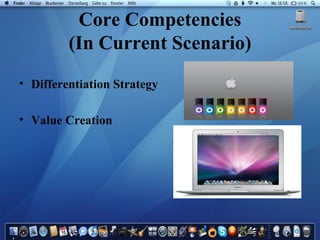
Differentiation Strategy Value Creation Core Competencies (In Current Scenario)
Differentiation Strategy Unique Features and characteristics Commands Premium Price High Customer Service Superior Quality Prestige Rapid Innovation Sustainable Competitive Advantage
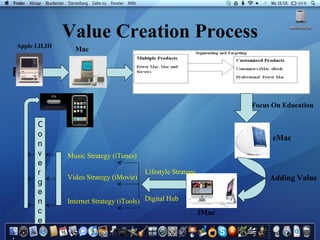
FF  Value Creation Process Focus On Education eMac Adding Value iMac Lifestyle Strategy Digital Hub Music Strategy (iTunes) Video Strategy (iMovie) Internet Strategy (iTools) Convergence Apple I,II,III Mac
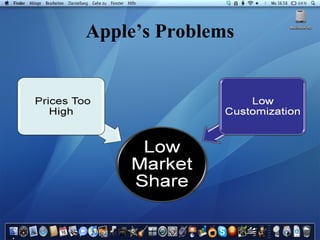
Apple’s Problems
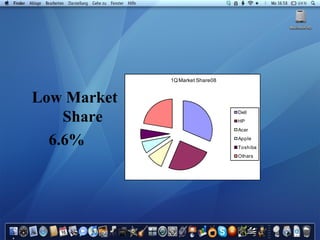
Low Market  Share 6.6%
Branding  Innovation Differentiated Product Superior Quality Retail Strategy Strengths
High Price Proprietary System Niche Market, Less Penetration Cannibalization Weaknesses
Opportunities   Fast growing Industry (Customer Electronics Industry) Technological Innovations Extend new products to loyal customers High Potential music phone market Strategic Alliances  
Threats   Extensive Competition  Substitute Products Low prices of Competitors Technical Advancements Economy downfall
Free flow of information permits innovation. Venture Capital as strong Catalyst. Synergy between an inventor & Entrepreneur. Packaging leads to success of product. Worked feverishly to project this philosophy. Incremental Innovation need to be managed with same as vigor as radical innovation. Importance of forming alliances with competitor. Decided to license OS. Attempted to reorganized R&D activities several times CONLUSION
THANK  YOU LMT School Of Mangement

APPLE INC.

  • 1.
    APPLE Inc. “THINK DIFFERENT” PRESENTED BY: ROHIT CHANDRA SIMRANJEET SINGH RAJAN MITTAL PARMEET SINGH MANVIR SINGH LMT School Of Management PRESENTED TO: Prof. R.K. DE
  • 2.
    CONTENTS HISTORY COMPETITIVEENVIRONMENT GROWTH CHANGES AT THE HELM DECLINE OF APPLE APPLE’s STRATEGY CORE COMPETENCIES SWOT CONCLUSION
  • 3.
    “ Change theWorld through Technology ” On April 1, 1976, as Apple Computer Inc. STEVE JOBS & STEVE WOZNIAK (Co- founder) Industry: Computer Hardware and Software, Consumer Electronics By 1976, Wozniak developed programming language for 6502 microprocessor. In 1978, Apple – II was presented. In 1979, Development of VisiCALE.
  • 4.
  • 5.
    Competitor Environment High Competition Share of Dell and HP Microsoft and Intel-Leaders of Software CE Industry- Sony, Nokia, Samsung, Cisco, Motorola
  • 6.
  • 7.
    GROWTH In1980, 25000Apple II was sold & largest stock offering. In 1982, Huge infrastructure of retail & touch $1B. Focus on dealers. Launched program “Kids Can’t Wait”. New computer models II-e & LISA GUI , interface between People & Machine.
  • 8.
    CHANGES AT HELMIn 1983 , growing invincibly & production demands was high. They move to STEWARDSHIP MANAGEMENT STYLE. John Sculley was elected president & CEO in 1983. In 1985 , Jobs ousted from the board. Reestablished Apple as pioneer in GUI. Unique features for PC & captured the attention of users.
  • 9.
    APPLE UNDER SCULLEY Macintosh less expensive than LISA. IN 1985, departure of Jobs & Wozniak. IBM forceful enter into PC market & apple demand was depressed. Reengineering the organization in 1986. Vision was to target office computing. Sales were $1.96B to $5.3B in 1989.
  • 10.
    IBM clones,led to slow down of market share growth. Apple was decentralized in 1988. Separate division for product development & manufacturing Change in organizational structure cause problems between marketing and R&D. Process improvement initiatives Smart manufacturing and geared the company to a market pull then technology push.
  • 11.
    DECLINE OF APPLE Refused to license its OS to other computer manufacturer. Technology proprietary and exploit it only in its own products. Microsoft with windows, diffuses its technology by putting on IBM PC. Finally realized its mistake of superior technology. In 1991, participate in IBM/Motorola/Apple consortium.
  • 12.
    Contd. Five distinctinitiatives: Better integration with IBM compatibles New family of Reduced instruction set computers (RISCs) Open system environment known as AIX. Multimedia joint venture Next generation of OS software based on object oriented programming.
  • 13.
    Contd.. Aim wasto break Intel & Microsoft strong hold on PC market. In 1993, Michael Spindler took over as CEO & aggressive actions was taken. Cost cutting measures: Laying off 2500 workers. Freezing executive salaries Canning some projects Reducing R&D by $100M a year.
  • 14.
    Contd. In 1996,Gilbert Amelio, replaced Spindler as CEO. Second Quarter loss was $740M. In 1997, stock fell to 12 year low Jobs was brought back as an advisor. He declined as CEO & remain CEO at PIXAR , a new hi-tech venture.
  • 15.
    Apple employs aProduct Differentiation Drawbacks as a result of their strategy include: Not appealing to Price Conscious Consumers Risk of Imitation by Competitors Risk of Change in Customer Taste Apple’s Strategy
  • 16.
    Differentiation Strategy ValueCreation Core Competencies (In Current Scenario)
  • 17.
    Differentiation Strategy UniqueFeatures and characteristics Commands Premium Price High Customer Service Superior Quality Prestige Rapid Innovation Sustainable Competitive Advantage
  • 18.
    FF ValueCreation Process Focus On Education eMac Adding Value iMac Lifestyle Strategy Digital Hub Music Strategy (iTunes) Video Strategy (iMovie) Internet Strategy (iTools) Convergence Apple I,II,III Mac
  • 19.
  • 20.
    Low Market Share 6.6%
  • 21.
    Branding InnovationDifferentiated Product Superior Quality Retail Strategy Strengths
  • 22.
    High Price ProprietarySystem Niche Market, Less Penetration Cannibalization Weaknesses
  • 23.
    Opportunities Fast growing Industry (Customer Electronics Industry) Technological Innovations Extend new products to loyal customers High Potential music phone market Strategic Alliances  
  • 24.
    Threats Extensive Competition Substitute Products Low prices of Competitors Technical Advancements Economy downfall
  • 25.
    Free flow ofinformation permits innovation. Venture Capital as strong Catalyst. Synergy between an inventor & Entrepreneur. Packaging leads to success of product. Worked feverishly to project this philosophy. Incremental Innovation need to be managed with same as vigor as radical innovation. Importance of forming alliances with competitor. Decided to license OS. Attempted to reorganized R&D activities several times CONLUSION
  • 26.
    THANK YOULMT School Of Mangement