Lecture 3
Subject-verb Concord II
3.1 Problems of Concord with a
Coordinate Subject
3.2 Problems of Concord with
Expressions of Quantity as Subject
3.3 Other Problems of Subject-verb
Concord
3.1 Problems of Concord with a
Coordinate Subject
I. Coordination with “and” or “both… and”
1. usually treated as plural when it refers to
two or more than two persons / things
2. treated as singular when it refers to only
one person or thing.
The poet and singer has come.
poet and singer
A and B = 2 parts
The A and the B = 2 parts
The A and B=1unit
Determiner
Head
word
Wits and humour abounds in the book.
War and peace is a constant theme in the history.
Truth and honesty is the best policy.
The hustle and bustle of the city life fatigues many people.
Salt and water is also a kind of medicine.
Egg and rice is her usual breakfast.
Wits and humour
War and peace
Truth and honesty
hustle and bustle
Salt and water
Egg and rice
A. 两种抽象的东西
被看作是一个
不可分割的整体
B. 两个名词已构成
一种食品
Observe the Following Sentences:
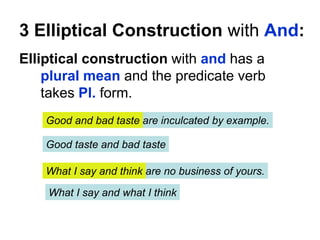
3 Elliptical Construction with And:
Elliptical construction with and has a
plural mean and the predicate verb
takes Pl. form.
Good and bad taste are inculcated by example.
What I say and think are no business of yours.
Good and bad taste
Good taste and bad taste
What I say and what I think
What I say and think
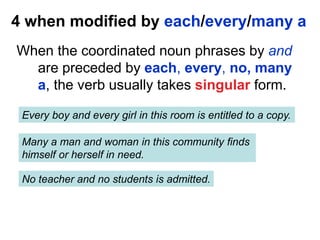
4 when modified by each/every/many a
When the coordinated noun phrases by and
are preceded by each, every, no, many
a, the verb usually takes singular form.
Every boy and every girl in this room is entitled to a copy.
Many a man and woman in this community finds
himself or herself in need.
No teacher and no students is admitted.
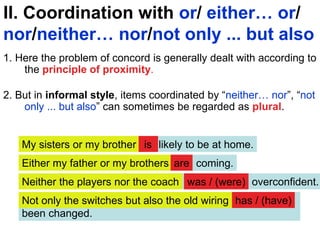
II. Coordination with or/ either… or/
nor/neither… nor/not only ... but also
1. Here the problem of concord is generally dealt with according to
the principle of proximity.
2. But in informal style, items coordinated by “neither… nor”, “not
only ... but also” can sometimes be regarded as plural.
Not only the switches but also the old wiring has / (have)
been changed.
My sisters or my brother is likely to be at home.
Neither the players nor the coach was / (were) overconfident.
My sisters or my brother is
Neither the players nor the coach was / (were)
Not only the switches but also the old wiring has / (have)
Either my father or my brothers are coming.
Either my father or my brothers are
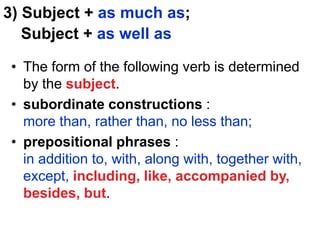
3) Subject + as much as;
Subject + as well as
• The form of the following verb is determined
by the subject.
• subordinate constructions :
more than, rather than, no less than;
• prepositional phrases :
in addition to, with, along with, together with,
except, including, like, accompanied by,
besides, but.
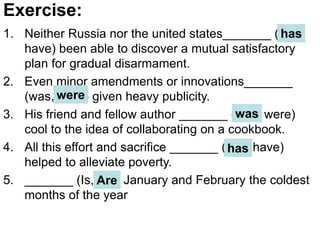
Exercise:
1. Neither Russia nor the united states_______ (has,
have) been able to discover a mutual satisfactory
plan for gradual disarmament.
2. Even minor amendments or innovations_______
(was, were) given heavy publicity.
3. His friend and fellow author _______ (was, were)
cool to the idea of collaborating on a cookbook.
4. All this effort and sacrifice _______ (has, have)
helped to alleviate poverty.
5. _______ (Is, Are) January and February the coldest
months of the year
has
were
was
has
Are
6. In many years of service, neither Philips nor I
_______ (has, have) seen anything like it.
7. It became necessary to involve every man, woman
and child who _______ (was, were) willing to help.
8. Law and order_______ (means, mean) different
things to people with different political opinions.
9. If your wife or husband_______ (is, are) proficient in
English, there are many study courses from which
they can choose.
10. Every change of season, every change of weather,
indeed, every hour of the day, _______(produces,
produce) some change in the hues and shapes of
these mountains.
have
was
means
is
produces
3.2 Problems of Concord with
Expressions of Quantity as Subject
• Quantitative expressions fall into
categories: Definite and Indefinite.
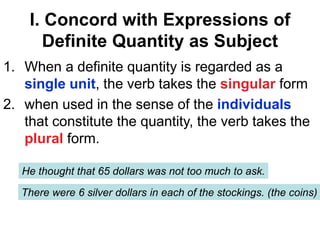
I. Concord with Expressions of
Definite Quantity as Subject
1. When a definite quantity is regarded as a
single unit, the verb takes the singular form
2. when used in the sense of the individuals
that constitute the quantity, the verb takes the
plural form.
There were 6 silver dollars in each of the stockings. (the coins)
He thought that 65 dollars was not too much to ask.
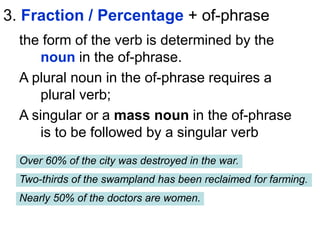
3. Fraction / Percentage + of-phrase
the form of the verb is determined by the
noun in the of-phrase.
A plural noun in the of-phrase requires a
plural verb;
A singular or a mass noun in the of-phrase
is to be followed by a singular verb
Over 60% of the city was destroyed in the war.
Two-thirds of the swampland has been reclaimed for farming.
Nearly 50% of the doctors are women.
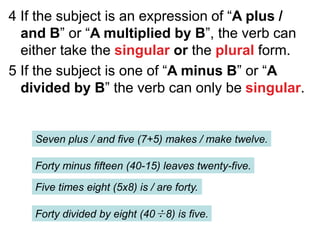
4 If the subject is an expression of “A plus /
and B” or “A multiplied by B”, the verb can
either take the singular or the plural form.
5 If the subject is one of “A minus B” or “A
divided by B” the verb can only be singular.
Seven plus / and five (7+5) makes / make twelve.
Forty minus fifteen (40-15) leaves twenty-five.
Five times eight (5x8) is / are forty.
Forty divided by eight (40÷8) is five.
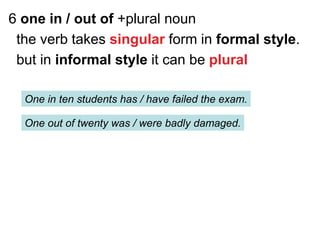
6 one in / out of +plural noun
the verb takes singular form in formal style.
but in informal style it can be plural
One in ten students has / have failed the exam.
One out of twenty was / were badly damaged.
II. Concord with expression of
indefinite quantity as subject
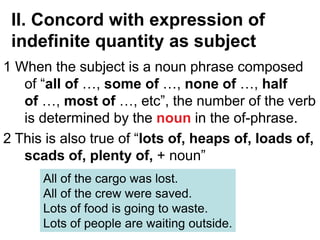
1 When the subject is a noun phrase composed
of “all of …, some of …, none of …, half
of …, most of …, etc”, the number of the verb
is determined by the noun in the of-phrase.
2 This is also true of “lots of, heaps of, loads of,
scads of, plenty of, + noun”
All of the cargo was lost.
All of the crew were saved.
Lots of food is going to waste.
Lots of people are waiting outside.
3 When the subject is a noun preceded by “a
portion of, a series of, a pile of, a panel
of”, the verb invariably takes the singular
form, whatever the forms of the noun.
4 when the subject is a noun, singular or plural,
preceded by “a kind / sort / type of” or by
“this kind / sort / type of”, the verb takes
singular form.
A substantial portion of the reports is missing.
A series of accidents has been reported.
This kind of man annoys me.
That type of car is old-fashioned.
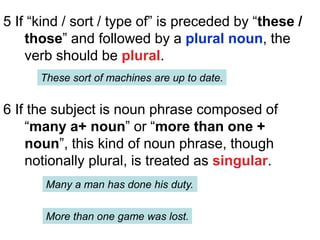
5 If “kind / sort / type of” is preceded by “these /
those” and followed by a plural noun, the
verb should be plural.
These sort of machines are up to date.
6 If the subject is noun phrase composed of
“many a+ noun” or “more than one +
noun”, this kind of noun phrase, though
notionally plural, is treated as singular.
Many a man has done his duty.
More than one game was lost.
7 If the subject is a plural noun preceded by “an
average of/a majority of”, the verb form is
determined by the notion of the noun phrase:
if the noun head is the word
“average/majority” the verb should be
singular; if the head is the plural noun, the
verb should be plural.
An average of 25 applications a month is not unusual.
An average of 25 persons apply each month.
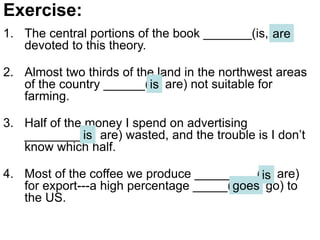
1. The central portions of the book _______(is, are)
devoted to this theory.
2. Almost two thirds of the land in the northwest areas
of the country ______(is, are) not suitable for
farming.
3. Half of the money I spend on advertising
________(is, are) wasted, and the trouble is I don’t
know which half.
4. Most of the coffee we produce _________(is, are)
for export---a high percentage _____(goes, go) to
the US.
Exercise:
are
is
is
is
goes
5. About half of the women in this area _______(is, are)
working-wives. None of them _______(has, have)
much time to do housework.
6. Some of the furniture _______(has, have) been
moved to another room in the house.
7. I’ll keep a third of the money and the rest _______
(is, are) yours.
8. Most of the residents ________(has, have) already
left the island; the rest ________(is, are) preparing
for the typhoon.
are
has have
has
is
have
are
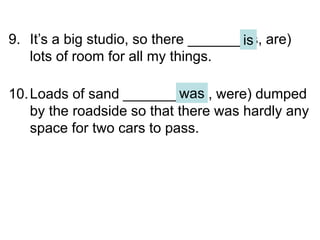
9. It’s a big studio, so there _______(is, are)
lots of room for all my things.
10.Loads of sand _______(was, were) dumped
by the roadside so that there was hardly any
space for two cars to pass.
is
was
3.3 Other Problems of Subject-
verb Concord
I. Problems of concord with a nominal clause as
subject
II. Subject-verb concord with a non-finite clause
as subject
III. Subject-verb concord in relative clauses
IV. Subject-verb concord in cleft-sentences
V. Subject-verb concord in existential sentences
I. Nominal Clause as Subject
1 When the subject is a nominal clause
introduced by what, who, which, how, why,
whether, etc, the verb usually takes the
singular form.
2 but when two or more clauses are coordinated
by and or both…and, a plural verb is required.
What caused the accident is a complete mystery.
What caused the accident and who was responsible for it
remain a mystery to us.
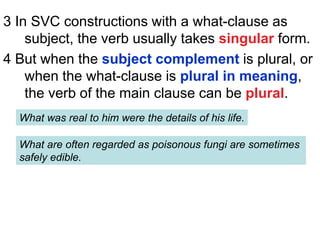
3 In SVC constructions with a what-clause as
subject, the verb usually takes singular form.
4 But when the subject complement is plural, or
when the what-clause is plural in meaning,
the verb of the main clause can be plural.
What was real to him were the details of his life.
What are often regarded as poisonous fungi are sometimes
safely edible.
II. Non-finite Clause as Subject
1 When the subject is a non-finite clause, the verb of
the main clause usually takes the singular form.
2 But when two or more such clauses are coordinated
by and, the verb of the main clause takes the
singular form when the subject refers to one thing,
and the plural form when the subject refers to
separate things.
To climb mountains requires courage.
Playing tennis is a very good exercise.
Reading Ibsen and solving a quadratic equation are entirely
different assignments.
III. Relative Clauses
1. In the construction of “one of +plural noun +
relative clause”, the principle of grammatical
concord is generally observed.
2. Sometimes, especially in British English, in
order to lay emphasis on “one”, the verb can
also take the singular form.
3. When “one” is preceded by “the” or “the only”,
the verb can only be singular.
Joan is one of those people who go out of their way to
be helpful.
Jasper White is one of those rare people who believes in
ancient myths.
He is the only one of those boys who is willing to
take on another assignment.
IV. Cleft-sentences
1. In cleft-sentences, subject-verb concord in
that-/ who-clause is generally determined by
the number of the focal element functioning
as subject in the clause.
2. when the focal element is “I”, the verb to be in
the following who-/ that-clause usually agree
with “I” in both person and number;
It is I who am to blame.
3. If the focal element is “me” instead of “I”, the
verb to be in the following who-/ that-clause
should take the third person singular number.
It is me that is to blame.
V. Existential Sentences
1. In existential sentences, subject-verb concord
is generally determined by the number of the
“notional subject”,
2. But in informal style, especially in spoken
language, the verb often agrees with the
“formal subject” and takes the singular form,
even though the “notional subject” is plural.
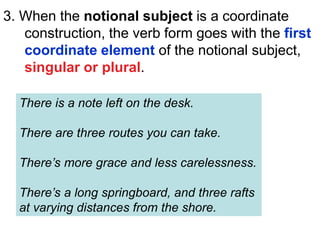
3. When the notional subject is a coordinate
construction, the verb form goes with the first
coordinate element of the notional subject,
singular or plural.
There is a note left on the desk.
There are three routes you can take.
There’s more grace and less carelessness.
There’s a long springboard, and three rafts
at varying distances from the shore.
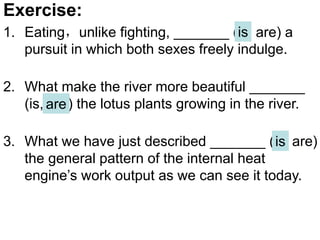
1. Eating,unlike fighting, _______ (is, are) a
pursuit in which both sexes freely indulge.
2. What make the river more beautiful _______
(is, are) the lotus plants growing in the river.
3. What we have just described _______ (is, are)
the general pattern of the internal heat
engine’s work output as we can see it today.
Exercise:
is
are
is
4. Children interfering in their parents’ right to
remarry _______ (has, have) become a
social problem.
5. To go there on Monday _______ (is, are)
pointless---there’s a public holiday.
6. Why he entered the house and how he
managed to get out of it without being seen
by people _______ (remains, remain) a
mystery to us all.
has
is
remain
7. What appear to be disciplinary problems
_______ (is, are) easily solved by very
elementary applied psychology.
8. He’s one of those men who never _______
(cares, care) how they look.
9. There are few things in this world that
_______ (give, gives) me more pleasure
than a long bath.
are
care
give
10.Watering the flowers and looking after the
children ______ (is, are) all she has to do
every day.
11.Sitting and talking to old friends _______ (is,
are) a pleasant way to spend an evening.
12.Can you say “no” to a friend or relative who
_______ (wants, want) to insist?
are
is
wants
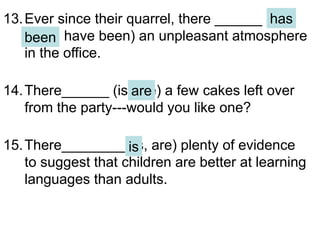
13.Ever since their quarrel, there ______ (has
been, have been) an unpleasant atmosphere
in the office.
14.There______ (is, are) a few cakes left over
from the party---would you like one?
15.There________ (is, are) plenty of evidence
to suggest that children are better at learning
languages than adults.
has
been
are
is

eliptical construction.ppt

  • 1.
    Lecture 3 Subject-verb ConcordII 3.1 Problems of Concord with a Coordinate Subject 3.2 Problems of Concord with Expressions of Quantity as Subject 3.3 Other Problems of Subject-verb Concord
  • 2.
    3.1 Problems ofConcord with a Coordinate Subject I. Coordination with “and” or “both… and” 1. usually treated as plural when it refers to two or more than two persons / things 2. treated as singular when it refers to only one person or thing. The poet and singer has come. poet and singer A and B = 2 parts The A and the B = 2 parts The A and B=1unit Determiner Head word
  • 3.
    Wits and humourabounds in the book. War and peace is a constant theme in the history. Truth and honesty is the best policy. The hustle and bustle of the city life fatigues many people. Salt and water is also a kind of medicine. Egg and rice is her usual breakfast. Wits and humour War and peace Truth and honesty hustle and bustle Salt and water Egg and rice A. 两种抽象的东西 被看作是一个 不可分割的整体 B. 两个名词已构成 一种食品 Observe the Following Sentences:
  • 4.
    3 Elliptical Constructionwith And: Elliptical construction with and has a plural mean and the predicate verb takes Pl. form. Good and bad taste are inculcated by example. What I say and think are no business of yours. Good and bad taste Good taste and bad taste What I say and what I think What I say and think
  • 5.
    4 when modifiedby each/every/many a When the coordinated noun phrases by and are preceded by each, every, no, many a, the verb usually takes singular form. Every boy and every girl in this room is entitled to a copy. Many a man and woman in this community finds himself or herself in need. No teacher and no students is admitted.
  • 6.
    II. Coordination withor/ either… or/ nor/neither… nor/not only ... but also 1. Here the problem of concord is generally dealt with according to the principle of proximity. 2. But in informal style, items coordinated by “neither… nor”, “not only ... but also” can sometimes be regarded as plural. Not only the switches but also the old wiring has / (have) been changed. My sisters or my brother is likely to be at home. Neither the players nor the coach was / (were) overconfident. My sisters or my brother is Neither the players nor the coach was / (were) Not only the switches but also the old wiring has / (have) Either my father or my brothers are coming. Either my father or my brothers are
  • 7.
    3) Subject +as much as; Subject + as well as • The form of the following verb is determined by the subject. • subordinate constructions : more than, rather than, no less than; • prepositional phrases : in addition to, with, along with, together with, except, including, like, accompanied by, besides, but.
  • 8.
    Exercise: 1. Neither Russianor the united states_______ (has, have) been able to discover a mutual satisfactory plan for gradual disarmament. 2. Even minor amendments or innovations_______ (was, were) given heavy publicity. 3. His friend and fellow author _______ (was, were) cool to the idea of collaborating on a cookbook. 4. All this effort and sacrifice _______ (has, have) helped to alleviate poverty. 5. _______ (Is, Are) January and February the coldest months of the year has were was has Are
  • 9.
    6. In manyyears of service, neither Philips nor I _______ (has, have) seen anything like it. 7. It became necessary to involve every man, woman and child who _______ (was, were) willing to help. 8. Law and order_______ (means, mean) different things to people with different political opinions. 9. If your wife or husband_______ (is, are) proficient in English, there are many study courses from which they can choose. 10. Every change of season, every change of weather, indeed, every hour of the day, _______(produces, produce) some change in the hues and shapes of these mountains. have was means is produces
  • 10.
    3.2 Problems ofConcord with Expressions of Quantity as Subject • Quantitative expressions fall into categories: Definite and Indefinite.
  • 11.
    I. Concord withExpressions of Definite Quantity as Subject 1. When a definite quantity is regarded as a single unit, the verb takes the singular form 2. when used in the sense of the individuals that constitute the quantity, the verb takes the plural form. There were 6 silver dollars in each of the stockings. (the coins) He thought that 65 dollars was not too much to ask.
  • 12.
    3. Fraction /Percentage + of-phrase the form of the verb is determined by the noun in the of-phrase. A plural noun in the of-phrase requires a plural verb; A singular or a mass noun in the of-phrase is to be followed by a singular verb Over 60% of the city was destroyed in the war. Two-thirds of the swampland has been reclaimed for farming. Nearly 50% of the doctors are women.
  • 13.
    4 If thesubject is an expression of “A plus / and B” or “A multiplied by B”, the verb can either take the singular or the plural form. 5 If the subject is one of “A minus B” or “A divided by B” the verb can only be singular. Seven plus / and five (7+5) makes / make twelve. Forty minus fifteen (40-15) leaves twenty-five. Five times eight (5x8) is / are forty. Forty divided by eight (40÷8) is five.
  • 14.
    6 one in/ out of +plural noun the verb takes singular form in formal style. but in informal style it can be plural One in ten students has / have failed the exam. One out of twenty was / were badly damaged.
  • 15.
    II. Concord withexpression of indefinite quantity as subject 1 When the subject is a noun phrase composed of “all of …, some of …, none of …, half of …, most of …, etc”, the number of the verb is determined by the noun in the of-phrase. 2 This is also true of “lots of, heaps of, loads of, scads of, plenty of, + noun” All of the cargo was lost. All of the crew were saved. Lots of food is going to waste. Lots of people are waiting outside.
  • 16.
    3 When thesubject is a noun preceded by “a portion of, a series of, a pile of, a panel of”, the verb invariably takes the singular form, whatever the forms of the noun. 4 when the subject is a noun, singular or plural, preceded by “a kind / sort / type of” or by “this kind / sort / type of”, the verb takes singular form. A substantial portion of the reports is missing. A series of accidents has been reported. This kind of man annoys me. That type of car is old-fashioned.
  • 17.
    5 If “kind/ sort / type of” is preceded by “these / those” and followed by a plural noun, the verb should be plural. These sort of machines are up to date. 6 If the subject is noun phrase composed of “many a+ noun” or “more than one + noun”, this kind of noun phrase, though notionally plural, is treated as singular. Many a man has done his duty. More than one game was lost.
  • 18.
    7 If thesubject is a plural noun preceded by “an average of/a majority of”, the verb form is determined by the notion of the noun phrase: if the noun head is the word “average/majority” the verb should be singular; if the head is the plural noun, the verb should be plural. An average of 25 applications a month is not unusual. An average of 25 persons apply each month.
  • 19.
    1. The centralportions of the book _______(is, are) devoted to this theory. 2. Almost two thirds of the land in the northwest areas of the country ______(is, are) not suitable for farming. 3. Half of the money I spend on advertising ________(is, are) wasted, and the trouble is I don’t know which half. 4. Most of the coffee we produce _________(is, are) for export---a high percentage _____(goes, go) to the US. Exercise: are is is is goes
  • 20.
    5. About halfof the women in this area _______(is, are) working-wives. None of them _______(has, have) much time to do housework. 6. Some of the furniture _______(has, have) been moved to another room in the house. 7. I’ll keep a third of the money and the rest _______ (is, are) yours. 8. Most of the residents ________(has, have) already left the island; the rest ________(is, are) preparing for the typhoon. are has have has is have are
  • 21.
    9. It’s abig studio, so there _______(is, are) lots of room for all my things. 10.Loads of sand _______(was, were) dumped by the roadside so that there was hardly any space for two cars to pass. is was
  • 22.
    3.3 Other Problemsof Subject- verb Concord I. Problems of concord with a nominal clause as subject II. Subject-verb concord with a non-finite clause as subject III. Subject-verb concord in relative clauses IV. Subject-verb concord in cleft-sentences V. Subject-verb concord in existential sentences
  • 23.
    I. Nominal Clauseas Subject 1 When the subject is a nominal clause introduced by what, who, which, how, why, whether, etc, the verb usually takes the singular form. 2 but when two or more clauses are coordinated by and or both…and, a plural verb is required. What caused the accident is a complete mystery. What caused the accident and who was responsible for it remain a mystery to us.
  • 24.
    3 In SVCconstructions with a what-clause as subject, the verb usually takes singular form. 4 But when the subject complement is plural, or when the what-clause is plural in meaning, the verb of the main clause can be plural. What was real to him were the details of his life. What are often regarded as poisonous fungi are sometimes safely edible.
  • 25.
    II. Non-finite Clauseas Subject 1 When the subject is a non-finite clause, the verb of the main clause usually takes the singular form. 2 But when two or more such clauses are coordinated by and, the verb of the main clause takes the singular form when the subject refers to one thing, and the plural form when the subject refers to separate things. To climb mountains requires courage. Playing tennis is a very good exercise. Reading Ibsen and solving a quadratic equation are entirely different assignments.
  • 26.
    III. Relative Clauses 1.In the construction of “one of +plural noun + relative clause”, the principle of grammatical concord is generally observed. 2. Sometimes, especially in British English, in order to lay emphasis on “one”, the verb can also take the singular form.
  • 27.
    3. When “one”is preceded by “the” or “the only”, the verb can only be singular. Joan is one of those people who go out of their way to be helpful. Jasper White is one of those rare people who believes in ancient myths. He is the only one of those boys who is willing to take on another assignment.
  • 28.
    IV. Cleft-sentences 1. Incleft-sentences, subject-verb concord in that-/ who-clause is generally determined by the number of the focal element functioning as subject in the clause. 2. when the focal element is “I”, the verb to be in the following who-/ that-clause usually agree with “I” in both person and number; It is I who am to blame.
  • 29.
    3. If thefocal element is “me” instead of “I”, the verb to be in the following who-/ that-clause should take the third person singular number. It is me that is to blame.
  • 30.
    V. Existential Sentences 1.In existential sentences, subject-verb concord is generally determined by the number of the “notional subject”, 2. But in informal style, especially in spoken language, the verb often agrees with the “formal subject” and takes the singular form, even though the “notional subject” is plural.
  • 31.
    3. When thenotional subject is a coordinate construction, the verb form goes with the first coordinate element of the notional subject, singular or plural. There is a note left on the desk. There are three routes you can take. There’s more grace and less carelessness. There’s a long springboard, and three rafts at varying distances from the shore.
  • 32.
    1. Eating,unlike fighting,_______ (is, are) a pursuit in which both sexes freely indulge. 2. What make the river more beautiful _______ (is, are) the lotus plants growing in the river. 3. What we have just described _______ (is, are) the general pattern of the internal heat engine’s work output as we can see it today. Exercise: is are is
  • 33.
    4. Children interferingin their parents’ right to remarry _______ (has, have) become a social problem. 5. To go there on Monday _______ (is, are) pointless---there’s a public holiday. 6. Why he entered the house and how he managed to get out of it without being seen by people _______ (remains, remain) a mystery to us all. has is remain
  • 34.
    7. What appearto be disciplinary problems _______ (is, are) easily solved by very elementary applied psychology. 8. He’s one of those men who never _______ (cares, care) how they look. 9. There are few things in this world that _______ (give, gives) me more pleasure than a long bath. are care give
  • 35.
    10.Watering the flowersand looking after the children ______ (is, are) all she has to do every day. 11.Sitting and talking to old friends _______ (is, are) a pleasant way to spend an evening. 12.Can you say “no” to a friend or relative who _______ (wants, want) to insist? are is wants
  • 36.
    13.Ever since theirquarrel, there ______ (has been, have been) an unpleasant atmosphere in the office. 14.There______ (is, are) a few cakes left over from the party---would you like one? 15.There________ (is, are) plenty of evidence to suggest that children are better at learning languages than adults. has been are is