SUBJECT-VERB
AGREEMENT
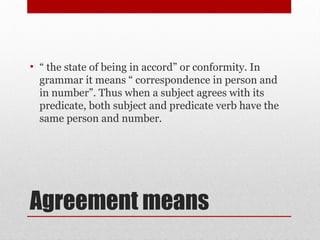
Agreement means
• “ the state of being in accord” or conformity. In
grammar it means “ correspondence in person and
in number”. Thus when a subject agrees with its
predicate, both subject and predicate verb have the
same person and number.
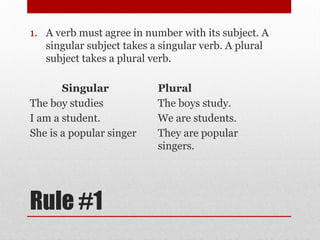
Rule #1
1. A verb must agree in number with its subject. A
singular subject takes a singular verb. A plural
subject takes a plural verb.
Singular Plural
The boy studies The boys study.
I am a student. We are students.
She is a popular singer They are popular
singers.
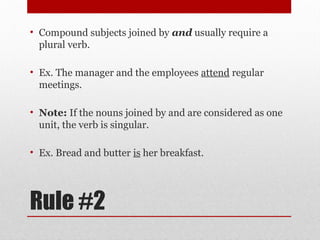
Rule #2
• Compound subjects joined by and usually require a
plural verb.
• Ex. The manager and the employees attend regular
meetings.
• Note: If the nouns joined by and are considered as one
unit, the verb is singular.
• Ex. Bread and butter is her breakfast.
Rule #3
• Singular subjects joined by or or nor take a singular
verb.
• Ex. Either Susy or Cindy is in the office.
• Neither Ben nor Connie is the sponsor of the game.
• Note: When one of the subject joined by or or nor is
singular and one is plural, the verb is made to agree with
the subject nearer the verb.
• Plural Subject Closer
• Either the teacher or the students are in the gym.
• Singular Subject Closer
• My friends or Albert watches the store at lunchtime.
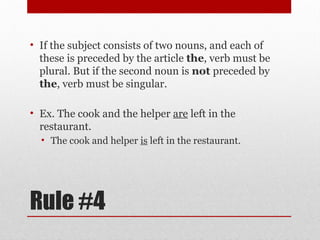
Rule #4
• If the subject consists of two nouns, and each of
these is preceded by the article the, verb must be
plural. But if the second noun is not preceded by
the, verb must be singular.
• Ex. The cook and the helper are left in the
restaurant.
• The cook and helper is left in the restaurant.
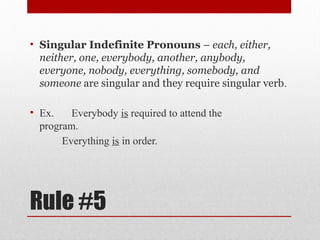
Rule #5
• Singular Indefinite Pronouns – each, either,
neither, one, everybody, another, anybody,
everyone, nobody, everything, somebody, and
someone are singular and they require singular verb.
• Ex. Everybody is required to attend the
program.
Everything is in order.
Rule #6
• Plural Indefinite Pronouns – all, both, several,
many, few, take a plural verb.
• Ex. Many are invited to attend the party.
Both are interested in winning.
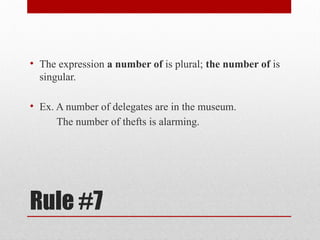
Rule #7
• The expression a number of is plural; the number of is
singular.
• Ex. A number of delegates are in the museum.
The number of thefts is alarming.
Rule #8
• Nouns denoting quantity, fraction, percentage, currency,
take a singular verb, but if they are followed by the
phrase of the, the object of the phrase determines the
number of the verb.
• Ex. Fifty percent prefers the Chinese cuisine for the party.
Fifty percent of the employees prefer Filipino dishes.
Rule #9
• Nouns ending in s but singular in meaning are singular.
Ex. Physics is a difficult subject.
Rule #10
• Nouns in pairs take plural verb, except if the expression a
pair of is used.
• Ex. The pants are printed with a logo.
A pair of pants is sold at a low price.
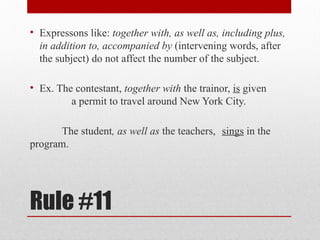
Rule #11
• Expressons like: together with, as well as, including plus,
in addition to, accompanied by (intervening words, after
the subject) do not affect the number of the subject.
• Ex. The contestant, together with the trainor, is given
a permit to travel around New York City.
The student, as well as the teachers, sings in the
program.
Rule #12
In sentences beginning with here or there, the true subject
follows the verb.
Ex. There are four hurdles to jump.
There is a high hurdle to jump.
Here are the keys.
Rule #13
• Titles of books, movies, novels, etc are treated as singular
and take a singular verb.
Ex. The Grapes of Wrath takes a long time to read.
The Burb is a movie starring Tom Hanks.
Rule #14
• A collective noun taken as one unit takes a singular verb. It
is plural if every member of the group is thought of as
individual doing his own task.
• Ex. The team is going to Mindanao to administer a sport seminar. ----
Singular
The battalion has been marching for peace and unity.
The family are arguing about the upcoming elections.--- Plural
The members of the class are working hard on their projects.
Rule #15
• Final Rule - Remember, only the subject
affects the verb!
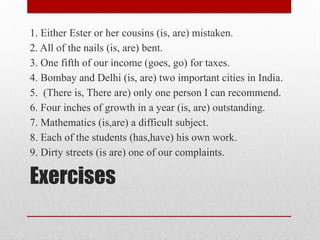
Exercises
1. Either Ester or her cousins (is, are) mistaken.
2. All of the nails (is, are) bent.
3. One fifth of our income (goes, go) for taxes.
4. Bombay and Delhi (is, are) two important cities in India.
5. (There is, There are) only one person I can recommend.
6. Four inches of growth in a year (is, are) outstanding.
7. Mathematics (is,are) a difficult subject.
8. Each of the students (has,have) his own work.
9. Dirty streets (is are) one of our complaints.
More exercises
10. Each of the girls (look-looks) good on skis.
11. The football players (run-runs) five miles every day.
12. The man with the roses (look-looks) like your brother.
13. The women in the pool (swim-swims) well.
14. Nobody in the class (has-have) the answer.
15. Either the workers or the boss (deliver-delivers) the merchandise.
16. The committee (work-works) hard for better schools.
17. A magazine and a book (was-were) lying on the floor.
18. Gymnastics (is-are) easy for Angela.
19. Interesting news (is-are) what sells our paper.

Subject - Verb Agreement powerpoint.pptx

  • 1.
  • 2.
    Agreement means • “the state of being in accord” or conformity. In grammar it means “ correspondence in person and in number”. Thus when a subject agrees with its predicate, both subject and predicate verb have the same person and number.
  • 3.
    Rule #1 1. Averb must agree in number with its subject. A singular subject takes a singular verb. A plural subject takes a plural verb. Singular Plural The boy studies The boys study. I am a student. We are students. She is a popular singer They are popular singers.
  • 4.
    Rule #2 • Compoundsubjects joined by and usually require a plural verb. • Ex. The manager and the employees attend regular meetings. • Note: If the nouns joined by and are considered as one unit, the verb is singular. • Ex. Bread and butter is her breakfast.
  • 5.
    Rule #3 • Singularsubjects joined by or or nor take a singular verb. • Ex. Either Susy or Cindy is in the office. • Neither Ben nor Connie is the sponsor of the game.
  • 6.
    • Note: Whenone of the subject joined by or or nor is singular and one is plural, the verb is made to agree with the subject nearer the verb. • Plural Subject Closer • Either the teacher or the students are in the gym. • Singular Subject Closer • My friends or Albert watches the store at lunchtime.
  • 7.
    Rule #4 • Ifthe subject consists of two nouns, and each of these is preceded by the article the, verb must be plural. But if the second noun is not preceded by the, verb must be singular. • Ex. The cook and the helper are left in the restaurant. • The cook and helper is left in the restaurant.
  • 8.
    Rule #5 • SingularIndefinite Pronouns – each, either, neither, one, everybody, another, anybody, everyone, nobody, everything, somebody, and someone are singular and they require singular verb. • Ex. Everybody is required to attend the program. Everything is in order.
  • 9.
    Rule #6 • PluralIndefinite Pronouns – all, both, several, many, few, take a plural verb. • Ex. Many are invited to attend the party. Both are interested in winning.
  • 10.
    Rule #7 • Theexpression a number of is plural; the number of is singular. • Ex. A number of delegates are in the museum. The number of thefts is alarming.
  • 11.
    Rule #8 • Nounsdenoting quantity, fraction, percentage, currency, take a singular verb, but if they are followed by the phrase of the, the object of the phrase determines the number of the verb. • Ex. Fifty percent prefers the Chinese cuisine for the party. Fifty percent of the employees prefer Filipino dishes.
  • 12.
    Rule #9 • Nounsending in s but singular in meaning are singular. Ex. Physics is a difficult subject.
  • 13.
    Rule #10 • Nounsin pairs take plural verb, except if the expression a pair of is used. • Ex. The pants are printed with a logo. A pair of pants is sold at a low price.
  • 14.
    Rule #11 • Expressonslike: together with, as well as, including plus, in addition to, accompanied by (intervening words, after the subject) do not affect the number of the subject. • Ex. The contestant, together with the trainor, is given a permit to travel around New York City. The student, as well as the teachers, sings in the program.
  • 15.
    Rule #12 In sentencesbeginning with here or there, the true subject follows the verb. Ex. There are four hurdles to jump. There is a high hurdle to jump. Here are the keys.
  • 16.
    Rule #13 • Titlesof books, movies, novels, etc are treated as singular and take a singular verb. Ex. The Grapes of Wrath takes a long time to read. The Burb is a movie starring Tom Hanks.
  • 17.
    Rule #14 • Acollective noun taken as one unit takes a singular verb. It is plural if every member of the group is thought of as individual doing his own task. • Ex. The team is going to Mindanao to administer a sport seminar. ---- Singular The battalion has been marching for peace and unity. The family are arguing about the upcoming elections.--- Plural The members of the class are working hard on their projects.
  • 18.
    Rule #15 • FinalRule - Remember, only the subject affects the verb!
  • 19.
    Exercises 1. Either Esteror her cousins (is, are) mistaken. 2. All of the nails (is, are) bent. 3. One fifth of our income (goes, go) for taxes. 4. Bombay and Delhi (is, are) two important cities in India. 5. (There is, There are) only one person I can recommend. 6. Four inches of growth in a year (is, are) outstanding. 7. Mathematics (is,are) a difficult subject. 8. Each of the students (has,have) his own work. 9. Dirty streets (is are) one of our complaints.
  • 20.
    More exercises 10. Eachof the girls (look-looks) good on skis. 11. The football players (run-runs) five miles every day. 12. The man with the roses (look-looks) like your brother. 13. The women in the pool (swim-swims) well. 14. Nobody in the class (has-have) the answer. 15. Either the workers or the boss (deliver-delivers) the merchandise. 16. The committee (work-works) hard for better schools. 17. A magazine and a book (was-were) lying on the floor. 18. Gymnastics (is-are) easy for Angela. 19. Interesting news (is-are) what sells our paper.